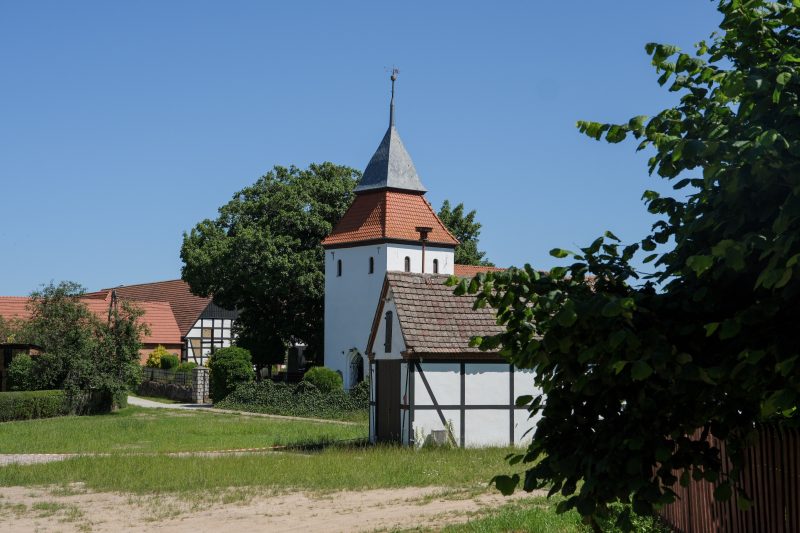
Something a little strange is at play in Tykocin. From the moment you arrive, you’ll wonder how a town of barely 2,000 people, made up mostly of low-level wood and brick houses, is somehow dotted with a sense of grandeur more typical of somewhere many times its size.
Strung along a bend in the Narew River in the flat, green expanse of Podlasie, it’s the kind of place that wears its past lightly, and although that previously mentioned grandeur has faded somewhat, its occasional appearance will surprise you. The expansive market square was built for a population far larger than the one that remains; the castle walls across the water once held a king’s body, and the town’s synagogue ranks amongst the finest Baroque Jewish buildings left in Europe.
It’s a small town that hosts the architecture of a much more significant one. However, for several centuries, this quiet corner of northeastern Poland mattered more than nearby Białystok, the regional capital that now dwarfs it. Tykocin has never quite recovered its former stature, which is precisely why it’s worth a visit.

That stature was earned early in Tykocin’s history. A settlement has stood on this stretch of the Narew since at least the early 15th century, and Tykocin received its first city rights in 1425 from Prince Janusz I of Warsaw, only for the town to be transferred, mere months later, to the Grand Duchy of Lithuania by King Władysław Jagiełło, a reminder of just how contested this borderland once was.
In 1522, the Trakai voivode Olbracht Gasztołd brought nine Jewish families to settle in the town, laying the foundation for a community that would grow, over the following two centuries, into one of the largest and most influential Jewish populations in northeastern Poland. It was so influential, in fact, that Białystok’s own Jewish community was initially subordinate to Tykocin’s, long before it became the larger of the two settlements.
Alongside its role as a religious and commercial centre, Tykocin also functioned as a royal residence and a fortified stronghold, housing at various points the Crown Treasury, the royal library, and the main arsenal of the Polish-Lithuanian Commonwealth, which gave it a significance that would be surprising to anyone visiting such a quiet and peaceful town today.


The Jewish community’s prosperity left behind the architectural legacy that still defines Tykocin’s character, with the Great Synagogue chief among them, while the ruling nobility first the Goštautas family, later the Radziwiłłs and the Branickis built and rebuilt the castle and market square in their own image throughout the years.
Decline set in gradually from the 18th century onward, hastened by the destruction of the Swedish Deluge, the horrors of the Second World War, and then by the steady rise of neighbouring Białystok as the region’s Capital. Yet Tykocin’s Baroque core survived largely intact, spared the scale of both wartime destruction and post-war redevelopment that other Polish towns were subject to.
In a way, that’s why Tykocin is so interesting. Amongst the remnants of past splendour, you’ll find a town that is both packed with Polish heritage and a lightly weathered fragment of a place that once mattered a great deal.
Getting to Tykocin
You’ll find Tykocin in the Podlasie region of northeastern Poland, a short enough drive from Białystok that it makes for a straightforward day trip from the city, but far enough from the country’s main tourist destinations that it is likely to only draw people with a real intent to visit.
The nearest airport that has frequent flights from the UK or other major European hubs is Warsaw Chopin (WAW). Renting a car at the airport is the simplest way to handle the onward journey, particularly if Tykocin is one stop within a wider Podlasie or northeastern Poland itinerary.
By Car
If you’re able to, I would highly recommend renting a car to visit Tykocin as it’s by far the easiest and most convenient way of getting there.
From Warsaw, it’s roughly 175 kilometres (around 1 hour 45 minutes) along main roads, mostly via the S8 towards Białystok before cutting off onto local roads for the final part of the journey. From Białystok itself, Tykocin is only 30 kilometres away and can be reached in around half an hour, depending on traffic. There’s parking near the market square and on surrounding streets as well as a free car park at the castle.
I tend to use Discover Cars for my car rental when travelling, as they allow you to book in advance and compare multiple providers for the best deal. A hire car also opens up the wider Podlasie region, allowing you to take detours to less-visited villages or explore the Biebrza National Park at your own pace.
By train
There’s no direct rail line into Tykocin, so public transport means travelling via Białystok. From Warszawa Centralna, PKP Intercity trains run to Białystok roughly hourly, taking around 1 hour 50 minutes. From Białystok’s bus station, regional buses to Tykocin run fairly frequently with the journey itself taking around an hour. All told, budget around 3.5 to 4 hours door to door from Warsaw.
By Bus
A slower but more budget-friendly alternative is the direct coach network, with operators such as Żak Express running services from Warszawa Centrum through to Białystok, from where the same local bus onward to Tykocin operates. This route takes longer than the train (typically 4 to 4.5 hours total) but is noticeably cheaper.
A practical note: Given the limited frequency of onward buses from Białystok, it’s worth checking timetables in advance rather than assuming you can simply turn up and go, particularly if visiting outside peak season, when services are a little thin on the ground. If you’re travelling without a car. It could be worth building in an overnight stay in Białystok either side of your Tykocin trip to remove most of the scheduling pressure.
Things to Do in Tykocin
Tykocin is small enough to see on foot, and the few main sights are all clustered close around the market square and the riverbank. However, beyond the landmarks, the town itself is a place of great historical significance, so it is worth spending some time just exploring its streets.
The Great Synagogue
As the town’s real centrepiece, the Great Synagogue feels like the most obvious place to start any exploration of Tykocin. Built in 1642 on ul. Kozia in the centre of the old Jewish district (historically known as Kaczorowo), the synagogue replaced an earlier 15th-century wooden structure on the same site and is thought to have drawn its design from the fortified synagogue in Pińsk, built just two years earlier in 1640.

It’s a massive, late-Renaissance-Baroque stone building on a near-perfect square plan, with a main prayer hall rising nine metres to a nine-field vaulted ceiling. At its centre stands a massive four-pillar bimah, and the walls throughout are covered in richly painted inscriptions, prayers, and decorative details that are absolutely beautiful and matched by very few buildings throughout the region.
Obviously, the synagogue’s 20th century history was anything but smooth. It was desecrated and closed during the Second World War, requisitioned by the German army as storage, and later used as an ordinary warehouse, reportedly even for fertiliser, as it fell into disrepair. Restoration began in earnest, and the building reopened on 1 November 1976 as a branch of the Podlaskie District Museum in Białystok, one of the very few Jewish museums permitted to operate in communist-era Poland, a fact that in itself makes Tykocin’s somewhat unique.


Today it functions purely as a museum and cultural centre rather than an active synagogue, drawing over 60,000 visitors a year and having been named one of Poland’s ‘Seven New Wonders’ in recognition of its architectural and historical significance.
Inside, alongside the restored prayer hall itself, the former women’s gallery houses a permanent exhibition on Jewish life and customs in the town, with English-language descriptions throughout.
Tykocin Castle
On the opposite bank of the Narew sits the reconstructed royal castle, a building whose history stretches back far further than its appearance suggests. The original fortress was built in 1433 for the Lithuanian noble Jonas Goštautas, replacing an earlier wooden stronghold, and it passed to the Polish crown in the 1560s upon the extinction of the Goštautas line.
King Sigismund II Augustus then expanded it into a proper royal residence, housing the Crown Treasury, the royal library, and the main arsenal of the Polish-Lithuanian Commonwealth, making Tykocin, for a period, one of the most strategically important sites in the entire kingdom. When Sigismund Augustus died in 1572 as the last of the Jagiellonian dynasty, his body was brought here and kept for several months, reportedly warmed by the famous Wawel tapestries, while arrangements were made for his funeral procession to Kraków.


Decades later, in 1705, the castle hosted an equally curious meeting between King August II the Strong and Tsar Peter the Great, during which August II founded the Order of the White Eagle, still Poland’s highest state honour, for the very first time.
The castle’s fortunes turned during the Swedish Deluge of the 1650s, when it was besieged and damaged under Radziwiłł control, and it never fully recovered, falling into ruin over the following century and eventually being stripped for building materials.
What stands here today is a careful modern reconstruction, begun in 2002 on the original 16th-century foundations and based on archaeological data and historical sources, complete with a museum, restaurant, and guesthouse. Inside, you can see an underground exhibition on the fortress’s history, alongside a restored Glass Hall featuring a reconstructed monumental tiled stove and a display dedicated to the Order of the White Eagle. It’s worth noting that entry is by guided tour only (typically around 30 to 40 minutes per tour), and it’s worth booking ahead in peak season.
The Market Square and Old Town
The first thing you may notice about Tykocin’s market square is that it’s disproportionately grand for such a small town. Officially named Plac Czarnieckiego, it’s also an unusual shape. It’s an elongated trapezoid rather than a regular rectangle, modelled on French urban planning of the kind Jan Klemens Branicki admired when he rebuilt the town in the mid-18th century, with Louis XV’s newly completed square in Rennes reportedly serving as a point of reference

At its centre stands a two-metre bronze monument to Hetman Stefan Czarniecki, made from Szydłowiec sandstone by the French sculptor Pierre de Coudray and erected in 1763 on the initiative of Branicki, Czarniecki’s own great-grandson. It’s said to be the second-oldest secular monument in Poland, only beaten by Sigismund’s Column in Warsaw, and the Hetman is positioned facing the Baroque church, in a deliberate visual link between the two men’s legacies. The rest of the buildings surrounding the square feel incredibly modest in comparison, made up of low, 18th-century townhouses, made of wood or brick, that have survived largely intact.


Wander beyond the square, and you’ll find yourself in the streets of the former Jewish quarter, historically known as Kaczorów, which still has traces of the community that once lived here. I recommend taking a slow and unhurried walk around to soak up the architecture and atmosphere. The whole historic complex has been formally recognised for its significance, having been declared a Monument of Polish History by presidential decree, which is a rare designation that puts Tykocin’s largely unchanged medieval-to-Baroque streets on a level with some of Poland’s most protected heritage sites.
Holy Trinity Church
Taking up the entire eastern side of the market square and drawing the eye more than any other building in town, the Holy Trinity Church was founded by Hetman Jan Klemens Branicki (the same magnate behind the lavish Branicki Palace in Białystok) and built between 1742 and 1751 under the supervision of architect Tomasz Belloti. Consecration followed in 1750.

It’s considered one of Poland’s earliest notable examples of adapting a Palladian palace design to sacred architecture, a style that wouldn’t become common in Polish residential building for decades afterwards, and its scale and symmetry owe a clear debt to Branicki’s grander Białystok residence. Fittingly, much of the brick used in its construction was reportedly salvaged from the ruins of Tykocin Castle, itself partially demolished during the Swedish Deluge, linking two of the town’s biggest landmarks.


Inside, the church retains a complete set of original 18th-century Baroque and Rococo furnishings, along with wedding portraits of the Branicki family, making stepping inside worthwhile. Its position facing the square, directly across from the old Jewish quarter, is also a really nice reminder of how closely Tykocin’s Catholic and Jewish communities once lived alongside one another, a coexistence that really shaped the town’s architecture and character.
The Wooden Burgher House
On the main square, at 10 Czarniecki, you’ll find one of Tykocin’s finest surviving examples of traditional wooden architecture, dating to 1885 and now serving as the headquarters of the Centre for Studies on the History and Culture of Small Towns. It’s part of what the town calls the ‘Wooden Architecture Route’, which is a self-guided trail linking the town’s best-preserved timber buildings, of which this house is the most prominent example.


The centre wasn’t open when I visited, but inside, the building houses an exhibition called “133 Stories,” exploring the lives and history of the town’s residents, and entry is by voluntary donation rather than a fixed ticket price.
Beyond the Town
A short drive from town, the village of Pentowo has built quite a reputation around its white stork population. Although if you visit at the right time of year, you will spot them throughout the region, they nest in unusually high numbers on the surrounding rooftops and poles each summer here. Although there isn’t much else to see, it’s a nice detour or addition to a day in Tykocin.


If you have even more time, it makes sense to head to Biebrza National Park, the largest national park in Poland, which lies within reach and offers vast wetlands containing moose and one of the highest densities of bird species found anywhere in Europe. Dotted around are footbridges and observation towers that make the marshland accessible to anyone (you won’t need serious hiking gear), and it’s a genuinely great addition if you like to combine a love of wildlife with your travels.
Where to Eat & Drink in Tykocin
Although the dining scene in Tykocin is relatively sparse, what does exist tends to cluster around the market square, making it easy to eat well without too much planning or searching for where to go. Expect straightforward, hearty Podlasie cooking such as pierogi, regional soups, and simple grilled fare, as well as a few places leaning into the town’s Jewish culinary heritage.
Tejsza
Set inside the historic Talmudic House on ul. Kozia, just steps from the Great Synagogue, Tejsza specialises in Jewish cuisine and leans fully into its setting. The dining room itself is the main draw, decorated with Hebrew ornamentation that ties the food directly to the town’s history, and the menu runs through dishes like festive tzimmes, kugel, and kreplach alongside other traditional recipes rarely found elsewhere in the region. It’s the closest thing Tykocin has to a destination restaurant and is worth booking ahead if visiting on a weekend.

zamek W Tykocinie Restaurant
The restaurant inside the reconstructed castle leans fully into the town’s heritage, drawing on Podlasie, Jewish, and Tatar culinary traditions for dishes like cholent, goose dumplings with pickled ginger, Narew goose stomachs in butter sauce, and Korycin cheese in crispy breading, dished up in a place that makes it feel like you’re dining back in the medieval era, with stone walls, candlelit tables and tapestries on the wall.


Its signature, though, is the białys, a yeasted, onion-topped bread roll that’s often mistaken for a bagel but is, in fact, its own distinct tradition. Bialys originated in nearby Białystok among the city’s Jewish bakers, most likely sometime in the 19th century, and take their name from the Yiddish and German ‘Bialystoker kuchen’, or bread from Białystok. Unlike a bagel, a bialy is never boiled before baking; instead, the centre is pressed into a shallow depression and filled with chopped onion and sometimes poppy seeds. The style all but disappeared from Poland after the Holocaust, surviving mainly through the Jewish immigrants who carried the recipe to New York in the early 20th century, which makes finding it served fresh here, as the bun for a beef burger, in the region where it was actually invented, a rare thing to seek out. You can also buy the rolls on their own from one of the stalls in the castle’s courtyard.

Grill Bar
For something quicker and less formal than the town’s sit-down options, Tykocin has a straightforward grill bar on the main square serving classic Polish street food such as kebabs, zapiekanki, and grilled meats. The food may not be as good or extravagant as elsewhere, but it fills a gap for a quick lunch on the move.
Villa Regent
Right in the centre of town on Sokołowska, next to the Grand Synagogue, this restaurant focuses heavily on the Jewish and kresy (borderland) culinary traditions that were a big part of Tykocin’s cooking over centuries, with a menu built partly around recipes attributed to Abraham and Sara Turek, early residents of the building itself.


Signature dishes include cholent, beef cheeks, and herring prepared in a style that hasn’t changed in years, alongside chicken with cymes: a sweet, fruity vegetable stew reminiscent of a tagine. I popped in for a cup of Israeli coffee and to sample their halva ice cream, which was absolutely delicious, and it was worth the visit to spend some time in their beautiful, traditional dining room, which is full of trinkets and photos from the town’s Jewish history.
Karczma Rzym
A few kilometres outside town in Kiermusy, this countryside inn commits hard to traditional Polish cooking in a setting that matches, styled on old Polish noble manor traditions such as heavy wooden furniture, folk decoration, and an atmosphere that feels much more rustic than anything you’ll find in the town centre. Expect regional staples like herring prepared in several different ways, pierogi, and bread served with Kiermusy-style lard.
Where to Stay in Tykocin
Being such a small town, it goes without saying that accommodation in Tykocin is fairly limited. There are a handful of central guesthouses, B&Bs or rental flats, and one genuinely memorable option inside the castle itself. If you don’t mind staying on the outskirts, there are a scattering of countryside inns and agritourism stays for those who prefer a rural setting. Given how compact Tykocin is, it doesn’t matter too much where you choose to stay, as nothing is really too far from anything else, so the choice comes down to personal preference more than convenience.
Zamek w Tykocinie
Sleeping inside the reconstructed royal castle itself is the obvious choice for anyone who wants to feel at one with local history during their stay. Rooms are set within the castle walls, and the on-site restaurant, as mentioned above, really leans into the setting with a menu of traditional Polish dishes served in vaulted, historically styled interiors. It’s priced at a premium relative to the town’s other options, but for a one-night splurge, it’s a nice treat.
Alumnat
A small, romantic inn right in the centre of town, and a place that has real character; Think thick walls, low beams, and a handful of individually decorated rooms, giving it a more boutique, intimate feel. Breakfast is well-regarded and generously laid out, often featuring local Podlasie produce, and the garden running down to the riverbank is one of the property’s highlights, particularly birdwatching across the water and the reedbed sof the Narew.
Austeria u Augusta
A charming guesthouse on Plac Stefana Czarnieckiego, right on the main square, putting you within a short walk of everything the town centre has to offer. Rooms are traditional in style, in keeping with the building’s setting on Tykocin’s most historic stretch.
Apartment LOFTykocin
If you would prefer self-catered accommodation to a hotel stay, this self-contained apartment in a block on Zagumienna is just a short walk from the main square (around 5 minutes), and is quite a modern, practical and, rather cute place to stay. The layout includes a kitchenette and all the domestic ameneties you need, along with a washing machine, which makes it a sensible option for longer stays or as a base for exploring the wider Podlasie region rather than just Tykocin itself. The bonus for me was the onsite parking, in a fairly large carpark, which meant I didn’t have to spend my time driving around, looking for a parking space or paying parking fees while visiting the town.
How Much Time Do You Need in Tykocin?
Tykocin’s is small, and much of the town can be explored in half a day, but maybe allow yourself an entire day to allow coffee stops and meals. In a day, you’ll have more than enough time to visit the synagogue, the castle, and the square with time left over for a slow lunch at one of the places listed above. But an overnight stay, with a second day built around a trip to Biebrza National Park or the storks of Pentowo, turns a day trip into a proper regional escape.
Is Tykocin Worth Visiting?
For anyone weighing it against the bigger names on a Poland itinerary, the honest answer is that Tyokcin probably isn’t worth a huge detour from somewhere like Warsaw. However, if you’re in the area, are the kind of traveller drawn to quieter, less-visited places, and have an interest in history.


The synagogue alone justifies the detour for anyone interested in Jewish heritage in Poland, and the combination of castle, church, and pretty, if small, historic centre makes it a nice place to wander for a few hours for a slow day of history, architecture, and quiet countryside. If you’re staying in Białystok, it earns its place on a Podlasie or northeastern Poland itinerary without needing to compete with Kraków or Warsaw.
When is the Best time to Visit Tykocin?
Late spring through early autumn (roughly May to September) is possibly the best window for visiting, when the weather is at its best, and the market square, riverbank, and surrounding countryside are all at their best and outdoor dining options are in full swing.
June and July bring the added draw of nesting storks at Pentowo, while Biebrza National Park’s wetlands are liveliest for birdwatching in spring and early summer, before the vegetation grows too dense.
Long days and midsummer weekends can bring a noticeable uptick in tourists and day-trippers, particularly around local festivals, so a weekday visit is often best if you want the place to yourself.


There are also a handful of events that are worth planning a visit around. Tykocińska Biesiada Miodowa (Tykocin’s Honey Feast) is held each August and turns the square by the old monastery into a festival of live music, local food, and a talent show alongside honey-focused stalls and tastings. Królewskie Śpiewanie (Royal Singing) is a summer open-air music festival, utilising the castle, the river, and the town’s Baroque architecture as a literal backdrop. For something considerably less musical, the Szturm na Zamek (Storming of the Castle) is a large-scale historical reenactment held at the castle each February, drawing military history reenactors from across Poland to stage battles in a wintry setting of snow and ice on the frozen Narew. Winter, aside from this festival, is the quietest time by far. Although the castle and synagogue remain open, some countryside attractions and restaurants shut down, and the town is much less busy.