Tucked between the Baltic coast and a scatter of glacial lakes west of Gdańsk, Kashubia may not be as well known to UK tourists as nearby Gdansk of the heavily visited cities of Krakow and Warsaw. Its food may even be less familiar to people who most closely associate Polish cuisine with pierogi, bigos, Żurek and not much else. However, despite many visitors’ experiences of Pomerania being limited to the Tri-city area, venturing south into the smaller sub-region of Kashubia can open the door to some wonderful culinary experiences.
Geography, it seems, is the defining factor behind the dishes that show up on the Kashubian table. It’s a region that is characterised both by its terrain, coast and its borders. It’s a narrow belt of small hills and moraine ridges left behind by retreating glaciers, dotted with approximately seven hundred lakes and thick forests that runs south from the Baltic coast for over a hundred kilometres.
Surprisingly, to me at least, locals call the slightly hillier, lake-studded heart of it Szwajcaria Kaszubska, ‘Kashubian Switzerland’, which can feel either tongue-in-cheek or like an inside joke when driving the area’s flat roads, devoid of anything that resembles alpine peaks. However, the landscape around Kartuzy, Chmielno and Wieżyca does roll slightly, in a way that the flat, low-lying part of Poland that surrounds it mostly doesn’t. It’s these hills, lakes and forests that give the region freshwater fish and foraged mushrooms inland, saltwater herring and smoked fish on the coast, and unusually sweet strawberries that ripen on the sun-warmed slopes around Kartuzy.


That isn’t to diminish the historical factor that comes into play when talking about the food here. The Kashubians are a West Slavic people descended from the Baltic Slavic tribes who settled this stretch of Pomerania well over a thousand years ago, and they’ve kept a language, recognised since 2005 as Poland’s only official regional language, that is distinct enough for linguists to still debate whether it’s a dialect of Polish or a separate tongue in its own right.
In between, the region passed through Danish, Teutonic Knight, Swedish, Prussian and German hands before being folded fully into Poland in 1454, and again after the Second World War. The to-and-fro between different rulers and across different borders means that multiple influences come into play. It’s there in kartoflaki, still known by the German-inflected bùlwa rather than the Polish word for potato; in the German and Scandinavian style of smoking and pickling; and in a cuisine that generally seems much more rural than what is found in big cities. It is a cuisine that has grown and developed from centuries of fishing families, forest smallholders and lake villagers making what they could with whatever they were able to catch, grow or forage for themselves.
Must-Eat Foods in Kashubia
While the food isn’t quite as distinct in places like Podlaskie, it’s this mix of sources that sets it apart. Coastal Poland, further along the Baltic leans, on similar ingredients, but Kashubia’s cooking pulls just as heavily from its lakes and forests as it does from the sea. And unlike the hearty, meat-and-potato cooking associated with Poland generally, Kashubian food keeps a lighter identity that owes more to what can be found outside the kitchen door than to the national culinary identity.
Śledź po Kaszubsku (Kashubian-Style Herring) - Gdynia & Puck
If you’re beginning your Kashubian food odyssey from Gdansk or along the Baltic Coast, start where the Kashubians themselves would: with herring. All along the fishing harbours of Puck Bay, where boats still land the day’s catch each morning, herring dressed with raisins, onion and a mustard-cream sauce is the closest thing the region has to a signature dish. It’s not for everyone, but to people who don’t mind this particular fish, it’s sweet and briny and a product of the waters that has been a staple on the Baltic for a thousand years.


It’s a legacy that stretches back a long way. Herring bones recovered from Truso, an early trading port near the mouth of the Vistula, not far from Kashubia’s eastern edge, suggest Baltic fishermen were already landing and trading the fish as far back as the Viking Age, centuries before anyone thought to document it. By the Middle Ages, herring had become one of the great currencies of northern Europe, a fundamental component of a Catholic calendar packed with meat-free fasting days, and the commodity that built the fortunes of the Hanseatic League, the merchant confederation that controlled Baltic trade from Lübeck to the Pomeranian coast for the best part of four centuries.
Puck itself was important within this, as its herring was shipped out alongside grain and amber along the same trade routes that carried salt in and profit out. The dish on a Puck menu today, however dressed up with raisins and cream, is something that has developed since, and at the tail end of that very old economy.
You’ll find herring all over Pomerania, but look for it on menus in Puck and the harbourside bars of Gdynia, where the fish doesn’t travel far before it ends up on your plate.
Wrzeciona Kaszubskie (Kashubian Spindle Cutlets) - Sulęczyno
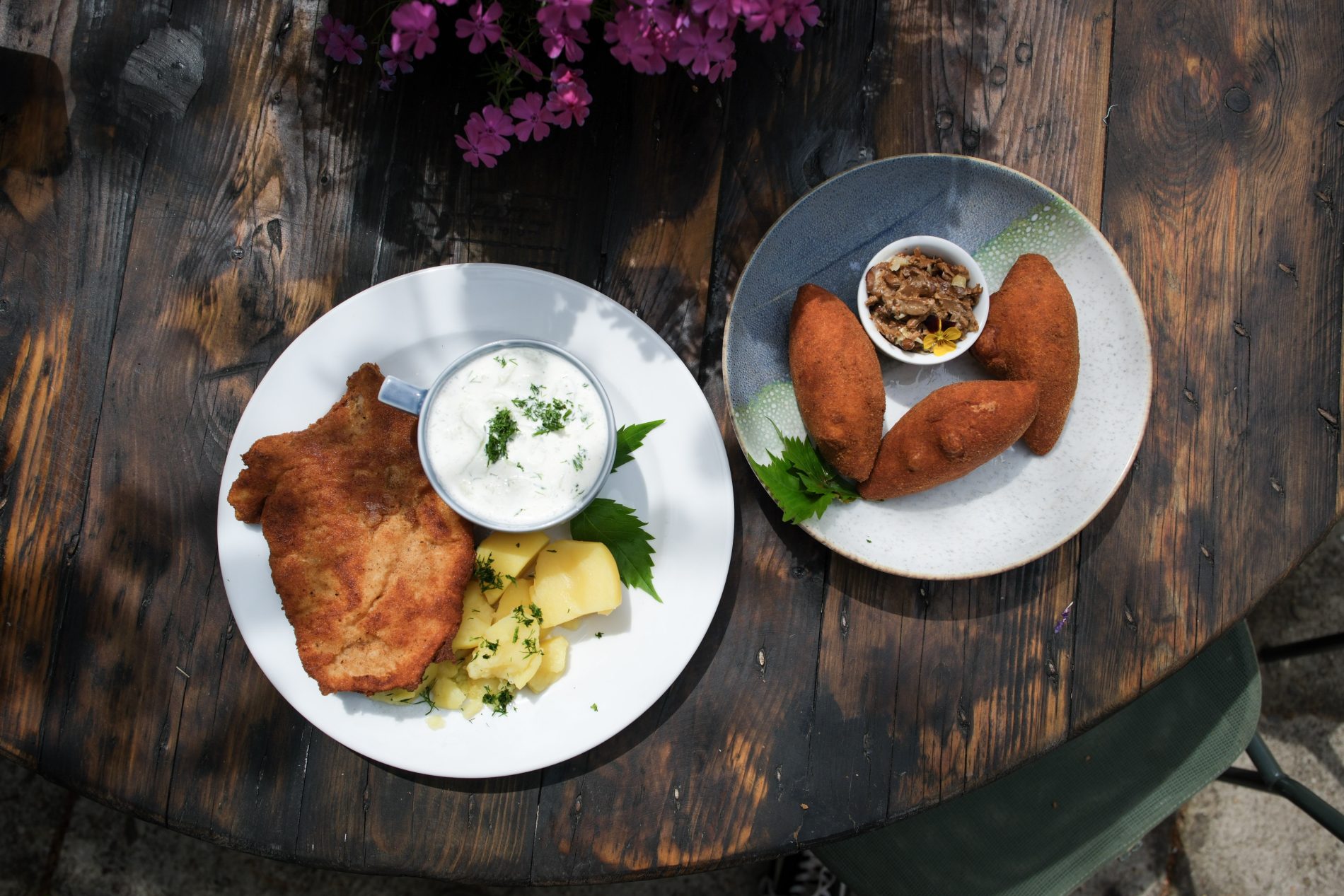
If kartoflaki is a representation of what is grown in Kashubia’s fields, wrzeciona kaszubskie reflect what comes from its forests. Looking at these breadcrumbed and fried ovals – kind of the shape of a rugby ball or American football – it’s difficult to imagine what kind of joy their crisp coating contains, but they are one of the first things I ate in Kashubia, and even after eating my way around the region, they remained one of my favourites.
They are actually thin cutlets of pork or chicken that are wrapped around a filling of wild mushrooms (podgrzybki, borowiki, koźlarze, or whatever the woods have given up to foragers that week) and rolled into the tapered, spindle-like shape that gives the dish its name, a nod to the old hand-spinning tool it resembles.

Apparently, it’s a Sunday-dinner dish above all, but I sampled them midweek at the wonderful Kuchnia Regionalna Jasnochówka in (you guessed it) Jasnochówka on the southeastern edge of Wdzydze Lake, where the quaint, waterfront restaurant dishes up some utterly delicious plates of traditional Kashubian cuisine. Otherwise, the lakeside village of Sulęczyno, deep in the forested heart of the Kashubian Switzerland landscape, is home to some of the region’s most committed Kashubian-kitchen restaurants and is as good a place as any to try a proper version.
Wędzona Ryba (Smoked Fish) - Hel Peninsula
If you head up north and drive the thin spit of the Hel Peninsula, you’ll smell the unmistakable stench of one of the region’s other great preservation techniques: alder-wood smokehouses lining the road, curing flounder, mackerel and eel over slowly burning embers. It’s a tradition that was originally born back in the day out of a necessary way of preserving the daily catch to make it last through the Baltic winter, and it is still eaten straight from paper at roadside stalls all across Hel or Władysławowo, with nothing but bread and a squeeze of lemon. Sometimes something with this much smoky flavour needs no fancy additions.

Zupa Rybna Kaszubska (Kashubian Fish Soup) - Kościerzyna
Inland from the coast, in the lakeside town of Kościerzyna ( one of Kashubia’s unofficial capitals), the same fish turns up once again but in a slightly different form: a clear, lemon-sharp soup made with the freshwater catch from the surrounding lakes rather than the sea. Along with the previously mentioned smoked fish and herring, these meals are a good representation of the region’s split identity, which is half maritime and half lakes, with Kościerzyna sitting squarely between the two.
Kartoflaki (Potato Dumplings) - Kashubian Lake District villages
Away from seafood and the coast, potato does most of the heavy lifting, as you may have come to expect from Polish cuisine in general. Kartoflaki are dense dumplings that are still known locally by the German name bùlwa, rather than the Polish ziemniak and were shaped by Polish and German influence in roughly equal measure.
They’re a village dish and the kind of thing you’re more likely to find in a family kitchen in the lake district rather than in a restaurant in Gdańsk, but a few places around Kartuzy and the smaller lakeside villages still have them on the menu; often served the old way, with pork crackling or a mushroom sauce.
Kaszëbskô Malëna (Kashubian Strawberries) - Kartuzy & Chmielno
One thing I learned while travelling around Kashubia is that strawberries are a big deal here. I couldn’t drive very far without spotting roadside stalls stacked high with them or signs advertising their availability. By late June, talk of strawberries is unavoidable. But what makes strawberries from this particular part of Poland so sought-after?


Grown on the moraine slopes around Kartuzy and Chmielno, in the heart of the Kashubian Lake District, the Kashubian strawberry (kaszëbskô malëna in the Kashubian tongue) has actually earned EU Protected Geographical Indication status in 2009, one of a small handful of Polish foods to carry that label, separating it from the apparently inferior strawberries found elsewhere. In comparison, it’s small, dark-red in colour, and intensely sweet, characteristics imbued by the cool nights and warm days of the hilly terrain that few other growing regions can replicate. Because of this, almost every local will tell you, not entirely without pride, that it simply tastes like nowhere else.
Chmielno takes that pride and turns it into a proper festival. The Festiwal Truskawek Kaszubskich (Kashubian Strawberry Festival) has run every summer since the mid-2010s, usually on the first Sunday of the school holidays at the town’s stadium, and by its tenth edition in 2026 it had grown into the region’s biggest single celebration of the fruit. You’ll find market stalls selling fresh berries and preserves straight from local growers, a “Truskawkowa Kreacja” competition judged in part by Poland’s Ministry of Agriculture, folk performances from the Kaszubski Zespół Pieśni i Tańca “Chmielanie” dance troupe, and the crowning of a “Queen of Kashubian Strawberries” for the season.
The festival has also made something of a habit of chasing national records: one recent edition saw local cooks fry nearly 1,500 strawberry pancakes in a single hour for an attempted Polish record, using around 50 kilograms of fruit in the process.


While I found that the festival wasn’t as strawberry-heavy as I would have expected from a strawberry festival – it had the feeling more of a family carnival complete with a fun fair and stalls selling souvenirs and trinkets than a specific strawberry-related event – I did enjoy the baked goods cooked by the local women’s circle and got to sample some delicious strawberry beer from the nearby Amber craft brewery.
While in Pomerania, I did also get to sample one of Poland’s more surprising national dishes that incorporates the fruit, even if it isn’t the local variety. It’s something that can draw a certain level of ire or side-eye from non-Poles (especially, I imagine, Italians) who didn’t grow up with this peculiar concoction. Makaron z truskawkami is sweetened pasta tossed with fresh strawberries, sugar and cream (sometimes butter, sometimes a dusting of vanilla sugar), eaten as a light summer lunch rather than a dessert, and a combination that regularly baffles visitors unfamiliar with Polish home cooking. Apparently it is a childhood staple, but you won’t typically find it on a Kashubian menu, where the strawberry tends to be treated with more ceremony as befits a fruit with its own protected status.
Ruchanki (Kashubian Yeast Pancakes) - Sopot
For something sweet outside strawberry season, Kashubia’s cafés and bakeries are the place to find ruchanki, fluffy, oval yeast pancakes that started life as a way to use up leftover bread dough, which was then fried in small rounds and eaten mostly for breakfast, sometimes with a bit of apple for fruit mixed in.
Each year, as Poland marks Tłusty Czwartek, or Fat Thursday, as the last big indulgence before Lent, most people nationally gorge on pączki, the filled doughnuts sold by the millions in bakeries every February. In Kashubia, it’s much the same, but they also add ruchanki, and their cousin pùrcle (a distinctly Kashubian take on the doughnut, flavoured with orange zest and a splash of spirit in the dough), to the line-up. The dish has since been formally recognised on Pomorskie’s list of traditional regional products, complete with an officially specified size; Each disc has to be roughly 5–7cm across and half a centimetre thick.

The ones I sampled, served with a pool of jam, were a little thicker, but no less delicious, and were handed to me out of a cute little hatch in the garden of the previously mentioned Kuchnia Regionalna Jasnochówka. This little shed outside the main restaurant serves only ruchanki, and it’s worth stopping by for these alone.
Even the name carries a bit of local colour. Nobody agrees exactly where the name ruchanki comes from, although one theory traces it to the old dialect word for thoroughly kneading dough, another to the yeast needing to ‘get moving’ (ruszyć) before the dough will rise, but the word now sits close enough to a much cruder bit of modern Polish slang that first-time visitors tend to do a double-take on seeing it printed on a café menu, something Kashubian bakers are well aware of and not above enjoying.
Traditionally they’re served simply, dusted with icing sugar or spooned over with jam, though older recipes sometimes call for fjut, a treacly beet syrup that was once used as a cheaper stand-in for honey.
Kaczka z Wiśniami (Duck with Cherries)
Duck with a pairing of fruit is something that’s found relatively commonly in Central Europe, particularly around Czechia and Poland, and it is no different here. Duck and goose, cooked and occasionally served raw, are a real pillar of Kashubian cooking, alongside foraged mushrooms and wild fruit that is never far away in this part of the countryside. Duck heart stewed with cherries is a particular favourite of the region’s restaurants, but the fruit-and-meat pairing turns up again and again in local cooking due to reliance on orchards, forests and lakes rather than open farmland.

There’s a habit of pushing sweet and savoury together on the same plate, and it seems to be a defining trait of Kashubia. Poultry itself carries a certain weight here too: unlike the everyday fish and potatoes that make up most of the Kashubian table, duck and goose were traditionally reserved for weddings, holidays and other special occasions worth marking, which is part of why cherry duck still feels like quite an extravagant meal.
Kuch (Kashubian Streusel Cake)
No visit is complete without kuch, a yeasted streusel cake found in almost every Kashubian café, worth your time, usually alongside cheesecake made from local curd cheese.
The name itself gives hints at its origins and tells you a lot about the region’s borderland history. Kuch is a straightforward Kashubian rendering of the German word Kuchen, just as the yeast that leavens it is młodze rather than the Polish drożdże, and the version most often served, młodzowy kuch, keeps both German-inflected words in its name.
It’s an old recipe, even by Polish baking standards: written descriptions of a Kashubian yeast cake go back to the 16th century, with a full, recognisable recipe surviving from around 1700, and the bake was formally recognised on Poland’s list of traditional regional products in 2006.
The classic version adds lemon zest, vanilla and a handful of raisins, sometimes grated apple for moisture, and is finished with a thick, buttery streusel topping (the kruszonka), sometimes with an icing glaze. There’s an old Kashubian saying that a Sunday without kuch on the table barely counts as a Sunday at all.
Dziadówka (Buttermilk Soup) - Kościerzyna
While you are in the Kashubian Lakeland, look out for dziadówka. It’s a smooth, tangy soup made from potatoes, onion, buttermilk and fried bacon. Traditionally served in the lean weeks before the new harvest came in, it’s simple and humble, but it is surprisingly comforting and survives in a region precisely for that reason: because it was cooked at home for generations. Although it is more closely associated with Kościerzyna on the southern edges of the region, I actually sampled it in Chmielno, sat on the dockside of Chëcz u Kaszëbë.


Getting to Kashubia
If you’re arriving from the UK, your best bet is to fly into Gdańsk Lech Wałęsa Airport (GDN) as it’s Kashubia’s main gateway, with year-round direct flights from all over the country as well as Dublin, Edinburgh and most major European hubs on carriers including Ryanair, Wizz Air and LOT. Jet2 also make the route during the Christmas period. The airport sits on Gdańsk’s western edge, already inside the wider Kashubian region, and it’s roughly 20 minutes by taxi or bus into central Gdańsk, and about 40 minutes by car to Kartuzy.
By Car
I would say that a hire car, easily picked up at Gdańsk Airport, is by far the most practical way to cover Kashubia properly, and essential for getting to the Lake District villages and smaller inns that aren’t easily reached by public transport.
Kartuzy is about 35 to 40 minutes from Gdańsk via the DK20 or S6, with Chmielno being a further 15 minutes, and Kościerzyna another 30 minutes south. Bytów is further out again, roughly a 1.5-hour drive from Gdańsk or Kościerzyna at Kashubia’s western edge. Roads throughout are generally well maintained, though the lake district’s routes can be quite windy, so allow extra time.
I tend to use Discover Cars for my car rental when travelling, as they allow you to book in advance and compare multiple providers for the best deal. A hire car also opens up the wider Pomerania region, allowing you to take detours to less-visited villages or explore at your own pace.
By Public Transport (Bus/Train)
Along the coast, Gdańsk, Sopot and Gdynia are linked by the SKM (Szybka Kolej Miejska), a frequent commuter rail line that makes the whole Tri-City stretch easier to cover without a car. Gdańsk to Sopot takes around 20 minutes, Sopot to Gdynia is another 10 minutes or so.
From Gdynia, a separate branch line runs up the coast to Puck, Władysławowo and all the way out along the Hel Peninsula to the town of Hel itself. If you’re heading inland, the regional PKS coaches and private minibuses connect Gdańsk to Kartuzy, Chmielno and Kościerzyna. It’s cheap and reasonably frequent on the main routes, though services aren’t so frequent to smaller villages, and there’s no rail service at all to Bytów, which is reachable only by coach or car.
Where to Stay in Kashubia
If you’re torn on where to stay in Kashubia, it splits fairly neatly into three bases. Most people opt to base themselves outside of the region in Gdansk, as it’s the closest big city, but the coast – Sopot, Gdynia and the string of harbour towns up towards Hel – is the easiest area outside of this and the best-connected.
However, to stay in the heart of the region, the Kashubian Lake District around Kartuzy and Chmielno is a must. There are fewer transport links, but it puts you right in the middle of the strawberry fields, traditional villages, and lake-view cafés that make up the heart of the food-led itinerary above. It also means you’re only a short drive from most of the places listed here.
Further west, around Bytów, options thin out considerably and there’s little reason to base yourself there rather than visit on a day trip. It works best as a stop en route rather than a stay. For most visitors, splitting a trip between a night or two on the coast and a few more inland gives you a full picture of what Kashubia has to offer.
Sofitel Grand Sopot
You can never really go wrong with a well-regarded chain hotel, and this grand, cream-coloured Belle Époque hotel dating to 1927, standing directly on Sopot’s beach a short walk from the pier and the buzz of Monte Cassino Street, is one of the best in the area. It’s the obvious base for exploring the coastal side of the above food trail. Gdynia’s harbour restaurants, Puck’s herring stalls and the smoked-fish shacks of the Hel Peninsula are all within easy reach and its own restaurant features a decent amount of Baltic seafood, so you can start sampling the region’s cooking before you’ve even left the hotel. Prices are high, so it’s a splurge rather than a budget pick.
Adler Medical SPA Kaszuby
There are any number of fancy resorts in the region, but this polished lakeside spa resort in Stężyca, in the heart of the Kashubian Switzerland landscape, with lake-view balcony rooms, a proper spa programme running from Balinese massage and aromatherapy treatments, a sauna and Turkish bath, and a private beach on the water, is one of the best.
It’s a step up in comfort and price from the region’s more modest family-run hotels, but the on-site restaurant features Kashubian specialities quite heavily, from grilled trout to the region’s traditional black soup, so it is ideal if you want to explore Kashubia’s food culture without even leaving the grounds. Its position between Kartuzy, Chmielno and Kościerzyna makes it perfectly placed for seeing the best of the region.
Agroturystyka Chmielno
I have a bit of a thing for agrotourism stays in Poland and will always recommend it over any alternative: friendly locals, animals, and a personal experience that you don’t get at the big hotels.
The villages around Chmielno are dotted with small, family-run agroturystyka guesthouses; working farms and smallholdings that let out simple rooms or self-contained apartments, often with a garden, a barbecue, and a lake view thrown in. Many are run by the same families who grow the Kashubian strawberries the region is famous for, and breakfast frequently means whatever’s just come off the land. It’s a budget-friendly way to stay, best suited to travellers happy to trade fancy amenities for direct contact with the place and the people behind the food.