Stepping foot in Swołowo, it’s hard to tell where the line between museum and village starts or ends. Although there is a small building with a gift shop and a counter selling tickets to buildings full of displays and exhibits, just down the street, you will find people hanging out washing in the gardens or enjoying coffee on their patios; On the grass verges that surround the village pond, a group of men sit and chat while dog walkers amble past; A cat gently snoozes in the shade beside a timber-framed cottage that predates most of Poland’s, if not Europe’s, current borders.
In a way, that’s the great appeal of Swołowo and the Museum of Pomeranian Folk Culture. Rather than being a place that is completely reconstructed or cut off from the typical daily life of the area, it’s a real Pomeranian village that happens to have some of its most extraordinary buildings restored, opened, and exhibited to interested members of the public. Locals still live in the village, and the open-air museum simply exists alongside them.


Swołowo has a nickname that tells you everything before you’ve even bought your tickets, plastered on signs along the roads approaching it: placards declaring this to be the Capital of the Checkered Land. It’s easy to see where it gets its name. Look at the facades along some roads, and you’ll see black timber beams laid in a grid over whitewashed plaster, repeating house after house.

The Kraina w Kratę, the Checkered Land, is the name used for the narrow belt of coastal Central Pomerania that runs roughly from Łeba to Darłowo, where this style of construction somehow managed to survive. It’s a very specific and unique architectural style in which builders here raised a skeleton of timber beams, coated them in black pine tar to weatherproof them against the Baltic damp, then packed the spaces between with clay mixed with straw, sawdust, and wood shavings, which are then all finished in white lime plaster.
Seen from a distance, the effect is unmistakable: a grid of black and white, not dissimilar from a mock-Tudor style, covering farmhouse after farmhouse, stitched across the fields. Nowhere in this region wears the name better than Swołowo, where some seventy of these half-timbered buildings still stand, most of them still lived in, and home to the Museum of Pomeranian Folk Culture.


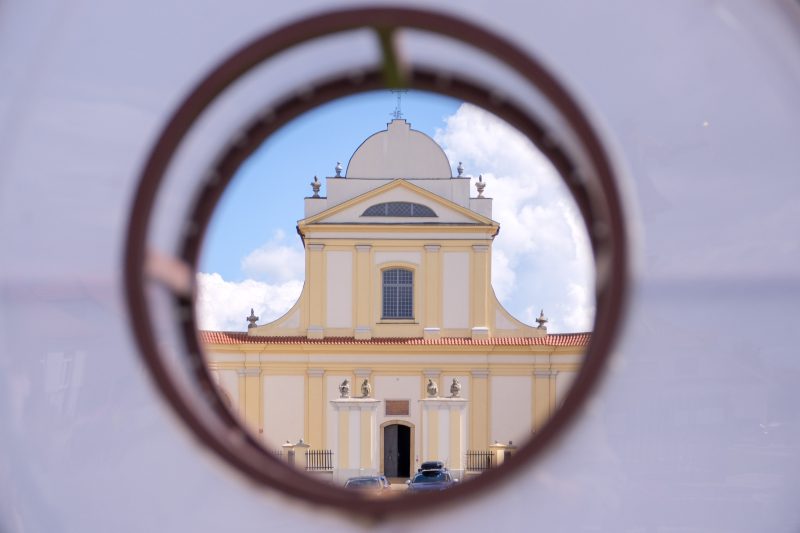
Swołowo is what geographers call an owalnica, an oval-plan village, its houses arranged in a ring around a central pond, a settlement pattern that was common at the time and has remained unchanged here since it was first laid out. If anything, it adds to the serenity of the place, giving it an airy, open feel; a patch of water surrounded by paths and greenery, some gardens backing onto it but most buildings set way back from the pond. Central to all of this is the beautiful spire of the Church of the Most Blessed Virgin Mary, developed and reconstructed in its current form between 1867 and 1893.


Written records place the Albrecht family farming here as early as 1659, part of a German-speaking peasantry that worked this stretch of Pomerania for close to three centuries. That history ended abruptly after the Second World War, when the region’s borders were redrawn, and the German population either left or was expelled, for obvious reasons. They were replaced by Polish settlers arriving from across the new Poland, many of them, as it happens, from villages around Kielce, several hundred kilometres to the south. It’s their descendants who still occupy the fachwerk houses today, and their inherited recipes and traditions, all on display in the museum’s kitchens, living rooms and farm buildings, that keep a thread of continuity running through a village that changed hands entirely within living memory.

In 2002, the Museum of Central Pomerania in Słupsk took over what had been the Albrecht family’s four-sided homestead, which consisted of a house, barn, stable, and byre arranged in a closed square around a courtyard, entered through a gatehouse, in a layout that’s typical of a prosperous Pomeranian farming family of the nineteenth and early twentieth centuries. What followed was nearly six years of painstaking restoration. Some structures were completely dismantled and rebuilt on their original foundations using the same historic techniques; others were carefully repaired and returned to their pre-war appearance. Even as I walked through the village today, I saw builders hard at work reconstructing even more of Swolowo’s more run-down facades, showing that this important piece of Pomeranian history is going to be well preserved long into the future.
Walk Through the Museum of Pomeranian Folk Culture
The Zagroda Albrechta, the Albrecht Farmstead, opened to the public in 2008 as the museum’s founding exhibit, and the wider Museum of Pomeranian Folk Culture has continued to grow around it. Today it spans three separate clusters of buildings scattered throughout the village, tracing a route that takes around two to three hours to walk in full.
The Gatehouse and Courtyard
Your initial introduction to the Albrecht family’s home will be passing through the arched entrance, which carts and livestock used to travel through into the farmstead’s enclosed courtyard. Today it houses the museum’s administrative offices on the ground floor, but climb the stairs, and you’ll find workshops given over to weaving and pottery, and a small brewing hall that was once used for producing the farmstead’s own beer. It’s a working space rather than a typical museum display, and if you visit during busier periods, you’ll be able to see a weaver at the loom or a potter at the wheel, bringing these centuries-old crafts to life.


In the courtyard itself, you can peek into the stables and see old farm equipment lying around, as well as a menagerie of chickens, ducks, and a rather unfriendly goose that seemed to take issue with my presence.
The Garden and Inn
The farmstead’s orchard has managed to survive largely in its original condition, and you will find old cherry, apple, and pear trees, vegetable beds, and a small children’s play area with wooden swings, set against a paddock where horses and sheep still graze. The museum retains a single hectare of farmland here, which is only a modest fraction of the roughly fifty hectares the family once worked, but enough to keep the agricultural feeling.
On the courtyard’s edge, a building that once housed the Albrechts’ seasonal farmhands has been converted into an inn, serving traditional Pomeranian goose dishes through the summer season, although I didn’t get to sample it as it wasn’t open during my visit.
The Farmhouse
Directly opposite the gatehouse stands the chałupa, the family’s home, and easily my favourite part of the museum. The interiors have been reconstructed with intricate detail and care, drawing on accounts from both the farmstead’s former German residents and the first Polish settlers who moved in after them, right down to the decorative tiles and stencilled patterns hand-painted on the walls of every room.


As you wander through, you pass the village sołtys’s office, the formal parlour reserved for guests and special occasions, a bedroom with its own small adjoining cellar, the kitchen and pantry, and a through-hallway connecting front door to back. Tucked beyond it is the Altenteil, a self-contained wing with its own kitchen, bedroom, and parlour, set aside for parents who had formally handed the farm over to their children but continued to live alongside them, showing how three generations once shared a single roof under Pomeranian custom.
The Byre
Across the courtyard, the old cattle byre now houses the museum’s most ambitious exhibit: Kraina w Kratę: Past, Present, Future, a multimedia exploration of the region’s distinctive half-timbered building tradition, tracing the technique from its origins through to the modern-day restoration.
The Barn
A second barn, moved to the site from farmstead number seventeen elsewhere in the village, holds the museum’s collection of agricultural machinery and hand tools: ploughs, threshing equipment, and the everyday hardware of a farming life. It’s less glamorous and impressive than the other rooms or displays in the museum, but it gives a good sense of how this land was worked for generations.
Farmstead 15
This is where you’re likely to begin your visit to Swołowo, as the museum’s ticket office is located here, and the walking route starts from its gate. Farmstead 15 exists in something closer to its current form by design rather than being left in this way by former owners. In 2007, the museum relocated three buildings from elsewhere in the village to fill it out, and annexed a barn from the neighbouring farmstead next door to extend its grounds.

One barn now contains an exhibit on the history of weaving traditions, taking into account the economic and social changes that followed World War II and the arrival of settlers migrating to Pomerania after 1945, as well as sections on flax cultivation and sheep breeding in the region, as well as traditional methods of fabric production. There’s also a weaving studio, which hosts classes and workshops.

The second barn hosts an impressive multimedia exhibition inspired by a historical-ethnographic map depicting the region’s cultural phenomena (created in the interwar period by Rudolf Hardow) that illustrates the rural culture of Central Pomerania after World War II. This covers its social, material, and spiritual aspects, as well as a discussion of annual festivities and celebrations in Central Pomerania.
Farmstead 14
Farmstead 14 is much more humble than the Albrecht Farmstead, as this was the holding of a middling zagrodnik, or a farmer of more modest means than the Albrechts, whose land had grown to five buildings by the twentieth century. Taken over by the museum in 2007, its centrepiece is a timber-framed house where you will see the date 1864 scratched into the clay infill of the attic wall, likely marking the year of construction.

Two smaller outbuildings complete the farmstead: a bread house with a large clay-domed oven, rebuilt on its original spot and once used for baking loaves and roasting meat, and a blacksmith’s workshop, the only museum building in Swołowo that wasn’t originally local, having been relocated here from the nearby village of Pęplin.
Getting to Swołowo
Swołowo sits about 14 kilometres northwest of Słupsk, just off the road toward Darłowo. This means it is close enough to some main attractions to slot naturally into a Pomerania itinerary, especially if you are visiting the Baltic coast. However, it is still far enough from the main tourist trail that it feels a little like a hidden gem.
By air
The nearest airport to Swołowo is Gdańsk Lech Wałęsa Airport, although it is roughly two hours’ drive to the east. This makes it the most practical starting point for most international visitors, with plenty of connections from the UK and other major European hubs. It also means you can pair a city break to Gdańsk with a wider Pomerania itinerary.
By train
Słupsk is the regional rail hub and the obvious base for a visit. Direct trains run from Warszawa Centralna, taking around five hours, with additional services connecting via Gdynia along the coast. From Słupsk, Swołowo itself has no rail link, so the final leg needs a car, taxi, or bus.
By car
Driving is by far the easiest way to reach the village and gives you the freedom to combine it with other stops in the Land of Słupsk. From Słupsk, follow the road toward Darłowo and watch for the signposted turning to Swołowo, or take the Słupsk–Szczecin road and follow the marked turn-off a few kilometres further on. You’ll find two small in the village; one near the entrance off the Darłowo road, the other by the museum’s farmsteads if you’re arriving from the Szczecin road. Either is fine, as the village is compact enough that it doesn’t matter too much which one you choose. Parking is free.
I picked up a rental car from Gdansk Airport, which allowed me to explore the wider Pomeranian region without being tied to public transport timetables. I tend to use Discover Cars for my car rental when travelling, as they allow you to book in advance and compare multiple providers for the best deal.
By Bus
By bus: Regional buses connect Słupsk with villages in the surrounding area, though services can be infrequent, particularly outside peak season. If you’re relying on public transport, it’s worth checking current timetables in advance, or building in a taxi from Słupsk as a backup.
Practical Information
Location
Swołowo is a small village in the Słupsk area of Pomerania, northern Poland, roughly 14 kilometres northwest of Słupsk itself and within easy reach of the Baltic coast around Ustka.
Opening Hours
The museum is open year-round but closed on Mondays, with a shorter free-entry window to the Albrecht Farmstead on Monday mornings for anyone passing through. Tuesdays typically run shorter hours with free admission, while Wednesdays to Sunday see it open normal hours, just longer in the summer season than in autumn and winter. As the hours shift with the season, it’s worth checking the museum’s own site before travelling.
Prices
Prices are reasonable, but expect a standard adult ticket and a reduced rate for students, seniors, and visitors with disabilities, with young children admitted free. Combined tickets covering other Museum of Central Pomerania sites (including Słupsk Castle and the Museum of the Slovincian Village at Kluki) are also available if you’re planning a wider regional tour.


Where to Stay Near Swołowo
If you plan on visiting Swołowo, there are a few good options in the wider region, and the surrounding Land of Słupsk makes a genuinely good case for a place to explore. Base yourself in Słupsk itself, sink into the quiet of a countryside farmstead, or trade the fields for sea air on the coast at Ustka, which is more of a hub for holiday-makers. Whichever you choose, you’re never more than a short drive from the checkered cottages. Here are a few options worth considering.
Zagroda Śledziowa (Herring Farm), Starkowo
Just a ten-minute drive from Swołowo, this is the kind of place you remember long after the trip ends and is more of a destination than just a bed for the night. Occupying a weathered farmhouse dating to 1901 that has been painstakingly restored since 2010, Zagroda Śledziowa is also a living tribute to the Baltic herring that has sustained this coastline for generations.

The beautiful rooms have been carefully furnished with antique and upcycled furniture, making them one of the most stylish and cosy places to go to bed down in the region. In the evening, the on-site restaurant has a menu almost exclusively made up of herring prepared a dozen different ways, in burgers, smoked, pickled, fried, and even curried, alongside home-baked bread and preserves made the old way. By day, you can visit the farm’s own herring museum, borrow one of the free bikes for the old railway cycle path nearby, or simply do nothing at all besides relax in the lovely courtyard and gardens.
Hotel Pod Kluką, Słupsk
For those who want a comfortable base close to Słupsk’s Old Town, Hotel Pod Kluką delivers modern, well-kept rooms just a short walk from the castle, the riverside parks, and the city’s restaurants. It’s an ideal launchpad for exploring the wider region, from Swołowo to the coast and the Słowiński dunes that are all within easy striking distance, while having all the amenities that the town offers.
Dolina Charlotty Resort & Spa, near Słupsk
If your idea of a countryside escape includes a spa, a pool, and a little more luxury, Dolina Charlotty is the region’s standout resort. Set in landscaped grounds with a wellness centre and a fantastic restaurant, it’s a comfortable, restorative option.
Villa Mistral, Ustka
If you’re craving a little sea air and a cute, timber-framed town, the popular seaside town of Ustka is roughly twenty minutes from Swołowo and offers a cluster of self-catering apartments and guesthouses within walking distance of the pier and promenade where you can wake to the sound of the Baltic Sea, spend the morning on the beach, then drive inland in the afternoon.
Villa Mistral, a four-star guesthouse, has rooms that open onto private balconies, and you’re only a five-minute stroll from the waterfront, meaning that it’s close enough to take a stroll down to the sand before breakfast.
Why Swołowo Deserves a Detour
If you just have a short time in Pomerania, it would be fairly easy to bypass Swołowo on the way to one of the region’s more popular sites such as the dunes of Słowiński National Park or the beaches further north. However, there is something unique about this place that makes it worthy of a detour, from its timber-frame architecture and exhibits detailing the history of Słupsk country, to the gentle pace of the place. It’s certainly worth leaving the coastal route to stop by here.

Festivals and Seasonal Events
Swołowo is open year-round, but there is also a calendar of seasonal and traditional events, meaning it may be worth timing your trip to coincide with the festivities:
Asparagus Festival (June): A celebration of the region’s spring harvest
Children’s Farm: Educational, hands-on sessions for younger visitors, held every Sunday in July
Blacksmithing Open Day: A collaboration with regional smithing associations, held in August
Babie Lato (“Indian Summer,” September): Including a much-loved competition for the best homemade liqueur
St. Martin’s Pomeranian Goose
Feast: A culinary event drawing goose-meat enthusiasts from across the country
FAQ
If you’re still in two minds about visiting Swołowo, you may have a handful of questions, like how much of a detour it is. Whether it’s worth the drive off the coastal road? And what exactly you’ll find once you arrive. Here are straightforward answers to the questions that come up most.
What is Swołowo?
Swołowo is a village in Pomerania, northern Poland, home to the Museum of Pomeranian Folk Culture. It’s an open-air museum of thirteen restored 19th-century buildings set within a still-inhabited ‘living’ village.
How much time do you need in Swołowo?
Most visitors comfortably explore the village and its buildings in two to three hours, longer if visiting during one of the seasonal festivals. However, it is worth noting that when I visited, some of the buildings began to be shut and locked up half an hour to an hour before the official closing time, so factor this in if you’re arriving late in the day.
Is Swołowo worth visiting?
While there are an abundance of skansens to visit around Poland, this one has the distinction of being still a living village occupied by people, where restored buildings stand alongside inhabited homes. This makes it one of the more authentic folk-culture experiences in Poland, recognised with the title of European Village of Cultural Heritage.