Not many countries in Europe have a history as tumultuous as Poland’s and in turn, not many cities have a past as eventful as Warsaw’s. Warsaw has changed hands countless times throughout the last millennium and has only been the Polish capital for less than 300 of those years; from 1596 until the Russian invasion of 1815 and then for the short-lived period of Polish independence from 1918 until the outbreak of WWII in 1939. Poland didn’t regain full sovereignty until the collapse of what was the Soviet Union in 1989.
This turbulent past makes Warsaw incredibly interesting but is also why the sprawl of Warsaw feels a little bewildering. It is a bizarre jumble of modern glass skyscrapers, gothic churches, concrete Communist monstrosities and beautiful medieval-style squares that are anything but medieval. The fact that the city was completely destroyed following WWII only adds to its disparate architectural styles.
However, beyond its past, Warsaw is an exciting and vibrant city: a cultural powerhouse with one of Europe’s most exciting bar and nightlife scenes, a burgeoning restaurant scene and a whole host of world-class museums.

The Best Things to do in Warsaw
1. Wander Around the Old Town
2. See an Alternative Warsaw in the Praga Neighbourhood
3. Bathe in the Glow of the Neon Museum
4. Eat at a Bar Mleczny
5. Have Street Food and Drinks at an Abandoned Railway Station
6. Take an Enlightening & Harrowing Tour of the Old Jewish Ghetto
7. Delve into Warsaw’s Communist Past
8. Explore Chopin’s Warsaw
9. Walk along the Vistula from Łazienki Park to the Old Town
10. The Warsaw Uprising Museum
Wander Around the Old Town
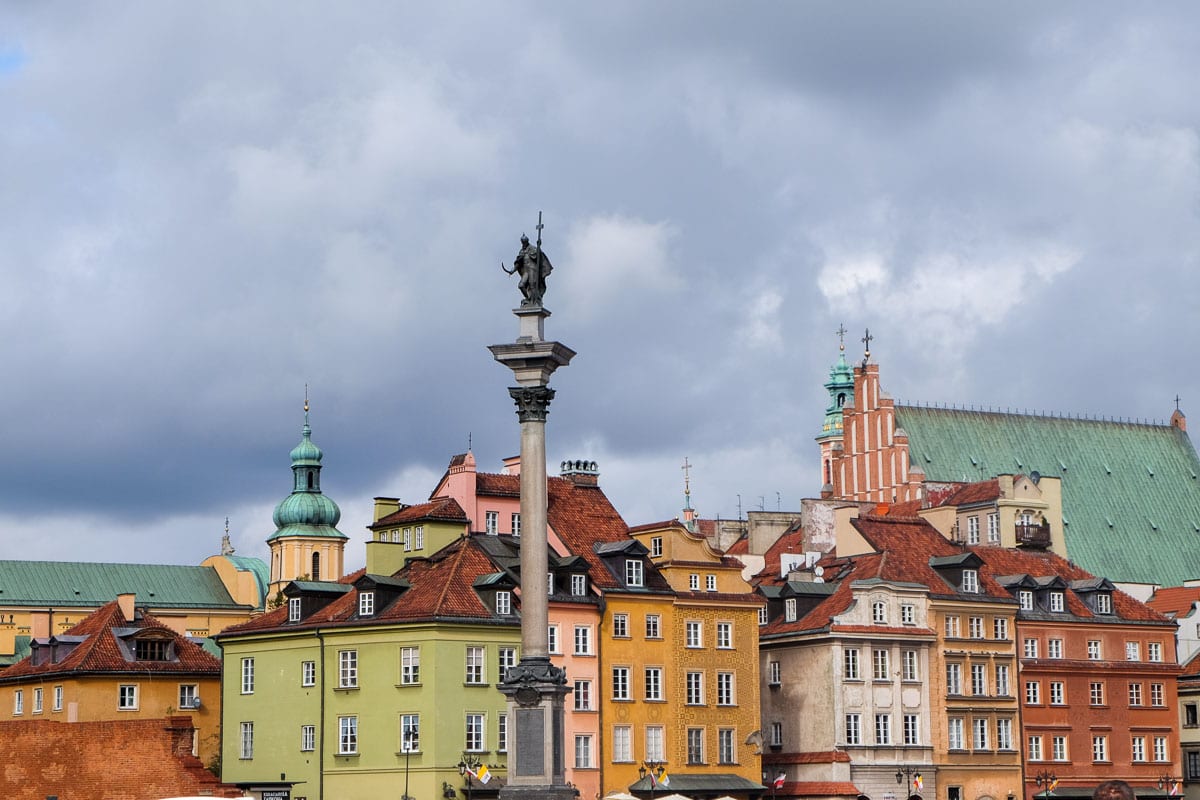
Standing in Warsaw’s colourful and charming Market Square, it’s hard to believe that many of the buildings in the city’s old town are only 60 years old. Following the doomed uprising which took place in 1944 against the German occupiers, Hitler’s retribution proved brutal. Warsaw was completely decimated. Anything deemed of cultural importance was razed, and whole districts were set on fire. By the time the Nazi’s were done, over 85% of the city was rubble.
Using paintings and photographs as an architectural blueprint, the Old Town was painstakingly rebuilt, with the reconstruction of the historic centre only completed as late as 1962. The Old Town’s rebirth was such an incredible feat that it has earned it UNESCO World Heritage Status.
Today, you wouldn’t know that the old town is relatively new construction, and you can easily spend a whole day wandering around, exploring its ornate churches and pretty streets. Castle Square is the perfect place to start, where you can see and visit the Royal Castle, a carbon-copy of the original that was decimated by the Nazi regime. A castle has stood on the site since the 14th century but its current form (well, the original that the current form is a replica of) dates from the mid-1600s when it was used as a residence for a steady stream of Russian rulers and later, Polish Presidents.

Afterwards, wander through the reconstructed cobbled streets to the beautiful Market Square where a rectangle of colourful townhouses surround bars, restaurants, the famous Warsaw Mermaid statue. Although there aren’t many points of interest here, The History Museum and the Museum of Literature are both worthy of your time.
The tower of St. Anna, also known as The Old Town Observation Terrace, is the best place to get a bird’s eye view of both Castle Square and the Old Town. It costs just 5zł to enter and gives you a 360-degree panoramic of the old town on one side, the modern glass and steel structures of the city’s downtown area on another, as well as a spectacular view over the Vistula to Praga and the national football stadium.
Adjacent to Castle Square and St. Anna’s Tower is Trakt Królewski, or the Royal Route, which connects the Old Town to the modern city centre. Stretching from Plac Zamkowy and encompassing the beautiful grid of streets containing ul Krakowsjie Przedmieście, ul Nowy Swiat and Al Jerozolimskie.
Originally used by the upper class to reach their properties in the countryside south of the old town, Trakt Królewski is architecturally one of Warsaw’s most spectacular areas featuring a whole host of important buildings such as the University of Warsaw’s campus, Church of the Holy Cross and the Baroque Ostrogski Palace where you will find the Chopin Museum. The route will eventually lead you to Royal Łazienki Park.
See an Alternative Warsaw in the Praga Neighbourhood
Head east over the Vistula from the well-trodden tourist path of Warsaw’s Old Town over to the less-visited right bank and you will find yourself in Praga; a once run-down and dangerous area of the city that even locals refused to venture into, never mind tourists.
At the moment though, the revitalisation of the right bank seems unstoppable. As property prices rise in the city centre, the area has seen an influx of students and artists searching for cheap accommodation. With them, they have brought a burgeoning art scene and increasing gentrification. The neighbourhood is now bursting with life and quickly becoming one of Europe’s new creative capitals. Expect to find incredible street art, WWII ruins riddled with bullets holes, cool underground bars, and some offbeat museums such as the Museum of Life under Communism.

Fabryka Trzciny has long been considered the catalyst that kickstarted Praga’s resurgence. Formerly a factory producing marmalade, then sausages, and finally running shoes, the derelict building was bought by TV producer Wojciech Trzcinsk and transformed into an art centre. It now houses bars, auditoriums, and is regularly used for cinema screenings, art shows and gigs.
Make sure to head over to 11 Listopada no. 22, a cool courtyard in the centre of Praga that’s home to several bars, clubs and art spaces. It’s a great place to spend the evening during a warm summer night when you can drink in the graffiti-covered courtyard under the glowing strings of fairy lights. Also, explore Mala and Konopack streets, used as the filming location for Roman Polanski’s Oscar-nominated film ‘The Pianist‘.
Bathe in the Glow of the Neon Museum
The Neon Museum is one of the Polish capital’s quirkiest and best attractions. It sits across the Vistula River, away from Warsaw’s centre, in the run down and crumbling neighbourhood of Praga. In recent years Praga has seen a creative upturn, with artists and hipsters moving in to transform the area’s tumbledown warehouses and factories into creative spaces. The neon museum occupies one such warehouse and is devoted to the restoration and preservation of the iconic neon signs that littered the city during the communist era.
In 2004, David Hill and his partner Ilona Karwinska were so struck by the remaining neons that they decided to document them. As their fascination morphed into an obsession, the couple began to acquire old signs, often rusting and in disrepair. The first was from a shop called Berlin, which had sold textiles manufactured in East Germany. The sign was removed and about to be destroyed so Ilona contacted the owners and they agreed to give it to her. It was this one advertisement that started the collecting process. Ilona found it so hard to see so many of the signs being destroyed that she decided to save as many as possible, eventually amassing enough to open the collection up to the public. Although the collection of signs is the main attraction, there are a number of other exhibits explaining the prevalence of neon during the post-war period.
Where: Soho Factory, Mińska 25, Praga District
Opening Hours: Mon, Tues, Thurs & Fri 12pm – 5pm; Sat 12pm – 6pm; Sun 11am – 5pm; Closed Wednesdays
Entry Fee: 10zł


Explore Chopin’s Warsaw
There are a number of ways to explore the music of Frédéric Chopin – Poland’s famous composer – while in Warsaw. Dotted throughout the city are black benches with buttons on them which, when pressed, will play his music. If you want to be serenaded by live musicians, Chopin concerts are held regularly in venues throughout Warsaw, including at the music centre on Nowy Świat, which hosts nightly Chopin concerts all year round as well as alfresco concerts in Łazienki Park during the summer.
For a more in-depth look at his life, head to the Chopin Museum on Okolnik Street where a multimedia exhibition housed inside the Beautifully Baroque Ostrohski Palace contains displays and listening booths in which you can browse Chopin’s oeuvre. For something a little more morbid, you can visit Frédéric Chopin’s heart in the city’s Holy Trinity Church that, according to his will, was placed in an urn and embedded in a pillar.
Where: Frederick Chopin Museum, Pałac Gnińskich, Okólnik 1
When: Tues to Sun 11am – 8pm
Fee: 22zł (free on Sundays)
Have Street Food and Drinks at an Abandoned Railway Station
Warsaw’s Nocny Market (Night Market) brings together some of the city’s most popular bars, restaurants and street food vendors in one spot: a disused train station (Warszawa Główna) right in the centre of downtown Warsaw. Some of the old railway paraphernalia remains, but mostly the site has had a complete facelift meaning and neon signage and street art adorn the once-bare, concrete platforms. Every evening, DJs and bands provide the soundtrack and there are multiple bars serving up cocktails and craft beer. You can even get a tattoo at one of the stalls if you forgot to get one before you came.
The site can be a little difficult to find. To get there, hop off a tram or bus at Pl. Zawiszy and walk towards the long alley with ‘Warszawa Główna’ emblazoned on the building.

Take an Enlightening and Harrowing Tour of the Old Jewish Ghetto
Before WWII, over 300,000 Jews lived in Warsaw and made up 30% of the capital’s population – only New York could boast a larger Jewish contingent – yet within 6 years, over 90% of these people would perish.
I had never cried from the content of a walking tour until I took a historical walk around Warsaw’s former Jewish Ghetto with a local historian, hearing a harrowing account of the horrors that Polish Jews were subjected to in the past century.
I had been reluctant to take a Jewish tour of Warsaw, knowing that what I would hear would be distressing, but I had no idea just how much these stories would affect me. Listening to our guide describe the horror, as we stood in the exact spot that it took place, brought tears to my eyes. However, In my mind, you cannot understand a city without knowing about its history, no matter how disturbing.

Beginning on the corner of Świętojerska Street – the site of the former Nalewki Street – which was once one of the city’s busiest trading areas and the centre of Jewish Warsaw and ending at the fantastic Museum of the History of Polish Jews, the tour takes you through the area that was transformed into the Jewish Ghetto by the Nazi regime and aims to tell the stories of Poland’s Jewish community before, during and after WWII.
For more information, head to the fantastic POLIN Museum. Easily one of Warsaw’s finest museums, The Museum of the History of Polish Jews opened in 2014 and documents over 1000 years of Jewish history through a series of multimedia exhibits.
You can find the details of all of Warsaw’s free walking tours here, including starting locations, times, and themes.
Read More: A Walking Tour of Warsaw’s Jewish History
Delve into Warsaw’s Communist Past
It has been over 30 years since the fall of communism in Poland, but small remnants of the post-war era can still be spotted throughout the country. In some cases, communist nostalgia is even embraced, albeit in a tongue-in-cheek way.
The much-derided Trabant cars still pootle around the city and refurbished military transport vans ferry tourists around the main sights, only now painted in colourful pastels rather than bland greys. Many of the communist-era buildings remain too; blocky, brutalist behemoths that have been repurposed rather than torn down, often with a new life that is a far cry from the original uses. The former censorship building is now home to the Polish Press Agency and the old Communist Party headquarters houses Eastern Europe’s first Ferrari dealership, only the red colour of the car on display connecting its past to its present. Cuda na Kiju, a popular bar, has also set up shop in the headquarters.
Taking a communism themed walking tour of Warsaw is the easiest way to understand what life was like for Polish citizens under communism and thanks to a local guide, I was able to hear personal stories as well as gain insights that I would ultimately miss if I was walking the city alone.
The tour begins in the Old Town and works its way towards modern Warsaw towards Pl. Konstytucji, the constitution square used as a parade ground during the post-war years, ending at possibly the most striking remnant of the post-war years: The Palace of Culture and Science. It’s a building that casts a long shadow – both figuratively and literally – across Warsaw. Originally commissioned by Stalin as a ‘gift from the Soviet people’, many people see as a symbol of Russian dominance.
Read More: Milk Bars & Neon

Eat at a Bar Mleczny
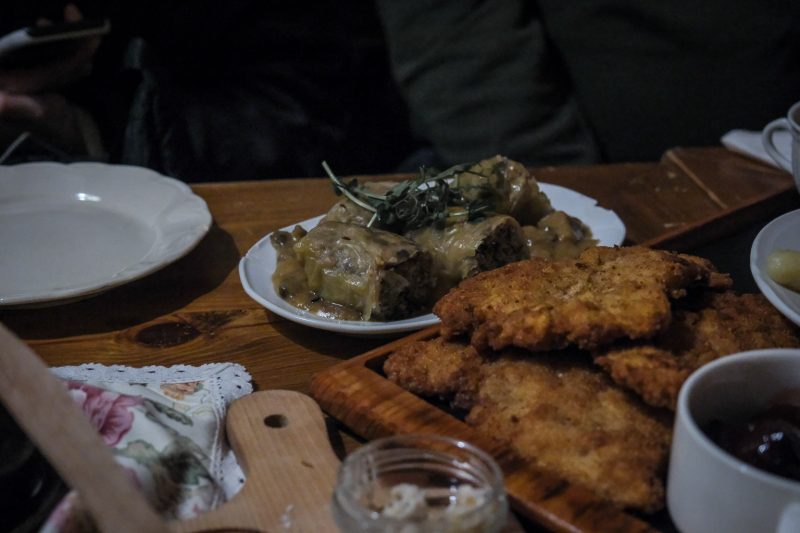
Milk bars, or bar mleczny in Polish, may seem like a communist throwback and in some ways, they are. These government subsidised canteens serve hearty, traditional cuisine and blossomed during the post-war period as one of the few places that could guarantee a hot, nutritious meal – usually meat and potatoes, soups, vegetables, pierogi and as the name suggests, dairy.
Although not much has changed for them in terms of food, decor or service, their cheap, homely meals are still popular today. For tourists, they’re a perfect place to taste old-fashioned Polish food and get a feel for what the country was like before the iron curtain fell. For others, they’re a place to get a nostalgia fix or substantial home-cooked dish. I love milk bars. For just a few złoty it is possible to eat like a king.
The best milk bars I visited were Bambino (Hoża 19, 00-521 Warszawa; 8am – 8pm), Rusałka (Floriańska 14; 9am – 5.30pm), and Prasowy (Marszałkowska 10/16; 9am – 8pm weekdays or 11am – 7pm on weekends).

Walk along the Vistula from Łazienki Park to the Old Town
When the sun is out, there is no better place to take a stroll than Łazienki Park. Warsaw’s largest outdoor space stretches over 80 hectares of outdoor space containing lakes, palaces, two orangeries, a planetarium, follies and an amphitheatre. Once the hunting ground attached to Ujazdow Castle, the land was acquired by King Stanislaw August Poniatowski in 1764 and transformed into this beautiful park. Events take place in Łazienki throughout the year, but on Sunday afternoons in summer, a free Chopin concert takes place here twice a day.
The bike path along the left-hand bank of the Vistula, stretching from Most Poniatowskiego & Łazienki Park to Rondo Waszyngtona is a pleasure to walk at any time of year, but come summer, the shores of the river come to life. You will find hundreds of people relaxing with BBQs and bonfires next to Poniatowski bridge on the sandy beaches of Praga. The beach pavilion and café space, Plażowa, hosts a number of free concerts called ‘Miejskie granie’ (‘urban playing’) throughout the summer. The left-hand bank of the river also has some great entertainment on offer with Pomost 511 and Cud nad Wisłą, two cool bars sitting beside each other on the Old Town side

The Warsaw Uprising Museum
The Warsaw Uprising Museum charts the history of the city’s heroic and tragic 63-day struggle to liberate the city from German occupation in 1944. One of Poland’s – if not Europe’s – best museums, it contains 3 floors of photographs, films, personal accounts, and interactive displays that do a fantastic job of portraying the sense of dread and desperation that Warsaw’s residents felt at the time. Ultimately, over 200,000 people died during the uprising and 90% of the city was razed by the Nazis as punishment. Give yourself a few hours to explore the whole museum.
Where: Grzybowska 79
Opening Times: Mon, Weds – Fri 8am – 6pm; Sat & Sun 10am – 6pm; Closed Tuesdays.
Entry Fee: 20zł. Entry is free on Sundays but expect a queue.
Where to Stay in Warsaw
Being a huge city, Warsaw has dozens of low-cost accommodation options and finding the right one – a hostel that is both in a good location and well-reviewed – can be a bit of a gamble. However, for every poorly rated hostel, the Polish capital has an abundance of great ones. For something a little more upmarket, the huge selection of apartments dotted throughout the city are possibly the best option, although excellent hotels can be found around the Old Town and Royal Route.
Safestay Hostel (formerly DREAM)
DREAM hostel is perfectly located on Krakowskie Przedmiescie, or the historic Royal Route, just a 2-minute stroll from the heart of the old town. It is possibly one of the cleanest, best-equipped hostels I have stayed in. The top floor bar and common area are social, but still pretty relaxed. The hostel is ideal for travellers that want to meet other backpackers but avoid a non-stop party atmosphere.
Oki Doki
Warsaw’s biggest, and arguably most popular hostel has two locations in the city. The massive 140-bed Oki Doki features individually designed, themed rooms as well as an onsite bar. It has a reputation for being a bit of a party hostel, so those looking for somewhere a little quieter can head to Oki Doki Old Town which is a little more elegant, modern, and subdued. Both hostels organise different activities each day, such as pub crawls, city tours, and pierogi cooking lessons.
B&B Autor Rooms
The stylish and minimal B&B Autor Rooms is located just a short hop from Ujazdowski Park in the South of the city and features beautifully designed rooms as well as a shared lounge, a terrace, and a shared kitchen.
Getting to Warsaw
The majority of inbound flights land at Warszaw Chopin – the city’s main airport – located 10km from the city centre. However, budget airlines such as Ryanair may arrive at Warsaw Modlin on the outskirts of the city.
Regular trains run from the airport’s Warszawa Lotnisko Chopina station to the city’s central rail hub, while the airport bus (no. 175) stops close to the Old Town. From Warsaw Modlin, the best way of reaching the city centre is with the Modlin Bus (33zł) which alights outside of the Palace of Culture.
Getting Around Warsaw
Although the city is sprawling, Warsaw has an extensive bus and tram service, meaning that getting around the city is relatively easy. Tickets can be purchased from machines at bus stops or from newsstands near to stops. A Standard ticket costs 4.40zł, or you can purchase a 20-minute ticket for 3.40zł that allows you to travel by multiple buses, trams and metro trains within that timeframe. If you are in Warsaw for a day or more, I highly recommend buying a day pass (15zł) or multi-day pass.