“Sir, are you from a newspaper?”
I look up from scrolling through photographs in my camera’s viewfinder to find 3 Indian teenagers crowded around me, hair matted and sopping wet, their sodden trousers clinging to them and water puddling around their feet. They’re looking at me wide-eyed, their gaze flicking from my camera to my face, then back to the camera.
“Sir, are you from a British newspaper?” One of them asks again.
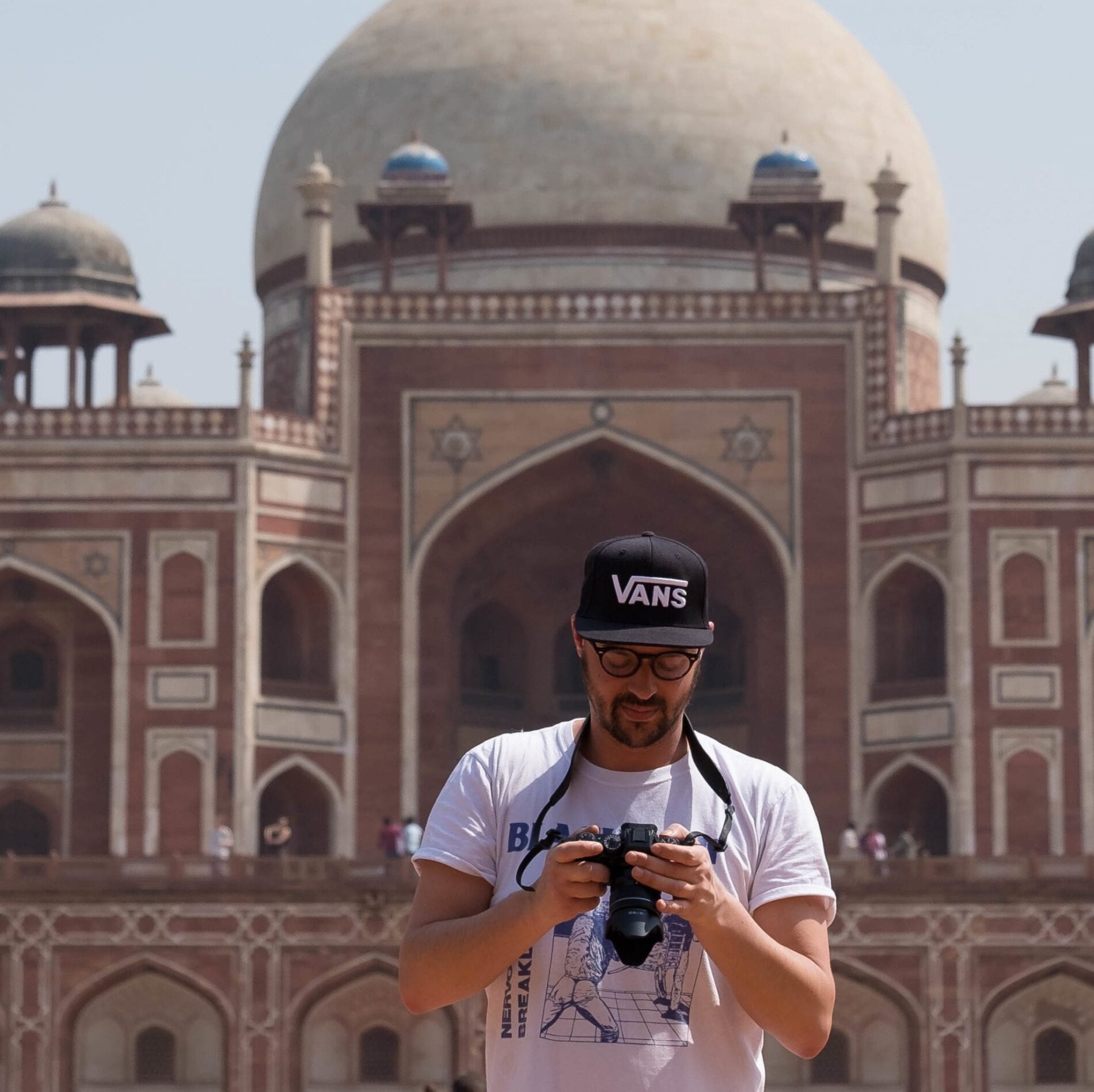
The 40-degree heat scorching my skin, I’m bright red and dripping with sweat, I look dishevelled in a sweat-soaked t-shirt and my shorts are dirty, stained with speckles of orange from that morning’s spilt chai. I certainly don’t look respectable enough to be a journalist. Even for a tourist, I’m not doing too well in that regard. That’s not what these kids see though. They spot my camera and large lens and make their assumptions.
“Sorry, no. I’m just a regular tourist,” I apologetically explain. They ask for a photo anyway.

There’s a flurry of excitement as the boys excitedly chat between themselves and usher me over to the step well’s edge. Peering over, I see that it’s a long drop, around 20 metres from the rim of Toorji Ka Jhalra’s inverted pyramid of zig-zagging steps to the water below. This doesn’t phase the daredevils. The first of the intrepid urban cliff divers casually steps through the makeshift, protective fence and clambers onto the rooftop of one of the many balconies that overlook the well. Standing upright and taking a step back, he puffs up his chest in one deep preparatory breath and glances back towards me, as if to check that I had my camera ready to document this incredible feat of daring.

He breathes out, takes a fast-paced step forward, planting his foot hard and propelling himself off the ledge, disappearing from view.
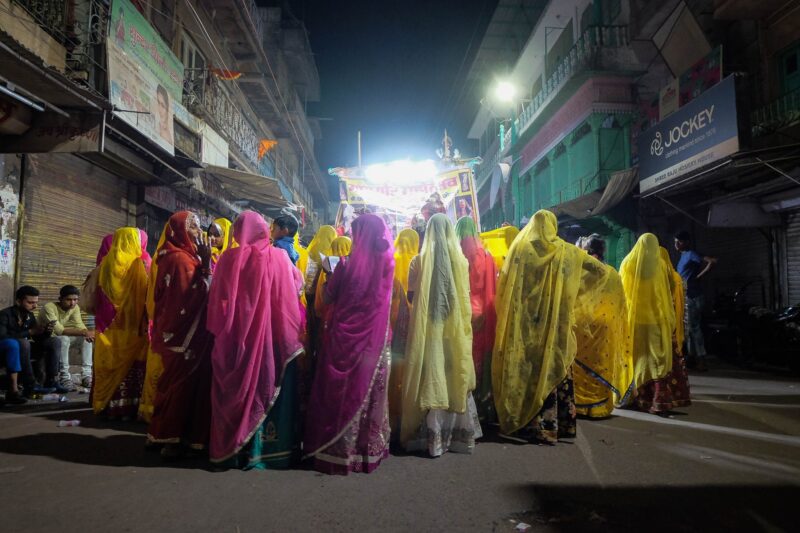
There’s a second of complete silence before a splash echoes around the sandstone structure. I stick my head over the fence again to see the green water foaming and rippling out in concentric circles, the pink and yellow rose petals on its surface – floating there since the previous evening when I had watched dozens of women in colourful saris twirl, dance and drum at the well’s edge before pouring silver pots full of flowers into the water as part of Gangaur celebrations – bob chaotically.
His friends follow, stepping towards the ledge, turning to check that I have my camera ready, and then taking an almighty synchronised leap. An almighty splash rings out to the sound of claps and jeering from the other kids.

India’s step wells fascinate me and Rajasthan is littered with them; There’s Agrasen ki Baoli in the centre of New Delhi, the visually spectacular Chand Baori of Abhaneri, built in 900AD and containing 3500 steps, the infinitely photogenic Panna Meena Ka Kund in Jaipur, and thousands of other examples. I had read somewhere that the average city in Rajasthan has around 40 such wells. I also read that Jodhpur once had as many as 100 hidden away within its narrow alleyways. It’s fairly common to ask a local where the stepwell is, only to have them reply “which one?”
Unfortunately, the advent of running water left many disused, covered up, or in a state of disrepair. For many years Toorji Ka Jhalra, constructed in the 1740s by Maharaja Abhay Singh’s Consort, continuing an age-old tradition of Royal women building public works, was in much the same situation. The zig-zagging steps, built to follow the fluctuating water table had been completely submerged by stagnant, debris-filled water. It was only recently that the well was drained and cleaned; Dhananajaya and Nikhilendra Singh, owners of the nearby Raas hotel, set about purifying the water and sandblasting the steps with some help from Jodhpur’s maharajah. Since then, a number of fancy shops and boutiques have sprung up in this newly spruced up area of town. Once again becoming the centre of the community in Jodhpur, not as a source of drinking water, but as an open-air swimming pool for the local kids, albeit an unofficial one where swimming is technically not allowed.


Periodically there is a honk and a siren blast as the local police arrive to spoil the fun. The kids freeze when they see the officers. Then they scatter. Sprinting up the well’s steps, they quickly bundle their discarded clothes in their arms and run in disparate directions as the police watch on, helpless. I can tell that it’s a scene that plays out multiple times a day, every day; A pointless game of cat and mouse where both parties are fully aware that the stepwell will only stay clear of swimmers for a short period of time.
With the well silent once again, the police return to their car with a shrug. I decide to escape the sun with an ice-cold lassi on the balcony of the Stepwell Cafe, one of the newly refurbished buildings in the area. As I slurp on my mango flavoured yoghurt drink, I have a view directly overlooking Toorji Ka Jhalra. I watch as a boy pokes his head over a surrounding wall, checking for the local authorities. When he sees that the coast is clear, he emerges tentatively. Half a dozen other boys follow and before long, scores of children are leaping back into the water.

see the boy that mistook me for a journalist standing on the well’s rim. He looks up and sees me too. He gives me an enthusiastic wave before lifting both hands to his face and making a clinking motion, the universal symbol of miming a photograph. I ready my camera and watch on as he takes another 20m leap of faith.