Elephants have always been an integral part of Sri Lanka’s history. For much of it, they were seen as a symbol of power and authority, as well as a convenient asset. In medieval times they were used to build the nation’s great cities. Later, the Dutch used them to work on the canals. When the British arrived just 20 years later, they were set to work, clearing large areas of jungle for tea plantations. The Sri Lankan elephant has always been desired by humans, mostly because it was mysteriously easy to train.
That seems strange considering how single-minded a Sri Lankan elephant can be. It is said that the wild elephants follow the same paths all of their lives, as do their descendants after them. These Elephant paths, or alimankada, zigzag across the island in a crosshatch of invisible corridors, often unknown to humans. They can remain unused for years until, all of a sudden, the elephants will appear again and little can be done to divert them. They will happily traipse through farmland and gardens, sweeping aside fences and huts to continue their journey.

This tussle with the free-roaming beasts is so prevalent that it even has its own name; the human-elephant conflict. There is little you can do if you find yourself in their path. They usually come at night, plodding through the undergrowth to feast on rice fields and crops, the farmers employing a barrage of firecrackers, fireworks and shouts in an attempt to scare them away. Each year over 80 farmers die, squashed while trying to protect their fields from a herd of constantly hungry, walking hoovers. As many, if not more, elephants meet their end at human hands. Despite this, the creature is still revered.
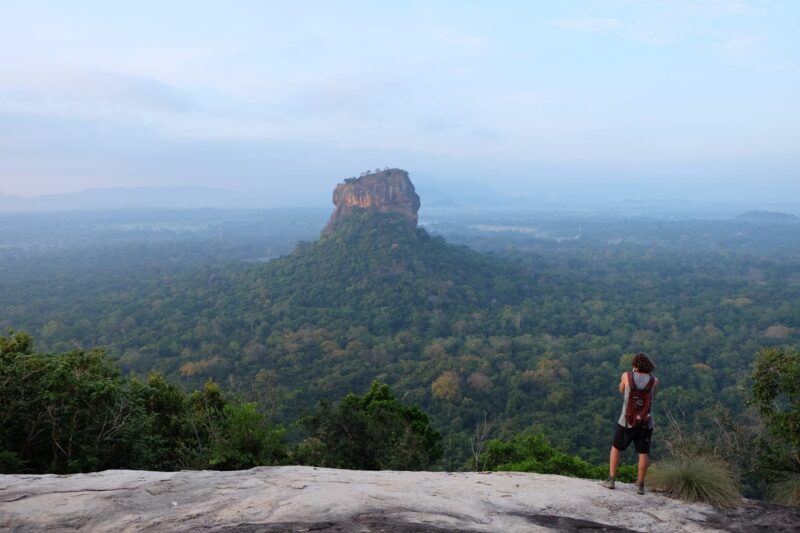
This is why, when I informed my homestay host in Sigiriya that I was heading to the bottle shop to buy some beers, he insisted that I take his 10-year-old son with him. “The elephants,” he warned “can be very dangerous.” I was unsure how a small boy would protect me from a group of marauding giants, but I accepted his offer as I wanted the company. We trudged the few miles along dusty orange roads through the jungle, a matted knot of undergrowth and rosewood trees. It was pitch black until the fireflies appeared, buzzing and filling the treetops with pinpricks of light. I scanned the trees with my iPhone torch to see if I could see anything or hear a rustling.
For most of the walk, I fielded Torre’s questions about England – almost exclusively cricket and religion-related. We didn’t bump into any elephants. The only hairy moment was Torre insisting I stop walking on the side of the road and move into the middle. “Because of elephants?” I asked. “No,” he replied calmly, “because the grass is full of deadly snakes.”

The battle with elephants has been ongoing for centuries, since the days of Anuradhapura. Until then, there were very few elephants in Sri Lanka. The ones that were there lived hidden in the lush surroundings of the central highlands. As the North Central Province was gradually irrigated by the vast reservoirs of successive kings, the new grasslands and forest suddenly became an elephant feast. Their numbers ballooned. The kings didn’t mind; the elephants were biddable.
After the reservoir kings – during British rule – things changed. Elephants were regarded as pests and the hunting began. Over the course of the next 130 years, the population fell from 15,000 to just 3,000. The Sinhalese have countless reasons to hold a grudge against the British, but this is a big one.

These days the elephants mostly have the reservoirs to themselves. A network of 22 national parks and nature reserves are scattered throughout the island – taking up over 15% of the total landmass – giving the gentle giants space to roam in peace. I hadn’t yet seen a single elephant during my travels and so a visit to the National Parks and a Sri Lankan safari was high on my list.
I’d mentioned this in passing to my trusty driver, Kasun, and instantly his eyes lit up. He began rambling about how the nearby park of Minneriya is the best spot for elephant watching and that luckily, his uncle was a tour guide. Statements like this are to be taken with a pinch of salt in Sri Lanka. After just a few days of travelling you become distinctly aware that whatever you need, someone will have an ‘uncle’ that can sort you out, often with mixed results. However, I decided to put my faith in Kasun. I liked him and he had pulled through for me a few times already. In Kandy, he had taken me on a free tour and found me the perfect spot to watch the funeral procession of a Buddhist monk, Most Ven. Galagama Aththadassi Thero. When I needed to get up north quickly, he had somehow managed to borrow a car and drive me for a pretty low price. He made a few phone calls and within half an hour we were loading ourselves into his ‘uncle’s’ safari jeep and heading out on our swiftly organised expedition.

The park is just a 10-minute drive along the highway from Habarana, and 25 minutes from Sigiriya. Already Kasun’s excitement was palpable. He stood up at the front of the jeep, animatedly chatting to his uncle as they kept an eye out for elephants. Soon we were entering the main entrance of the national park.
The park centres around the vast Minneriya tank, built by Mahasena over 1,800 years ago. Although it was abandoned not long after it was constructed, it is one of the few places in the country that regularly survives the drought of the annual dry season. I suppose that’s why, despite its relatively small size, Minneriya is one of the best places in the country for wildlife spotting. Elephants, deer, langur monkeys and sloth bears can all be found here, making the most of the permanent water supply.
However, it is elephants that are the park’s main attraction. Minneriya forms part of the elephant corridor that joins both Kaudulla and Wasgomuwa national parks. During the summer months, when the tanks elsewhere dry up, one of the country’s most incredible natural wonders takes place. Up to 300 of the beasts, from as far away as Trincomalee, descend on the waters of Minneriya in an event dubbed ‘The Gathering’ – the largest meeting of Asian elephants anywhere in the world. Unfortunately, we were a few months too early to attend this annual meet-up but Kasun assured us that we were about to see an abundance of pachyderms.
At first, we didn’t see much of anything. We bounced down the dusty orange roads, peering into the tangle of hard, knobbly undergrowth for any signs of wildlife. Occasionally the leaves of the palu and halmilla trees would rustle but nothing would emerge. Kasun’s uncles would occasionally clutch at straws, pointing out a fish eagle or muster of storks, clinging to a branch, surveying their surroundings with a solemn vigilance. It was clear he was getting frustrated. It was much too early in the year for the gathering and so the tank was clear of elephants, leaving the birdlife to paddle alone.
Then they came. First, we spotted a bulbous grey mound undulating in the bush, a speck of hope in a sea of grass. It raised its head to reveal its flapping ears and swinging trunk. We kept our distance. Apparently, a lone bull can be a dangerous creature but it was a sign that more elephants would be near. We continued on, heading deeper into the tangles of thorn on ever-narrowing tracks.
There was a crackle of speech over our walky-talky and then silence as our driver cut the engine. The jeeps both in front and behind doing the same. We sat and waited in the silence, just the hum of bugs and the chorus of birds filling the air. As the shadows lengthened and the orange hue of the ground intensified, the thorn rustled with life and the elephants emerged. First, a couple plodded towards the road but scores followed. Lone bulls, family groups, cows with calves – whole circuses of them. I couldn’t believe my eyes.

They poured from the undergrowth in their dozens. The seemed relaxed and content – as strange as it is to describe the emotions of elephants in this way – as the gambolled through the fields, ears flapping and trunks waving. It may not have been The Gathering, but it was more than I could have hoped for.


Despite the dozen or so waiting jeeps, the elephants remained indifferent to our presence. I scrambled for my zoom lens in order to capture some photos but it wasn’t needed. The elephants wandered towards our vehicles and grazed beside the wheels, close enough that if I had reached half an arms-length from the window, I could have stroked a trunk or fondled an ear.


From then on, the floodgates seemed to be open. Everywhere we drove in the park there would be elephants munching on grass or stripping trees. At one point, 10 or so cows crossed our path. They had a new calf with them, looking fluffy and inquisitive, peering out from beneath its mother’s legs at the parked jeeps. Even though the adult elephants seemed at ease with our presence, they ushered the youngster away from us with their trunks, keeping themselves between the calf and cars.
It’s strange to think that, if it survives both the Sri Lankan roads and the ongoing human-elephant conflict, this baby could still be here in 50 years time, traipsing the same alimankada that its ancestors have for centuries. The majority of elephants in Minneriya don’t wander far, but they definitely wander. They are constantly on the move, looking for trees, foliage and water, always following their set paths.

We stayed for as long as we could in the park – until the elephant’s shadows became drawn and the light started to fade. Kasun guided us to the park’s highest point where we could see the whole of Minneriya stretched out below us and hope to catch one last glimpse of our beautiful surroundings.
By the time we had descended the peak and returned to our driver, the elephants were going, plodding gracefully into the sunset and deeper into the park. With that, we left. There were a few latecomers; the occasional lone tusker or pair of cows grazing by the side of the A11. Sights like this are normal, only a 3rd of Sri Lanka’s elephants live in national parks, the rest roam wild. Even so, it is heartening to know that, despite their mixed past, they can now live in relative peace. Less than 150 are in captivity, the rest can wander their predestined paths without chains and bullhooks – just as it should be.