
Ask anyone in Sri Lanka about Sigiriya and they will proudly declare it the ‘8th wonder of the world.’ It is easy to see why the Sinhalese hold such reverence for the rock. The last resort of King Kasyapa, Sigiriya is possibly the most picturesque battlefield that the world has ever known and the crowning jewel in the country’s ‘cultural triangle’.
I’m not sure what I expected to find as we made our way into the country’s North Central Province. I guess the fact that many call it the dry zone should have told me. The trees and hills of Kandy gradually fell away as we drove north and in its place, an expanse of green-brown scrub appeared. Throughout the drive, there was little sign of human life apart from actual roadside signs; ‘Spice Garden’, ‘clothes outlet’ and the occasional advertisement for a fuel stop that turned out to be a single pump where customers diligently filled old Pepsi bottles with trickles of dirty looking fuel.
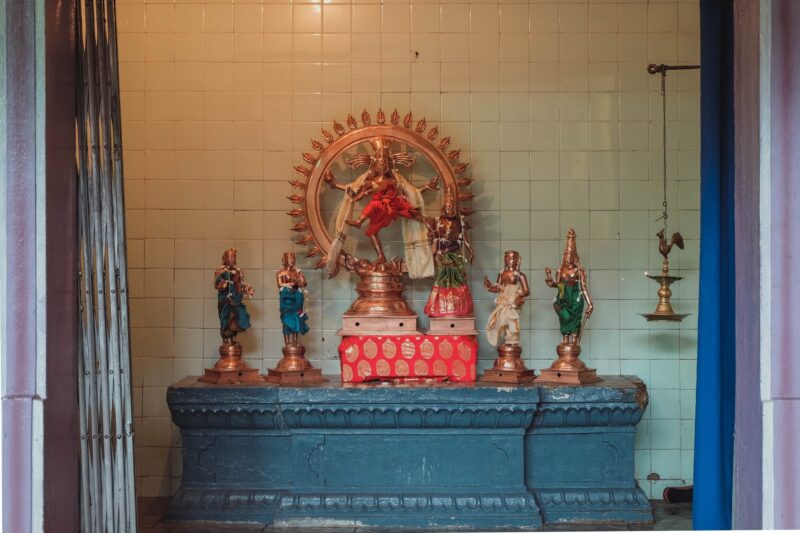
Our driver, Kasan, did his best to give us a running commentary on what we were seeing. He spoke a lot, mostly in English, but even he began to struggle for points of interest, resorting to single nouns but still in a disproportionately excited tone. “Cows!”, “Spice farm!”, “Temple!”. The drive was lacking in incident and soon even his nouns dried up. We made a short stop at a Hindu temple on the road out of Kandy. I assumed it was Kasun’s way of giving us a little excitement – finally something to see – but as he ambled inside I got the impression that it was just an excuse for him to carry out his worship for the day.


Continuing northwards, we were back amongst the scrub. With all the desolation and dust, it was hard to imagine that – thousands of years ago – this was home to a great civilization.
The remains of this ancient kingdom still appear on the pockmarked map of the North Central Province. Giant ponds, or wewas, dimple the landscape. From the road they were hard to spot, the only sign of them the sudden explosion of life; Yellow-eared bulbuls, shimmering kingfishers and fluorescent parakeets moved among the trees that now appeared among the bush. Then came the stilted ibis wading within the undergrowth as cormorants and adjutants milled in the pools in a carnival of squarks and chirps. It was once assumed that these pools were completely natural but it is now known that they are man-made, an engineering marvel that is almost 3000 years old.
Little is known about the people that constructed them except that they were masterful builders with unprecedented knowledge of physics. They began building channels, or ellas, to bring water from the highlands, 150 miles to the south. Some were over 10 metres wide. Despite the land appearing flat, this ancient group managed to accurately syphon the water into natural basins almost imperceptible to the naked eye. By the 13th century, over 5,000 ellas were built, creating over 18,000 reservoirs or tanks. The landscape was changed forever, bringing flora, fauna and riches.

Half an hour from Sigiriya lay the result of these riches; A city that was once the biggest in the world. At its peak, it would have taken a whole day to traverse on foot and had a population of 2 million – larger than Birmingham, Liverpool and Leeds combined. That city is Anuradhapura. For over 1,400 years it remained the island’s capital and was the home to a succession of over 100 monarchs. Not many other cities in history have been occupied for so many years continuously. All that is left standing are the columns and steps of many buildings. Wandering around, it takes a strong imagination to see how the city functioned so well. But it did function. It was the home of engineers, mathematicians, farmers and even hosted some of the world’s first hospitals.

Some of the more intact and impressive buildings are also the most extravagant. I couldn’t help but wonder what had inspired the construction of the giant dagobas rising above the trees like concrete bubbles, still complete as they were all those thousands of years ago. One such dome, the Jetavanarama Dogoba is thought to have once been the largest brick building in the world, containing over 93 million bricks. Enough to build a small town.
The golden age of the reservoir kingdoms wasn’t to last though; wherever there are riches, turmoil is bound to follow. It began in 477AD with the regicide of King Dhatusena. Dhatusena had two sons, Mogallana, born to his most important queen, and Kasyapa, born to a lesser consort. Upon hearing that Mogallana was heir to the throne, Kassapa rebelled. He drove Mogallana from the city and captured his father, demanding to know the whereabouts of the kingdom’s treasure. The king had just finished a stupendous reservoir – the great Kala Wewa tank – and declared its water to be all the treasure he needed. Furious with this answer, Kasyapa entombed his father – still alive – in a chamber and left him to die. Kasyapa fled down the old Anuradhapura road, which was the next stop on my journey through the triangle.

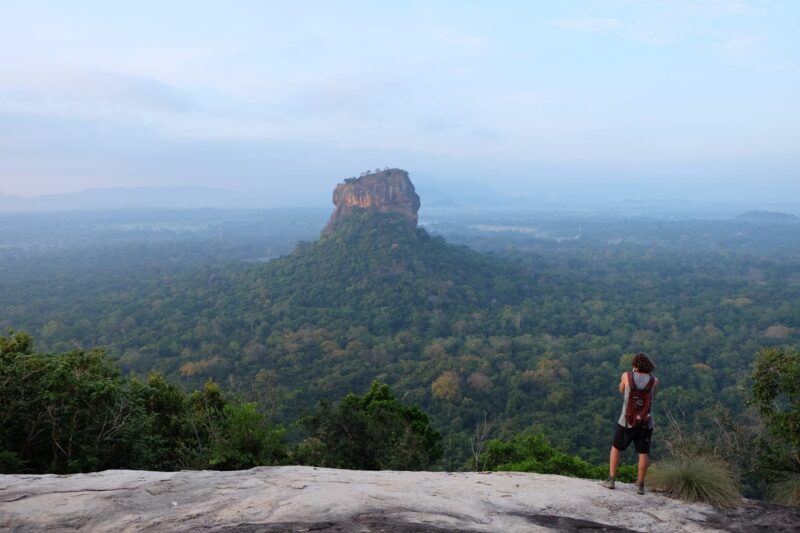
Kasayapa chose Sigiriya as his last resort. The rock itself probably remains much as it was when he arrived; a 200-metre tall tower of solidified magma, left behind as a volcano’s innards solidified and its outer crust eroded away. I had caught a glimpse of Sigiriya earlier that morning from Pidurangala, watching the sun bathe the tectonic wonder in purples and reds as it rose. From afar it looked as if it had never been inhabited, its sides smooth and unassailable and its top covered in vegetation rather than ramparts.
It is thought that Kasyapa spent eighteen years preparing for his brother’s arrival. Ledges for sentries were carved all along the outer walls and a grand fortress was constructed atop the rock. In that time he worked hard to redress his guilt, taking a vow of asceticism. At its base were public pools, moats, farms, hospitals and even poor houses. The ramparts spread for miles into the forest. It seems that Sigiriya could have survived an eternal siege.

I arrived to find a siege of a different kind. Foreign tourists, school groups and orange-robed monks all jostled for position and the pathway approaching the fort. I turned up as early as possible to avoid the midday sun during my climb but practically everyone else in central Sri Lanka had the exact same plan. I needn’t have bothered. Even at this hour, the sun was red hot, the air scorching my skin like the blast from an open oven. It is easy to see why Kasyapa had chosen to build a network of pools and water gardens inside his fortification. They are some of the world’s oldest landscaped gardens and even today, they are meticulously kept.
Part of me dreaded the climb to the top. Despite doing a little hiking, generally, I am quite sedentary. Any bursts of overly strenuous activity fill me with unease and anyway, climbing 1200 steps in one fell swoop is a different proposition to ambling for a few hours over rolling countryside. Luckily for me, the stairs were narrow – cut for tiny medieval feet – and quickly became clogged with monks, giving me a few minutes respite between each ascent.

Occasionally the steps would give way to rusting ladders and gangways, bolted to the rocky side. About 25 metres up, we found ourselves wandering through a cavern filled with voluptuous women. There were about a dozen of them painted on the walls, life-sized and half-naked from the waist up. It is thought that these pictures once covered the whole outcrop, from top to bottom – one of the largest murals ever created, the colourful images visible from miles around. Some say that these maidens depict members of Kasyapa’s hareem but with his vow of aposaka, it is more likely that they are celestial nymphs, painted to protect the fortress in the battle that was to come.

Higher up were Kasyapa’s more practical defences. During his reign, the king had built a giant lion sculpture – giving Lion Rock its name – with the stairs leading into its mouth. Only the 50-tonne brick paws were left. Visitors funnelled through them then up a spindly staircase to the top.
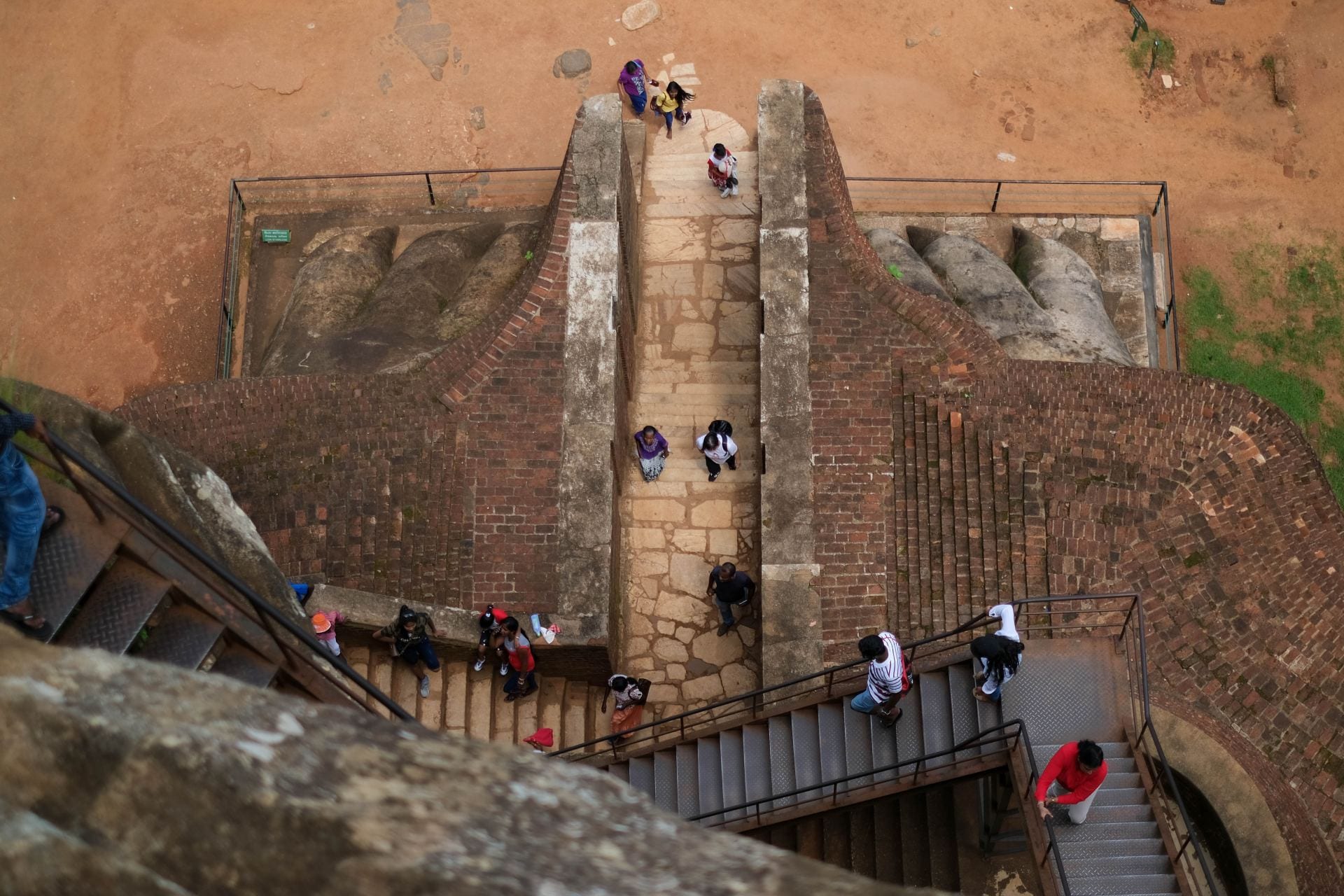
We found nothing at the summit. The palace had long crumbled, leaving the stubs of the surrounding walls and a few pools of water. In its time, it must have been an impressive sight to behold, visible from miles around. I wandered the gardens among the orange-robed monks, trying to drink in the view. From here it was possible to see the true success of the reservoir kingdoms. What was once an arid landscape was now a lush, emerald carpet as far as the eye can see. Their tanks were still visible – shimmering reflectors in a sea of green. With this fortress, Kasyapa probably thought he was indestructible. I can’t imagine any other reason why he would have left his fortress and gone into battle in such a foolhardy manner.

Polonnaruwa was the final gasp of the tank building kingdom. I was told by my overly ambitious tuk-tuk driver that it would take half an hour to reach from Sigiriya, but it was more like 90 minutes through heavy traffic and clouds of dust. He kept me occupied and distracted from both the uncomfortable seat and his outrageous driving by blasting Sinhalese pop from his tinny sound system. As he weaved across lanes, I could see why each tuk-tuk contained a miniature Buddhist shrine – possibly as insurance to counteract the lack of careful driving.

We approached on what appeared to be a seaside road in the middle of the country. It was the work of Parakrama the Great; 5,600 acres of water in a lake built between 1153 and 1186. In this time Parakrama constructed 1,500 reservoirs including this, the biggest of them all. Polonnaruwa was his city and now stood in ruins. It was once a grand statement of imperial pomp, with walls 80km long and a population of 3 million.
We rented some bikes for a few rupees and began our exploration. The site stretches 4km from north to south and it is impossible to see it all by foot in a single day. Even pedalling, we struggled.
On a map, the well-worn ruins probably don’t look like much; brown disks and matrices of columns scattered at random among the bush. From the ground, it is a different matter altogether. Ornate carvings of gods and warriors adorn every surface and vast domed dagobas rise from the jungle as if alien structures. Just to get between each area of the city is a 10-minute cycle in the oppressive heat. I found myself sheltering beneath trees and in crumbling temples just to escape the sun.


I removed my shoes to brave the scorching earth as I wandered some of the more religious sites. Sleepy, reclining buddhas the size of a double-decker bus, compact temples hidden in alcoves and lily-covered lotus pools still blooming 30 centuries later.
With a scale so unimaginable, I found the city hard to piece together. I cycled for hours but still only uncovered a fraction of its treasures. Before long I ran out of both time and water. I left to find my tuk-tuk driver dozing by the tank, sheltering under a kumbuk tree.
Time was something that Polonnaruwa also lacked. Despite being one of the most impressive of the reservoir cities, it was also one of the shortest-lived. The carving of the huge buddhas bankrupted the city. Upon Parakrama’s death, there were cycles of invasion, regicide and chaos. The people that weren’t driven away by anarchy, left because of the mosquitoes. Over 1,600 tanks were left derelict and Malaria brought the kingdom to its knees. Just 223 years after it was established, the people abandoned Polonnaruwa, just as I was doing now.


Information
Sigiriya
Entrance fee: 4200 Rupees (around $30)
The site is open daily from 7 am until 6 pm (with the last entrance at 5 pm). I would recommend climbing the rock either early morning or late evening to avoid the midday sun – Lion rock is completely exposed and the heat can be stifling. However, most visitors will do the same so Sigiriya can get very busy at these times.
There are 1200 steps to the top and the climb will take around 1 hour. although it is not particularly strenuous, make sure that you’re wearing comfortable footwear and that you take plenty of water.
If you find the entry price a little eye-watering, then the nearby Pidurangala rock is a great alternative. It may not have the history or fortress, but you get a fantastic view over Sigiriya. It is best to climb as early as possible so that you can watch the sunrise over Lion Rock. The entry fee is just 300 Rupees, although there may not even be anyone there to sell you a ticket at some points of the day. If that is the case, then the entry is free. See what I made of Pidurangala here.
Polonnaruwa
Entrance fee: $25
The site is open daily from 7.30 am to 6 pm. I would recommend arriving early or late to avoid the midday sun as there is not much shade available among the ruins and you can quickly become overheated.
It is worth hiring a bicycle to traverse the ancient city as it is far too vast to walk. Vendors outside the main gate will rent them to you for just a few rupees.
I spent around 3 – 4 hours at Polonnaruwa but even this did not seem like enough time to see everything. Try to allow most of a day for your visit.
Wear clothes that cover your knees and shoulders, especially if you are a woman, as some of the ruins are sacred. The best thing to do is to carry a sarong so that you can wrap it around your waist whenever you need to.
Anuradhapura
Entrance fee: $25
The site is open daily from 7 am to 7.30 pm. Again, I would recommend arriving early or late to avoid the heat.


2 Responses
Hi! I’m heading to Sri Lanka in March and was wondering, what was the overall cost of your Tuk-tuk driver for they and how did you organise it? Thanks!
I hope you love Sri Lanka, it’s a beautiful country!
Our Driver cost 5,000 Rs/£23/$30 for the day I think. If you want to travel from Sigiriya or Dambulla to Anuradhapura it’ll cost about 2-3,000 Rs. It is fairly easy (and much cheaper!) to get there by bus from Dambulla though, they leave every 30 mins from the bus station and it takes around 1.5 hours. We organised the tuk-tuk through our homestay but there are plenty around that you can flag down and haggle with!