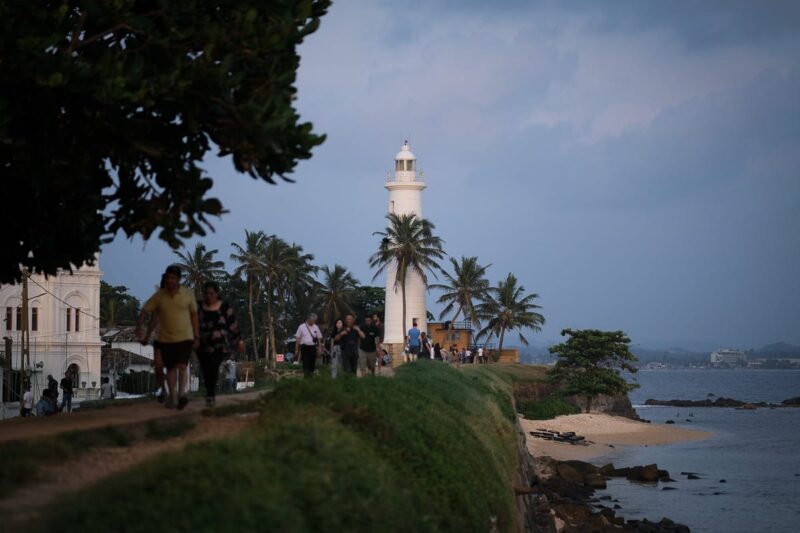
As you head Northwards in Sri Lanka from Kandy, out of the verdant central highlands towards the island’s heart, the dense forests give way to an area characterised by dusty orange roads and scrubland. However, despite appearances, this region is home to some of Sri Lanka’s greatest wonders: Ancient monuments, cities and temples that make up 5 of the nation’s 8 UNESCO World Heritage Sites in what is dubbed the Cultural Triangle.
These northern plains served as home to Sri Lanka’s oldest and greatest civilisations in the form of the sprawling ancient cities of Anuradhapura and Polonnaruwa, as well as the spectacular rock citadel of Sigiriya, known by locals as the 8th Wonder of the World. It’s these absorbing and fascinating historical remnants that make Sigiriya and the surrounding area an essential stop on any Sri Lanka itinerary.
Where to Stay Near Sigiriya
With the ease of travelling around the local area by public transport – either tuk-tuks or by bus – you can easily stay in any of the towns or villages surrounding Sigiriya, however, Dambulla, Habarana and Sigiriya itself are the most popular. Many people choose accommodation close to Lion Rock to allow them to visit easily upon opening in the morning.
For the budget-conscious, Jaana Guest is a wonderful little guesthouse in the centre of the village. While it may be a little basic, the family that run the guesthouse are incredibly welcoming and I highly recommend sitting down with them for dinner in an evening as Jaana is a chef at a nearby luxury hotel and creates wonderful meals while his wife cooks excellent Sri Lankan fare.
Jetwing Vil Uyana is possibly the best hotel in the area and one of the country’s most ambitious. The accommodation is made up of luxurious thatched villas surrounding man-made wetlands and forests that are perfect for wildlife-watching in serene surroundings.
On my second stay in the region, I spent the night at Jetwing Lake near Dambulla. This beautiful hotel set within the solitude of 18-acres of land beside Siyambalaweva lake is the perfect getaway.
Things to do Around Sigiriya
Named a UNESCO World Heritage Site in 1982, Sigiriya is one of Sri Lanka’s most memorable attractions and the reason that most people venture this way. However, the town of the same name is the perfect base for exploring the myriad temples, ancient cities, and national parks of the Cultural Triangle and central Sri Lanka.
Climb Lion Rock
Ask anyone in Sri Lanka about Sigiriya Rock and they will proudly declare it the ‘8th wonder of the world.’ It is easy to see why the Sinhalese hold such reverence for the hilltop fortress. The last resort of King Kasyapa, Sigiriya is possibly the most picturesque battlefield that the world has ever known and the crowning jewel in the country’s ‘cultural triangle’.
The story behind Lion Rock began in 477AD with the regicide of King Dhatusena. Dhatusena had two sons, Mogallana, born to his most important queen, and Kasyapa, born to a lesser consort. Upon hearing that Mogallana was heir to the throne, Kassapa rebelled. He drove Mogallana from the city and captured his father, demanding to know the whereabouts of the kingdom’s treasure. The king had just finished a stupendous reservoir – the great Kala Wewa tank – and declared its water to be all the treasure he needed. Furious with this answer, Kasyapa entombed his father – still alive – in a chamber and left him to die. Kasyapa fled down the old Anuradhapura road and chose Sigiriya as his last resort.


The rock itself probably remains much as it was when he arrived; a 200-metre tall tower of solidified magma, left behind as a volcano’s innards solidified and its outer crust eroded away. From afar it looked as if it had never been inhabited, its sides smooth and unassailable and its top covered in vegetation rather than ramparts.
It is thought that Kasyapa spent eighteen years preparing for his brother’s arrival. Ledges for sentries were carved all along the outer walls and a grand fortress was constructed atop the rock. In that time, he worked hard to redress his guilt, taking a vow of asceticism. At its base, he built public pools, moats, farms, hospitals and even poor houses. The ramparts spread for miles into the forest. It seems that Sigiriya could have survived an eternal siege.
The gardens and pools remain at the site – they are thought to be some of the world’s oldest landscaped gardens – and even today, they are meticulously kept. Passing the fairly underwhelming Sigiriya museum (entry included with ticket) the path towards the rock passes the outer moat and through the water gardens – an area of four pools – and into the boulder gardens. This area of the site was once the centre of monastic practices, with over 20 caves, some inscribed with etchings dating back as far as the 1st century BC.
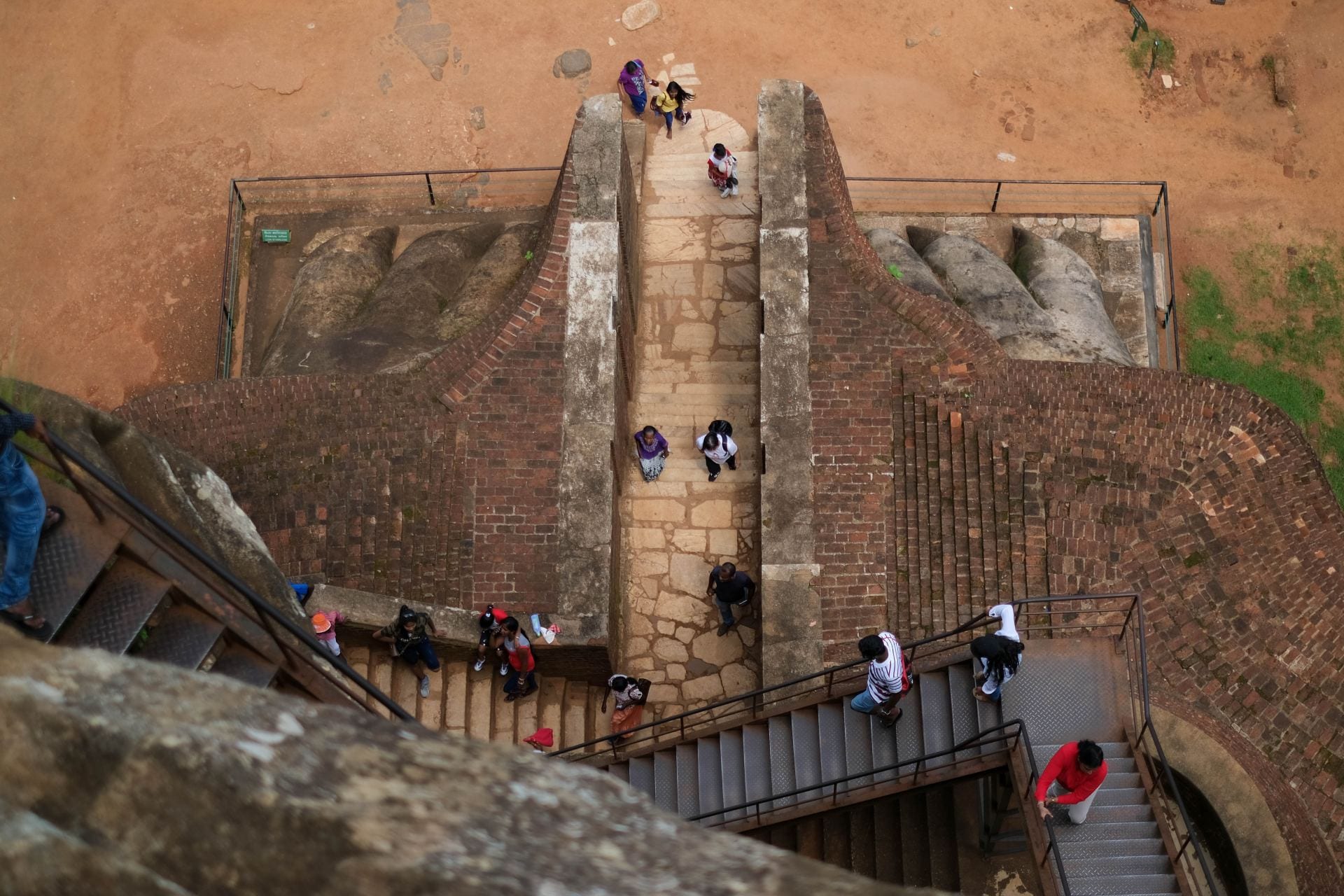
From here it’s a 1200 step climb to the top of Lion Rock. Luckily, the stairs are narrow – cut for tiny medieval feet – and quickly become clogged with tourists, giving you a few minutes respite between each ascent. Occasionally the steps give way to rusting ladders and gangways, bolted to the rocky side. About 25 metres up, you will find a cavern filled voluptuous women. There are about a dozen of them painted on the walls, life-sized and half-naked from the waist up. It is thought that these pictures once covered the whole outcrop, from top to bottom. One of the largest murals ever created, the colourful images were visible from miles around. Some say that these maidens depict members of Kasyapa’s hareem but with his vow of aposaka, it is more likely that they are celestial nymphs, painted to protect the fortress in the battle that was to come.
Higher up are Kasyapa’s more practical defences. During his reign, the king had built a giant lion sculpture – giving Lion Rock its name – with the stairs leading into its mouth. Only the 50-tonne brick paws are left, which visitors must funnel through to reach the top.
At the top are the ruins that remain of Kasyapa’s fortress. Not much is left but a few walls, Kasyapa’s throne and some bathing pools. However, the view is worth the climb: a lush, emerald carpet as far as the eye can see.
Entrance fee: 4200 Rupees (around $30)
Opening times: The site is open daily from 7 am until 6 pm (with last entrance at 5 pm). I would recommend climbing the rock either early morning or late evening to avoid the midday sun – Lion rock is completely exposed and the heat can be stifling. However, most visitors will do the same so Sigiriya can get very busy at these times.
Read More: Sri Lanka’s Cultural Triangle
Watch the Sunrise from Pidurangala
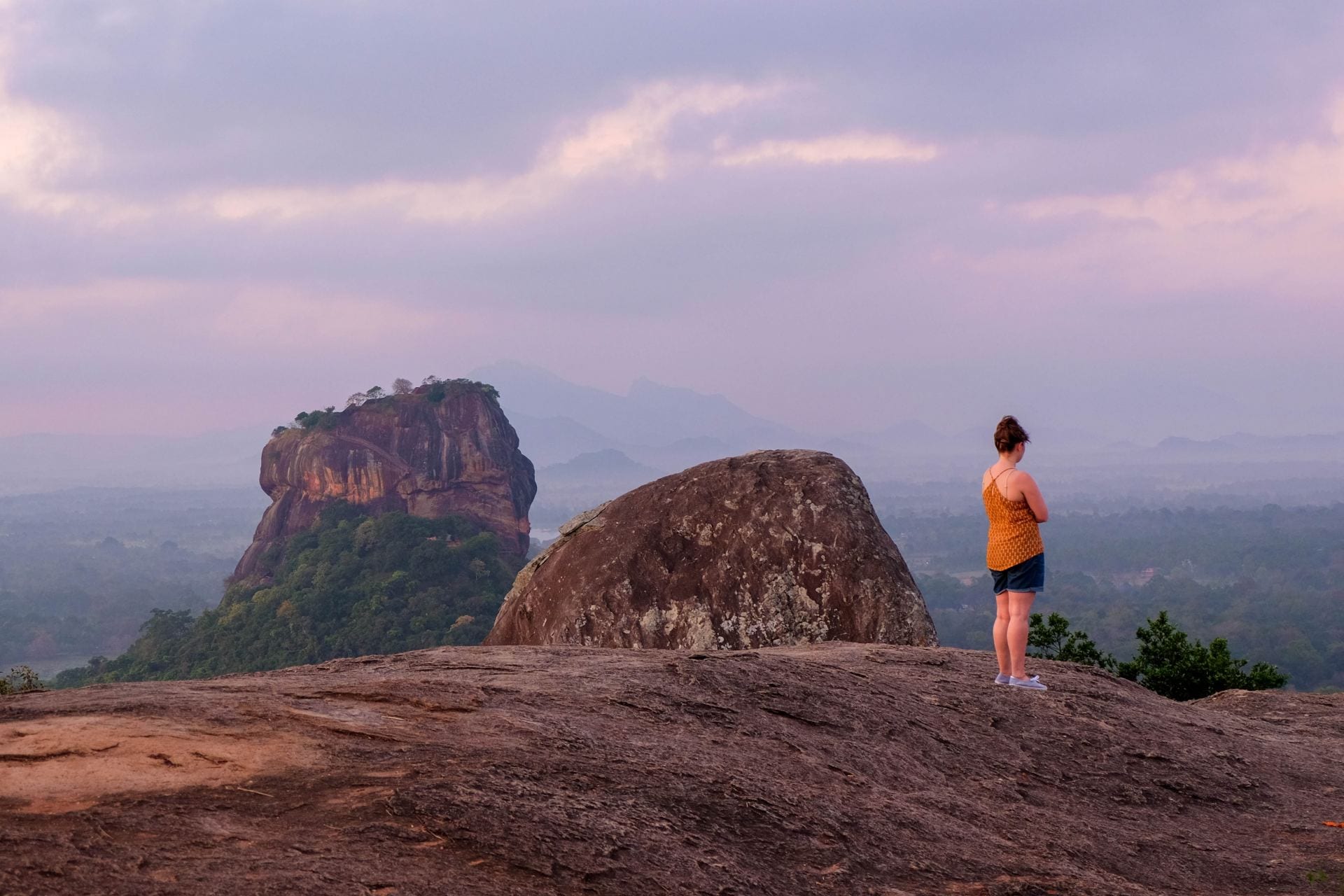
Another rocky outcrop emerging from the jungle just a few Km from Sigiriya is Pidurangala Royal Cave Temple. It is the remains of a hardened magma plug from an extinct volcano that has long since eroded, just leaving its solid centre behind. It is thought that the monastery here dates back to the reign of King Kassapa who displaced the monks of Sigirya to make space for his royal palace. As compensation, they were relocated to Pidurangala and provided with a temple that still sits at its base.

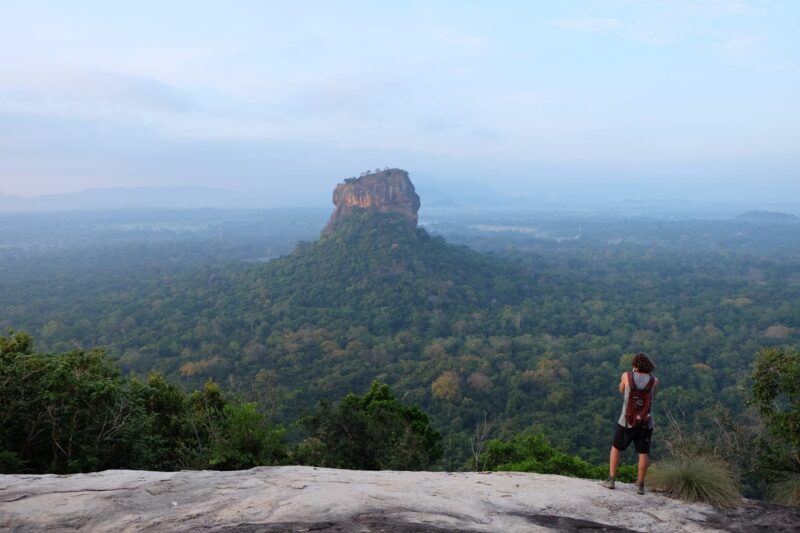
However, the main draw of Pidurangala is the view from its summit, particularly at sunrise, where the vista shows nearby Sigiriya in all its glory, a view that’s unparalleled unless you go to the expense of chartering a balloon. It only takes around 20 minutes of climbing to reach the top, although the last hundred metres resembles more of a scramble than a leisurely walk. The effort is worth it though: once you reach Pidurgala’s flat top and see Sigiriya rising hundreds of metres from the jungle, its smooth sides illuminated in the glow of the morning light.
Read More: Sunrise From Pidurangala Rock
Go on an Elephant Safari in Mineriya or Kaudulla National Parks
Minneriya National Park is just a 10-minute drive along the highway from Habarana, and 25 minutes from Sigiriya. One of a network of 22 national parks and nature reserves that are scattered throughout Sri Lanka (taking up a whopping 15% of its landmass), the park centres around the vast Minneriya tank, built by King Mahasena over 1,800 years ago. Although it was abandoned not long after it was constructed, it is one of the few places in the country that regularly survives the drought of the annual dry season. I suppose that’s why, despite its relatively small size, Minneriya is one of the best places in the country for wildlife spotting. Elephants, deer, langur monkeys and sloth bears can all be found here, making the most of the permanent water supply.

However, it is elephants that are the park’s main attraction. Minneriya forms part of the elephant corridor that joins both Kaudulla and Wasgomuwa national parks. During the summer months, when the tanks elsewhere dry up, one of the country’s most incredible natural wonders takes place. Up to 300 of the beasts, from as far away as Trincomalee, descend on the waters of Minneriya in an event dubbed ‘The Gathering’ – the largest meeting of Asian elephants anywhere in the world.

Kaudulla National Park, located 22km north of Habarana, connects with Minneriya as another vital point in the elephant corridor. Like Minneriya, it centres around a lake where elephants can be found in their hundreds. Depending on the time of year, or even the time of day, the number of elephants can vary in each of these two parks, so it is best to consult a safari operator before deciding which to visit. As a rule of thumb, August and September are the best time to visit Minneriya while Kaudulla is best up until December.
Most hotels in the region will be able to offer a Jeep Tour to either park, with prices starting at around Rs. 3500.
Take a Day Trip to Dambulla Cave Temple
Cut into an overhang 150 metres above the town of the same name, Dambulla Cave Temple contains 5 caliginous grottoes, filled to the brim with Buddhist paraphernalia and painted with intricate Sinhalese murals. They date back to the reign of Vattagamini Abhaya (89-77BC) who was driven from his capital, Anuradhapura, by Tamil invaders and forced into hiding for 14 years. He took refuge in these caves and when he finally reclaimed his throne, commemorated his hiding place by converting them into temples. Over the centuries that followed, various kings added embellishments such as statues and paintings to create the temples as we see them today.

At the foot of the site is a huge, gilded Buddha statue sat atop the appropriately named Golden Temple, its signage spelled out in 10-foot-high neon lettering. On the rocks all around are ceramic statues of orange-robed monks stood silently, their lifeless eyes locked intently on the golden Buddha. Even more bizarrely, the entrance to the Buddhist museum housed within sits inside the mouth of an enormous cat-like creature.
It is 364 steps up to the temple itself with the entrance to the caves, numbered 1 – 5, all accessible from a central courtyard. I have read that it is best to visit them in descending order, starting at cave 5 and working your way back to cave 1 in order to see them in increasing degrees of splendour.

The first two caves are relatively small, with a reclining, 10m brick long Buddha filling cave 5 with paintings of Vishnu and Kataragama flanking it on both sides. Cave 3 is much more interesting – over 50 carvings of Buddha line the walls and the murals on the 10m high sloping ceiling give the impression of a vast, fabric canopy. The pièce de résistance has to be Cave 2, the Maharaja Vihara, or ‘Temple of the Great Kings’. Restored in the 18th century by a Kandyan king, it is an enormous chamber 50m long and 7m high. Opulent frescoes fill the ceiling, depicting scenes from Buddha’s life such as the Defeat of Mara and the Isipatana. The floor space is filled with carvings of Buddha, both wooden and stone. fragrant incense fills the air alongside the smell of fresh lotus flowers that have been laid at the feet of the sculptures.
The ease and cost of reaching this UNESCO World Heritage Site make it well worth the detour from Sigiriya or a short stop on the road from Kandy. Not only is it a significant part of Sri Lanka’s history, but it is also a chance to see some of the most unique and beautiful temples that the island has to offer.
Getting there: The temple complex is approximately 2km south of Dambulla. Buses leave regularly from Colombo, Kandy, and Sigiriya for Dambulla, stopping at the bus station 1km from the southern end of town. From there it will cost you Rs. 100 – 150 for a tuk-tuk to the temples.
Opening times and entry fee: The Site is open daily from 7.30am until 7pm. Entry costs Rs. 1500 and tickets can be purchased from the booth at the back of the Rangiri Dambulla Development centre. It’s worth noting that the ticket office is closed for a short lunch break around midday.
Read More: Dambulla Cave Temple
Visit the Ancient Ruins at Polonnaruwa
The great ruins of Polonnaruwa are not only one of the highlights of Sri Lanka’s Cultural Triangle, but also one of the best sights on the entire island. First established by King Vijayabahu and later completed in a grand statement of imperial pomp by Parakrama the Great, Polonnaruwa represented the apex of Sri Lankan civilisation in the 12th century; a city of 3 million people encircled by 80km of fortified walls.
On a map, the well-worn ruins probably don’t look like much; brown disks and matrices of columns scattered at random among the bush. From the ground, it is a different matter altogether. Ornate carvings of gods and warriors adorn every surface and vast domed dagobas rise from the jungle as if alien structures. Just to get between each area of the city is a 10-minute cycle.

With a scale so unimaginable, I found the city hard to piece together. The site is 4km from north to south and it is impossible to see it all by foot in a single day. Even renting bikes and pedalling, I struggled. I cycled for hours but still only uncovered a fraction of its treasures.
Time was something that Polonnaruwa also lacked. Despite being one of the most impressive of the reservoir cities, it was also one of the shortest-lived. The carving of the huge buddhas bankrupted the city. Upon Parakrama’s death, there were cycles of invasion, regicide and chaos. The people that weren’t driven away by anarchy, left because of the mosquitoes. Over 1,600 tanks were left derelict and Malaria brought the kingdom to its knees. Just 223 years after it was established, the people abandoned Polonnaruwa.
Entrance fee: $25
Opening Times: The site is open daily from 7.30 am to 6 pm. I would recommend arriving early or late to avoid the midday sun as there is not much shade available among the ruins and you can quickly become overheated. I spent around 3 – 4 hours at Polonnaruwa but even this did not seem like enough time to see everything. Try to allow most of a day for your visit. It’s worth hiring a bicycle to traverse the ancient city as it is far too vast to walk. Vendors outside the main gate will rent them to you for just a few rupees.
Where to Eat and Drink in Sigiriya
Due to its small size, decent restaurants in Sigiriya can be few and far between. Most large or mid-sized hotels and even smaller guest houses provide good meals so you won’t have to wander far in search of food. If you do feel like escaping the confines of your accommodation, Ahinsa Restaurant in Sigiriya is one of the better cafes, serving up delicious Sri Lankan food.
Getting In & Out
Most visitors to this region head straight from Kandy along the main road north to Dambulla and onto Sigiriya. The bus from Kandy takes around 2 hours and leaves every 20 minutes while from Colombo, the regular buses also leave every 20 minutes and the journey takes 4 hours. The onward bus to SIgiriya can be caught from the main road near the Cave Temples and takes around 30 minutes.
Staying in Dambulla, Sigiriya or Habarana, most of the major cultural sites are very easy to reach by public transport. There are regular buses connecting Kandy, Dambulla, Sigiriya, Anuradhapura and Polonnaruwa but it is best to ask your hotel or guest house for the latest timetables.
I visited Sigiriya as a guest of Sri Lanka Tourism, however, all views are my own.