Loïc is sat with a half-empty bottle of white wine on the table in front of him. He’s holding an overly full glass of the same wine to his ear, leaning his earlobe directly on the rim of the glass while daintily holding its stem between his thumb and forefinger.
“The main point of wine tasting is consistent listening to the wine. The wine will sing a special melody. After drinking or tasting many different wines, you may even begin to hear words.”
It’s at this point that I realise he may be a little tipsy. Dressed in a checked shirt and V-neck jumper with a worn suit jacket and round, turtle-shell glasses resting on the end of his nose, Loïc has the look of an academic, or possibly an eccentric geography teacher. It’s a fitting outfit choice, because he is, after all, a wine scholar; as well as writing for his own wine-related website, he produces articles for some of France’s top publications. Throughout the day, with each sip of wine, he pulls out a pen and his slightly battered notebook. Each page is filled with line upon line of wine descriptions that he constantly adds to, scribbling furiously in slanting, rushed script each time he swills a gulp of red around his mouth.


According to him, the most wine he has ever tasted in one day is 800 different varieties, one after the other in a vertical tasting while making notes on each. When asked how it is possible, he assures me that “we don’t drink the wine, we spit it out. Obviously a little might slip down the throat, and you do end up rather drunk by the end”.
We had met Loïc at the port of Le Verdon for the start of our Princess Cruises shore excursion around Bordeaux, where we hopped on board our bus and began our journey through the rolling green fields of vines. This port is the gateway to what is arguably the finest wine-producing region in the world, as well as the ‘Port of the Moon’; The UNESCO World Heritage-listed city of Bordeaux itself.
Bordeaux is considered by many as the gold standard of wine-making. The Bordelais take their wine very seriously, and Loïc is a prime example of this. As we meander towards our first stop, Chateau Branaire-Ducru, he waxes lyrical about the regions wine-making prowess. Bordeaux’s vast expanse of vineyards covers an incredible 120,000 hectares on both sides of the River Garonne, producing up to 5.7 million hectolitres of wine each year using a blend of several grape varieties. There is some debate among connoisseurs over which side produces the best grapes – Rive Gauche (Left Bank) and Rive Droite (Right Bank) – but for a layman like me, I’m sure that it is all spectacular.
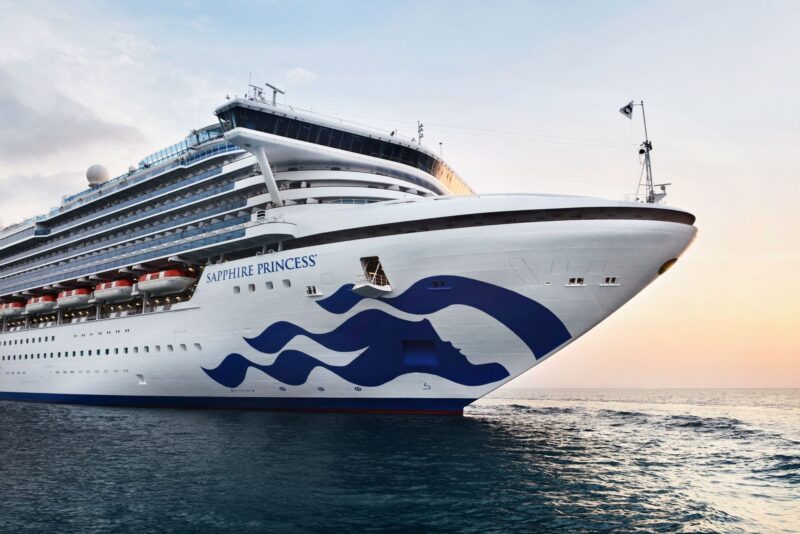
I visited Bordeaux as part of a 7-day cruise with Princess Cruises, leaving from Southampton and stopping off at La Coruña, Bilbao, Bordeaux and Guernsey. Click here to find similar cruises.
These 120,000 hectares are then split into 65 appellations (production areas whose soil and microclimate are distinct to that area, giving the wine produced there a unique quality). For our visit, we’re specifically heading to Medoc, an area made up of 8 appellations on the Left Bank of the Garonne and Gironde Estuary, immediately northwest of Bordeaux city. It’s an exclusively red-wine producing zone and is thought to produce some of the best wine in Bordeaux.

Chateau Branaire-Ducru
Chateau Branaire-Ducru, a manor house and sprawling estate on the southern border of the Saint-Julien & Haut-Medoc appellations with green vineyards that cover over 50 hectares, is spectacular. I’m not much of a wine expert myself, but I enjoy a tipple, and the extravagant setting alone was worth the visit. Many of Bordeaux’s chateaux have an unmatched grandeur. Built with pale limestone, flanked by well-manicured gardens and surrounded by rows of green vines, it’s impossible not to feel elegant while wandering the grounds and soaking in the history of these buildings. Almost all the estates welcome visitors, and there are dozens to choose from, but luckily we had Loïc to show us the best of them, and a driver to ferry our tipsy selves between them.
The grand vin Château Branaire (often referred to as Château Branaire Ducru) is as elegant as it comes. We spend some time exploring the vines and taking a look at the different varieties of grape that are grown in the region. As I am far from being a wine expert, I will let Loic’s words explain:


“Blending is a significant aspect of Bordeaux winemaking. The wine is always blended. We have to use at least two varieties of grape. The reason is due to the fact that historically speaking, the vines are a Mediterranean plant but here along the Atlantic ocean, they’re growing in a different climate. It’s too rainy here, meaning the plants can be subjected to diseases and fungus that will be disastrous to the crop. It’s better to split the risk between different varieties of grape.”
“Firstly, there is the Cabernet Sauvignon, which is the fundamental grape variety in this area. In opposition to that, to split the risk, we have the Merlot. While the Cabernet is Acidic and tart, the merlot is much more sensual with lots of tenderness, meaning they balance each other perfectly. In between, there is a 3rd variety, the Cabernet Franc. Between the sensuality and the blackberry fruitiness of the Merlot and the trite, vertical – almost minty – aromas of the Cabernet Sauvignon, is a space that needs to be filled in terms of the aromatic landscape in the glass. This is filled by the Cabernet Franc, which is almost floral with delicate aromas. In new world wines, you will see that wine is sold by grape variety, whereas here, we describe each one by the region in which it is grown.”

The average age of the vines at Château Branaire is 35 years old. To keep the average this low, each year, one or two hectares are replaced with new vines, the younger vines are then used to produce the winery’s second label wine. Château Branaire averages about 15,000 cases per year and the estate also produces about 7,000 cases of its second wine, Duluc de Branaire-Ducru. We had the chance to sample both wines as well as take a tour of the wine cellar where around 1/3 of the production undergoes malolactic fermentation in new oak barrels.


I sample both while taking Loic’s tasting notes into account, trying to taste that blackberry fruitiness of the Merlot or looking for its sensuality, as he describes it. To me, they are just two glasses of very delicious wine.
Although I was certainly impressed by Château Branaire, our next stop is even more extravagant. Château Rousseau de Sipian, with its imposing, turreted mansion, overlooks the Gironde estuary and occupies a centuries-old park surrounded 10-hectares of vines. The Renaissance-style chateau was built in 1850 by the Rousseau family, when Guillaume Rousseau, owner of Domaine Frêche, and Marie Bert, owner of the Domaine de Sipian, married and combined their wine-producing capabilities. At the time, production was around 100 to 150 barrels per annum but now the chateau produces around 15,000 bottles per year.

Château Rousseau de Sipian
Loic takes us through another tasting session, but by now I’m already feeling a little tipsy from our 10am tasting earlier in the day, so I spend my time wandering the Chateau grounds, wine in hand, feeling more sophisticated than I have ever felt in my life. Although the wine-tasting and cellar tour, led by Loïc, was fantastic, the main reason for our visit to the Chateau is to enjoy an incredible 4-course meal in Rousseau de Sipian’s elaborate Renaissance-style dining room. Tall ceilings, frescos on the walls and creaking antique furniture make me feel like I’m dining in a scene from Beauty and the Beast. One by one, courses are brought other to us; smoked salmon with whipped creme fraiche, chicken with herb-crusted tomatoes and potato gratin, followed by a cheese course and a dessert of apple pie and creme anglais.

Loic takes us through another tasting session, but by now I’m already feeling a little tipsy from our 10am tasting earlier in the day, so I spend my time wandering the Chateau grounds, wine in hand, feeling more sophisticated than I have ever felt in my life. Although the wine-tasting and cellar tour, led by Loïc, was fantastic, the main reason for our visit to the Chateau is to enjoy an incredible 4-course meal in Rousseau de Sipian’s elaborate Renaissance-style dining room. Tall ceilings, frescos on the walls and creaking antique furniture make me feel like I’m dining in a scene from Beauty and the Beast. One by one, courses are brought other to us; smoked salmon with whipped creme fraiche, chicken with herb-crusted tomatoes and potato gratin, followed by a cheese course and a dessert of apple pie and creme anglais.
If this doesn’t already seem like a lot to handle, each course is served with a wine pairing, taking our day’s wine count up to 6, although it may be higher thanks to the occasional top-up, not that anyone is counting by this point. That is how I find Loic, half-empty bottle beside him, with an ear to his glass while he both speaks and listens to his drink.

“I have the benefit of having large tears, which is quite adequate because, as a professional wine taster, we never taste with the palate. We only taste with the tears.”
The French accent does lend itself to sounding authoritative when it comes to philosophical musings, but at this point, I’m almost certain that this is the wine talking, rather than something deeper. Stumbling out of the chateau, we board our bus and head back to the cruise ship with me thinking that, when we’re in the ship’s bar that evening, I’ll make sure to listen to my drink and see if it will sing me a melody.