“The thing I’m most excited about on this cruise is the day in Guernsey.” I could see the excitement in Steve’s face at the sheer mention of the island. His eyes widened and he began excitedly pushed his pastry around his plate. We were sat on the lido deck of Sapphire Princess, enjoying our morning coffee on our first sea day. As seems to be the way on cruise ships, you make new friends quickly and with ease. Steve had spotted me and my camera and decided to take a seat next to me to first question me about my camera equipment, but soon moved on to telling me almost everything about himself. Within 10 minutes, I knew his entire life story, every cruise he had taken in the last 5 years, and his emphatic love of Guernsey. Apparently, it was the entire reason behind him picking this particular cruise. Guernsey was the final port of call on my 7-night cruise around Spain and France with Princess Cruises and, as someone that hadn’t visited the Channel Islands before, I was intrigued.

After spending the day in Guernsey, I definitely see what all the fuss is about. It was easily one of my favourite stops on our cruise. It’s a fairly unique place. Although not part of the UK, Guernsey is a British Crown Dependency with its own government and an associate relationship with the British Commonwealth and the EU. It has a definite British feel, yet it’s different enough to give you the feeling of being abroad.
Known for its beautiful beaches, excellent seafood, rolling countryside, and the hilly, cobbled capital of St Peter Port, Guernsey punches well above its weight in culture, history and attractions.
I visited Guernsey as part of a 7-day cruise with Princess Cruises, leaving from Southampton and stopping off at La Coruña, Bilbao, Bordeaux and Guernsey. Click here button to find similar cruises.
Princess Cruises Shore Excursions
Princess cruises had some pretty great shore excursions available, including a scenic drive around the island that took in Guernsey’s highlights, from the rocky cliffs of the West Coast through the island’s centre, passing scenic villages, farmhouses and narrow country lanes. The tour is also available by bike. As well as this, there was a tour that visits the Occupation Museum, which tells the story of the island’s ordeal from June 1940 to May 1945, followed by a tour of the Underground Hospital and Munitions Store, a German bunker complex on the island’s coast.
If you have visited Guernsey before, there is a 5-hour tour of Herm, the Channel Islands smallest Island at just 1 square mile, that takes in Manor Village, the Herm School and St. Tugual’s Chapel, as well as a tour that visits Sark Island. Sark was one of the last feudal states in Europe ruled by a democratically elected Seigneur.
As a first time visitor to the Channel Islands, I decided to go it alone and see how much of the Island I could see in the time we had. After all, the ship arrived in Guernsey at 7am (offshore – we took a small boat from Sapphire Princess to St Peter’s port) and wasn’t set to leave until 6pm, meaning that even if we didn’t head to shore until 8.30 am and leave at 5 pm as we planned, we would have a good 8 hours onshore which is plenty of time to see what Guernsey has to offer.

Getting Around Guernsey
Guernsey’s bus network is fairly extensive and covers all the island’s parishes and major sights. The Guernsey sightseeing route (numbers 91, 92, 93), goes all the way around the island, allowing you to stop at all of the major attractions. The flat fare for any journey is £2 for any distance on all routes, however, you can also get a day pass for £4.50.
The Best Things to do on a Guernsey Day Trip
Explore St. Peter Port
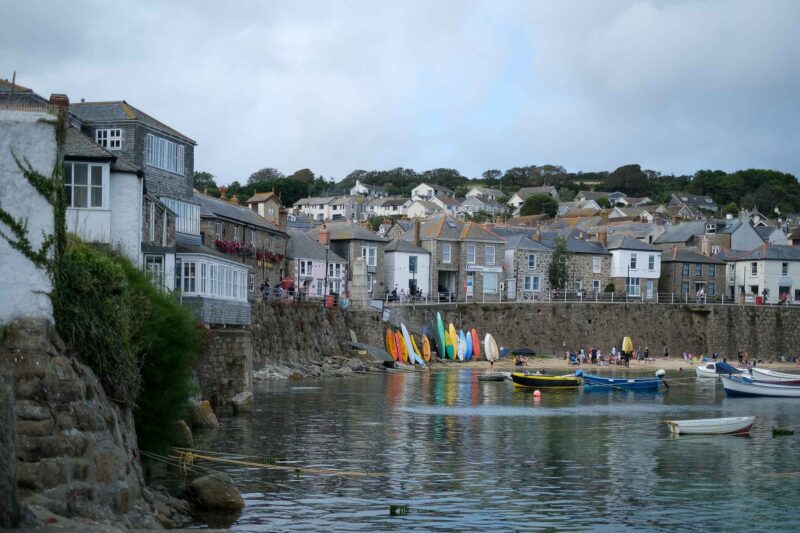
Hoping off our tender, we arrived smack-bang in the middle of St Peter Port. With its bunting-strewn, winding cobbled streets and Regency architecture, it is an incredibly charming town, one that is reminiscent of some of Cornwall’s finest. Although a fair amount of time can be spent just wandering the streets, shopping at cute boutiques or sampling some of the town’s fantastic restaurants, it also includes two of the island’s top attractions; Castle Cornet, an 800-year-old fortress that guards the picturesque harbour, and Hauteville House, eccentrically designed by Victor Hugo. If you don’t want to venture too far afield, St Peter Port has enough on offer to occupy you for a full day.

Visit Castle Cornet
Each day at noon, cannon fire rings out across Guernsey harbour as scarlet-clad gunners let off the noon-day gun from the impenetrable walls of Castle Cornet. Just a short walk from the centre of St. Peter Port, the castle has been guarding the island for 800 years and now hosts 5 museums; The Story of Castle Cornet, 201 Squadron (RAF) Museum, Maritime Museum, Royal Guernsey Light Infantry Museum and Royal Guernsey Militia Museum as well as 4 historic gardens.
A guided tour begins at 10.30 am every morning and the Noonday gun is fired daily by soldiers in 19th-century costume. During summer, the Guernsey History in Action Company re-enacts stories from Guernsey’s past and the Regency Dancers can sometimes be found performing in the Hatton Gallery.
Entry costs £10.50
Relax in Candie Gardens
Once part of a private estate, Candie Gardens was established in 1894 and offers one of the best views on the island, giving a panoramic vista over the rooftops and chimney stacks of St. Peter Port to the harbour, where you will see the docked cruise ships, all the way across to neighbouring islands. Not only does the lower garden have one of the best examples of a Victorian flower garden in the British Isles, it is also home to the oldest known heated glass-houses, which date back to the late eighteenth century and hosts the annual Nerine Festival each October.

Hauteville House
During his exile from France between 1851-1870, Victor Hugo lived at 38 Rue Hauteville, overlooking St Peter Port. Many of Hugo’s masterpieces were written here; Les Misérables, Toilers of the Sea, The Man Who Laughs, and The Legend of the Ages ad even the house itself is a masterpiece in its layout and decor, designed by Victor Hugo himself, decorated with layer upon layer of tapestries, silks and mirrors, fusing the Gothic, Renaissance and Baroque. The property recently underwent major renovation and re-opened to the public in April 2019. It has been faithfully restored to the days of Victor Hugo, both inside and out, meaning that visitors can still enjoy what was described by Charles Hugo, the poet’s son, as “a veritable three-storey autograph, a poem in several rooms”.
Open daily (except Wednesdays) from April 7 – September 30 from 10 am to 4 pm. Entry costs £10


Beach Hop along the West Coast
The thing that surprised me most about Guernsey is just how beautiful the island’s beaches are. There are 27 very different bays to choose from; some with long stretches of sand, others with hidden coves where you can have the entire place to yourself and some, in the case of the south coast, lined with stunning cliffs. I took the number 92 bus east from St Peter’s port to Pembroke Beach where the stunning stretch of sand is surrounded by fortifications and loophole towers dating back to the Anglo-French war of 1778. The bus takes visitors all the way along the west coast, meaning you can hop off at whichever beach takes your fancy. Petit Bot Bay and Rocquaine Bay are both popular swimming spots, but I found that Vazon Bay was a must-visit. If the weather takes a turn and it isn’t sunny enough for a swim, you can pop into Fort Grey, the Shipwreck Museum.

The Little Chapel
Decorated all over with a rainbow of seashells, pebbles and broken china, The Little Chapel is one of Guernsey’s most-loved tourist attractions and a stop-off on pretty much every shore excursion tour of the Island. Nestled in a picturesque valley in the parish of St Andrew and standing at just 16ft by 9ft this tiny chapel, a replica of the basilica and grotto of Our Lady of Lourdes in Massabielle, is thought to be the smallest consecrated chapel in the world.

The chapel was a labour of love for Brother Déodat, who came to Guernsey in 1904 when France installed new anti-religious laws. The first chapel he built was just 9 feet long and 4.5 feet wide, however, it received so much criticism that Déodat demolished it overnight and began work on a new one. The 2nd incarnation of the chapel took Déodat 4 months to build, but this one only lasted 9 years and was demolished after the Bishop of Portsmouth was unable to fit through the door during his visit to the island in 1923. The final grotto was built with a larger opening.
There is no charge to enter the Chapel as it relies entirely on public donations


Hop on a Ferry to Sark or Herm
The neighbouring Islands of Sark and Herm can be easily reached from Guernsey by ferry and make the perfect day trip. If you’re worried about making your ferry crossing in time for sail away, Princess Cruises offer guided excursions to both islands.
Sark is the smallest of the four main Channel Island at just three miles long and a mile and a half wide. It has a population of 550 and no cars. In fact, the island’s only motorized vehicle is a tractor-drawn ambulance. However, that isn’t the most interesting thing about Sark; It was actually the last feudal state in Europe. Until recently, the island was governed by a Seigneur, appointed by the British monarch, and its legislators were landowners who had inherited the right to govern. It wasn’t until August of 2006 that Sark’s residents were permitted to stand for election and Europe’s youngest democracy was born.
If Guernsey is a little to metropolitan for you, then Herm is the perfect place to get away from the world. Located 3 miles from St Peter Port, Herm is too small for independence, it is owned by Guernsey and has been operated, under a lease, by the same family for three generations. Apparently, the Island’s only hotel has no televisions, clocks, and certainly no wifi.
Get immersed in WWII History
Guernsey was the only area of the British Isles to fall under German rule in the Second World War. Standing on a desolate, windy peninsula, the five-storey Pleinmont Tower on the southwest corner of Guernsey is a good place to begin your exploration of the 1940-45 German occupation. It was from here that German observers controlled the island’s coastal artillery, with a system of communication instructing gunners where to direct their fire at incoming British aircraft. For a little more information, The Occupation Museum depicts what life in Guernsey was like during five years of German Occupation. Elsewhere, the La Vallette Military Museum is housed in underground tunnels built by the Germans using forced labour during the war.

Things to know before visiting Guernsey
UK currency can be used on Guernsey, but most ATMs will dispense Guernsey’s own notes. These aren’t accepted in the UK, so make sure to spend them or exchange them before you return to the cruise ship as they are not accepted in the UK.
There is no reciprocal health agreement between Guernsey and the British Government, so UK residents will be charged for medical treatment on the island. Make sure that you have travel insurance before heading to Guernsey. World Nomads offer travel insurance, you can click here to get a quote.
This post has been created as part of a sponsored collaboration with Princess Cruises, however, all views expressed are my own.