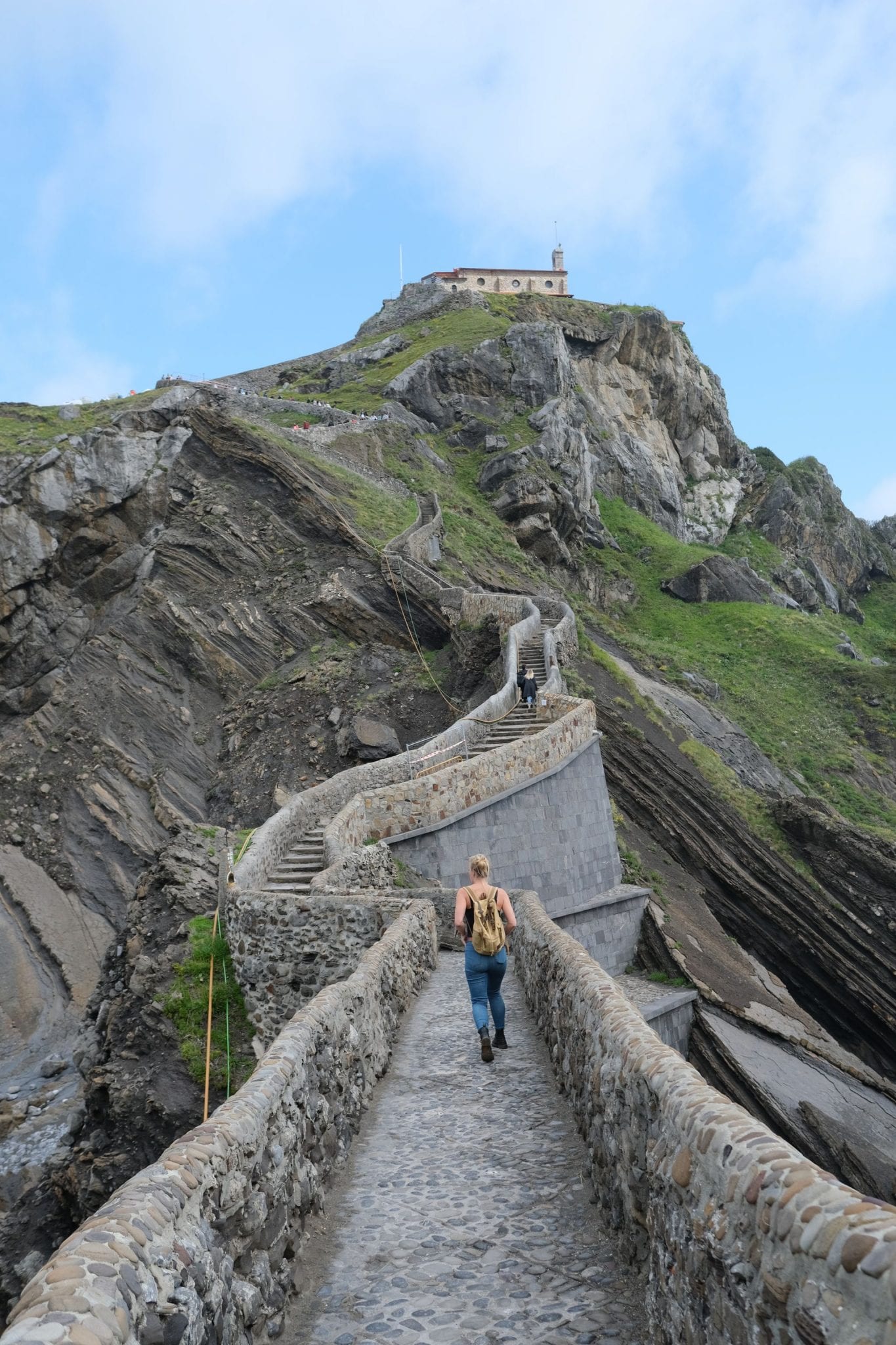
Like all good pilgrimage sites worth their salt, Gaztelugatxe takes a little bit of effort to reach. There are 241 steps up a winding, man-made stone causeway from the Basque mainland to the rugged, wind-beaten islet. 241 steep steps to reach the hermitage at the top, with the notoriously brutal swells of the Bay of Biscay crashing against both sides of the crooked walkway.
Through the centuries, it’s this continuous battle between the land and sea that have formed the island, carving out a large cave and magnificent natural arch. Looking at the path now, I can only imagine the plight of pilgrims, having walked hundreds of miles to reach the hermitage that sits atop the rock, edging their way across in inclement weather and riotous storms.

Recently, fans of prestige fantasy TV drama have been making another sort of pilgrimage to the site. Game of Throne’s devotees will already know Gaztelugatxe. The winding staircase was transformed by the show into Dragonstone, the ancestral home of the Mother of Dragons, Daenerys Targaryen. It’s thought that around 75,000 tourists are now heading here each month. While there isn’t data on how many people visited previously, there has been a noticeable spike due to the Game of Thrones effect and people flocking to see the spot where Daenerys returns to Westeros with her 3 mighty dragons flying overhead.

I didn’t arrive at Gaztelugatxe on the back of a dragon, but like Daenerys Targaryen, I did arrive by sea, docking at Bilbao as part of my Princess Cruises trip to Spain and France. However, rather than landing on the beaches surrounding the Hermitage, we were met at the port by a friendly guide and travelled the 50 minutes to castle rock by bus as part of a Princess Cruise shore excursion.
From afar, or the viewpoint situated beside the carpark, San Juan de Gaztelugatxe is impressive. However, it isn’t until you head down the steep hill – a 15-20 minute walk – to the start of the bridge that you really see how impressive the church on the rock really is. In Game of Thrones, the hermitage has been eschewed for an enormous, magnificent CGI fortress, but the church is beautiful in its own right. I arrive at the rock’s peak somewhat sweaty, legs aching, and follow the ritual that so many pilgrims have taken part in before me; grasping the short rope that hangs from the church’s bell tower, I pull on it 3 times, letting the sound of bells ring out and dissipate across this small part of the Atlantic coast and make my wish.
Even if the climb to the top hadn’t done it’s best to take my breath away, the view from the top of the rugged coast, the relentless sea pounding against the rocks and the flocks of seabirds flying overhead succeeds in doing so.

Religious rites and legends at Gaztelugatxe – like the bell ringing and the journeys people undertake to reach the rock – are intrinsically tied to the sea. The hermitage is full of devotional offerings: model boats, paintings and photographs. They are made by sailors and fishermen to the saint as a sign of thanks for protecting their boats from the dangers of the Bay of Biscay.
When the tuna season begins, fishermen come to Gaztelugatxe to ask the saint for good weather, good health and good fishing. The people of Bermeo bring their boats into these waters to meet their ‘obligations’ to Gaztelugatxe: 3 turns to the port side and 3 to starboard in a spot where it is thought that an image of the Virgin Mary lies below the waves. In some cases, they toss St John’s wort from the deck after burning it in a pan. Even the most up-to-date 21st-century tuna fishermen, despite being fitted with the most innovative technology still come to Gaztelugatxe to perform the rite before heading to the tropics in search of fish.

Although there are 241 steps from the shore to the church, legend has it that the saint only needed 3 steps to reach the hermitage from the nearby town of Bermeo. It takes us a little longer to reach Bermeo, heading there on our coach, it’s around 20 minutes away. We’re met with a perfect little Spanish fishing town. Mismatched, multicoloured houses ring the harbour, and along the harbour mouth, at the front of the small peninsula – a part of town where higgledy-piggledy fisherman’s houses are separated by a labyrinth of stairs and alleyways – people lounge outside cafes and pretty little tapas bars, reading their newspapers over a morning coffee or eating some of the regions famous seafood.

The buildings of Bermeo are brightly coloured for a reason. Some centuries ago, Bermeo was a vibrant centre for the whaling industry and fisherman would use paint leftover from coating their boats to decorate their houses and protect them from the brisk coastal weather. However, the story goes that the houses are painted different colours so that the fisherman, returning from sea drunk and stumbling to shore, are able to see which house is theirs, even in their inebriated state.
Maybe this tale is true, or maybe it is just another fallacy in a part of Spain that is seemingly brimming with mythological tales. Although it may not be as exciting as stories of dragons, knights and Targaryans, it is still a fun legend to believe.
Getting to Gaztelugatxe
By Bus
Buses depart from Bakio regularly between 9.30 am and 7.30 pm or from Bermeo between 10 am to 8 pm.
By Car
It’s 45 minutes’ drive from Bilbao. Take road BI-631 to Bilbao Airport (Loiu). Past Mungia, drive onto the BI-2101 in the direction of Bakio. When you reach Bakio, follow the signs to San Juan de Gaztelugatxe.
It takes about an hour to get to San Juan de Gaztelugatxe and back, on a 3km hike. It is no longer possible to reach the bridge by car so you have to park at one of the 3 car parks by the old road and walk down to the start of the footbridge. There are two ways of reaching San Juan de Gaztelugatxe on foot. The first route is shorter but sharper, starting at the Eneperi restaurant and going downhill along asphalt and dirt paths. The second, longer, route, is paved from beginning to end and includes a viewpoint from which to soak in the whole landscape.
I visited Gaztelugatxe as part of a 7-day Princess Cruises cruise aboard the Sapphire Princess around Spain and France. Staterooms start at £849.99. For more cruise deals click here.
This post has been created as part of a sponsored collaboration with Princess Cruises, however, all views expressed are my own.