
The tingling sensation hits me before the smell even reaches my nose; a focussed tickle of the olfactory receptors that causes my entire nostril to spasm. Within seconds I’m sneezing uncontrollably.
These men sit in tiny, dimly lit, tiled alcoves. All manner of spices and ruby red chillies are laid out in front of them, spilling from the top of open hessian sacks. Some of them bark orders to the labourers that move bags of leaves and spices from stall to stall, heaving them up onto enormous weighing scales. Others huddle in groups, gossiping and playing cards in clouds of cigarette smoke, crumpled roll-ups clenched between their teeth. Some are fast asleep.

Khari Baoli is home to Asia’s largest spice market and the Gadodia Market building is the epicentre. Most spice porters of Khari Baoli are former farmers; agriculturists that migrated to Old Delhi once farming work had dried up, following the long line of family members that have done the same. The market is where many porters not only work, but live. They come from as far as Jammu and Kashmir, Madhya Pradesh and Rajasthan, descending on the market to eke out a living by hauling sacks of herbs, seeds and spices on their back, to and from the building.
With each discarded sack, a plume of spice and dirt enters the atmosphere, kicked up into the air and drawn into your nose. Beyond the stinging, the aroma is hard to place. A mix of smells so disparate that they end up dulling each other, leaving the narrow corridors of Gadodia with a musty but heady odour. A smell that is distinctly Indian.

The back of the market opens into a network of uncovered alleyways snaking between apartment buildings and I push my way through. Yet more tiled alcoves filled with more bored men. Some relax; laid out, hands behind their heads and eyes closed using wooden carts as makeshift beds. Others load up those beds with dozens of heavy sacks and go from store to store.

Passing out of the market through Gadodia’s wrought-iron archway, Chandni Chowk hits you like a brick wall. I watch as the porters unload trucks full of leaves and powders to the dismay of the motorists stuck behind them.
I’m once again in the dusty, dry, heat of daylight. The spice smell blends with diesel smoke, perfume and mountains of cow dung. Then you notice the noise: The sound of 19 million people, working, living, and excessively honking their horns. unfamiliar music ripples above the traffic to provide the soundtrack with shouts and sales pitches acting as the vocals. Like the smell of the market, its sounds are so cacophonous that they blur in your head, merging into a constant, deafening hum that you eventually becomes white noise.

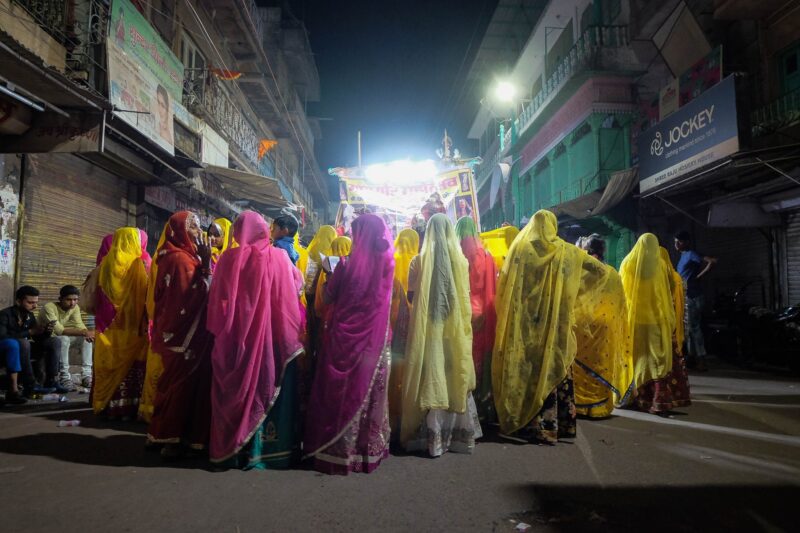
For those that aren’t careful, Old Delhi will swallow them whole. The air is suffocating. There are people everywhere. The narrow streets feel claustrophobic and overflow with workers, stray animals and stray children. Mopeds weave by, while rickshaws push through the chaos, their passengers sunk back in resignation at the impenetrable mass of humanity. Among them are the Tourists that whizz by, their faces full of wide-eyed delight or frightful dismay.
Despite this, it’s beguiling. It’s like stepping into an Aladdin’s cave; The colourful spices, the orange marigolds scattered across the pavement as a woman threads them into fragrant necklaces, the bangle shops sparkling and shining in every colour imaginable. Every single one of them makes you stop and stare. To be lost here is to be lost in another world, another culture, a city that is unlike any other.


It’s easy to imagine that the whole area is put up for show; a more elaborate, disorderly, and tumultuous Synecdoche, New York. How can it be that this maelstrom functions as a city? Somehow it manages.

Chandni Chowk cuts through the centre of Old Delhi, from the magnificent Red Fort in the east to Jama Masjid. It can be a long stretch to handle in one sitting, but the most intrepid and persistent of travellers will make it south to Dariba Kalan, Old Delhi’s ancient silver jewellery alley, or Paranthewali Gali, where hawkers have been selling paratha, an Indian flatbread, since the 1870s.
Chandi Chowk itself has existed since 1653. The street is built up of layers and layers of history, and traversing it is like peeling an onion. Behind the dishevelled 20th-century apartment blocks covered in reams of tangled telephone wires and drying laundry, are crumbling colonial mansions. Look a little harder and you will find yourself wandering amongst the central courtyards of gorgeous havelis or stumbling upon centuries-old temples hidden away on cramped backstreets.

I weave my way through the main thoroughfare clutching the seat of a cycling rickshaw as tightly as I can, eventually abandoning my driver in the gridlock of Chawri Bazaar. My next stop, Jama Masjid, stands like a proud red island in the centre of Delhi’s pandemonium, a magnificent walled mosque adorned with minarets and gigantic onion domes.
By the time I arrive, the day is already drawing to a close. The city’s Muslim population surges down the side streets in an attempt to beat the post-work rush and arrive in time for evening prayers. I hastily climb the mosque’s steps and discard my trainers amongst the piles of abandoned flip-flops, stepping on to red-hot sandstone that has spent an entire day absorbing the city’s heat. Inside, a couple of workers zig-zag across the 400 square foot courtyard with a hose in an impossible attempt to cool it down, only to have the water evaporate faster than they can spray it.


The building has been here as long as Old Delhi itself, built by Mughal Emperor Shah Jahan in 1644. It’s said to have cost over 1 million rupees and remains India’s largest mosque. At capacity, it can hold 25,000 people. Although nowhere near that amount, I find myself in a mass of thousands of worshippers, seemingly the only non-Indian in attendance. People cool their feet and wash in the courtyards central pool as kids run riot and families rest on blankets laid out to avoid the scorching stones.


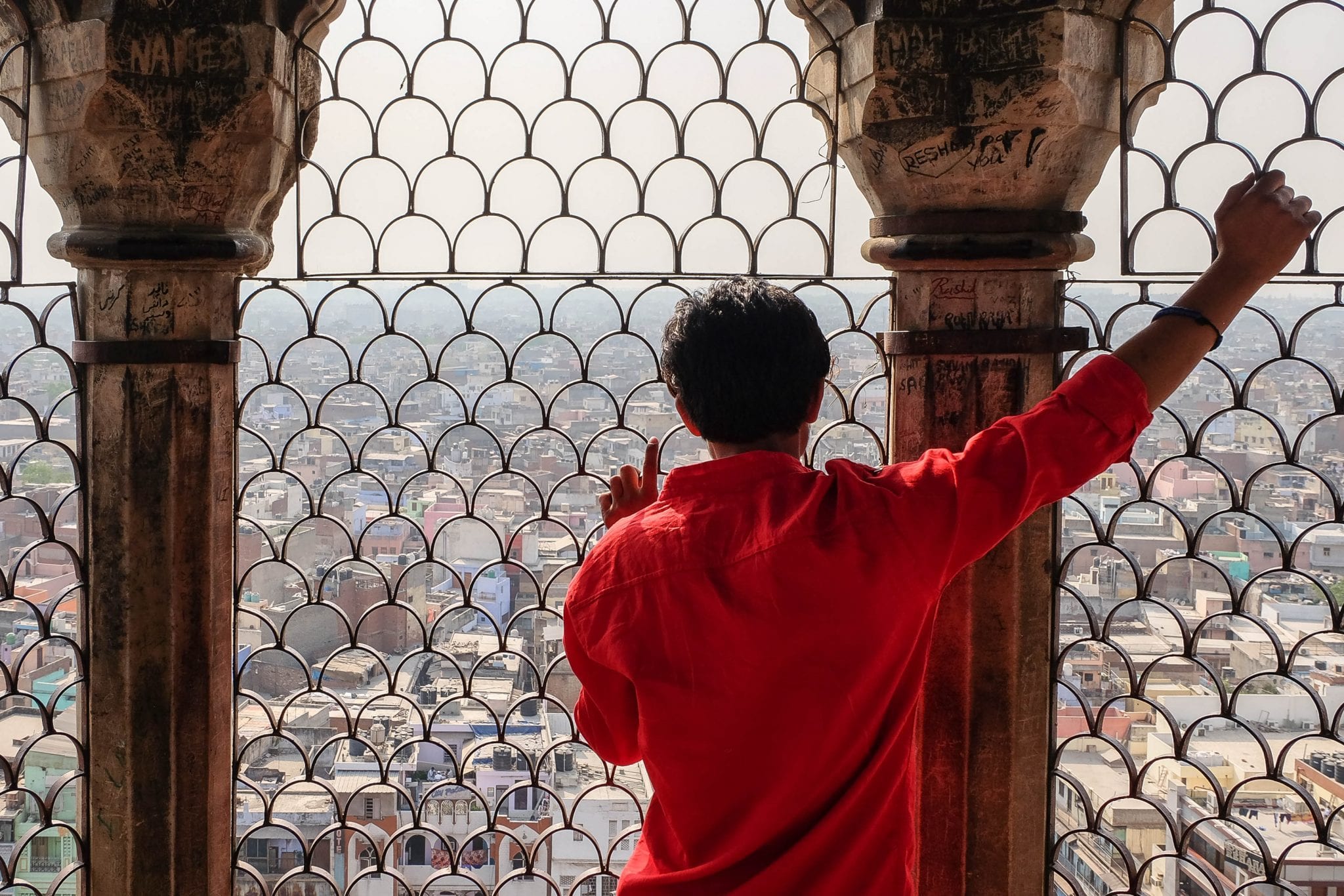
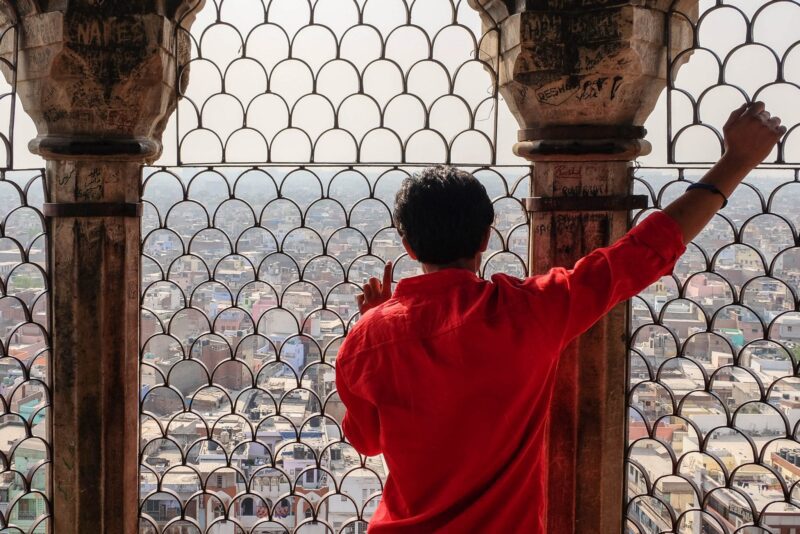
Feeling the lenses of dozens of camera phones aiming towards me, I retreat to the relative safety of the mosques 40m high minaret, heaving my lethargic legs up 130 steps to the summit. It’s only from here that you can really grasp the scale of India’s capital. Even at this height, it is impossible to see its edges. The streets I just spent an entire afternoon wandering, an area I had thought so dense and vast, are just a tiny patch on the expansive tapestry that is Delhi. I had so much more to explore.
With that in mind, I retrieve my shoes and head down Jama Masjid’s steps, back to Chawri Bazaar, towards Chandi Chowk to reprise my part in Delhi’s centuries-long performance.
Information
Khari Baoli
The spice market is open from 11 am to 7 am daily except for Sunday, when it is closed.
Although it is generally a wholesale market, small packets of spices and herbs are available for tourists to purchase at an inflated price.
To reach the market, take the yellow Metro line to Chandi Chowk station and from there, it’s a 15-minute walk. Make sure to visit the cloth market and Fatehpuri Masjid while you are there.
Jama Masjid
To reach the mosque, take the northern exit from Chawri Bazaar station on the yellow line (the south points you towards Ajmeri Gate) and you’ll find yourself in the middle of a bustling bazaar. From there it is a 15-minute walk or a 20 rupee rickshaw ride to Jama Masjid.
The Mosque is open from 7 am until sunset, but note that tourists are not allowed in between 12.15 pm and 1.45 pm or in the half-hour before sunset. Pictures should not be taken during prayer hours.
Entry to the mosque is free, but there is a 200 rupee camera charge. Even if you don’t intend on taking photos but have a camera with you (including a smartphone), you’ll be charged.
It is an extra Rs.100 to climb the minaret but be warned, it is steep and can become cramped at the top.
Ensure that your clothes cover you fully, including ankles and arms, otherwise you will be loaned a rather unfashionable sheet-like garment to wear inside the mosque.
Take a bag for your shoes in if you don’t feel comfortable leaving them outside.


India Essentials
When travelling, there are certain brands and resources that I always rely on when booking things like flights, accommodation and tours. Here are my recommendations.
Mobile Data and SIM Cards
Prepaid eSIM’s are a great way of accessing affordable data and staying connected while travelling. I use and recommend Airalo.
Booking Accommodation in India
When securing accommodation abroad, I almost always rely on Booking.com as they have everything from rental properties to homestays and luxury hotels.
Most cities in India also have a good range of hostels for the budget traveller and some of the country’s largest chains such as Moustache and Zostel have outposts here. I always use Hostelworld when booking my bed in hostel dorms.
Train Travel in India
Thanks to India’s extensive rail network, the country is best explored by train, however, booking rail tickets in India can be slightly confusing when using local booking services. The cheapest and easiest way of securing tickets is via 12GO, who allow you to search for journeys and book trains easily.
Tours in India
Many of India’s cities are vast, sprawling and chaotic, meaning that they are best seen with the help of a local guide. Whether you are planning an adventurous day trip or a delectable food tour, Get Your Guide and Viator have a huge number of options.

One Response
Hi Dave,
I really enjoyed the article and particularly the photography. It really got the mood of Delhi spot on. Now quarantined in my place its great to have a look at other people’s adventures in some familiar surrounds.