
Slinking along the banks of the Yamuna river, it felt like we were in the middle of the world’s most inept drug deal. I anxiously surveyed the small, concrete jetty in the hopes of finding the man I was looking for. Our hostel receptionist had assured me he would be here.
Dusshera ghat is eerily quiet compared to Agra’s centre. Just a few hundred metres away, throngs of tourists pour through the eastern gate of Shah Jahan’s masterpiece to the calls and yells of vendors hawking trinkets or guided tours. Down on the river bank, the only sign of life was a couple of old men huddled on a cluster of stone benches, chain-smoking, while another slumps perpendicular to them, half comatose and staring into space, as if unaware that right behind him was the world’s most beautiful building.

It makes me wonder if the sight of the Taj Mahal has become mundane to them – just a part of everyday life. I suppose that seeing it every day would become a law of diminishing returns, just another piece of scenery in the background of your life.
The calm is only broken by the constant drone of singing emanating from a tiny Hindu temple that sits on the ghat. At well-timed intervals, a man in flowing white and orange robes emerges and slowly walks its perimeter, hands clasped as if in prayer, towards a bell in its furthest doorway. Each time, he pulls it sharply with one swift ding that rang out loudly over the Yamuna.

I continue to scan my surroundings until one of the resting men locks eyes with me. He slowly removes the dog-eared cigarette end from his clasped mouth – something you can tell he very rarely does – and flashed me a wide smile with his yellow, tobacco-stained teeth.
“You here for a boat ride?” I try to nod discreetly, as not to alert the two policemen that have just wandered around the corner of the temple and into view.
Officially, it’s illegal to take tourists for boat trips on the Yamuna. Earlier, when planning this little excursion, I had asked around to gauge whether a boat trip was possible and the best answer that I was given as to why it was not, is that it was for ‘security reasons’. Security for what, I was unsure. Whether this was to prevent an armada of tourist vessels descending on the Taj’s rear, scaling its outer wall and thus avoiding the 1,000 rupee entry fee, or protection against more nefarious terrorist incidents, I’ll never know. However, it made it increasingly difficult for me to achieve my goal of seeing the mausoleum from the water.
While questioning our hostel receptionist about the matter, I had spotted a sign on the notice board; ‘Sunset boat rides – 200 rupees each.” Each time I had inquired about the sign, I was told that the tours were not running. I decided to take the matter into my own hands.
The smiling man makes me feel a little more at ease. His slicked-back hair, long billowing scarf, and incredibly thin roll-up cigarettes give him the air of an ageing bohemian or an Indian dandy. Ignoring the nearby authorities he casually tells me that it would cost 100 rupees each. He motions for me to wait, he won’t be long.
I position myself on a bench by the water as he slowly hobbles towards the bank. The cacophonous pounding of the temple’s drum circle becomes more frequent, the chanting increasingly intense, the sound growing ominous. At regular intervals, the robed man appears again, rings the bell, and then returns to his building. I watch as a man emerges from the temple, places a small stack of stale chapatis on a concrete platform and then stands back. A rowdy flurry of fur and teeth arrives in the form of Rhesus Macaques to devour his delivery. When they’re sated, they scurry back into the trees. The man quickly empties another plastic bag of treats onto the platform for the whole charade to begin again.


Down by the water, our captain proceeds to untether his dinghy and assist two men, arms loaded with bulging plastic bags, aboard. With just a dozen swift pushes of his punt, he propels them to the opposite shore. For many locals, this is the only way of crossing the Yamuna. Bridges are few and far between.
The previous evening I had caught my first real glimpse of the Taj Mahal from Mehtab Bagh gardens on the river’s north bank. Although it is only a few hundred metres from the mausoleum, getting there and back is a 16 km round trip, taking 20 minutes each way and costing around 150 rupees on an overpriced tuk-tuk. It requires travelling a few kilometres west of the city, crossing the Ambedkar bridge, and then making your way back eastwards to the Taj Mahal viewpoint.
Mehtab Bagh is beautiful; a long, lush green lawn dotted with flowering bushes designed to mirror the Taj Mahals own decorative gardens. Legend says that Mughal emperor Shah Jahan long planned an exact copy of the Taj to be built in the spot as a tomb for himself, only made entirely of black marble. The idea originates from the fanciful writings of Jean-Baptiste Tavernier, a European traveller who visited Agra in 1665. It was suggested that Shah Jahan was overthrown by his son Aurangzeb before it could be built.

I wasn’t the only person to have the idea of watching the sunset from the gardens. A few hundred other tourists and teenage Indian couples – hoping to picnic and canoodle in the relatively discrete setting of the garden’s orchards – were already there. We worked our way through the stalls selling trinkets, overpriced drinks and Taj Mahal snow globes. Why anyone thought these were a viable souvenir, I’ll never know. I’m not sure it has ever even snowed in Agra beyond the last ice-age but even still, I couldn’t help but be drawn to their kitschness.
Beside the entrance stood a man with his camel, urging tourists to gaze upon it. I wandered over to take a photograph, expecting the usual sales pitch for camel rides or hassle to pay for a photograph but he wasn’t offering either of these things. He just wanted people to look at his camel. To be honest, I’m not sure what his angle was, but he certainly hasn’t quite grasped the Indian ability to exploit the tourist dollar of the thousands of tourists that travel India’s Golden Triangle each day.

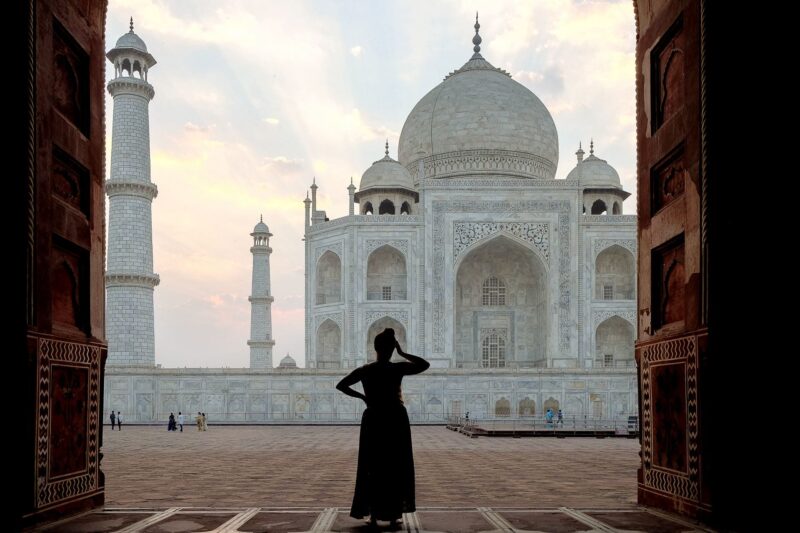
That evening I sat in silence with dozens of other people, gazing in awe at history’s greatest monument to love. Everyone was reverent, avoiding making a sound so as not to interfere with the moment. Finally, I was able to see it in all its humongous scale and glory. In the distance, the people circling the Taj within its grounds were dwarfed by its size. The buildings creator once said that “It made the sun and the moon shed tears from their eyes.” I don’t doubt him.
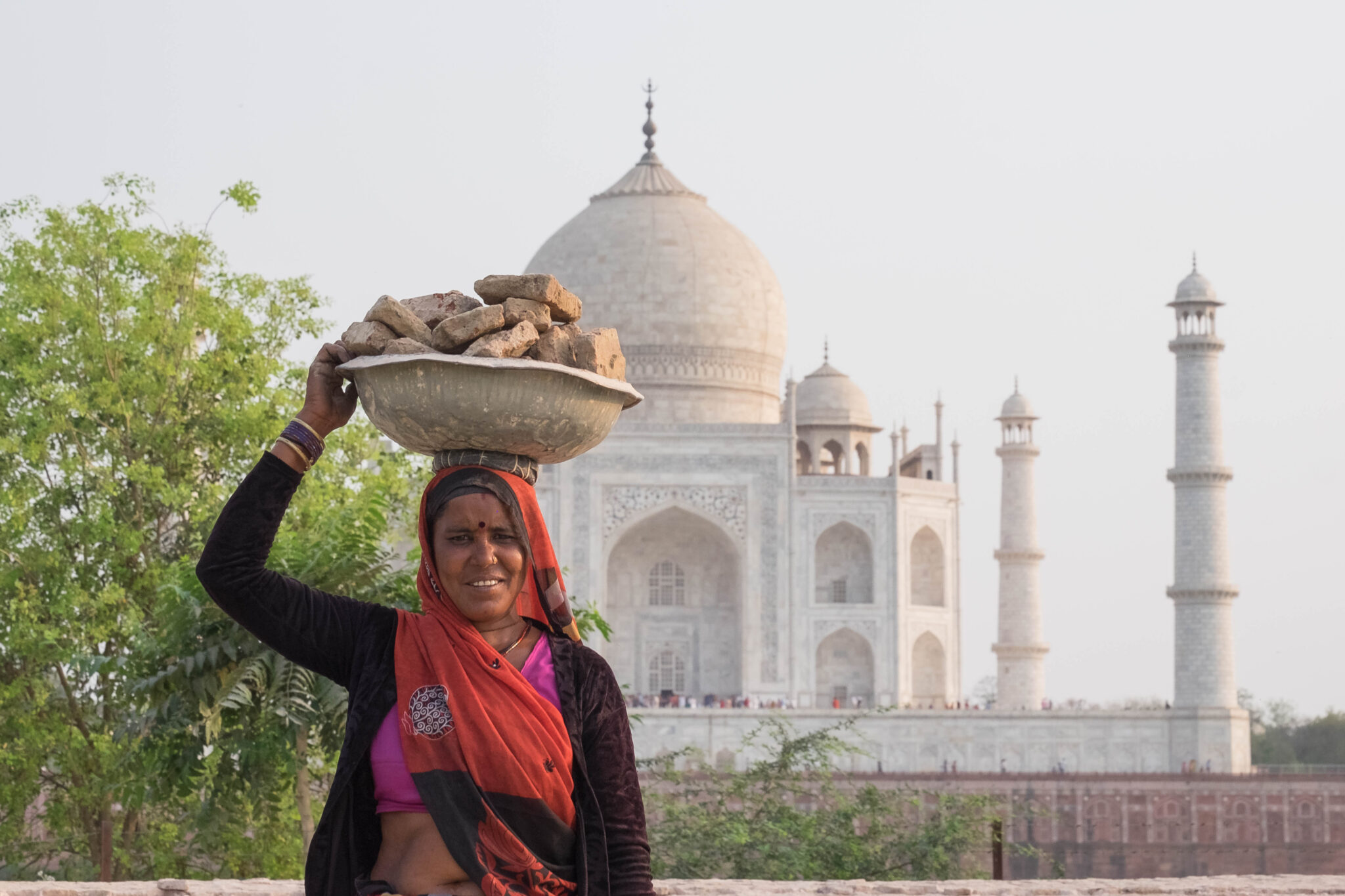
Gradually the light faded, casting an orange-pink glow on the building’s marble dome. Beside me, a newly married couple dressed to the nines in colourful, Indian wedding attire broke away from their wedding photographers to embrace in front of the view. They couldn’t look away, and neither could I.

Back in our vessel, to my dismay, our captain proceeds to take a bucket and scoop water from the boat’s hull. It seems a little dilapidated; unpainted and splintered, creaking under its own weight. I get the impression that it is barely fit to float, but in moments like this, beggars can’t be choosers. I step aboard, the whole vessel swaying and the ageing boards creaking beneath my feet. With one swift push, we set sail.

By now the daylight is beginning to fade, giving the water a glistening, golden hue. Our boatman deftly punts us toward’s the river’s centre, still clasping his ragged cigarette between his teeth. As soon as he is done with it, he flicks it out into the water and pulls another from his breast pocket, popping it into his mouth and igniting it without missing a beat.
Slowly, the boat spins around to face our launch point. The Taj looks even more breathtaking than it did the night before – A resplendent, pure white monument to lost love. It is an image I have seen a thousand times on television and in magazines, but only seeing it here before my own eyes, with a perfect but undulating copy reflected in the Yamuna, does its intricacy and scale really hit home.

I feel like I could stare in awe forever. As the sun lowers in the sky, the orange glow projected on the Taj intensifies, turning its pure white dome into a kaleidoscope of colour. It makes me think of thee men, sitting on the ghat and ignoring the wonder of the world that sits beside them, so used to its presence that they have become immune to its beauty. At this moment, I couldn’t imagine ever finding the sight of this building mundane.

India Essentials
When travelling, there are certain brands and resources that I always rely on when booking things like flights, accommodation and tours. Here are my recommendations.
Mobile Data and SIM Cards
Prepaid eSIM’s are a great way of accessing affordable data and staying connected while travelling. I use and recommend Airalo.
Booking Accommodation in India
When securing accommodation abroad, I almost always rely on Booking.com as they have everything from rental properties to homestays and luxury hotels.
Most cities in India also have a good range of hostels for the budget traveller and some of the country’s largest chains such as Moustache and Zostel have outposts here. I always use Hostelworld when booking my bed in hostel dorms.
Train Travel in India
Thanks to India’s extensive rail network, the country is best explored by train, however, booking rail tickets in India can be slightly confusing when using local booking services. The cheapest and easiest way of securing tickets is via 12GO, who allow you to search for journeys and book trains easily.
Tours in India
Many of India’s cities are vast, sprawling and chaotic, meaning that they are best seen with the help of a local guide. Whether you are planning an adventurous day trip or a delectable food tour, Get Your Guide and Viator have a huge number of options.

2 Responses
Mate, this is a gem of an article. Cheers!
I’m so in love with the way you write! Do you have any published books yet?