
“Poverty Tourism’ is a controversial topic in the travel industry and a concept I have never felt fully comfortable with. Tour guides will walk tourists through slums and villages so that they can gawp at local people and their way of life as if they are exhibitions in a human zoo. There is often no interaction or conversation with the community that lives there, no attempt to understand local life. In the worst cases, companies will drive paying customers through Favelas in armoured cars as if the neighbourhoods are an urban extension of Knowsley Safari Park. It can feel extremely voyeuristic. This was the dilemma I faced – should I take a tour of a Favela while in Rio de Janeiro or not?
“Why would you want to visit a favela?”
This was the question asked of me by my Carioca friends as they drove me to Praia da Barra da Tijuca, hoping to show me a little more of Rio outside the usual tourist spots of Copacabana, Ipanema and Botafogo. It wasn’t a question asked with any malice but more out of sheer curiosity. They couldn’t understand what anyone had to gain from visiting or why it would be of any interest to me. In all honesty, I didn’t really have an answer for them.

Favelas are as much a part of Rio de Janeiro as Cristo Redentor and Copacabana beach. They have a reputation worldwide as hotbeds of violence and unrest. The truth is, they are filled with regular, hard-working residents. A quarter of the cities population still lives in these neighbourhoods and chances are that many of the people you will interact with within the city – bartenders, clerks, hotel staff, bus drivers – will live in one of the city’s 800 favelas. They are a part of every single neighbourhood and to ignore them is to ignore one huge facet of life in Rio de Janeiro.
After many hours of research, trawling through scores of motorcycle and jeep tours, I came across Favela Santa Marta Tour. Santa Marta was the first favela to be ‘pacified’ back in 2008, a programme to expel drug gangs and install UPPs – or Pacifying Police Units – in the city’s most violent neighbourhoods. The hope was to break the cycle of police raiding favelas, having shootouts with traffickers, and then withdrawing. Since then, dozens of favelas have been pacified with Santa Marta, once the city’s most violent slum controlled by the Commando Vermelho (Red Command) drug gang, being held up as the model for how pacification can be a drive for social change.
Thiago Firmino, a local dancehall DJ, was born and raised in Santa Marta. He set up Favela Santa Marta Tour as a way to showcase the favelas to outsiders, to demystify them and show that they are not just violent slums but vibrant communities. Business was going well. He had now recruited local student Pedro Monteiro to act as his surrogate when he was busy with other engagements, of which there were many. As a cultural representative for Santa Marta, Thiago has given interviews in worldwide publications and appeared on TV in numerous countries. His part-time hobby of photographing favela life has earned him exhibitions in both London and Paris.

It was Pedro that we met at the petrol station opposite Santa Marta’s entrance on R. São Clemente. He was a lanky, spindly youth with a welcoming smile spread across lips. He seemed so young for a tour guide, no older than his late teens. After a short introduction and a few ground rules, he explained that we would make our way to the very top of Santa Marta and work our way down.
We slid up the hillside in the free tram, a gift from the government after pacification that now helps the 8,000 residents access the highest reaches of Santa Marta without having to slog up 1km of steps and crumbling paths. As we reached the top, the whole of Rio opened up below us. The corrugated shacks and brightly painted brick houses cascaded down the hillside, sandwiched in the middle-class neighbourhood of Botafogo and the more upmarket Lagoa. Beyond the high rises of Lagoa sat the Atlantic ocean and Copacabana beach.

It seems strange that Rio de Janeiro’s most deprived neighbourhoods have some of the best views in the city. Pedro explained that it is all down to the city’s history. Back when Rio was just a stretch of buildings along what is now Ipanema, Leblon, and Copacabana beaches, the wealthy bought up all of the oceanfront lands. The construction workers had to make do with building their houses on the only available space that was left – the steep hillsides. Now some of the city’s poorest people live on its most desirable real estate. Luckily for them, Brazilian law guarantees ownership of the land for those who squatted back then.
At the pinnacle of the neighbourhood, a bronze statue of Michael Jackson stands – arms outstretched as if mirroring Cristo only a few miles away- in a small square dedicated to the King of Pop. Behind the effigy was a mosaic mural depicting MJ on a US postal stamp. It was here that director Spike Lee filmed parts of the video for Jackson’s 1996 hit ‘They Don’t Care About Us‘. Authorities initially opposed the project, not wanting to show Brazil in a negative light, but Lee pushed on regardless with Jackson hiring local people as dancers and extras making him somewhat of a local hero. Pedro proudly walked us over to the concrete football field where Jackson’s helicopter had landed for filming, now the scene of an intense game between two school kids. Lee’s video plays on a loop in a small store off the square selling paintings by local artists and Santa Marta themed trinkets. It seems that a whole cottage industry of snack and souvenir stalls had cropped up around this one square, with some residents now making a living just from the tourist traffic.


Despite the improvements made since 1996, the signs of a tumultuous history still remain. In one poignant reminder of past trouble, I spotted a wall pockmarked with bullet holes that had been painted over with a colourful mural. It was now the headquarters of the local UPP. Every so often we would come across a patrol of UPP officers walking the alleys, assault rifles drawn as they cautiously peered around corners before stepping out, barrels pointing into the street. I had the feeling that the cops were putting on a bit of a show, hamming it up for us outsiders, but it is disconcerting nonetheless.
Although violence is no longer a part of the day to day life here, some social issues such as drugs still remain. Pedro urged us to be cautious when taking photos so not to capture people – some residents fear that minor discretions will be caught on camera and shown to the police. This was most apparent when we passed a group of teenagers smoking weed in a doorway and Pedro indicated that we should put our cameras away as we walked by.

As we descended into the depths of Santa Marta the views disappeared to be replaced by a maze of alleyways and crumbling concrete staircases. Half built and collapsed houses lined one path. Bags of cement and gravel were stacked in a vacant patch of grass while a cat dozed on top. Children ran by barefoot, shouting “Olá” to us and hi-fiving Pedro. An old man shuffled past, lugging bags of laundry up the steep incline. Tiny hole-in-the-wall grocery stores, barbershops and bars fill any gaps not taken up by breeze block and corrugated iron homes. It isn’t the war-zone that the media would have you believe but a thriving community. It always has been, but now without the extortion and threat of gang violence, the neighbourhood can prosper.
We were lucky enough to find Thiago at home and stepped inside for a brief chat over a glass of juice. In stark contrast to the dilapidated exterior, I found a neatly decorated home; modern and well kept. A huge flat-screen TV sat in one corner and a collection of expensive-looking cameras lined the shelves. Photographs of him with the various celebrities that he had provided tours to fill the walls; Vin Diesel, Bradley Cooper, Alicia Keys and Madonna. He chuckled, unsurprised by my reaction to what I found. I get the impression that he sees my bemused expression on most visitor’s faces and never tires of shattering their expectations.
As we moved further down the favela towards Botofogo’s main drag, the buildings became less ramshackle, more uniformed and neat. The labyrinthine alleyways opened out into Praça Cantão, Santa Marta’s main square, and we were suddenly surrounded by huge splashes of colour streaking across the facades of houses. 7,000-square-metres of colour to be precise. The Favela Painting art project was created by Dutch duo Haas & Hahn.
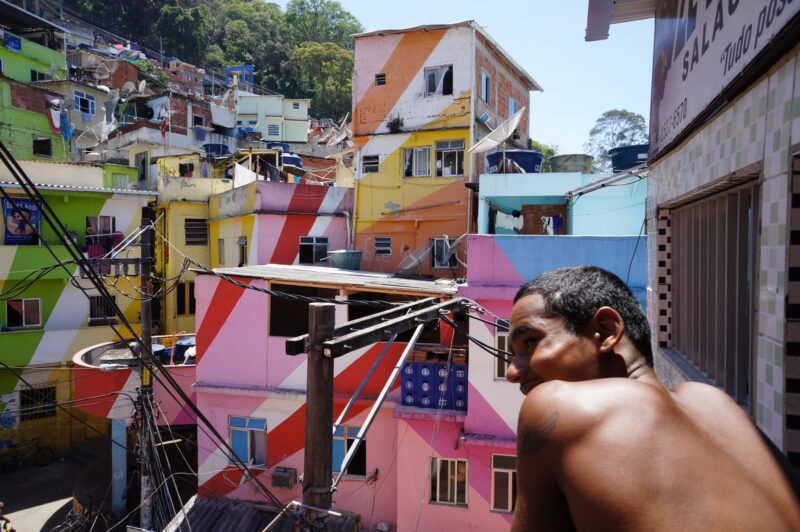
“Art is a unique messenger, crossing borders and building bridges. If implemented in an intelligent way it can be a powerful weapon to catalyze social change. This is the main objective of the Favela Painting Foundation”
Initially, 34 buildings were repainted by local youths in an attempt to refocus Praça Cantão as a place of shared community pride. Since then a monthly painting task force has been working its way up through the favela with over 800 people signing up to be involved so far. It has energised the community and made Santa Marta a place for the residents to be proud of. The cafes and bars surrounding the square seem to be doing good business and the constant flow of tourists coming to see the murals has brought in money and opportunities.

Santa Marta, it seems, is the exception rather than the rule. In some of the larger favela complexes, where armed traffickers are more established, the UPPs have been much more heavy-handed. Innocents are often caught in the cross fire and the police have even been known to plant weapons on the bystanders. In the worst cases, there have been instances of forced disappearances. Reading up on the pacification process, I came across a quote by a resident of Complexo de Alemao:
“There is no pacification here, what we have is a war. Criminals against police, fighting over who are the more powerful the more influential. And who suffers? We do.”
The message of ‘They Don’t Care About Us’ is as relevant now in some neighbourhoods as it was in the ’90s. Since 2009, almost 100,000 people had been forcibly removed from their homes in the favelas. It seems that the security of land tenure that initially gave people rights to their homes has a “state of exception” – in this case, the exception was the 2016 Olympics. We spotted a number of signs around Santa Marta protesting forced evictions – these removals were to free up desirable land for property developers.

There is no escaping the fact that a huge driving force of pacification was making the city safe for visitors during the World Cup and the Olympics events back in 2014 and 2016 respectively. It’s rather telling that the clutch of success stories are the favelas are close to the tourist areas of Leblon and Copacabana but even then they only manage to flourish due to huge infrastructure investments such as Santa Marta’s new funicular, community centres and clinics.
This got me thinking back to the question I was asked on our way to Praia da Barra da Tijuca.
“Why would you want to visit a favela?”
The tone I mistook for curiosity was actually incredulity. They maybe didn’t see why I wanted to visit because they didn’t see these communities as a part of the Rio they know and experience on a daily basis. For some of Rio’s wealthier residents, the favelas are seen just as the media portrays them – violent slums filled with crime and a sink of public funds.


With one in four of Rio’s population living in them, favelas should not be taken for granted. They play a hugely important role in the city, both culturally and socially. Samba, Capoeira and the Carnival’s extravagant parades that take place each year in the Sambadrome all have their roots in these communities – and that is what they are; not slums, not favelas, but communities. Hopefully, people like Thiago and Pedro can continue to shift perceptions and introduce outsiders to the realities of life in these neighbourhoods.




13 Responses
Bringing people together is normally a good way to fight prejudice and intolerance. Such favela tours may be a way to achieve this. Not sure how uncomfortable I’d feel. I did a research project in a favela in São Paulo in 1996. It lasted for 3 months and I’d sometimes bring my then 1.5 years old son with me to be looked after by a lady from the favela. My Brazilian in-laws were shocked at first but one day, I invited them to come with me and they realized that the people living there were not really that different from them. And I learnt a lot in these three months. I spoke with many people and heard a lot of incredible stories. Favela doesn’t always mean extreme poverty. The lady who looked after my son had a pretty normal house. Of course, they were also people who lived in cardboard “houses”. Sometimes, the houses looked poor and ugly from the outside but were well furnished and clean and pretty inside.
This seems like an amazing tour about which I am hearing for the first time. Your post was an awesome read. What did you like best in the favelas in Rio de Janeiro, Dave?
Poverty tourism sounds very interesting. I had never thought about a place from this angle but its so good to travel to such places where we can contribute to its betterment.
This is a really interesting way of looking at tourism that I hadn’t really considered before. It looks like you have a great experience and saw a different part of the area which is always interesting and fascinating! Will think about this in future when we travel – thanks for sharing.
Loved this post..its nice to have a views and discuss such relevant topics. I went to Rio in Dec and did not do the favela tour. I am from India and thought that I wd rather see the poverty in India that walk through a favela. I somehow wasnt sure if I wanted to walk through a favela and make the residents feel that I am peeping into their daily life. We all have such different views on the subject, dont we? And there is no right or wrong !
Thank you! That’s why I wasn’t sure about taking a tour – it felt intrusive and voyeuristic. I think I made the right choice in the end as the tour was so informative and gave a true insight into the neighbourhood. I wouldn’t like to do the tour without someone local showing me around though.
I am not really fond of the term ‘poverty tourism’ as I feel it is really wrong as tourists to walk around these neighbourhoods in a city looking poor people and click their pictures to show we empathise with them. It’s a whole different issue if you want to do something for them or maybe just interact with them and understand their issues. You have covered a very important issue in travelling and loved reading your experience. Have to agree the favelas indeed have beautiful views!
What a great post and great pictures! I can’t believe I didn’t know about the Michael Jackson statue and mural. I’m very familiar with the video and all things MJ related and now I want to go see it!
Super interesting read an topic you have brought up here. We know many don’t agree in this practice, but if the money really goes to the community (we will never know really eh?), then why not?. By the way really wanted to go to the Rio Favela you went, love the colourful houses, feeling a bit like we missed out!
The term “poverty tourism” itself is quite suspect. I personally don’t agree with the idea of tourists paying money to go on a day-tour in impoverished, crime-ridden areas where they take pictures and then leave. If travelers really want to do something good for the people of the favelas, I think it may be better to volunteer with local NGOs.
‘Poverty tourism’ obviously isn’t an official term, it’s generally used as a derogatory way to describe the kind of tours I spoke about in the first paragraph. Whatever you think of visiting favelas, they are a huge part of Rio’s cultures and so I think they should be seen if you want to truly understand the city. As I tried to explain in the article, they are not all impoverished or crime-ridden, they are vibrant communities. People like Thiago are doing wonders in dispelling these myths and bringing money into Santa Marta, probably doing more for the community than NGOs can.
What an interesting read, I prefer getting off the beaten track and speaking with locals. I glad you touched on a subject most people would avoid. I would definitely go on a tour that gives back to the community and helps out. Favela Santa Marta Tour sounds just like that and the founder Thiago Firmino, a local dancehall DJ also seems like a local hero. It is these types of people that I respect and thank you talking about this.
I think you’ve highlighted a really valid point here, and one that I’d never have come across before. Most tourism of course highlights only the positives of a country. That said, I think in this case, poverty tourism can be a good idea, so people on the outside can see there’s another side to the city, plus the people that live there. After all, we can’t help the circumstance we were born in, we just have to make the best with what we’re given. A big lol to that MJ bronze statue, it’s pretty freaky!