
A flamboyant feast of hedonism, Rio Carnival’s samba-driven celebration is one of the world’s greatest parties, where the city’s streets come alive with intricate costumes, enormous floats, and Brazilian rhythms in preparation for Lent. Even for the most well-travelled globetrotter, the festival is a once-in-a-lifetime event that needs to be on everyone’s bucket list.
It’s a festival where day street parties and dancing until the sun rises to pounding samba beats is the norm, where normal rules don’t apply and millions of people gather on Rio’s streets for five days of joy, passion and debauchery.
However, making the most of Rio de Janeiro’s Carnival requires a little forward planning, so here’s my guide to enjoying the event like a local.

When Does Rio Carnival Take Place?
Much like the winter carnivals that take place in Central Europe, Rio Carnival’s roots are in the Roman Catholic tradition of Lent when Christians would have a final feast before fasting for 40 days. It was brought to South America by Portuguese invaders in the 1600s who celebrated with balls and masquerade dances. African slaves and workers brought to Brazil by the Portuguese soon incorporated their own traditional customs, paying homage to their culture and gods. Present-day celebrations incorporate a fusion of African, Portuguese and Indigenous traditions, giving it an Afro-European blend that defines Brazil culture.
Rio Carnival starts the Friday before Ash Wednesday and officially lasts for five days, although Street parties can start as early as a month before Carnival weekend and often go on past the start of lent.
The dates for Rio Carnival in 2022 are from the 25th February to the 5th March and in 2023 it will go from the 17th February to the 22nd.
Where to Stay During Rio Carnival
Rio de Janeiro is an enormous, sprawling metropolis so deciding on which area of the city to base yourself for Rio Carnival can be a little perplexing. Although the parties take place throughout the city and the Sambadrobe is situated in downtown, I would recommend that you base yourself in either Ipanema or Copacabana. Both of these neighbourhoods are relatively safe with a good tourist infrastructure, from easy-to-reach metro connections to a good selection of restauraunts, bars and accommodation. They also have a couple of Rio de Janeiro’s best beaches, giving you a place to relax away from the mayhem if you should need to.
It’s worth noting that hostels & hotels will raise their prices 5-fold during the main week of carnival, with that the best ones filling up weeks or even months in advance so it is recommended that you book early.
For the budget traveller, To get round the extortionate dorm rates, the cheapest accommodation option is couchsurfing. Not only will you have free digs, but you get the added benefit of a local to give you tips and show you the best parties. Although again, the hosts become fully booked weeks in advance so make sure you’re organised.
Can’t find a couch to crash on? Chances are that it’ll be easier to find an apartment to rent on Airbnb. The pads in Copacobana and Ipanema fill up fast but it’s cheaper to easier to find somewhere to stay in a quiet neighbourhood such as Botafogo or Flamengo. Plus, an apartment away from the cacophony of revellers will mean you can catch some sleep when it all gets too much.
Cobanacopa Hostel
We booked in to Cobanacopa on a whim at the last minute before the carnival began and it turned out to be one of my favourite stays in Latin America. The dorms are basic but the location, facilities and atmosphere more than make up for this. Located in a secure neighbourhood in Copacabana with 24-hour security and just a short walk to both the metro and the beach, this hostel is perfect for carnival revellers. The hostel staff go above and beyond to make sure you know where all the best parties are, organise events and even provide customers with a rack of party costumes so that they can make the most of the festivities.
Mama Ruisa Boutique Hotel
Filled with curved, cobbled roads where elegant, crumbling old mansions hide behind high walls, the much-loved Santa Teresa neighbourhood of Rio de Janeiro is the city’s arty, bohemian hub.
The blocos of Santa Teresa are some of the Carnivals best so finding a hotel in the centre of the action is always a good idea. The stunning Mama Ruisa Boutique Hotel is located in a quiet area of the neighbourhood overlooking both Guanabara Bay and Sugarloaf.
You can also prepare yourself for a day of partying with a rich breakfast on the terrace or by the outdoor pool.
Belmond Copacabana Palace
The famed beach of Copacabana is synonymous with glitz and glamour. So much so that its palm-lined sands and glitzy art deco hotels have been immortalised in both song and on the silver screen. Nowadays it is a bustling bairro filled with shops, cafes and restaurants that make it the perfect tourist hub.
The elegant Belmont Copacabana Palace is possibly Copacobana’s best hotel, with its Ken Hom-directed Mee restaurant and classic decor, every corner of this 147-room Art Deco behemoth oozes style.
Getting Around
The simplest way to travel throughout Rio de Janeiro during carnival is either on foot or via the city’s metro system. The train lines are far from extensive but there are stations close to the majority of the main sights. The trains are clean, air conditioned and reliable so at 5BRL per trip, it’s a steal.
Buses on the other hand, are much more susceptible to the flurry of sudden road closures caused by parties, parades and blocos (more on these later). However, buses still run throughout the week of Carnival and with over 100 lines running and as long as you do some research on which bus to catch, you should be fine. Rides cost around 3.5BRL each way.
Taxis and Ubers tend to have the same issue as Rio’s buses, with the main party areas being closes to traffic, meaning you will not be able to get close to the action. There are times when an Uber is much more appealing than pubic transport though. After a hard night partying in Lapa, you may not want to hang around waiting for a bus. Luckily, taxis are in abundance in Rio and are pretty cheap. It can be a slight struggle to flag one down during Carnival time but when you do, just make sure it is one of the licensed yellow cabs and that the meter is activated. Otherwise, Uber is the safest option.
Rio Carnival Parties
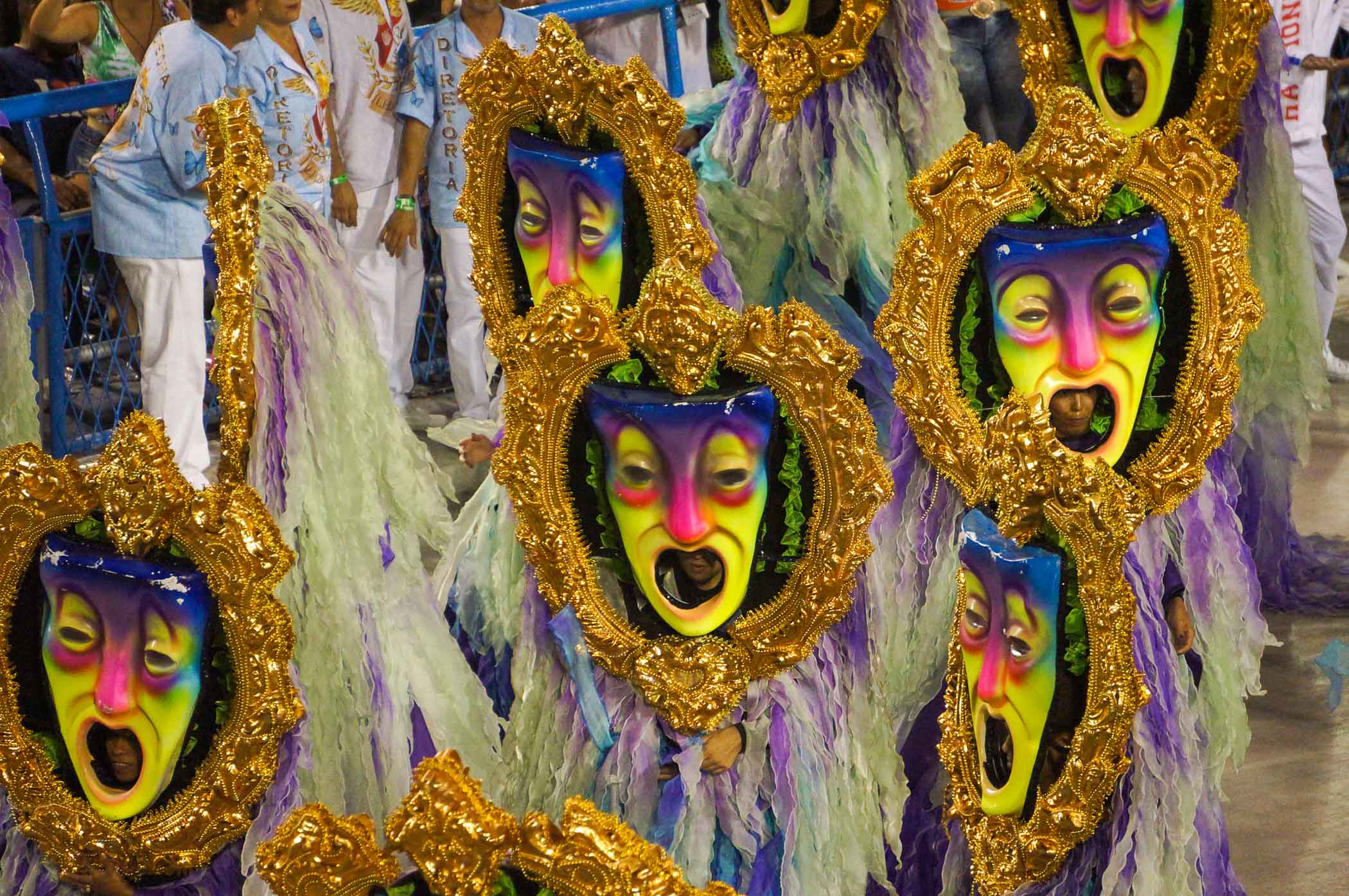
Rio de Janeiro’s Carnival revolves around 3 different types of events. Firstly, there are the Sambadrome parades, where the city’s best samba schools try their best to impress the judges and win the public with their elaborate dances, costumes, and floats in the Sambodromo, the iconic home of Brazil’s carnival, designed by Oscar Niemeyer in 1984. Then there are street parties, 500 of them, taking place throughout the city where neighborhood bands parade through the streets, playing songs, followed by crowds of rambunctious party-goers dressed in costume. Lasty, there are the elegant Carnival Balls that cater to Rio’s rich and famous such as the annual black-tie event Baile do Copacabana Palace or the Baile Gay at the Scala where guests pay up to Rs$1000 a ticket and compete to be awarded a prize for the most outlandish costume.
Carnival Blocos
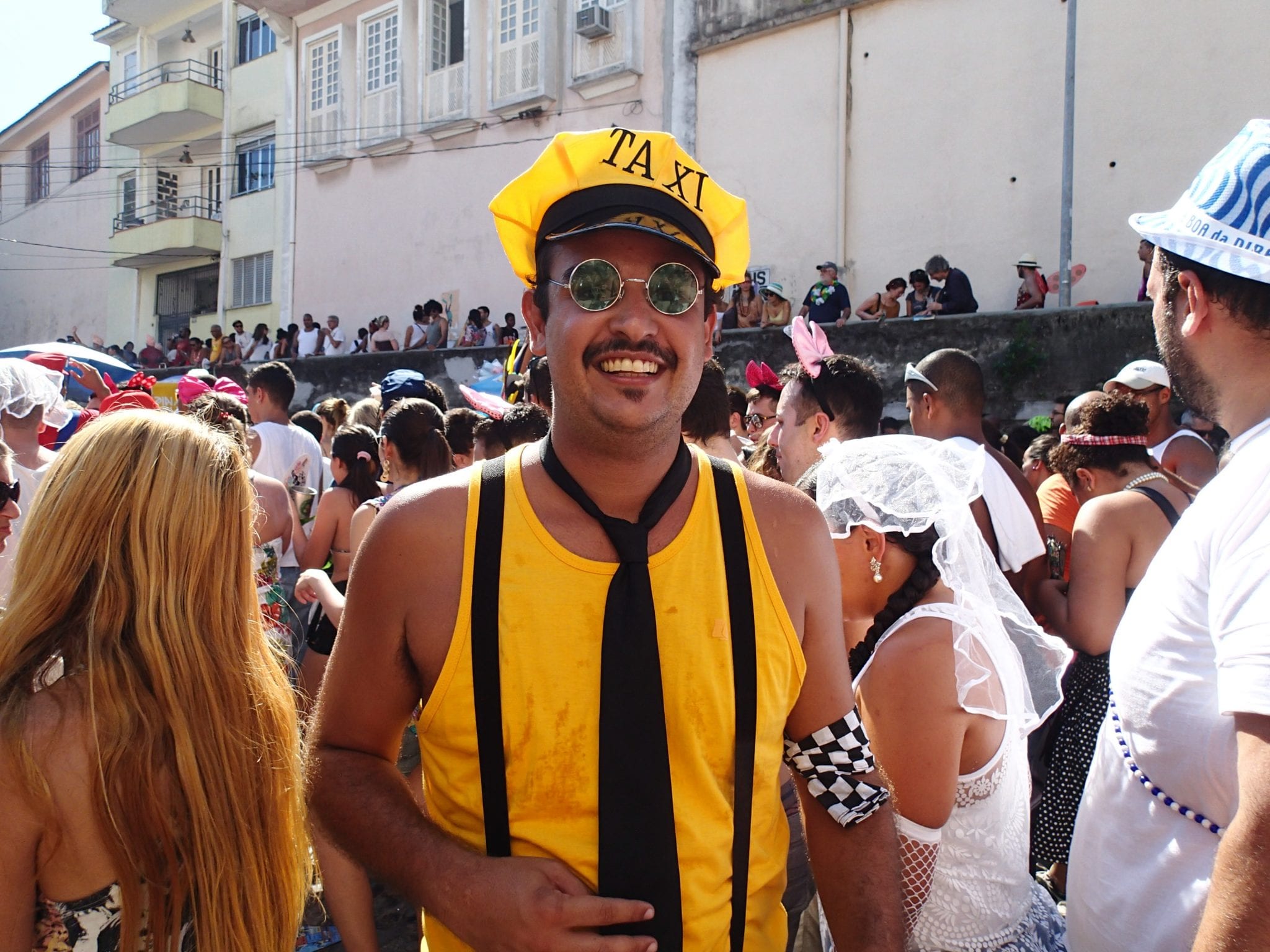
When you think of Rio Carnival it may be the famous samba parade at the Sambodrome that comes to mind, however, the heart and soul of Carnival are the numerous street parties – or blocos – taking place throughout Rio de Janeiro. These free street parties take place all over the city (there are around 500 in total), often simultaneously. Most are organised events, each with a starting point and time, often with a specific theme while unofficial street parties do happen, but you will have to find out about them through word of mouth from a carioca in the know.
Some of the more traditional blocos have been in orperation for decades and feature a live band parading through several city blocks while the antendees dance behind them. Other Blocos have a specific theme, whether this is a type of fancy dress or a style of music (for example, ‘New Kids on the Bloco’ features popular 90s songs played in a samba style while ‘Sargento Pimenta’ is a carnival celebration of The Beatles). There are new Blocos poppi ng up every year so make sure to check the official list of Blocos that is released close to Carnival with the specific dates, times and locations.
The Best Blocos at Rio Carnival
Carmelitas
The Blocos of Rio’s bohemian Santa Teresa neighbourhood hold a special place in the hearts of Cariocas and often attract a wild, young crowd. This bloco was inspired by the legend of a nun that jumped out the window of her convent, Carmelitas in Santa Teresa, in order to join the carnival festivities. Two parties take place, one to celebrate her escape and another at the end of the carnival to commemorate her return to the convent without punishment. Expect the crowd to be dressed in habits in an attempt to ‘hide’ the escaped nun.
Super Mario Bloco
A fairly recent addition to the carnival, this party sees revellers dressed as their favourite Nintendo characters while parading through the cobbled streets of Santa Theresa to the sambafied versions of Super Mario’s most loved tunes.
This is a fairly small bloco but was by far one of our favourites.
Bola Preta
Some of Rio Carnivals oldest and most popular blocos are found in Rio’s city centre, with Cordão do Bola Preta being the most famous. This celebration marks the opening of festivities and is normally the first official bloco of the carnival, attracting over 1 million people. If you want to dress to impress, make sure to adorn yourself in polka dots, the unofficial uniform of Bola Preta.
Sargento Pimenta
One of Rio’s Fastest growing blocos, now expected to attract almost 10,000 revellers, this party was inspired by the Fab Four’s ‘Sgt. Peppers Lonely Hearts Club Band’. Expect Beatles costumes and samba style covers of all their hits.
Banda de Ipanema
Make sure you have plenty of glitter and a fabulous costume for this parade representing Brazil’s LBGT community. Crossdressing and drag are the main themes here with the blocos drag queen procession being the star of the show. Expect up to 100,000 people crowding Ipanema’s waterfront for this outlandish and colourful spectacle.
Simpatia é Quase Amor
If Banda de Ipanema sounds a little too claustrophobic for you, Ipanema’s other popular parade, Simpatia é Quase Amor, is smaller scale and attracts young, hip partygoers looking for a little romance.
Tips for Making the Most of the Blocos
Plan which blocos you are heading to beforehand as if you turn up too late, the parade may have moved on and will be hard to locate.
Try not to cross the city in the time between parties as public transport can be wildly busy. Plan to hit up blocos close to each other in one day (e.g. An early morning parade in Santa Theresa, followed by parties in Lapa or Cinelandia)
If two blocos you want to see are located far apart, make sure you have enough time to get between them.
Vendors will be selling booze and food for fairly cheap at the blocos, but we recommend stocking up on beer and spirits at a supermarket beforehand.
Don’t take too many of your possessions with you as the close-packed crowds can be easy pickings for pickpockets. I took all my drink in a bag and any extra cash, room keys and camera (the cheaper, the better) were in a money belt around my waist.
Although the police turn a blind eye to some of the rules during blocos, urinating in the street is still a big no-no and can result in a hefty fine. Portaloos are located near each party but take a few Reals as many bars and restaurants will open their bathrooms to the public at 2-3BRL a time. Just make sure you bring some toilet paper.
To get the most out of Rio Carnival, head to as many different blocos as possible. Downtown parties have a very different feel to the beach front ones and small blocos of just a few hundred people can be as much if not more fun than gatherings of a million.
Try to get to at least one early morning event. We woke up hungover at 5.30am to catch the metro, two buses and take a 30-minute walk to a 7 am Bloco in Santa Theresa. It was the busiest and best experience of the carnival. It’s fine to drink at 6 am if you’re in Rio, right?



The Sambadrome Parade
The most iconic image of Carnival is the infamous parade of brightly costumed dancers making their way through the 700m long, purpose-built Sambadrome, or Sambódromo. For 5 straight nights, from around 10 pm to 5 am, Rio’s best Samba schools participate in a spectacular procession of elaborate costumes and colourful mind-blowing floats in an attempted to be crowned the winner by a watching panel of judges. The top school from each day then goes on to compete in the winner’s parade on the Carnival’s final night.
Despite being more popular with tourists than locals, the Sambódromo is the quintessential Carnival experience, where an impressive 90,000 spectators pack into the stadium to dance the night away into the small hours.

Tips for Attending the Samba Parade
Arrive fairly early (around 8 pm) to get a good spot in the bleachers. We were on the 2nd tier of the stadium but we managed to stand at the front to ensure we had a good view. The bleachers are unreserved, terrace style stands.
It is a long event, so bring a good quantity of food and drink with you. You can even bring your own alcohol provided it is not in glass bottles.
Wear comfortable shoes. I can’t stress this enough. The parades start at 9 or 10 pm and continue until 5am so be prepared to be stood for a long time. The Brazilians around us didn’t stop dancing for the entirety of the 8-hour event.
Vendors will be selling booze and food for fairly cheap outside the Sambadrome, but we recommend stocking up on beer and spirits at a supermarket beforehand.
Dress to impress. I don’t mean decking yourself out in your finest tux or ball gown – just go wild with the glitter, face paint and colourful wigs.
How to Get Sambadrome Tickets
Tickets for the Sambadrome sell out quickly, so if you don’t buy them in advance, you will probably have to rely on local travel agents or scalpers.
You can buy online and collect at the box office but make sure you do so with plenty of time to spare as the cheapest seats tend to sell out. We managed to get some tickets from our hotel reception at a reasonable price a couple of days before the event reasonable price, so this is also an option if they have sold out on the ticketing website.
Expect to pay at least R$500-R$800 for a spot in the bleachers. A box seat or VIP ticket will set you back even more. Arrive early and try to get a spot in sections 6 – 11 if you can afford it, as you will have a significantly better view of the performance; avoid 1, 12 and 13, as you don’t get much of an overview of the venue. Sector 9 is known as the tourist sector but you are free to buy any tickets you like so avoid this and mingle with the locals.
A cheaper alternative is to attend the A-league parade or the Winner’s Parade (taking place on the Saturday after Carnival, when the top five schools come back for an additional performance). Tickets to these two events will cost a much more reasonable R$150.


Visiting Cidade do Samba
If your visit to Rio de Janeiro doesn’t coincide with the annual Carnival but you still have the urge to sample Brazil’s largest celebration, This year-round venue offers a wonderful introduction to Carnival.
This is the space in which all of the city’s major samba schools build their floats, work on costumes and prepare for the sambadrome parade. Guided tours are available and give a fascinating insight into the work that goes into making this event happen. Every Thursday night, a mini-Carnaval parade and show is held.
Also, In the two months leading up to Carnaval, the samba schools are entitled to a technical rehearsal in this venue. The public can attend these rehearsals for free so check out the Carnival’s official website if you would like to watch.
What to Wear at Rio Carnival
Ask any Carioca and they will tell you that getting dressed up is an essential part of the Carnival experience, with some of Rio’s residents will spend months planning their party attire. There are no hard and fast rules when it comes to dressing up for carnival; some people will cross dress or go for a humorous costume while others will plaster themselves in glitter, wigs and feather boas. While you can get away with wearing pretty much anything (or almost nothing) It’s worth noting that some blocos do have a specific fancy dress theme. You will find street vendors selling costume items on almost every street corner in Copacabana and Ipanema.
Rio can get hot and humid in February and March (temperatures reached 45°C during my stay) so I would recommend wearing as little as possible (t-shirt/bikini top and shorts). While it may be tempting to wear flip flops and sandals, try to wear closed toe shoes in order to avoid injury from the broken glass left over at street parties.

Staying Safe During the Carnival
Rio has a slight reputation for being dangerous but over the last few years it has cleaned up its act. The large police presence in tourist areas and during Carnival means that as long as you are careful, you should have no problems.
Petty theft is the biggest issue during carnival as large crowds give pickpockets the perfect opportunity to get their hands on your belongings. If you can, leave your phone at the hostel and only carry cash with you in a safe place, preferably a money belt. The police will be far too busy to care about your stolen iPhone.
Try to stay in your group as it can be hard to locate friends in the crowds. If possible arrange a meeting spot in case you lose each other – We did this at each bloco and it worked most of the time. Always stay with at least one other person in case you can’t find your friends.
The area around the Sambadrome can be pretty sketchy. It’s fine during parade events due to the big crowd and police presence but I don’t recommend heading there during the day to pick up your tickets.
The biggest issue you will have to contend with is the heat of Rio. It was 40 degrees Celsius or more every day when we were there so make sure you carry plenty of water with you. Street vendors sell drinks but water is hard to come buy once you are at a bloco. You’ll spot the vendors dressed in logo’d T-shirts carrying huge coolers of drinks. The prices are fixed throughout the carnival but you can also find chancers undercutting them and selling beers, caipirinhas and iced vodka lollies too.
Plan ahead when moving between blocos. At the end of each party, there is a rush for public transport so set off slightly before the end to ensure you’re away from the crush. Don’t expect to get a taxi during blocos, the roads around each one tend to be closed to traffic.


Where to Get Some Downtime During Carnival
An entire week of partying can take its toll and it can be fairly easy to tire of claustophobic streets, drunken crowds and packed beaches. Ironically, you may find some calm in Rio’s most popular tourist attractions during the Carnival as most people are far too busy celebrating to visit the popular hotspots. I found that Christ the Redeemer, Sugarloaf Mountain and Jardim Botânico where all relatively peaceful places to get away from it all.
You will find that both Ipanema and Copacabana beaches will be packed with people, so go to one of the beaches that are located out of the touristic southern zone. Some of my local friends took me to Praia da Barra da Tijuca and it was almost entirely empty.
Is it Possible to do Rio Carnival on a Budget?
The short answer is no, it is almost impossible to experience Rio Carnival on a budget, mainly because accommodation prices increase five-fold during the week of Carnival. Unless you can stay with local friends, even the most frugal backpacker will struggle to stick to a strict budget. Then again, this is a once in a lifetime experience for many so it can be worth spending a little extra money. Even hostel dorm beds can set you back £30 – £50 per night.
To keep costs low, I bought food and alcohol from local supermarkets and mostly used the metro to travel around the city.
The best thing you can do is ensure that your visit to Rio de Janeiro is meticulously planned so that you don’t have to fall foul of scalpers and false companies selling fake tickets or accommodation that does not exist.





2 Responses
What an informative guide! I loved the tips on where to find the best parades and the insider info on local festivities. Rio’s Carnival seems like an unforgettable experience, and your suggestions for costumes are super helpful. Can’t wait to plan my trip!
Carnival in Rio is scheduled February 9 – 14 in 2024. If I haven’t made my flight and hotel arrangements by January 1, 2024, should I bother with making plans to attend?