
The terraces rumble underfoot with the synchronised stomping of the enraptured crowd. Samba rhythms pump from the speakers and the audience lets out a flurry of cheers as a troupe of dancers emerge at the far end of the stadium, ready to make their way along the Sambadrome’s illuminated, 700m long runway. A sea of feathers and sequins follows; performers bedecked in elaborate, shimmering costumes moving in perfect harmony to the beat of the drums. Everyone is on their feet and moving to music, clapping and swaying as a flurry of vivid pageantry plays out below. A whole year worth of preparation coming to colourful fruition on Brazil’s most prestigious stage.
It’s just gone 9 pm and already the grandstand is in a frenzy. To my right, a group of topless Cariocas clink their beers and sway arm in arm to the music. The women behind me almost perforate my eardrums as they sing along and scream excitedly in Portuguese at the passing parade. The heat is stifling. Despite it now being dark, the temperatures refused to drop below 30°C. I reach into my bag to pull out another warm can of Skol, settling down onto the steps between the gyrating hips of hundreds of Brazilians. Each school has 90 minutes to make their way through the Sambadrome – incurring penalties if they take any longer – and with 6 schools walking the runway, the competition wasn’t due to finish until 4.30 am. It was going to be a long night.

Carnival is celebrated throughout Brazil, from the northernmost state of Amapá all the way down to the border of Uruguay in the south to celebrate the start of Lent. Each year, for the five days running up to Ash Wednesday, Brazil plays host to ‘the greatest party on earth’. The streets of Rio de Janeiro fill with music and dancing as the city welcomes 2 million revellers, costumed and primed to party, at any of the hundreds of blocos that take place during the festival.

The highlight of Rio’s Carnival programme is undoubtedly the samba desfile, or samba parade, in which huge dance teams (or samba schools) representing different neighbourhoods of the city present intricately choreographed routines through the city’s purpose-built stadium. Rio has more than 100 samba schools, often based in favelas as social and recreational outlets to the people that live there. However, this is not just for entertainment. It is a competition and serious business. The 12 best schools in the city are known as the ‘special group’, receiving the most government funding and corporate sponsorships. Below them, the schools are split into tiers, like football divisions, and can be promoted or relegated to another group depending on their Sambadrome performances. Also, like football, each school has its own set of ferociously devoted fans.

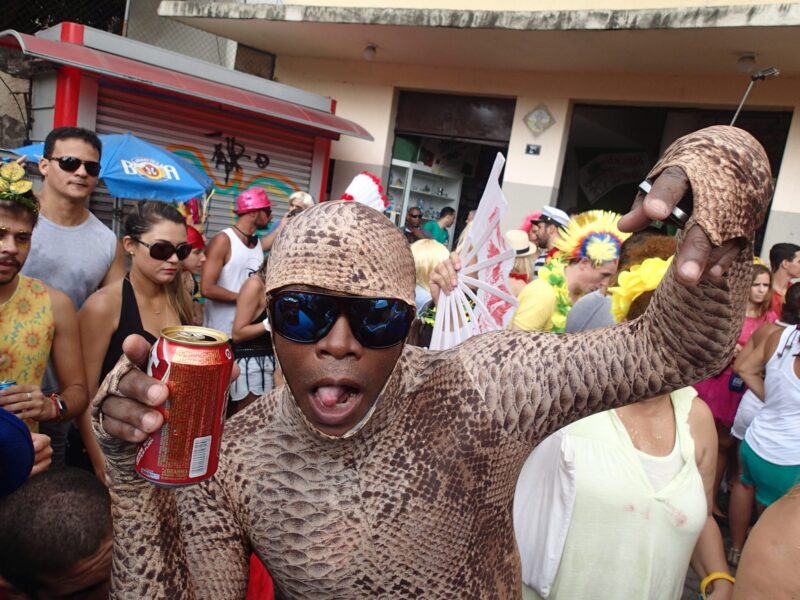
Our group of 7 had made our way north from Copacabana via the metro, armed with bags of booze and whatever fancy-dress supplies remained on the racks in our hostel. The carriage itself was its own portable Carnival. People dressed in fluorescent wigs and tutus swigged from plastic bottles filled with rum. A legion of horned demons swang from the hand rails while a man in a bow tie and braces, but not much else, danced along the aisle. At each stop, we would lose a group of costumed revellers as they alighted to join a bloco on the surface. For everyone that left, we would gain a gaggle of equally extravagant Cariocas.
Outside the Sambadrome, the party had already started in earnest. Portuguese pop music crackled from the tinny speakers of street food stalls serving up barbecued sausage to the people drinking at plastic tables. We joined the exuberant sea of people flowing towards the stadium and made our way through the turnstiles to the grandstand.

The stands at the Sambadrome are split into sectors, numbered 1-13 in ascending order. Sector 1 surrounds the start of the parade route while 12 and 13 give a view of ‘Apotheosis Square’, the parade’s finish line with its iconic arch. Sector 9 is reserved specifically for tourists and is in a great position, directly opposite the judges, meaning that the schools are putting on their best performance as they pass this point. The only problem is that tickets to sector 9 will set you back more than double what some of the cheaper sections will – 228 BRL (£55) compared to 91 BRL (£22) for an equivalent position in sector 11.


We were lucky enough to have snagged last-minute tickets from our hostel reception, avoiding the tourist trap prices of sector 9 and instead found ourselves among the Brazilians on the terraces of sector 11, the half way point. It is considered by some to be one of the most exciting sectors in the Sambadrome as it is located directly in front of the drummers’ niche, known as Recuo da Bateria. This is where the percussionists from each of the Samba Schools’ bateria are required to stop and perform for the judges, keeping perfect rhythm while spinning, jumping and dancing.


As soon as the first note of the first theme song began the whole of the grandstand was on their feet, 90,000 people singing in unison to every word. I shuffled through the information booklet I received with my ticket to search for the lyrics. It was in Portuguese and I was lost as to which verse of the song we were on. It didn’t matter, each song plays on a loop for the whole 90 minutes of that school’s performance. By the time each procession was passing me the lyrics and melody were seared into my mind, destined to be recalled as earworms at random moments throughout the rest of my life.
The procession slowly made its way down the concourse. I could get a real glimpse of the passion that Rio’s people have for Carnival. I shook as the floor vibrated with the constant stamping of feet and the pounding of drums. All around me people embraced and danced, still singing along to the theme tune as loud as when it first began. Strangers brought together by their love of Samba.

The parade itself was a feast for the senses. The Carnival King and Queen stepped out first, adorned with feathers and sequins, waving and beaming as they walked. They were followed by hundreds of dancers, their skirts ballooning out as they span in harmony and looking like brightly coloured spinning tops.
Then came the floats. Monstrous and fantastically themed, each one was a marvel to look at. As the evening went on we saw everything; a 20m tall eagle in the pose of Cristo Redentor, an enormous model of the Acropolis with Toga clad Greeks dancing through the pillars, Death riding a coffin-shaped carriage pulled by ghoulish, skeletal horses. I couldn’t believe the detail and skill needed to bring them to life, each one like a rolling film set created just for this one night.

Without a good grasp of Portuguese, I was unable to decipher any of the details about the schools in the information booklet. I had fun trying to work out the theme of each collection of floats. Some were a little on the nose – a Vanity theme of gym pumping men, a giant copy of Vogue on wheels, and the words FAME illuminated, surrounded by mirrors. Others were a little more cerebral; enormous cracked eggs surround by musical instruments, followed by an eagle-headed Jesus.
I hadn’t stopped moving for days. Between the blocos and the parties, I had been on my feet more than I had been off them. By midnight I could feel my legs burning and my feet throbbing but I wasn’t ready to stop. The sea of dancing people giving me the enthusiasm to keep dancing.

By 3 am I was done. The air was so thick with humidity that you could almost scoop up an armful and ring it out. The sweat was pouring from me and the amount of time I spent sat down between floats was gradually extending. We had made it through 4 performances but with our aching limbs, it was time to leave. I looked around and saw that the Cariocas that had frolicked none stop since 9 pm were still moving, appearing no worse for wear, just a little soggier.
As we left the metro at Cardeal Arcoverde, the sun was just starting to show itself beyond the eastern edge of Ipanema. We stumbled to our bunks, aching, sweaty and humming the samba tunes we were now so familiar with.


Tips For Visiting the Sambadrome
- Arrive fairly early (around 8 pm) to get a good spot in the bleachers. We were in the 2nd tier but stood fairly close to the front to ensure that we had a good view. The bleachers are unreserved, terrace style stands.
- Bring plenty of food and drink with you, particularly water as you will be dancing for a good part of the night and will need to keep hydrated. You can even bring your own alcohol – just no glass bottles.
- Wear comfortable shoes! I can’t stress this enough. The parades start at 9 pm and go on until 5 am, so be prepared to be stood for a long time. The Brazilians around us didn’t stop dancing for the whole 8 hours!
- Vendors will be selling food and drink for fairly cheap outside the Sambadrome, but it is worth stocking up on snacks at the supermarket to take with you into the stadium.
- Dress to impress! I don’t mean decking yourself out in your finest tux or ball gown – just go wild with the glitter, face paint and colourful wigs.

Getting Sambadrome Tickets
You can buy tickets online and collect at the box office but make sure you do so with plenty of time to spare as the cheapest seats tend to sell out. We managed to get some tickets from our hostel a couple of days before we went at a reasonable price so this is also an option if they have sold out on the ticketing website.
Grand tier boxes and VIP seating are available but as you’re on this page, I assume you’re looking for cheap seats. We recommend you go for grandstand tickets as they are reasonably priced and offer good views.
- The Grandstands in Sector 12 and 13 have restricted view, due to the fact that they are at the very end of the Parade.
- Opt for Sectors 6 – 11 if you can afford it, as you will have a significantly better view of the performance of all parts of the schools at that height/section of the Avenue.
- Buy tickets for the Private Chairs only if you cannot afford better seats.
- Sector 9 is known as the tourist sector but you are free to buy any tickets you like so avoid this and mingle with the locals!




3 Responses
I was in Rio last July and it was absolutely amazing. I really need to experience the Carnival there once in my life… it looks so colorful and fun!
Wow! what a great experience. So colorful and fun. And the music seems to have been amazing. An energy that was probably felt throughout the entire place. I have never been to a carnival but would love to experience this.
Great shots and it is just so colourful!! I dont think i have ever been to a Carnival!