High in the Beskid Mountains at 1100m above sea level, the imposing figure of Radegast stands tall, guarding the path that leads onwards to Mount Radhošť. These mountains have long been the domain of the pagan god of sun, abundance, and fertility; a cult worshipped by the Slavic tribes of the Eastern Baltic that somehow found its way to across to these rolling that border Slovakia and the Czech Republic.
For centuries, religious ceremonies have taken place at this site where the stone idol of Radegast is found, the body of a man with the head of a grimacing lion. On his scalp is a helmet in the form of a bull’s head with horns. In his right hand he is holding aloft a horn of plenty, with his left hand he is leaning against a shepherd’s axe.


This isn’t the original; It is thought that the first statue of Radegast was carved from wood and wore armour of pure gold. It was a place of worship and sacrifice, both animal and human. At the end of spring the ancient Slavs would celebrate the summer solstice on Radhošť, lighting bonfires around which they would dance and sing.
During the purge of Pagan worship and the impending creep of Christianity throughout Europe, the missionaries Cyril and Methodius ordered that the pagan idol be torn down, chopped in pieces and burnt. However, it is thought that a pagan priest rescued the statue and concealed it somewhere in the Beskid mountains, underground and out of sight within a shrine. It has never been found and remains there to this day.
The current statue of Radegast was installed in 1931 and was the work of Frenštát pod Radhoštěm sculptor Albín Polášek. He worked on the form from 1924, eventually hiring the Novák Studio in Prague to create the final piece. Sadly, the concrete and aggregate from which it was sculpted didn’t fare well in the harsh, mountainous climate and the state had to be removed for restoration in 1980. The second sculpture now stands in the entrance hall of Frenštát Town Hall, with a granite replica – created by sculptor Miroslav Machala, mason Jan Sobek, and funded by the Radegast Brewery in Nošovice, whose logo bears Radegast’s image – standing in its place on the path between Pustevny and Radhošť with its back deliberately facing away from any approaching hikers.

Despite Radegast still ruling these peaks, Christianity did manage to take hold, with the stunning timber structure of a church dedicated to the saints Cyril and Methodius being constructed at Radhošť’s summit. It’s the highest church in the Czech Republic and a pilgrimage has been regularly held here each July to celebrate Cyril and Methodius’ arrival.
In the days when Radegast’s power was at its peak, nothing much existed where Pustevny now stands, but it has gone on to become one of the most popular tourist destinations in the Beskid mountains. Sitting on a mountain saddle between Radohšť and Tanečnice, it takes its name from a group of hermits (poustevníci) who once inhabited this space. They were looking for somewhere remote far from civilisation and found it in these hills.
On the bright July day that I visited, taking the single cable chairlift up the hillside from nearby Trojanovice, Pustevny felt quite far from the remote seclusion that the hermits favoured. It’s an area that is criss-crossed with hiking and cycling trails, attracting hoardes of visitors a day during the peak months, although many come to spend time amongst the folksy, Art Nouveau buildings that were constructed here in the late 19th century.

The architecture, it seems, is what brings many people to this part of the Beskids and the colourful Wallacian-inspired structures of Maměnka and Libušín are two of the most well known, becoming an important part of the region’s cultural heritage. Alongside these two outstanding buildings are a century-old Wallach bell tower, and a series of mountain chalets where you can sleep and enjoy a taste of the local cuisine.
But as I mentioned above, until the 19th century, none of these buildings existed. At the time, Pustevny’s scenic setting drew members of the Frenštát association Radhošť Mountain Union, who set about an attempt to make the area more accessible by marking out trails and creating a network of mountain huts and refuges. The first – Pústevňa – was opened in 1891 with a second, Šumná, being added just 3 years later.
It was in 1897 that the Mountain Union commissioned Slovak architect Dušan Jurkovič to design and build both Maměnka and Libušín, both of which officially opened on 6 August 1899. He created the buildings in an Art Nouveau style, incorporating aspects of traditional Wallachian folk architecture, a decision that it seems can be traced back to his upbringing with a mother that was an expert in folk art and a father that belonged to a famous group of Slovakian patriots. The colourful touches and frescos that finalise the design of Libušín were added by painter Mikoláš Aleš who depicted Radegast, the border soldier Stavinoha and two bandits.


Unfortunately, following the outbreak of WWII, the refuges housed Hungarian auxiliary units and the Hitler Youth, leaving them damaged and in disrepair. Libušín and Maměnka were both considered for demolition but only saved thanks to the intervention of Jurkovič himself who travelled in person to Pustevny. Dispite the the Radhošť Mountain Union being disbanded and the buildings becoming the property of the state, it wasn’t until 1995 that renovation began. In 1999, Libušín’s restaurant once again started serving diners and Maměnka followed, receiving its first guests in 2003. It was at this time that the Pustevny resort was declared a National Cultural Monument.

Beyond its architecture, the area is well-known for its hiking trails. You can take a hike past Radegast towards Radhošť to give yourself a panoramic view of the entire Beskids or hike to the top of Čertův mlýn, Devils’ Mill. We decided to opt towards a slightly easier option when it comes to surveying the mountain range; taking the Valaška Trail. This 610 metre long set of wooden walkways, rope bridges and a cascading tower that rises up amongst the treetops until it reaches a height of 1099m above sea level. The glass walkway at the summit is heart-stopping experience for anyone that has a fear of heights, but it offers stupendous views of the Beskydy ridge. It would have been the perfect place for Radegast to survey his domain.


Where is Pustevny?
You will find Pustevny in the east of the Czech Republic, on the border between the Moravian-Silesian Region and the Zlín Region and just a stone’s throw from Slovakia. It is situated 1018m above sea level on a saddle of the Beskid mountain range between the peaks of Radohšť and Tanečnice.

How to get to Pustevny
The nearest city to Pustevny is Ostrava, Czechia’s third largest after Prague and Brno. There are regular, direct flights between London Stanstead Airport and Ostrava’s Leoš Janáček Airport, located 25km from the city centre and reachable via the S4 trainline.
Alternatively, Katowice Airport is located just one hour away by road with a Flix Bus service running between the Airport and Ostrava. If, like me, London Stansted is a little too far to travel to, there are regular flights to Katowice from a number of UK bases.
By Car
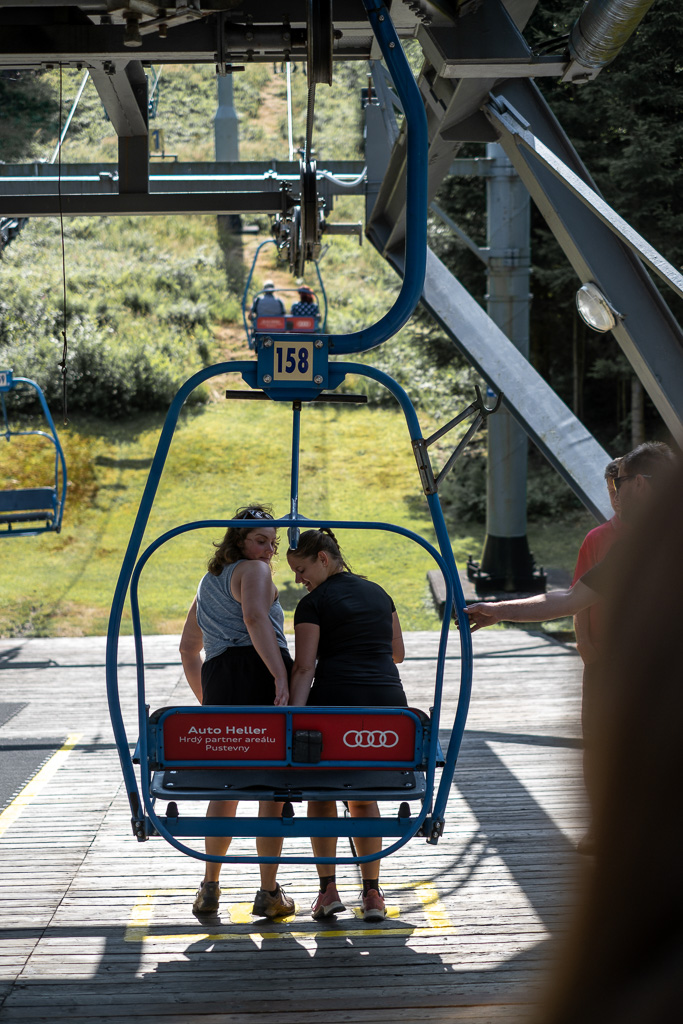
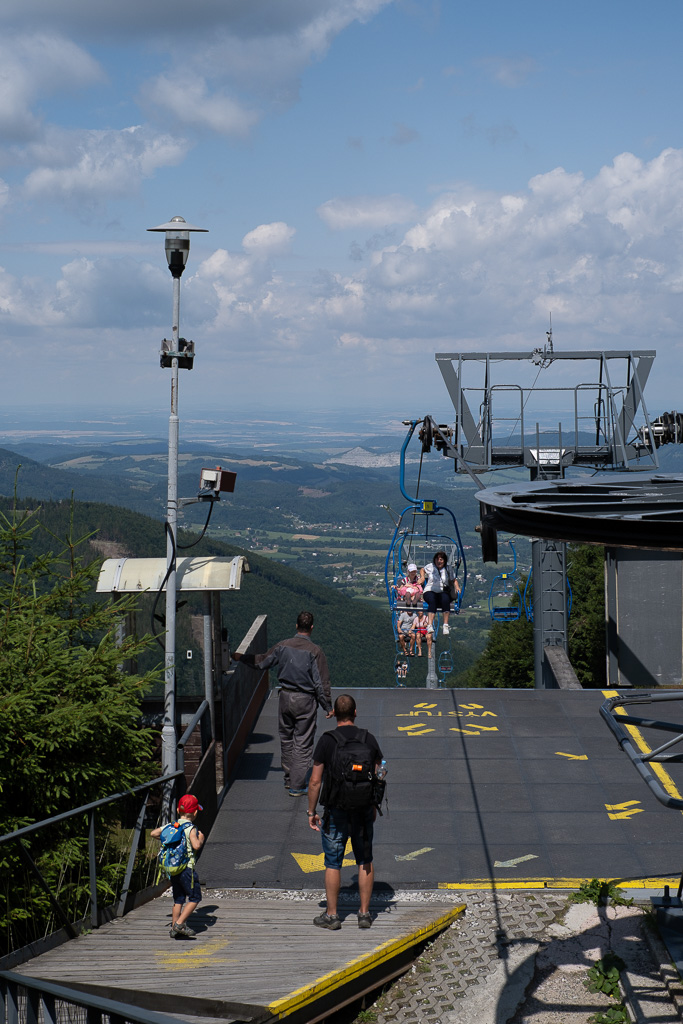
Pustevny is probably best reached by car, driving through Rožnov pod Radhoštěm and Prostřední Bečva to reach the village’s car park. Alternatively, I suggest parking in Trojanovice, to the north of Pustevny, and taking the single cable chairlift up to the village. The ride takes around 10-15 minutes and costs 220 CZK one way or 270 CZK for a return journey.
By Train
The nearest train station is in Frenstat. From here you can either walk to Pustevny following the blue-marked trail or take the bus to Trojanovice from where you can hike up hill or ride the chairlift.
By Bus
From Frenštát you can catch the bus to Trojanovice, alighting at the stop next to Hotel Ráztoka. From here you can take the chairlift up to Pustevny. If travelling via Rožnov pod Radhoštěm, you can take the bus from the main bus station via Prostřední Bečva. Pustevny is the last stop.
Things to do in Pustevny
Pustevny is the most popular recreational centre in the Beskid Mountains and offers a host of outdoor activities. In spring and summer it makes an excellent starting point for both hiking and cycling, while in winter, the tens of kilometers of well-maintained trails provide are popular with cross-country skiers. However, even if you are not looking for activities that aren’t bound to raise your heart rate, there is still enough to do in Pustevny to keep you occupied for a day or two.
Stezka Valaska
The Stezka Valaska is a wooden walkway that winds its way through the treetops, leading to a lookout tower on the slope of Mount Tanečnice. It boasts the only cableway in the Czech Republic and the longest skywalk in Europe. In good weather, it’s possible to look out across not only the peaks of the Beskids but also the Jeseníky Mountains and the peaks of Slovakia’s Great Fatra, Považský Inovec and the mine heaps in Rybnik, Poland.


See Dušan Jurkovič's Architecture
Until 1890, there were no buildings in Pustevny. The stunning timber structures that now dominate the area were commissioned by the Frenštát pod Radhoštěm hikers club as refuges, designed by Dušan Jurkovič and Michal Urbánek. Libušín and the neighbouring Maměnka were built in the Art Nouveau style with Jurkovič borrowing heavily from the folk style of the region, incorporating Wallachian features into the mountain huts. They were opened officially in 1889. Both of Jurkovič’s buildings are National Cultural Monuments.
Little bell tower
Another of the wooden constructions designed by Dušan Jurkovič was the 100-year old wooden bell tower. Unfortunately, the small, decorative structure didn’t survive the last century, but the original blueprints that were stored in the Slovak State Archives in Bratislava, were used to rebuild the tower in 1997.

View the Ice Sculptures in Winter
While Pustevny is a hikers paradise in summer, come winter, the snow-covered mountains attract skiiers that flock here for the well-groomed slopes and cross-country trails. Adding to the winter magic, is a display of intricate ice sculptures carved by skilled artists along with an outdoor market that runs throughout January.
Where to Eat and Drink in Pustevny
Despite its small size, there are several restaurants and snack bars dotted around Pustevny. Restaurant Libušín may be the most widely known, but the majority of hotels situated here serve food, usually local specialties.
Restaurant Libušín
If you are going to eat anywhere in Pustevny, it should be Libušín. Built in 1899 according to a design by Slovak architect Dušan Jurkovič, the stunning Art Nouveau Libušín cottage is as beautiful inside as it is on the outside. The dining room is decked out in ornate, teal wood panelling and hand-painted frescoes making it an incredibly atmospheric place to dine on their menu of traditional Wallachian dishes.


Upper Chairlift Station
Although the original chairlift station that stood in Pustevny and had been in operation since 1937 had to be demolished in 2016, the new station is a beautiful building, designed in stone and glass by Kopřivnice architect Kamil Mrva to fit in perfectly with the surrounding nature. The adjoining restaurant has floor to ceiling windows giving diners a stunning panoramic view of the Beskid mountain range and valley surrounding Frenštát pod Radhoštěm.
Koliba Valaška
The dining room at the reconstructed wooden cabin of Koliba Valaska is incredibly atmospheric, decked out in woodpanelling with a large stone fireplace acting as its centrepiece. It’s on this fire that Wallachian specialities such as strapačky are prepared.
Where to Stay in Pustevny
Hotel Maměnka
Built according to the design of folk architect Dušan Jurkovič, the stunning Hotel Maměnka is a national cultural monument. All of the 11 fully equipped rooms are hand painted in the Wallachian style, giving it a unique atmosphere and all meals for guests are served in the Libušín restaurant, which is also a national cultural monument.
Hotel Tanečnica
One of the oldest mountain hotels in the Czech Republic, Tanečnica has been operating for almost 97 years, first opening its doors in December 1926. It’s conveniently only 150m from the ski lifts and hosts both an indoor pool and a small gym as well as a large restaurant and outdoor terrace.
Yes, the rooms are decidedly retro, owing to it last undergoing renovation in the 1980s but it makes a perfect base for hiking and cycling in the local area.
Those looking for for accommodation with even more significant historical heritage can opt for the ‘presidential suite’, named because, according to records, the first Czechoslovak president Tomáš Garrigue Masaryk spent the night in this room during his visit to Wallachia in 1928.
Hotel Radegast
Situated at 1,121 meters above sea level, just below the peak of the towering Radhošť peak, the wooden structure of Hotel Radegast offers breathtaking views of the surrounding Beskydy Mountains and the landscape of Wallachia.
Built between 1933 and 1935 in a typically local style, the hotel has 13 rooms as well as an onsite restaurant.