
Arriving in Phu Quoc is a little like arriving at a party hours before it begins. The decorations are still in boxes, the balloons are waiting to be filled and the fairy lights not yet plugged in. You see, the island is currently in a state of mass development with a network of new roads weaving their way around its length and breadth and hotels being built at a breakneck speed. Wherever you look you look there’s building work, road crews and masses of orange cones.
Like most of Vietnam, Phu Quoc has a complicated past. Over the years Vietnam, Cambodia, France and the US have all staked a claim for the land with the dispute between Cambodia and Vietnam still ongoing today. It is closer in distance to Cambodia in the Gulf of Thailand than the Vietnamese coast and has been a bone of contention between the governments of the two countries, with the Cambodian opposition and irredentists still claiming that the island is Cambodian territory.

At 50km in length and 25km wide at its widest, it is Vietnam’s largest island – covered in dense jungle and with long stretches of beautiful sand, it was once a sleepy fishing community known more for its pepper farms and fish sauce (reportedly the best in Vietnam) than for its tourism. This is all set to change with the Vietnamese government looking to attract a multitude of foreign investors in a bid to make Phu Quoc Vietnam’s premier holiday destination. I’ve looked at the list of planned developments and it is ambitious to say the least.
This all becomes apparent as soon as you arrive at the brand new international airport – billboards and displays line the arrivals hall showing shiny, computer-generated artist impressions of vast resorts, plastered with names like Hilton, Marriot and Park Hyatt. I wasn’t heading to any of these. Instead, I had booked a room at the budget Praha Hotel which, for the price, was pretty nice. Set back just a few hundred metres from the beach, it had spacious rooms, a sea view and even a pool. It may have been cheap but to a backpacker like me, this felt like luxury.
Long Beach lives up to its name; It’s a 20km stretch of sand running along the west coast of Phu Quoc. To the south of Long Beach are the luxury resorts and villas and as you move further north towards Duong Dong town you begin to find more rustic accommodation and the Long Beach Village, the islands very own backpacker district. My hotel was closer to town than the opulent resorts of the south but a short schlep over some muddy scrub land brought me out onto an expanse of beach that was as good as any the wealthier traveller was paying for in other parts of Phu Quoc. Small shacks and beach bars lined the edge of the sand, loungers scattered around and barbecues were set up waiting for someone to sample that days catch. I grabbed a beer and settled in to wait for the sun to go down.
Being one of the few Western facing beaches in Vietnam, Long beach is famous for its spectacular dusks as the sun slowly lowers itself into the Gulf of Thailand. Gradually the light began to fade and the sky was illuminated, first with shades of orange, then with pinks, reds and finally purple, silhouetting the bathers swimming in the sea in front of me. With an evening display like this, I couldn’t help but congratulate myself on the brilliant decision to book that last minute, cheap flight and head here from Ho Chi Minh City.
To see the island fully, it’s worth renting a motorbike or scooter to reach the deserted northern beaches or the stretch of white sand at Sao Beach. Using a taxi to travel the length of Phu Quoc was going to be a budget breaker so, at $5 a day for the bike, I couldn’t say no. The hotel owner wheeled a scratched and haggard-looking moped to reception and handed over the keys and my helmet. The inner lining coming was coming away from the outer shell meaning that whenever I tipped my head forward, the lining would stay in place but the helmet itself would slide forward over my eyes. It wasn’t worth arguing in broken English or over the $5 I had paid so I accepted my tired-looking safety gear and headed South.

The road was a major highway connecting Duong Dong to the less developed town port town of An Thoi in the south. It is essentially a 2-3 lane highway to cater for the traffic that has not yet made it to the island. For miles at a time we were the only vehicle making use of this new infrastructure. On one side of the road there was nothing but trees, jungle and the occasional shack but on the coastal side, the landscape was essentially one long building site. Miles and miles of half-built resorts were sprouting up and excavators dug away at the land, laying the foundations for whatever 5-star behemoth was going to be placed there.
We occasionally were stopped in our tracks by lines of orange cones (the orange cone being the unofficial mascot of the island) signalling the sudden lack of the tarmac, only to be ushered around by the crew of workmen spreading the black tar across the ground. It seems the lack of road can’t stop the people of Phu Quoc as the other drivers and I continued on, undeterred by the fact that we were driving across the road’s foundations as the road crew were busy laying them. It’s times like this that I regret not arguing for a better bike. The lack of suspension shaking me to my core as we bumped over the gravel, each bump nudging my helmet further down my forehead and across my eyes.
After a short detour (read: getting lost) in An Thoi, I had finally made it to Sao beach. Taking a dirt road through the jungle I knew I had arrived in the right place when I saw hundred of scooters similar to mine unceremoniously dumped in a corner of the parking lot.

Sao Beach is known to be Phu Quoc’s premier stretch of sand, some even saying it is the best in Vietnam. As I walked out towards the sea I wasn’t going to argue. With its turquoise water, powdery white and swaying palm trees, it is the perfect picture postcard of paradise. It feels less developed than Long beach with its few small restaurants and hotels hidden by the surrounding jungle and palm trees. This isn’t to say that it is quiet though as a bus full of Vietnamese tourists laid claim to one of the beachside bars and began to partake in Vietnam’s favourite, and least endearing past time – unbearably loud and out of tune Karaoke.
The previous night had been my first experience of South East Asia’s passion for wailing like a bag of cats being thrown against a wall. The bar across the road from our hotel had its sound system turned up to teeth splitting levels with nails across a blackboard singing that made our windows rattle. I wouldn’t mind too much but we were subjected to an hour of the same Vietnamese show tune and there were only 3 drunk men occupying the bar. Add to this the sounds of what could only have been a whole removals team scraping furniture around the room next door (I guess I now know why Vietnamese hotel rooms have signs saying “please do not rearrange the furniture” – This must be a common occurrence). Let’s just say I didn’t get much sleep.
Other than the few bars and restaurants lining the sand there is not a great deal to do here. I love a beautiful beach but can only take lounging on the sand for a few hours before I start to get itchy feet. I wandered partway along the 7km stretch of coast for a bit, taking photographs and generally admiring the scenery. I took the occasional dip in the crystal clear, warm water but by mid-afternoon, I was ready to go.

One thing to note about Sao beach is that it is not as pristine as it once was. With Phu Quoc’s newfound popularity comes the problem of litter and a waterline that is strewn with plastic bottles, beer cans and food packaging. One man seemed to be walking the beach and attempting to pick up any trash he could find but it seemed to be a losing battle. For every bottle he collected, another two would wash up, drifting over from the harbour and town of An Thoi across the bay. It’s a shame as I can on only imagine how this beach could have been just a few years before. Pristine and empty stretches of squeaky white sand with not another single person in sight.

I made my way back to long beach. The road crews had left but sections that were just rubble when I headed south just a few hours before were now completely finished. Newly dug foundations marked where they would continue to lay their tarmac the next day. It was being paved at such a rate that if I had decided to stop my bike and spend the night here, by morning I would wake up to a new highway on either side, a roundabout circling me to so motorists could avoid the sleeping tourist.
On an evening the centre of Duong Dong comes alive as crowds descend on the daily Night Market. Each night the roads around the centre of town close and vendors stack dozens of tanks of live seafood outside their restaurants to entice the tourists. Lobster, crab, squid and prawns fill aquariums and platters lining the road – the idea is to pick your meal as it is still swimming around so that it can be plucked from the tank and barbecued for you fresh.

This is not the usual food market that you see around Vietnam, it’s for the benefit of tourists with prices to match. I managed to squeeze my bike into a gap on the overcrowded pavement and set about trying to find somewhere cheap, keeping an eye out for anywhere busy with Vietnamese people or locals as that will usually signify that a place has good food at a low price. I squeezed into a tiny plastic chair alongside tables full of old, drunk Vietnamese men chain-smoking and pounding back beers like they were going out of fashion. I had a look around at the groups nearby chinking their glasses and wolfing down plates of noodles and decided that if that’s what everybody’s having, I should too.
We were brought plates of noodles and a flame-blackened fish, still in its entirety. The food was okay but it didn’t excite me in the same way that the street stalls and food carts in Saigon had. At double the price of street food, I knew that this would be one of my last restaurant meals in Vietnam.
Feeling suitably relaxed from the previous day, I wanted to spend the morning driving north in order to find an untouched beach to myself, see the fishing boats bringing in their catch and have a little solitude. Although Long Beach is fast becoming a building site, the north remains relatively untouched and I couldn’t wait to explore the wilderness of the Island.
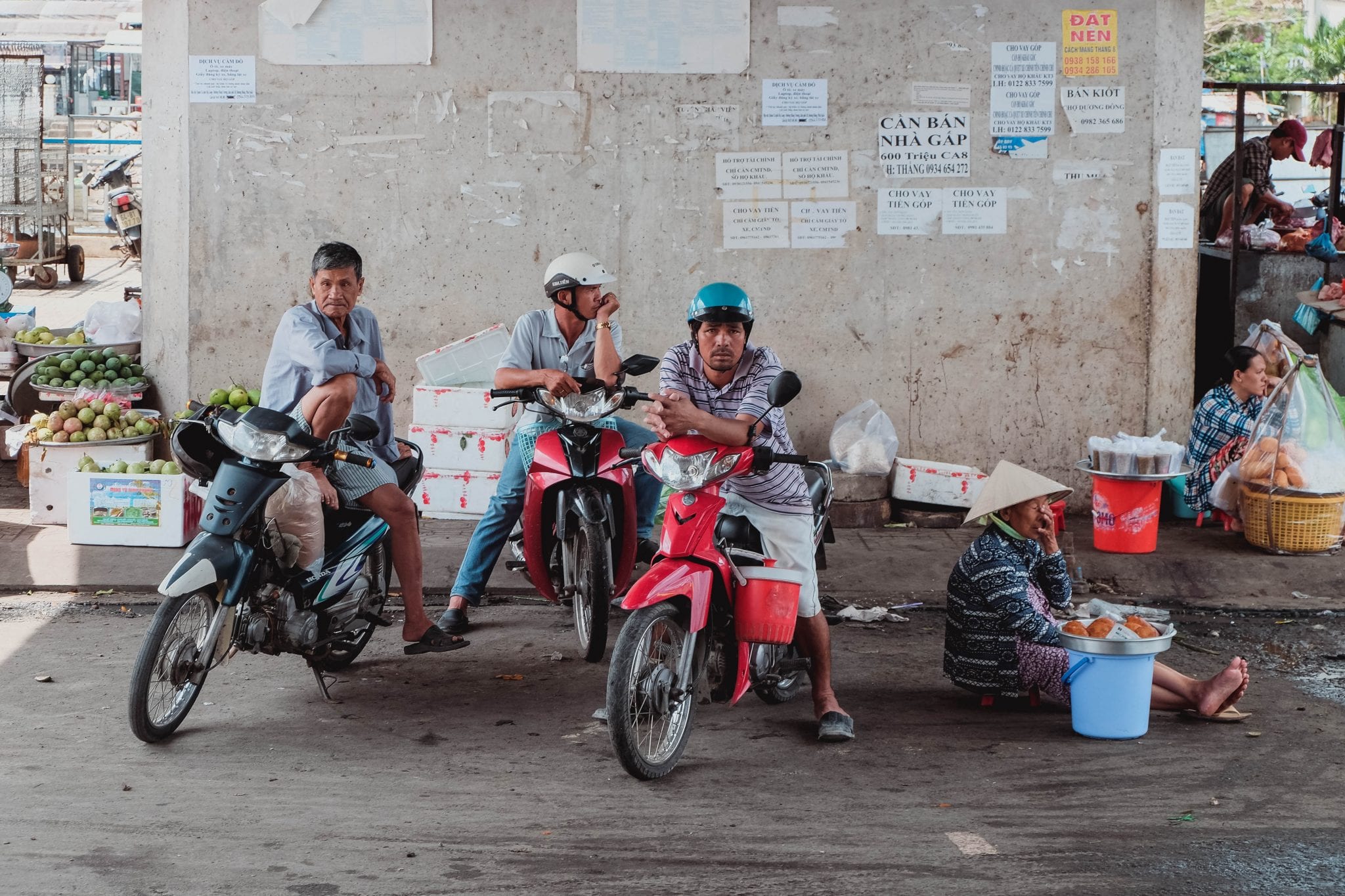
My search for serenity would have to wait. Driving through Duong Dong I somehow managed to take a wrong turn at a T junction and instead of finding myself on the main highway out of town I was suddenly surrounded by masses of honking scooters all jostling for position on the road as crowds of pedestrians weaved in and out of us carrying huge baskets of produce. I had stumbled upon Duong Dong Market.


Whatever development is taking place on Phu Quoc, it seems to have completely bypassed this small enclave of streets in the town centre. I imagine the market was the same before the hoards of tourists began to move in and will be the same long after they’ve gone. Wherever I go I like to wander markets, not the ones filled with trinkets such as t-shirts and fridge magnets aimed at me and other tourists but the food markets and the ones selling general household items – I think this, more than anything else, can give you a feel for a town.

I parked my scooter under the flyover and paid the 2000VND fee. Lining the main street were plastic buckets filled with every variation of seafood you can imagine; prawns, scallops, rays and even dogfish. Some stalls had small, water-filled plastic bags that were teaming with strange, colourful strands and what looked like frogspawn. My Vietnamese is none existent so I was unable to inquire about their contents. It looked like something from a sci-fi movie.
People buzzed by on motorbikes, stopping for a second to pass a few Dong to the women sitting on the curb, their baskets overflowing with unfamiliar fruits. At one end of the street wooden stalls were decorated with curtains of hanging meat, at the other, the meat was very much alive as counters were teaming with clucking and pecking chickens.


It was good to see that although the government are selling vast swathes of land and huge corporations are moving in, there is still a section of the island that retains its character. It’s the perfect antidote to the sanitised and overpriced beach resort scene – a place to get a taste of working Vietnam.
I continued Northwards out of town, clinging to the coast to avoid the main highway, passing small fishing villages with their own secluded beaches, as of yet untouched by developers. Small boats bob in the bays and people string up squid to dry on lines zig-zagging between their corrugated shacks.
After half an hour of driving through villages, the track came to an abrupt end, a barrier of trees blocking the way with just a small path leading into the jungle. I had come too far to turn back towards town so I pushed on, my moped skidding in the dirt but managing to find it’s way through the trees. At a small group of shacks in a forest opening, a woman waved and smiled frantically, clearly aware that I was lost but knowing that I was searching for a beach. She pointed in the direction of even more jungle and went back to relaxing in the shade. I emerged from the tree line to find myself in the middle of a luxurious 5-star resort, much to the shock of both me and the hotel’s patrons. The beach here was cordoned off for the benefit of the guests and to keep out the riff-raff which, in this case, was probably me. With that in mind, I left by the Hotel’s entrance and joined the highway in search of a more welcoming spot.
I sped down the motorway, veering off only when I spotted a sign inviting passing motorists to venture into the villages of Cua Can. The road crisscrossed small rivers, occasionally on small wooden bridges with barges and fishing boats passing below, on their way to the sea. The town was empty, the shops all seemed to be closed and I didn’t see a soul on the street – A sharp contrast to the chaotic market that I had just left. I carried on past the deserted Cua Can beach towards Vung Bau.

A couple of mopeds were already parked in the shade of the palms and I could see their owners, a group of fellow backpackers, tentatively scanning the bay to see if this was where they wanted to spend their day. Tourist boats bobbed in the sea a hundred metres from the shoreline, their cargo of orange-vested tourists spilling off into rowing boats to come ashore. Even heading this far North it is hard to get away from the crowds as boat trips spend the day circling the island in order to visit all of Phu Quoc’s more remote, tropical beaches. I stayed for a while, taking advantage of the one industrious family that had set up shop here, catering to boatloads day-trippers in need of a drink. Despite the multitude of rowing boats currently reenacting the D Day landings on its sand, Vung Bau still felt peaceful. It took an hour to get here but that meant it was an hour away from the thronging crowds of Long Beach and Duong Dong. It felt completely remote. There is no knowing how long it will be before the surrounding forest is sold off to developers with plans for mega resorts but I felt a little privileged to experience the tranquillity before it happens.
I returned to the highway and pulled in to Long Beach Village just in time to catch the last light of the afternoon, whiling away the time until sunset by swimming and dozing on the sand. When dusk did arrive it put on another spectacular show. The fading orange sun once again lowering itself into the ocean and the sky lighting up with oranges and red before the whole sky was painted purple and the stars began to appear one by one in a glorious finale to my time on the island.

You have to worry about Phu Quoc. The stunning beaches and densely forested parks are already showing signs of deterioration due to the rapid spread of sprawling resorts. Once a remote, nature-filled oasis, it is fast becoming a paved playground for holidaymakers. There is a hope that the 100,000 permanent residents can take full advantage of this by providing tours, restaurants and other services to cater for the influx of tourists but there’s a strong possibility that the majority of the capital will be heading overseas, into the pockets of major international hotel chains. Only time will tell how this little island will cope.


32 Responses
Hey Dave.
Thanks for the read that made us laugh and nod our heads due to the accuracy we feel and shake our heads due to … well, the accuracy of it all. We are currently sitting in a beach bar in phu quoc feeling a little Alien in the crowd of instagrammers and resort lords, while the amusement park like elevator music is putting us in some trance state. It didn’t change since your trip.
Greetings, Ronja & Jan
I have been to this island 3 times but all in about a year in 2014. The first time was just after New Year in 2014 when I was there and the island was so beautiful, many untouched places, amazing nature and quiet and nice but the second time already I saw the construction had started and third time I was already sad. Building aqua park, crazy posh hotel settlements had started to rise on this tiny island ruining wonderful places of the island. Shame, don’t think I’d want to return anymore as I got a glimpse of the beauty in the paradise island before. And it seems now, the paradise is almost lost.
Hi Dave, yes that sure looks like a great spot to get lost.
Thanks for the guidance and tips on the area. We must look into traveling there very soon.
Cheers Sharon…
Phu Quoc is beautiful, but there are still many potential aspects that need discovering and maintaining. but still, I hope everybody coming to this place to have a nice and unforgettable memory about it.
I was here in April 2014 and it was undergoing some huge hotel developments then. Evident by the makeshift villages set up in the middle of nowhere with rubbish all around them, it was clear the direction this Island was going to be taking.
A quick glance on Agoda shoes the sheer number of available accomodations that wasn’t so just 3 years ago.
We are doing a tour of Japan and Hong Kong in December and are considering Vietnam for a few days over Xmas. My girlfriend hasn’t been to Phu Quoc so we are giving it some thought, I’m just hoping that the small island hasn’t lost its charm….
It still has its fair share of charm, If you head north from Duong Dong there are still plenty of small communities, quiet beaches, and fishing villages. Most of the huge hotel development seems to be on Long Beach and south of the airport so it is possible to avoid it. You are right about the rubbish though, on the sections of beach with no hotels the rubbish was just left to wash onto the sand and there were piles of it by the sides of the new motorways. It is such a shame. Hopefully, you will get to visit and it will still be as charming as you remember.
The photographs of the dusk look so stunning. Phu Quoc seems like a surreal island. The beaches and the night time market look gorgeous. I wish I can visit this place soon.
You have quoted the correct title: Paradise! It is actually a Paradise right now but these upcoming building and resorts with so much flow of tourists will not leave it a paradise. I wish some miracle happens and the Phu Quoc Island retains its beauty.
Never heard of Phu Quoc island before but it looks surreal! Also, the food market and Sao beach look amazing!
I think Sao Beach and the Market were definitely my highlights! The food market was so busy with people and rather intense!
What an absolutely gorgeous set of sunsets but it really is too bad about the hotels. I think 1 or 2 should be enough. Why build so many the island looses its charm?
I can see why they are building so many as they want to have it as Vietnam’s main holiday destination. It may be fine once construction is complete but it feels like they are going a little overboard!
I hope it doesn’t get spoiled by tourism. Your photos show how stunning this is. That beach looks positively idyllic and I’m always up for dinner in a good food market, particularly if it’s Asian food. Great share for #FarawayFiles
Hopefully it won’t. At the moment there is so much construction that it is hard to see what it will be like once everything is completed.
It’s interesting hearing about how Phu Quoc has changed and is continuing to change. I guess there is no going back at this point to the way the island once was. It’s just going to change for better or worse depending on your point of view.
Yes it seems that tourism has now taken over the traditional industries here but only time will tell if it is better for the people of the island or not!
I adore South East Asia for the markets and the sunsets – thanks for sharing these by the bucketload. Cant wait to get back to Thailand #FarawayFiles
You describe Phu Quoc so well. There are some places where as soon as you enter you get a party kind of vibe. I guess this place is exactly like that.
Your sunset pictures are stunning! I love that you choose to see the island by scooter, that’s our favorite way to explore new places if we can! And $5?! Steal!!
It was one of the best sunsets I have ever seen, the colours were unbelievable.
Such a stunning place! Never heard about it earlier though. It’s really good the government agencies are taking up development seriously but i hope it is done sustainably.
I hope so too. It is hard to tell how the island will cope at the moment and the amount of trash caused by the development is a bit disturbing but we will have to wait and see.
Good photos. I spent six months in Vietnam ages ago and never got to the south–it was undeveloped and transportation was tough then. Good for you for renting the motorbike, as that’s absolutely the way to get around anywhere in the country.
I think transportation must have improved significantly since you were there as now it is very east to hope on a bus or train between cities with plenty of options catering to tourists. It was a little different on Phu Quoc but that looks set to change with all the infrastructure improvements.
Wow, definitely looks like paradise! Nice pictures, you captured its beauty well!
Thank you Kristof
Wow, you kind of get the feeling that you’re experiencing a way of life that’s going to be rapidly eroded and replaced with a commercialised reproduction. If increased development assured an improvement in quality of life for local residents that would be one thing, but alas so often these kinds of projects don’t end up helping locals much at all. But, time will tell, right?
We can always hope. There will be a lot of opportunities for them in the tourism industry but it does feel that most of the money from the visitors will go to international corporations. Hopefully the fishing industry of the island won’t be lost.
From your beautiful photos and descriptions, it seems like Phu Quoc is gorgeous. It’s a shame that it’ contested by both Cambodia and Vietnam and maybe that’s why it’s not quite as developed-transport wise.
I think a lot of it is due to the size of the island too as it is only small. The new roads should make transport a little easier but i’m not sure how the public transport infrastructure will improve.
I wish I’d have made it to Vietnam while in southeast Asia. So much untouched beauty, it looks like paradise!
Parts of it are paradise but unfortunately as I said in this post, it’s not going to stay untouched!