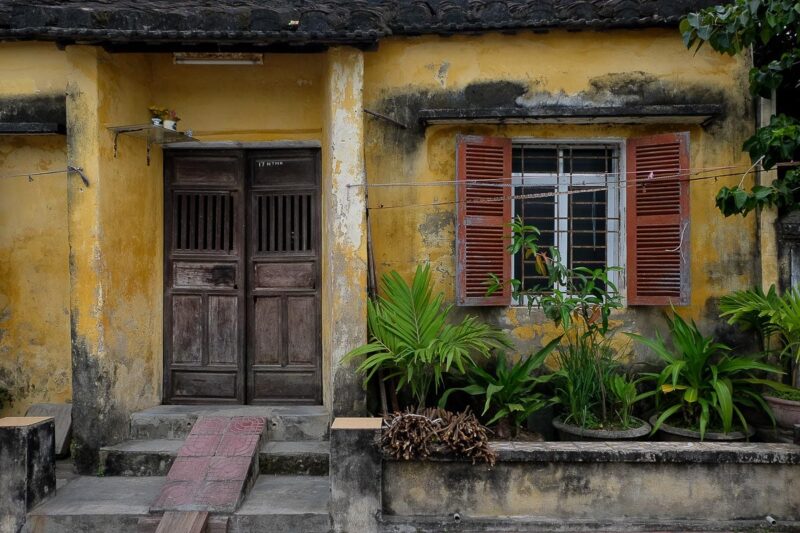
Fringed by pristine, white sand beaches and surrounded by picturesque rice paddies, the port town of Hoi An in the centre of Vietnam’s long eastern coastline exudes old-world charm and atmosphere. Age-worn canary yellow houses line the streets, decorated with silk lanterns that are strewn across every passageway bathing the streets in a colourful glow come evening time, while each morning fishermen unload their hauls of glistening fish for the waiting market traders.

For centuries the town, once known as Faifo, was the principal port of the Cham Kingdom and then, in the 17th century, its coastal position on the Thu Bon River delta allowed it to become one of the busiest ports in South East Asia. The Champa Empire eventually fell in 1832 but the port of Hoi An flourished, bringing in traders and ships from as far afield as Europe and East Asia. The Nguyen rulers even allowed Chinese, Japanese and Dutch communities to settle here while keeping their own customs, building houses, shops and even streets. Despite the shipping trade moving to nearby Da Nang a long time ago, this cultural mishmash still remains in Hoi An’s historical centre where a jumble of differing architectural styles – there are over 1,000 wooden frame buildings in the form of temples, shops and assembly halls –making it a fascinating melting pot of east meets west.
Although Hoi An itself is now devoid of any indication of the Champa Empire’s past might, head inland down the winding Thu Bồn River, past rice paddies, wooden rural villages and into the jungle and you will eventually reach the remnants of My Son Sanctuary, a sprawling complex dedicated to the god Shiva built over a thousand years by a string of Hindu kings.
The History of My Son Sanctuary
The Champa Empire rose to prominence in 192 AD, with its Hindu population heavily defining the culture of central and southern Vietnam until its fall in 1832. The Champa had come to Vietnam from Indonesia, bringing Hinduism to the country, building My Son as early as the 4th Century. Its strategically defensible position near the mouth of the Thu Bồn led to complex becoming one of the empires principle cities and from its inception until the 14th century, it gradually expanded, with tens of thousands of labourers, architects, and master builders constructing over 70 temples.

The name My Son translates to ‘beautiful Mountain’ referring to its position nestled in the lush jungle beneath the peaks of Cat’s Tooth Mountain. It soon became the political centre of the Champa Kingdom, used for religious ceremonies by the kings of Champa as well as a burial place for those considered Cham royalty and national heroes.
In 1832, the Cham Kingdom finally fell to the Vietnamese Kingdom and was absorbed, leaving My Son abandoned to be overrun by the forests of Quang Nam. Today, less than 200,000 Cham people remain in Vietnam, although many became Muslim and moved west to modern-day Cambodia.
The ravages of time and war have not been kind to My Son. During the American War, Viet Cong soldiers were believed to have used this complex as a repository of military supplies. The section of My Son with the largest temples was subjected to carpet bombing by American B52s, turning the majority of the site to rubble. Just 17 of the 70 temples remained standing but thankfully, international efforts have managed to conserve what is left, allowing the site to be awarded UNESCO World Heritage Status in 1999.
Much of My Son’s survival is down to the work of two men; French architect, archaeologist and historian, Henry Parmentier and Polish-born Kazimierz Kwiatkowski. Parmentier began slowly excavating My Son in the late 19th century, working hard with his team to discover the 72 monuments within the two kilometer wide valley, while Kwiatkowski is widely considered one of the most important figures in the effort to preserve cultural sites all over Vietnam, coming to the country in 1980, as part of a joint Polish-Vietnamese cultural preservation team. Until his death in 1997, he cleared landmines and fought with the Vietnamese government to uncover the region’s most important historical treasures. He is the main reason that My Son Sanctuary and Hoi An’s Ancient Town are recognised as UNESCO World Heritage Sites and is one of the few foreign nationals to have been recognised with a monument in Vietnam.
How to Get to My Son from Hoi An
My Son is around 55km (1 hour) away from the popular tourist town of Hoi An and approximately 70km southwest of Danang, near the village of Duy Phu . Unfortunately, there is no reliable public transport from Hoi An to the ruins, so in order to visit you will need to either need to hire your own bicycle/motorbike, rent a private taxi, or visit as part of an organised tour.

By Car or Moped
I recommend hiring a moped and driving the 55km yourself. The ride through rice paddies and smaller villages gives you a greater sense of what the region has to offer. The majority of the route is well signposted and driving yourself means that you can arrive before the tour buses and spend as much time as you wish at the ruins.
I rented a scooter in Hoi An for about £3 – 5 (100’000 Vietnamese Dong), and the fuel for a return trip Hoi An didn’t cost much more than a few pounds. Be aware that you will be driving through rural areas where the roads aren’t always well-maintained and can become treacherous in the rain and muddy conditions.
Although the route is well marked once you approach the site, I recommend using google maps to direct you, or if you don’t have international roaming on your phone, pre-save the directions.
By Taxi
Tours to My Son
Most hotels, hostels and tour agencies in Hoi An or Danang can arrange day trips to My Son. These are often surprisingly affordable and will set you back between £5 and £10 per person.
The tours generally leave the city at 7 or 8pm, returning between 1 and 2pm, giving you just a limited amount of time to explore the ruins. However, this is by far the simplest option for visiting My Son.
If you have a thirst for historical knowledge, it is worth booking with a reputable tour company to guarantee that your guide has a good working knowledge of the site’s past to help your appreciation for what you are seeing. Independent travellers can hire a guide at the front gate for about VND500,000 for the day.

When is the Best Time to Visit My Son?
I would advise visiting My Son first thing in the morning or late in the afternoon. The full complex can take around 3 hours to explore fully, so doing this early or late in the day will help you to avoid the intense midday heat that isn’t uncommon in this part of Vietnam.
USEFUL INFORMATION
My Son is open from 6.30pm to 5pm and entry to the site costs VND150,000 (approx. £5).
Unlike other temples around the world, there is no dress code for visiting My Son so you are not required to cover your shoulders and knees; shorts, singlets and crop tops are permitted. However, this is still a religious site so I would advise dressing a little respectfully.
Where to Stay Near My Son
Most people choose to base themselves in the historic city of Hoi An, an hour’s drive from the ruins. Strewn with strings of paper lanterns and daubed in a vibrant, golden hue, the old town of Hoi An is easily one of Vietnam’s most delightful tourist centres. Unesco World Heritage status has meant that so much of the grand Chinese and Japanese architecture (over 800 buildings have been earmarked for protection) that has been painstakingly preserved, meaning not much has changed in the city – at least superficially – for hundreds of years.
Vietnam Backpacker Hostel
One of the latest offerings from the trusted chain of hostels, Hoi An Backpacker Hostel has everything a traveller could need. It is centrally located halfway between the historical town and Cửa Đại beach. As well as having a huge pool, the hostel offers a free breakfast, nightly themed parties and has an on-site bar. For those looking to get out of town, trips to My Son and the Cham Islands, as well as further afield, are organised by the hostel.
Sunshine Hotel
After slumming it in sketchy Saigon hotels, Sunshine Hotel felt like a backpacker’s dream to me. Hot, powerful showers, a spacious room, and expansive, free breakfast meant I was in my element. It is situated a little far from the action (around a 30-min walk to the riverside) on the edge of town but they offer a free shuttle to the historic centre and have bicycles that you are able to borrow to explore the surrounding rice fields. The outdoor pool is a lovely bonus.
Under the Coconut Tree
Situated, yes you guessed it, in a lush grove of coconut trees, Under the Coconut Tree is a stark contrast to the bustle of Hoi An’s historic centre. It is fairly rustic; bamboo and rattan huts clustered around a huge communal dorm, each bed coming with mosquito nets, power outlets and an under-bed locker. The private rooms aren’t too fancy but it is also just a short walk down a private path to the beach, making this the place to stay for backpackers in An Bang
Is My Son Sanctuary Worth Visiting?
Modern day My Son is very much in ruin thanks to the indiscriminate bombing of American B52s during the war. Bricks crumbled, walls fell, and nature slowly reclaimed the land. The once-grand temples are now moss-covered with shoots and plants sprouting from every possible crevice. This wasn’t always the way. When My Son was first constructed, the skilful artisans crafted each tower and temple from an ingenious mixture of soft bricks and sandstone. Once a tower was completed, the Champas burned it at a low temperature to harden the structures to stone, removing the need for mortar.


Some people like to describe My Son as Vietnam’s Angkor Wat, but it seems an unfair comparison; There are fewer ruins here and much of what remains is confined to a 200 sq metre area split into three basic areas; Group A, Group B, and Group C. All that remains of group A, once containing the largest and most important monument at My Son, is rubble, with the area being intentionally finished off by a helicopter-borne sapper team.
Group B contains some of the first temples to be built on the site and was dedicated to Bhadresvara, which is a contraction of the name of King Bhadravarman, who built the first temple at My Son, combined with ‘-esvara’, meaning Shiva. Temples of Group C were built in the 8th century and used to worship Shiva. Ornate carvings and statues dedicated to the gods can still be seen here amongst the vegetation and ruin.
At the entrance to the site is an impressive museum with detailed information on Cham culture and religion as well as statues, artefacts and carvings rescued from the ruins.

While My Son may not be as impressive as Cambodia’s Angkor Wat, I consider it a must-visit if you’re in the Hoi An region. Despite its current condition, there are few other places where you can find remnants of an era of Vietnam’s past that’s largely been lost to history.