
It seems that if you want some peace and quiet in Vietnam you have to be awake at 5am. We walked along the streets of Can Tho with barely anyone else in sight, not a single car or moped on the road and the only sign of life was the gaggles of old men already huddled around tiny plastic tables on the roadside in a thick cloud of smoke as the puffed on their pipes, chain drank coffee and gossiped away. “This is what old men in Vietnam do,” our guide explained as I looked at them, surprised to see so many old people congregating to punish their lungs at this early hour.” Each day they meet early in the morning to share their news and gossip before the day starts”.
I was wandering the streets of Can Tho to explore the Mekong Delta and its famous floating markets. The delta, known as the river of 9 dragons due to the mighty Mekong river splitting into 9 distributaries to empty into the sea, is the agricultural hub of the country; ‘The rice bowl’ of Vietnam. The river carves its way through six countries (Cambodia, Myanmar, Laos, Vietnam, Thailand, and China) before dispersing as it crosses the Cambodia/Vietnam border, passing through lush jungle, riverside villages with stilted houses, rice paddies, and ancient, crumbling temples. It has been a lifeline for the people here for thousands of years and still is for some of the 20 million or so that call the delta home.

Although Can Tho is a bustling metropolis compared to the backwaters of the region, you only have to travel a short distance from the centre to see what life on the river is like. Women in traditional conical hats sail by on wooden boats filled with fresh produce ready to sell in colourful markets, children laugh and play as they leap into the water and farmers graze their buffalo in the flooded fields bordering the river. It’s the image of Vietnam that came to mind when I first decide to travel here and was one of my main reasons for heading south from Saigon.


The waterfront was dead at this hour; The only people around were small groups of tourists and the few boatmen trying to ease them into their wobbling, narrow sampan boats. Our driver looked surprisingly fresh and gave us a big smile as he hauled us aboard. It was still not yet 6 am. Trading at the markets begins at 4 am and has all but wrapped up well before lunch. To see the best of the market in all its glory you need to arrive before 8.

A heavy mist hung over the Mekong as we began to cruise the 6 kilometres to Cai Rang through the darkness. Already there were huge boats filled with dozens of orange jacketed tourists making their way back to Can Tho. Our guide explained that these were predominately Chinese tourists on organised tours that need to be back in Saigon by lunch. To do this they embark on their tours before the markets even begin. I have no idea how they could even see the markets while it is still so dark and seeing them all crammed in to a huge boat made me happy to be in our teetering vessel.

Along the banks of the river, the tiny villages of stilted, wooden houses were beginning to come to life. Lights turned on and people were out on the jetties cooking, doing laundry and generally starting out their day. Motorbikes were on the move, zipping along the embankments as children made their way to school. Queues were forming at crossing points as people waited to load their motorbikes on to barges to make their way across the river. It seems that our vantage point on the water was the perfect place to peer into the life of the people that live here. I almost felt voyeuristic as I watched from our sampan but people didn’t seem to mind, waving at us with big smiles as we passed.
Cai Rang Market
The sound of the market cut through the silence of the river; a buzz of excited chattering, the hum from dozens of engines and the sound of vendors shouting across the water to each other. It’s almost like a festival atmosphere as boisterous laughter and talk rings out across the river, people hop quickly from boat to boat, and others fling fruit over the water.
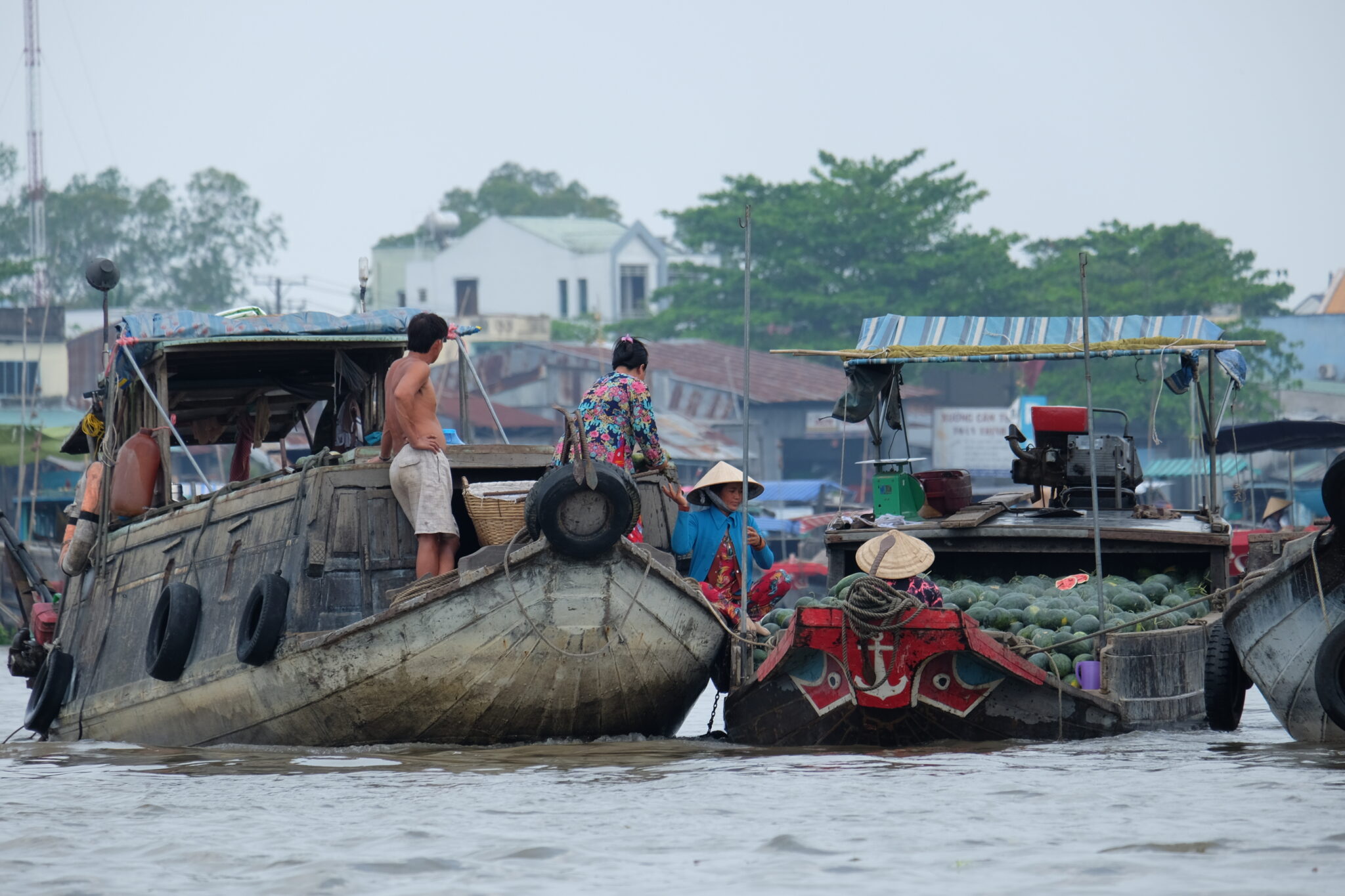
It’s a frenetic, bustling scene and a far cry from the peacefulness of the riverbanks we passed just minutes before. Large barges jostle for space and smaller watercraft weave between them. Each one piled high with fresh produce and as making sales is the name of the game, vendors often advertise their stock by hoisting a sample of their wares up a makeshift flag pole jutting from the roof of the boat, known as cây bẹo; potatoes, pumpkins, pineapples, and melons all pointing towards the sky.
As the Mekong’s main attraction I was under no illusion that we would be off the beaten path on this trip. The hoards of tourists didn’t bother me, and it seems, didn’t bother the traders as they carried on with their business, oblivious to the armada of visitors snapping photos. Most would give me a smile or a wave when they saw my lens pointing in their direction.
Despite the crowds, this market is far from a show for the benefit of tourists.


However, now, times are changing – Cai Rang is half the size it was just 10 years ago. Since the 1990’s the Vietnamese government has long been trying to improve the lives of the people living in on the delta with rapid urbanisation a well as a program of road and bridge-building. Although these schemes are hugely beneficial, they may also be the death of the floating markets. The proliferation of supermarkets and the ease of transporting goods by road may mean that the role of the market in the economy of the region will soon be redundant.

However, there are some benefits to all this development. The improving infrastructure has meant a huge influx of tourists (approximately 500-700 visitors to the market each day), as travel agencies both local and international add visits to Cai Rang to the top their ‘must-see’ itineraries. The majority of these agencies now work and collaborate with local vendors to offer services to tourists. A good example is the company that I used, Mekong Tours. Although our guide was a local university student, the driver of our boat as a former market trader who now uses his nautical skills to ferry passengers around. Likewise, his father had now given up on trading and we occasionally bumped into his as he was navigating another group of visitors through the waterways. We were encouraged to buy snacks and coffee from small fast food boats that zipped between the crowds, cooking their food, rather surprisingly, on open fires on the deck and serving as mobile cafes for the tourists. In all these ways the market is evolving to stay alive but how long it will survive, nobody knows.
After circling Cai Rang a few times our driver took us onward up the river towards our next stop; Phong Dien.

Phong Dien Market
Phong Dien is much more compact and intimate than Cai Rang. There were no large, motorised vessels present; just small stand up sampans. The Market here is much older than its larger neighbour and many of the people here still rely on a trading culture, swapping produce with each other rather than spending money. We were one of the few tourist boats in the whole of the market meaning that we could get up close to the traders to buy some fruit and chat with them. In fact, most of the people here seemed to spend the majority of there time gossiping, laughing and talking rather than touting for business. It was a sharp contrast to the overwhelming Cai Rang market. Just to be in the centre of it all was a fantastic experience.

We pulled up along the banks of the river for a warm coffee to wake us up and so that we could watch the market from afar. By now it was 8.30 am and the trade was starting to slow down, people were beginning to head home and it was time for us to venture into the smaller canals and backwaters of the delta.

The Backwaters
The smaller canals spread away from the river like a maze of spider webs but are no less important to delta life than the main channel. For generations, people have used the intricate network of free-flowing waterways to collect produce from farmers before transferring them via boat to the market and even today the majority of the villages in the region border the banks of the canals rather than major roads.


The tree-lined channels seem so tranquil. Dense mangroves cling to the banks, birds whistle from the trees and insects buzz across the surface of the water. If I didn’t know that we were so close to the city, I would be sure that we were in the middle of nowhere. We made a few stops along the way; first at a rice noodle factory and then to walk through a local village but it felt that this was just to pad out the tour. I was more than happy cruising through the backwaters and taking in the local life without the need of the side trips. A few small boats cruised past us, making their way to or from the markets but other than that, we were completely alone on the water. It was bliss.

By now the clear blue skies had given way to rain so we huddled under a makeshift shelter and cruised back towards Can Tho, passing through a depleted Cai Rang Market once more just in time to see the trade winding down for the day. Our tour concluded in Can Tho at around lunch time with us taking refuge in the boat with our guide and driver while we waited for the downpour to pass. We bid farewell to them both and thanked them for an incredible morning on the water.
Even if you have limited time in Vietnam, I can’t recommend a trip to these markets enough. Although touristy, it is a fantastic way to catch a glimpse of a local way of life that is quickly being lost.


TIPS FOR VISITING THE FLOATING MARKETS
Ensure that you book a tour that leaves as early as possible. If it starts after 6.30am, you are likely to miss the best of the markets.
Check what the tour includes before booking. Is it a quick trip to Cai Rang, or does it include the smaller waterways and Phong Dien?
Be wary of booking a tour from the touts on the waterfront – they generally will not speak English and may put you in a larger boat with 30 other people. We found that travelling in a small group in a sampan was the best way to get close to the markets.
It is a good idea to make sure that your boat has a roof as the weather can be unpredictable on the delta and you don’t want to get caught in a storm with no shelter.
Tour Information
We booked our tour through Mekong Tours. Based at the Xoai Hotel in Can Tho they offer tours of either one or both of the markets and the trip can be taken with or without a guide.
Cai Rang market tour – $25 per boat (up to 3 people). Includes Hotel pickup/drop off
7 hr tour visiting both markets (Phong Dien and Cai Rang), gardens, canals and stops at sights of interest – $42 per boat (up to 3 people). Includes hotel pick up/drop off.
It costs $15 to hire a tour guide for the 7 hr tour. I would highly recommend this as our driver didn’t speak any English so a guide was an invaluable source of information. Not only was she knowledgeable, but she also was fun to spend time with and answered all our questions and even provided us with food and drink. We bumped into other boats of tourists along the way without guides that had to borrow ours in order to communicate with their drivers.


12 Responses
Dear Dave!
I’m very glad about your sharing my homeland. Can Tho as a gentle charming city of Mekong Delta. I hope that you will share more about other destination of the South Viet Nam! Strongly recommend to: An Giang province and Ca Mau as well.
Hello Dave, nice one man. whic area was this specifically? Can Tho or Cai Be?
I took this particular tour from Can Tho – it was around 7 hours in all, returning back to Can Tho in the afternoon.
You have really captured the locals in a cool way in your photos. When I visited the floating markets I was slightly surprised I thought it was going to be more like the floating markets in Bangkok but the fact that these families stay here for weeks at a time to see their products was so fascinating.
I have never been to Bangkok but I have seen photos of the markets and they look awesome, just very different to the ones in Can Tho! I hear they’re more for the benefit of tourists in Thailand?
This seems so cool! We tried to do the floating markets in Bangkok several years ago and were so disappointed when people told us they weren’t really going on anymore. Your photos are gorgeous! Glad you got to experience what’s left of them.
Thank you! Hopefully they will keep going for a long time yet, even if it just for the benefit of tourists. It would be a shame for the people here to lose such a unique way of life.
This sounds like a truly amazing tour. I didn’t know the market had shrank so much in the last ten years. It seems surreal that a timeless civilization like the river delta can be threatened by civilization and bridges. We will need to make our way here before the markets fade away.
I would just love to visit the floating markets and see it in full swing. It’s sad to think that their days might well be numbered. However, it may be more a case of reinventing their existence, particularly as tourism is now significant for them. It still won’t be the authentic markets though in that case and I hope to see it before this change happens.
I completely agree. Tourism seems to be booming in Southern Vietnam so hopefully the money that visitors bring in will save the markets.
I always love waking up early and getting out while things are still tranquil. It seems to be the case all over the world. This is such a fascinating post to me because it is something I have never heard of. The backwaters markets seem to be more my pace, going back to my desire to have more tranquility. From the looks of your photos with the downpour, it is a great tip you give to get a boat with a covered roof.
If you like tranquillity then the backwaters would be perfect for you. Away from the markets you can just cruise the canals at a slow pace and taking in all the riverside life. It’s absolutely wonderful!