dolce vita
/ˌdɒltʃeɪ ˈviːtə/
noun
a life of heedless pleasure and luxury.
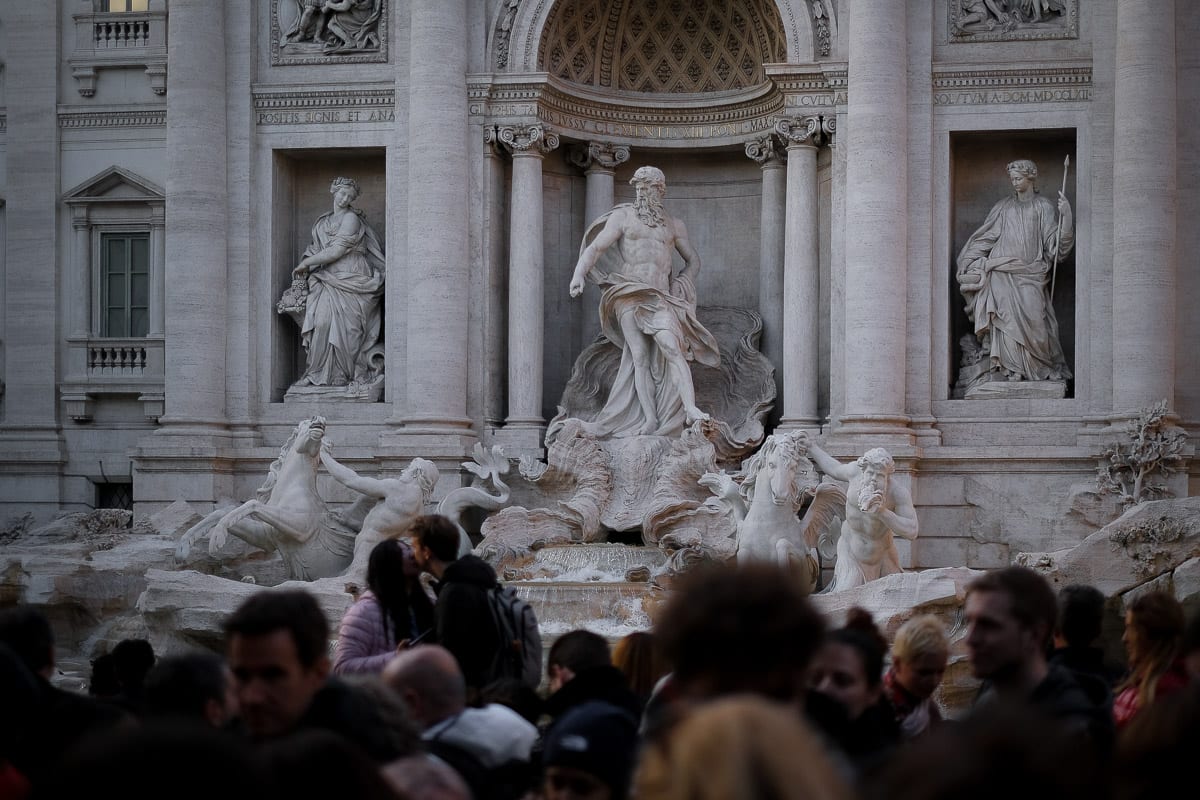
It’s almost midnight in Piazza Di Trevi. Hundreds of people are gathered around me as I push through the crowd, a little tipsy on fine Italian wines and clutching a tub of sickly-sweet tiramisu that I bought for the walk back to my hotel. It is easy to see why the world’s most famous water feature – its magnificent stallions, fanned out beneath a bearded Neptune, glistening a ghostly white in the moonlight – holds such appeal: it is enormous, taking up an entire side of the tiny piazza that bears its name, but there is a romantic draw too. Beside me, a couple embraces and kisses as they share a chocolate cone of gelato while beside the fountain itself, giggling teens perform a ceremony that must take place thousands upon thousands of times each day, turning their backs and throwing coins over their left shoulders into the water where it sinks to the robin-egg coloured bottom. According to legend, tossing one coin into the Trevi Fountain means you’ll return to the Eternal City, tossing two coins means you’ll return and fall in love. Tossing three coins means you’ll return, find love, and marry.
Disclaimer: My trip to Rome was provided by Jet2CityBreaks. However, all views expressed are my own. I flew with Jet2 Holidays from Leeds Bradford airport.
The Trevi’s romantic appeal was cemented by the 1960 film La Dolce Vita. Universally acknowledged as the most stylish movie ever made, director Federico Fellini’s three-hour magnum opus features a scene in which protagonist Sylvia lures entertainment journalist Marcello into the waters of the Trevi Fountain, beckoning him to join her as she wades through the water. It’s a timeless sequence that is immortalised in countless souvenirs in Rome today. Don’t get me wrong, I realise that the title La Dolce Vita is deliciously ironic for a movie depicting alienation, despair, and decadence, but it is hard not to be drawn in and want to live the lavish life in the Italian capital that is shown within its celluloid frames. The film is an incomparable feast and Rome has never looked better than in the black and white compositions of cinematographer Otello Martelli. In a way, it perfectly portrays the city’s melancholy sensuality and has always given me the urge to visit, to seek out that sweet life.
It seems fitting then, that I am staying at a hotel named The Glam, courtesy of Jet2CityBreaks. It’s a title that it wears well: The hotel is compact yet grand. The lobby is adorned with marble and artworks line the curving staircase that leads to the upper floors where you find a rooftop jacuzzi and a bar overlooking the hip, up and coming Monti neighbourhood, the current must-visit district in the city for nightlife and fine dining.
It’s only a short walk from the Glam to my next port of call. Via Margutta is a quiet, ivy-covered street just steps away from the crowded Piazza di Spagna, so empty that it could have been lifted from a tiny Tuscan village rather than be in one of the world’s most tourist-heavy cities. I have the street almost to myself, apart from an old gentleman sharply dressed in a suit and trilby rushing past with a newspaper folded under his arm and another man fastidiously polishing his vintage Fiat 500. Once home to modest craftsmen, workshops and stables, it now hosts art galleries and expensive cafes. It’s no surprise that Fellini decided to live here, but it was also featured in another cinema classic, Roman Holiday, as the location of the apartment rented by Gregory Peck’s journalist, Joe Bradley.

My plans to Rome are very much the same as those depicted in Roman Holiday, and although I have two and a half days to explore the city rather than Princess Ann’s single one, I don’t have a knowledgable guide like Joe Bradley, or a Vespa. There is a saying – una vita non basta – meaning that a single lifetime is inadequate for experiencing the Eternal City, but I’ll give it my best shot. Just a few metres away, the Keats-Shelley memorial house seems a good place to start. John Keats died in his residence beside the Spanish Steps in 1821 and his former home is now a small museum to the Romantics. As he died from consumption in the houses’ bedroom he would have gazed out on markets and workshops that once populated the piazza rather than the Dior and Yves Saint Laurent stores and camera-toting tourists that gather around Pietro Bernini’s boat-shaped fountain.
While Rome has changed significantly over the centuries since the balustrades of the Spanish Steps were constructed in 1723 by Alessandro Specchi and Francesco di Sanctis, much of the city’s almost 3000-year history remains for all to see: It is hard to walk the streets without stumbling across tall, crumbling columns and ancient temples. Wonders that, in any other country, would be assigned national monument status and hidden behind gates with hefty entrance fees. However, in Rome, they are so ubiquitous that they are mostly ignored. As I wander from tourist sight to tourist sight my mouth is agape at the remnants of the Roman empire just scattered around the city.

One such remnant that is far from ignored is the 2,100-year-old Colosseum and its broken arches. Once having the capacity to host 50,000 spectators that would watch over gladiatorial battles and decide the fate of the loser – yelling “iugula” (kill him) or “missum” to show mercy – now only 3,000 tourists are allowed to enter at any one time to explore Emperor Vespasian’s grand arcades and see the sophisticated collections of underground passages, trap doors, and enclosures for the wild animals that the well-trained gladiators would have to fend off.

Although I’m obviously impressed by the Colosseum, the Foro Romano enchants me more. It was the spot where a sleepy and drugged Princess Ann was found at nighttime by Bradley, beside the eight remaining pillars of the Temple of Saturn, built in 476 B.C. Unlike the stars of Roman Holiday, I had time on my side to wander the Forum during daylight hours. This is the spot from which the entire Roman Empire was ruled and where people like Caesar, Cicero, Constantine and Catullus once roamed. It’s filled with some incredible sights and artefacts, such as the Arco di Settimo Servo, Tempio di Saturno, the House of the Vetals and a black stone marking the grave of Romulus.
One of the great joys of Rome is that you don’t have to travel far to see one of the city’s greatest hits’. Multiple times each day I accidentally stumble past the Pantheon, a 2000-year-old building with a columned portico and domed ceiling that was studied by Michelangelo before designing the cupola of St. Peter’s Basilica, and without even trying I come across Circo Maximo, once the domain of death-defying chariot races put on to delight and excite the watching Roman Emperor.


It’s the next day that I see the dome of St. Peter’s for myself, first crossing over the Ponte Sant’Angelo in the shadow of the Castel of the same name, a schooner-like fortress that for centuries sheltered popes from marauding barbarians. The riverbank here is where the princess and the newsman danced on a moored barge for the first and last time before a wacky brawl causes them to take an unplanned, late-night swim.

No matter how impressive I find St. Peter’s, the Vatican’s queues represent the only downside to Rome and I leave as quickly as I came, tromping back over Ponte Sant’Angelo and along Via Giuseppe Zanardelli towards Rome’s centro storico. This is the Rome I came to see. It was the core of renaissance and baroque Rome, owing much to the rivalry between 17th-century sculptors Gian Lorenzo Bernini—who designed the famous Fountain of the Four Rivers on Piazza Navona—and Francesco Borromini, whose masterpieces can be found scattered around the city in the form of the famous Fountain of the Four Rivers in the splendid Piazza Navona or the Church of Saint Agnes in Agone, on the very same piazza. The centro storico is a more ramshackle that the wide boulevards of the city’s newer quarters. The streets here are narrower and seem to runoff from each other at random angles, but this only adds to the appeal.
I follow a trail of Bernini’s works through the city, passing his fountains in Navona and his obelisks that adorn Palazzo Montecitorio. I climb the steps of Piazza del Quirinale for spectacular views over the city and wander past the incredible column of Marcus Aurelius in Piazza Colonna before stopping off at Gelateria Giolotti for a caramel and chocolate cone. It is Rome’s oldest ice cream parlour, a place where to surly servers in waistcoats and bow-ties have been dishing out scoops since 1900 and customers included most of the members of the nearby Italian parliament and even the Obama family.


On my way across the Tiber to the Bohemian neighbourhood of Trastevere, I make another brief Roman Holiday related pilgrimage to the Santa Maria church. It was here that Gregory Peck stuck his hand into the slit-mouthed Bocca della Verità, a circular relief of a god, and elicited a cry of alarm from Audrey Hepburn when he pulled his arm out of the hole with his hand tucked up his sleeve.
There are no famous sights to be seen in Trastevere; it is a living neighbourhood rather than one crammed with monuments. There is no Spanish Steps or grand Pantheon, no Wonders of the World or crumbling forum. Instead, the focus is on Piazza di Santa Maria. It is where people gather outside cafes to gossip about the day and where groups of teenagers gather on the steps of the piazza’s prized marble fountains, laughing and joking in the shadow of the magnificent Romanesque facade of the Basilica di Santa Maria. Constructed in the 3rd century, the Basilica was built on top of the saint’s house; she supposedly survived decapitation for three days and, when her tomb was opened in 1599, her body was incorrupt. Inside I marvelled at the gilded ceiling and the crypt where apparently if you ring the bell, the nuns will show you the last remaining Cavallini frescoes in Rome, although I didn’t have the heart to disturb them.

Disclaimer: My trip to Rome, including flights, was provided by Jet2.
Trastevere wasn’t originally part of the city. It was swallowed up long ago as Rome expanded beyond the eastern shore of the Tiber past the Ponte Cestio bridge and the tiny Tiber Island that now connects it to the historic centre. What was once a melting pot of immigrants and workers is still a multi-national affair, only now filled with tourists, hipsters, and Rome’s bohemian crowd. Yet Trastevere still feels local and retains off-beat appeal. I seek refuge in Enzo Al 29, a small trattoria tucked away in Trastevere’s cobbled backstreets that is a far cry from the craft beer spots and cocktail bars that dominate the neighbourhood. It’s cramped inside, with waiters squeezing past the tightly-packed tables with steaming plates of Carbonara and Cacio e Pepe. It’s thought to be one of the best restaurants in Rome and its reputation, plus its low prices, cause crowds to gather outside competing for the next free table as the owner, Enzo, calms them with complimentary glasses of red wine while they wait.
It’s in Enzo Al 29 that I realise this Dolce Vita that I have been searching for isn’t to be found in Rome’s monuments and antiquities, no matter how fascinating and delightful they are, but in every aspect of the city. It’s those early morning cappuccinos and pastries in Campo de’ Fiori watching on as shoppers fill bags with tender, violet cimaroli artichoke; late afternoon aperitivos on rooftop terraces with the entire city laid out before you; wandering the craggy, cobbled lanes too narrow for the cars but filled with diners that spill out of ivy-draped cafés.

It’s just a short walk from the centre of Trastevere to the Janiculum hillside where the entirety of Rome stretches out below me. Here, beneath an enormous statue of one of Italy’s great heroes, Giuseppe Maria Garibaldi, couples sit atop the piazza’s wall embracing, sharing cones of sickly-sweet gelato and admiring a bird’s-eye view of one of Europe’s great cities. I allow my eyes to sweep across the cityscape, from the layered wedding cake extravagance of Il Vittoriano to the Colosseum.
Unmarred by the glass skyscrapers and ugly tower blocks, the 2,753-year-old city looks timeless, as magnificent as it has ever looked, with just huge cupolas, Egyptian obelisks, and Corinthian columns dominating its skyline. It’s a view that invokes both the brevity of civilisations as well as the longevity of human achievement. Gradually, the cityscape of travertine marble turns honey-toned in the lowering sun, and I realise that Rome has seduced me, lured me into its waters just as Sylvia lured Marcello. The cliches are true: all roads do lead to Rome, so I may as well do as the Romans do and embrace the sweet life.

Disclaimer: My trip to Italy was provided by Jet2CityBreaks. However, all views expressed are my own.