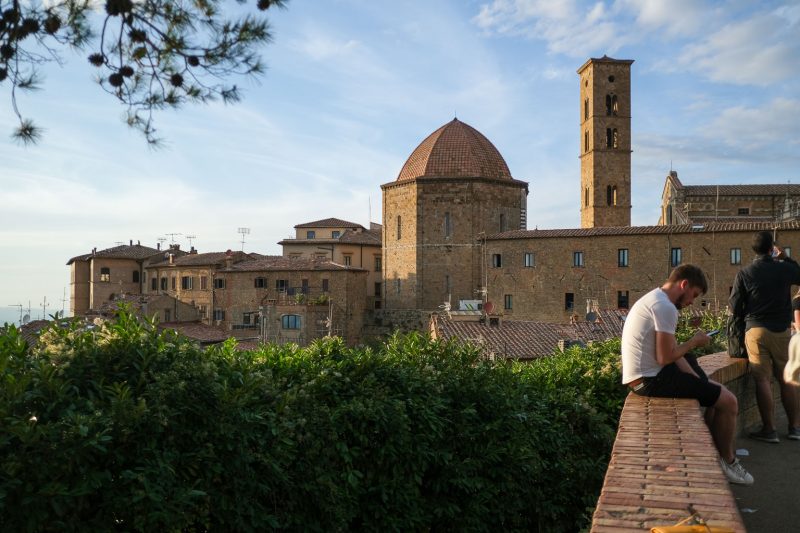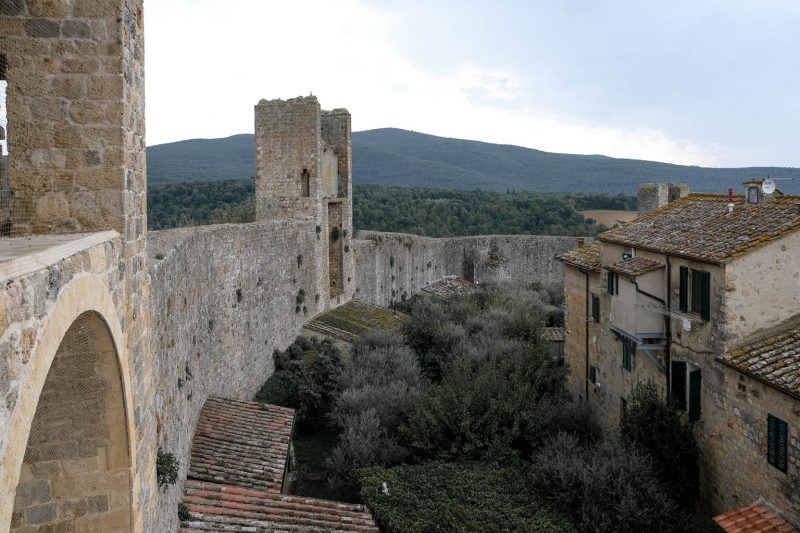
Amidst the verdant, rolling hills of the Val d’Orcia, surrounded by the woodland of Mt. Amiata, the quiet village of Bagni San Fillipo seems rather unremarkable on first glance. Like many other tiny Tuscan villages, it’s nothing more than a small cluster of streets lined with pretty sandstone homes topped with terracotta roofs. There is a small, dilapidated church and a handful of restaurants and cafes but beyond this, it seems like a place where not a lot happens.
However, the settlement’s name does hide an interesting history. The San Filippo part is derived from St. Filippo Benizi, who was born to a noble Florentine family and entered the priesthood under the prior of Florentine order of Mary’s Servants. Upon the death of Clemente IV, when it became evident that he was in line for succession, he retreated to this corner of Tuscany to become a hermit and avoid being elected Pope at the Viterbo’s conclave.

Here, over millennia, the calcium deposits of the Fosso Bianco creek have formed a cascading terrace and waterfalls in the valley, that runs parallel to the village giving a series of blue, sulphurous pools that are completely immersed in nature.
I you have spent some time exploring Tuscany, you will know that this region is brimming with such springs – the luxurious pools of Saturnia are probably the most well-known – from natural wonders to exclusive spa hotels. Despite being less popular that Saturnia, it is thought that those at Bagni San Filippo are the oldest natural spa in the world to be used by people.
The first mention in writing comes from Prior Filippo Benizi himself but even long before he hid himself away here, archaeological evidence suggests that both the Etruscans and Romans used these springs for their perceived healing properties.


The thermal baths were restored in the 16th century at the time of Cosimo I de Medici and the curative and relaxing effects of the water here – thanks to the high concentrations of calcium, magnesium, and sulfates – continue to draw locals and tourists alike.
Although there is a nearby spa hotel where you can get massage, facial and mud treatments along with access to their swimming pools, most people opt for the streams of hot water that flow freely in the nearby woods, with the natural setting adding to the appeal.

The most famous of the bathing spots is the Balena Bianca, an enormous calcium formation that has earned itself the nickname of the “White Whale”. This is where two streams of hot water have joined together to flow over the rockface, with the sediments layering and building to create an impressive boulder of white limestone dotted with pools and waterfalls.
Standing at almost 20 metres tall, it is thought that the water at this point can reach a balmy of 48°C, with the milky blue water shimmering as it cascades down to the valley floor below.
Bagni San Filippo may not be as inviting or famous as nearby Saturnia (Cascate del Mulino), but this hidden gem of the Tuscan countryside is a rejuvenating and serene diversion that should be added to any Tuscan road trip.


Where is Bagni San Filippo
Bagni San Filippo is a small, picturesque town nestled in the heart of Castiglione d’Orcia in the Province of Siena, on the eastern edge of Monte Amiata. It is only a 30-minute drive from Pienza and relatively easy to visit from anywhere in the Val D’Orcia. If travelling from further afield, Bagni San Filippo is around an hour and 15 minutes south of Siena and 2 hours south of Florence.
How to Get to Bagni San Filippo
Bagni San Filippo is relatively off the beaten path and although it is possible to reach via public transport, it can be a long and arduous journey, meaning that the only feasible way of visiting the thermal springs on a day trip is by car.
I found this to be the case for much of my trip; Tuscany is best explored in your own vehicle, meaning that you aren’t relying on bus and rail timetables as well as giving you the opportunity to get off the beaten track. I tend to use Discover Cars for my car rental when travelling, as they allow you to book in advance and compare multiple providers for the best deal in your chosen location.
Travelling by car
To reach Bagni San Filippo, you need to make your way to Southern Tuscany and Val d’Orcia at the eastern side of Monte Amiata. From Rome and Florence, Bagni San Filippo is about a two-hour drive. Heading here from Siena will take you approximately and hour and 15 minutes.
From Sienna, the route is fairly simple, taking the SS2 motorway south for most of the way until you turn off at the SP61before turning onto a one-way street named ‘Via del Fosso Bianco’. Once you hit SP61, the springs and town are well signposted.
The journey from Florence is a little longer, requiring you to make your way south on the A1 before joining the west-bound SP146 at Querce al Pino which eventually changes to the SP40. SP40 eventually merges with the SS2 motorway and at this point, follow the same directions as above.
Travelling by Public Transport
Despite it being a long and arduous journey from most of Tuscany’s major towns or cities, it is possible to visit the hot springs of Bagni San Fillipo by public transport.
From Siena or Florence, you will need to catch the intercity or regional train service to Buonconvento where you change to the southbound 112 bus (heading to Pienza). Alight in the town of S.Quirico V.Dei Fossi and switch the 54A bus bound for Abbadia S.S. – Largo Verdi. This bus stops in Bagni San Filippo itself, just a few metres from the trail that leads to the hot springs.
You can buy train tickets for the train at the station, but I recommend visiting the TrenItalia website to check the timetables and prices before travelling. When booking trains in Italy, I usually use Omio. Remember, if you have a physical ticket, you must validate it before boarding the train to avoid a fine. There are small machines at each station where you can punch your ticket.
If you purchase online or via the TrenItalia app, there is no need to validate your ticket.
Parking at Bagni San Filippo
You will find some free parking around the town of Bagni San Filippo but most people opt for the spaces close to the trailhead on Fosso Bianco. The majority of these spaces are outlined in blue and are metered and can fill very quickly in summer.
I couldn’t find any on-street parking close to the thermal pools but found that there were many more spaces if you continue further down the road.
You will find free parking (marked with white lines) are located further down via Fosso Bianco, towards the SP61, but it is a fairly long walk from there to the entrance of the springs.
After parking the car on via Fosso Bianco, you will find the trail entrance on the same street, next to Bar La Cascata. The gently sloping dirt path is clearly signposted and can be followed until it crosses a small stream via a wooden bridge. There are a few pools and springs at this point, but it is worth continuing to follow the river as the pools downstream are much more impressive.
As you make your way downhill, you will come across various waterfalls and pools, with varying depth and water temperatures – from hot to lukewarm – with the calcium carbonate build-up becoming even more dense and impressive until you reach the astonishing white whale formation.
Where to Stay Near Bagni San Filppo
Although there are a small selection of rental apartments and bed & breakfast properties in Bagni San Filippo, beyond the hot springs, there isn’t a great number of things to see within the village and I would recommend staying elsewhere, either in the stunning countryside of the Val D’Orcia or in nearby towns such as Pienza, Montepulciano, or Montalcino.
However, if you decide to spend a night or two in Bagni San Filippo, here are the best options:
B&B
B&B Il Fosso Bianco
Located close to the centre of Bagni San Filippo, the rooms at B&B Il Fosso Bianco are classically designed but understated, making it an ideal place for couples to have a romantic getaway. Family accommodation is available and selected rooms have a patio, terrace or balcony with coutyard/garden views.
B&B
BBBagni
The charming and rustic BBBagni is fairly compact, with just a few rooms, but it is a cosy place to stay just a short walk from the hot springs.
Agritourismo
Agriturismo Selvella
Although it is located a 10-minute drive from Bagni San Filippo, nestled between two hills in a valley at the heart of the Tuscan countryside, the homely Agriturismo Selvella is a secluded escape away from the masses of tourists that flock to this corner of Italy.
There are expansive gardens, sauna, swimming pool and a generous breakfast thanks to the fact that the Selvella produces olive oil, cereals and jam, as well as eggs from the farm’s chickens.
Tips for visiting Bagni Di San Filppo Thermal Springs
When visiting the springs, make sure to stay in the designated pools and not cross into the fenced-off areas. Although the town welcomes visitors, they are trying to limit the damage caused to certain areas and keep them well preserved.
As there is nowhere to buy food and drink beside the pools, make sure to bring adequate snacks and water with you. There are picnic benches near the head of the trail, but you will find plenty of space to set down a picnic blanket close to the springs. Make sure to take any litter with you and leave no trace.
It’s best to arrive at Bagni San Filippo early. Not only to make sure that you get a parking space, but also to beat the crowds of tourists and locals to allow you to bathe in peace without the pools being full of people, especially if you are visiting at the weekend or during the summer months.
As the pools and springs are located in a natural, wooded valley, the path leading down to them can be steep and muddy with the area around the pools being difficult to traverse for people with mobility issues or that use a wheelchair.


When is The Best Time to Visit Bagni Di San Filppo
The sulphuric streams at Bagni di San Filippo remain warm all year round, however, it is best to avoid visiting during the winter or wetter months. As rainwater flows through the valley during heavy storms, the pools become muddy and rather unpleasant to bathe in.
However, the cooler weather does make the steaming water even more tempting, adding an extra pleasure to visiting during the shoulder months of Spring and Autumn. As with much of the region, I would avoid the peak summer months or public holidays, when the area can become very crowded. This also means that weekdays are preferrable over weekends, giving you the opportunity to enjoy the warming waters in relative peace.
I stopped by on a weekday morning in late September and the cascading springs were relatively quiet.
FAQs
What are the Opening Hours?
As this is a public space, there are no opening hours and you can enter the pools at any time, 365 days a year. However, as the springs are fairly remote with no facilities nearby, I wouldn’t recommend visiting at night.
Is there an Entrance Fee?
Although entry to the baths was formerly free of charge, there is now a small pay point that has been set up at the end of the trail that slopes gently down towards the baths. It’s €2 per adult with small children going free. However, you do receive a not-so-fashionable rubber wristband for the price, just to prove you haven’t snuck in without paying.
Are there Toilets and Changing Facilities?
The springs at Bagni di San Filippo are down a remote trail in the middle of the woods, meaning there are no public services or facilities beside the pools. If you want to change, you will have to do it with a towel wrapped around you or wait until you get back to the village.
The only public toilets are a few portaloos located close to the trailhead, near the town itself. There are no toilets beside the springs.
How Much Time Do You Need at Bagni San Filippo
As there isn’t a lot to see or do in the town of Bagni San Filippo itself, you won’t require a long time there. I think anywhere from a few hours to a morning or afternoon should be more than enough time to bathe in the hot springs and then enjoy lunch or dinner in the town.


Where to Eat & Drink in Bagni San Filippo
All that swimming and walking is bound to work up an appetite and thankfully, there are several bars, cafes and restaurants in the village where you can grab a bite to eat after your visit to the thermal pools.
If you’re searching for a quick sandwich or bite to eat, then you can stop off at Bar La Cascata, near the trail entrance, or La taverna di Emma where you can have small plates and cured meats and cheeses. For a larger lunch or dinner, Osteria Lo Spugnone is probably your best bet as they serve up traditional Italian and Tuscan fare.
Bagni San Fillipo Packing List
It’s important to wear sensible shoes – such as trainers – rather than flip flops to walk the dirt path down to the hot springs. Not only is it a little steep with loose ground, but it can also become muddy after heavy rain. If you plan on exploring further down the Fosso Bianco, hiking boots are recommended.
While you will obviously need to bring a swimsuit and towel, make sure to bring warm, comfortable clothes to change into once you have finished bathing. You will be in a shaded area and the difference between the air temperature and the warmth of the water can cause quite a chill. It’s also worth bringing a spare towel or blanket to lay underneath your bags and clothes while you swim to stop them getting filthy.