Arriving on the weekend of Düsseldorf carnival, I feel like I’m arriving at a party late and underprepared. It’s a party that has been going in earnest for three straight days, now into its fourth and showing no signs of slowing. I had arrived in North Rhine-Westphalian capital to take part in the Rose Monday parade, an annual celebration in which the city’s old town is closed down and young and old hit the streets to watch over 50 elaborate carnival floats, including Jacques Tilly’s famous satirical designs, parade through town.
Carnival celebrations happen across Germany every year but none with more passion and humour than the Rhenish Carnival in Düsseldorf. Filled with parades, parties and outrageous costumes, it’s time for some culturally-sanctioned reckless abandon, tongue-in-cheek gags and witty satirical takes on the political issues of the past year, from both at home and abroad.

What I underestimated before arriving though, was just how seriously Düsseldorfers take these festivities. Hopping the tram from my hotel in the city’s downtown area towards the banks of the Rhine, we pass the occasional group of party-goers in costume. Every so often a cowboy, jester, or astronaut will board the tram clutching bags that rattle with bottles. The closer we get to the old town, the more these occurrences increase. A group of Minions step on and then alight a few stops later, followed by a gaggle of witches, a troupe of clowns, the cast of Sesame Street, and even Theresa May, who has seemingly got lost on her way to Brussels and decided that pouring a glass or two from the keg of beer that she is wheeling behind her is more pressing than any Brexit negotiations that she has planned.


If anything betrays the city’s commitment to the carnival, it is the length of the festivities. Although the week leading up to Ash Wednesday is when the main celebrations take place, Düsseldorf’s Carnival officially begins in autumn. At 11 minutes past 11 o’clock on the 11th of November, crowds gather and bars overflow with jesters for the Hoppeditz Awakening. In this ceremony, locals ‘awaken’ the Hoppeditz Fool, who clambers atop his platform and scolds the crowds in front of Düsseldorf’s City Hall. Afterwards, the costumes are packed away until the beer starts to flow and the party starts in earnest on the Thursday before Ash Wednesday.
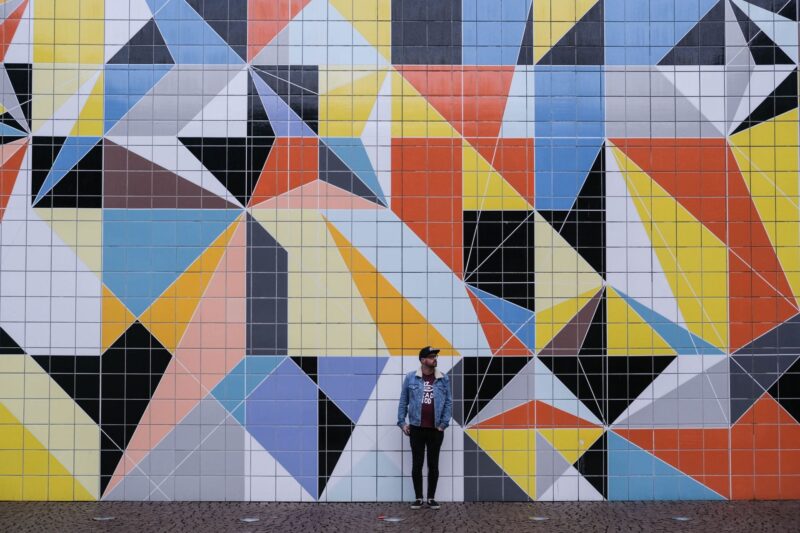
By the time I reach the banks of the Rhine, camera in hand hoping to capture a few shots of the cityscape with the Mediahafen and Rheinturm in the background, I’m fighting my way through crowds of costumes. All beside the Rivertime Wall, a piece of street art made up of thousands of tiny colourful ceramic tiles created by artist Hermann-Josef Kuhna, groups of teens gather on the steps, drinking and dancing along with the speaker stacks and amps that they have somehow managed to drag along with them.

Just metres away in Burgplatz, in the shadow of the Schifffahrtsmuseum’s tower, the sound of trumpets and drums emanates from a huge marquee emblazoned with the logo of a local brewery. Men in bright red uniforms and tricorn hats stand outside puffing cigarettes. Occasionally a full brass band will wander out through the doors in full face paint and patchwork outfits, the sound of the crowd belting out carnival songs following them into the square.
While in most cities this would seem like the centre of the party, on Düsseldorf’s Karnevalssonntag, or Carnival Sunday, this was just a small enclave of revellers away from the main festivities. A side-party if you will. Most of the city is drinking along the Königsallee. For 99% of the year, the King’s Avenue is Düsseldorf’s premier shopping destination. This wide boulevard with a landscaped canal running along its centre is lined with designer boutiques and purveyors of high fashion, but today the facades are boarded up, bars and food trucks replacing window displays of exquisite jewellery and designer garments in preparation for the afternoon’s celebrations and for Monday’s main parade.


Rose Monday at Düsseldorf Carnival
I’m told that being asked to ride on a float at Düsseldorf’s Rosenmontag parade is quite the honour, one that is reserved for members of the city’s prestigious carnival clubs, dignitaries, and people of importance. I’m none of those things. So, imagine my surprise when I scroll through my emails, ignoring the usual bank account detail requests from Nigerian princes and promo emails from companies that I bought one item from well over 12 years ago but keep putting off unsubscribing from their mailing list, and see Visit Düsseldorf asking if I would be interested in hopping aboard their float for the annual Carnival festivities. Obviously, I said yes. What a fantastic opportunity I thought, until I read the follow-up email;
“Will you be bringing your own costume or do you want us to provide you with one?”
Answering yes to that email is why I now find myself stood a few streets away from the Königsallee, Düsseldorf’s main shopping street and thoroughfare, dressed head to toe in the colours of the European flag; blue stars painted on my face, I frizzy blue wig reminiscent of 80’s Kevin Keegan with bad dye-job, bright blue gloves, and a scarf emblazoned with the flags of various European nations. It’s an outfit that even ‘Mr. Stop Brexit’ himself, Steve Bray, would consider a little too much. To dress up though is to get in the Carnival spirit. Almost all of the city’s residents don costumes for the few days preceding lent and surprisingly, to be wearing any kind of normal attire is a sure-fire way of attracting bemused glances.

Our float for the day matches our outfits perfectly: a huge, two storey carriage decorated in blue and yellow. On its side are Anthropomorphised versions of some of Europes most loved landmarks. A smiling Eiffel Tower is joined the Leaning Tower of Pisa, and Düsseldorf’s Schlossturm, all full of joy and hugging while a disgruntled Big Ben stands off to the side, a frown on its face, no doubt a result of the small papier-mache dog that appears to be urinating on its base. The floats are the work of satirist and artist, Jaques Tilly, representing different aspects of Düsseldorf and German culture, as well as mocking controversial political topics of the past year.
Among them are depictions of Greta Thunberg, a gruesome depiction of Saudia Arabia’s Crown Prince Mohammad Bin Salman Al Saud, his hands covered in blood with a Donald Trump Guardian angel on his shoulder, and the famous float of Theresa May that you possibly saw at the million-strong anti-Brexit March in London, her nose elongated and spearing a deceased economist. I’m told that Jaques has offended so many governments that he keeps a list – one that he has to update yearly, of countries that he has to avoid visiting. Each year over 50 floats make their way around the city’s Altstadt, weaving through the cobbled streets as spectators line the roadside screaming the traditional Düsseldorf greeting of “Helau!”


Düsseldorf’s Carnival is one of the largest and most celebrated in all of Germany and technically dates back to the 13th century when it was known as Fasching, or in modern German Fastenschank; the last serving of alcohol before Lent. However, the modern version of carnival and its traditions date from the 17th century. Back when most of the Rhineland was occupied by the French, the Rhineland carnival’s military-like parades, colourful military-style uniforms, and the “fool’s greetings” shouts were a way to make fun of the French and their militaristic posturing. For obvious reasons, the French decided to ban the tradition.
When the ban was finally lifted in the early 19th century, carnival committees, or Karnevalsvereine, were set up to re-establish the carnival tradition – complete with parades and comical military uniforms.
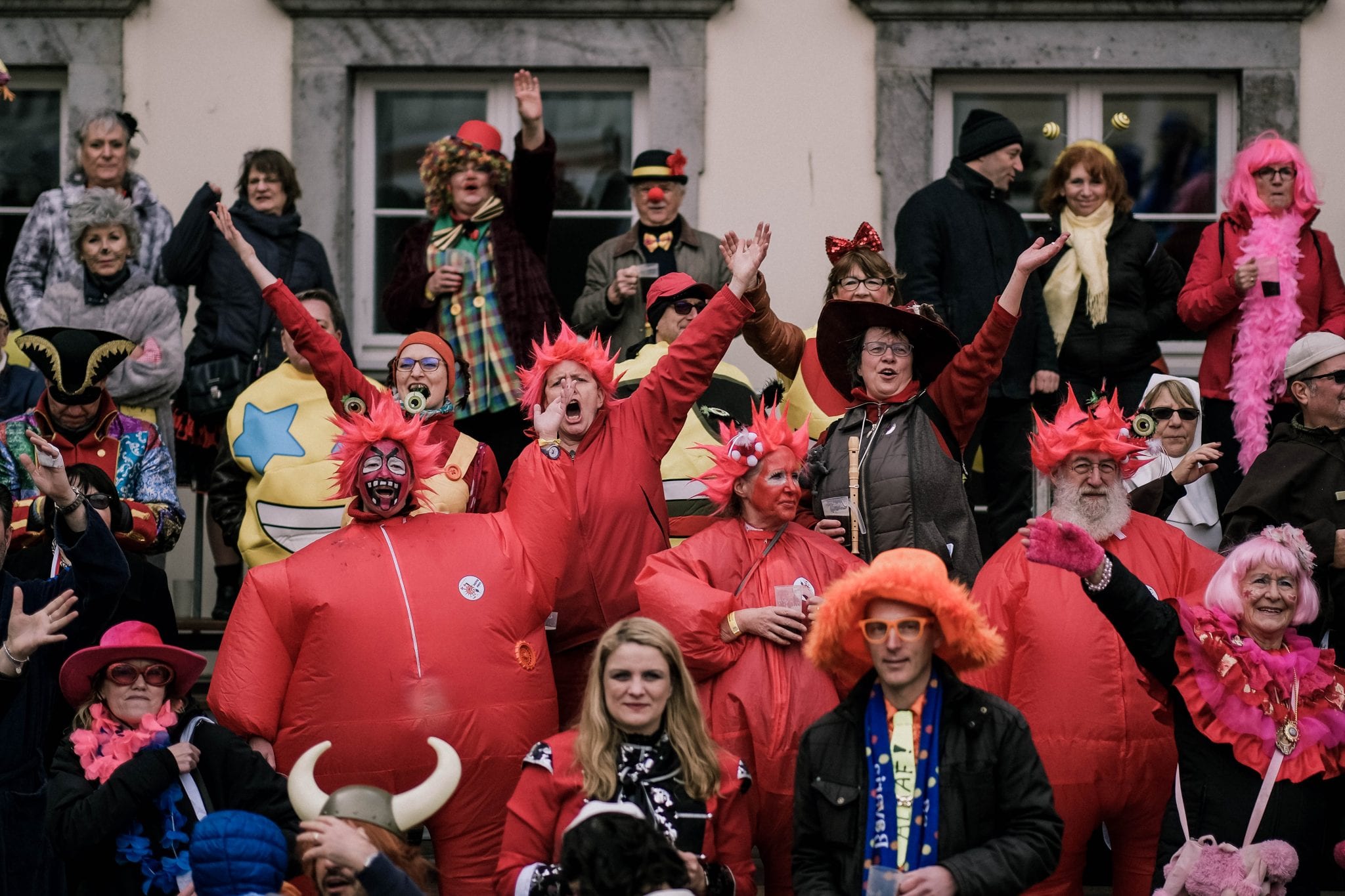
The military costumes are on full-display, along with animal onesies, pirate outfits, and everything in between, as the participants gather beside their assigned floats to have a few beers and last-minute checks are made to prepare for the parade.
We continue to wave and smile, putting on a show for the people gathered. Troughs lining the top of the float are filled with sweets and treats that we throw by the handful down to the children below. Some come fully prepared with buckets and bags in which to catch the airborne confectionary, while others improvise with upturned umbrellas.

By the time we begin weaving through the narrow streets of the Oldtown, we’re almost out of treats, but people still hang out of windows and gather from balconies to watch us pass by and give us a hearty ‘helau’.
Overall, our tour of the city takes around 3 hours and we finish, slightly exhausted, delirious and elated, but very much in need of an altbier. Riding a float on Rosenmontag was quite the experience and one that I am not sure I’ll ever get to repeat, but it was fun while it lasted.
Kö-Treiben
If Rose Monday is the day to gather with family and watch the tongue-in-cheek parade, Sunday is the day to party with friends. Seemingly the entire population of the city descends on this 1km strip of concrete in their finest costumes, dressed to impress and bringing along as much booze as they can carry for the informal street party. Some people even bring their own homemade floats – really just decorated trolleys filled with kegs of altbier, bottles of spirits and cans of pilsner – a mobile bar to keep then fueled with booze for the entire day.

I work my way through the crowd, beer in one hand and camera in my other, viewfinder almost constantly pushed against my eye as I try to capture as many of the costumes as possible. It is only 1 pm but it seems like the beer has been flowing for hours; bands play on the backs of trailers while people dance. A 100 person long conga line snakes around me and disappears into the crowd.
By the time evening descends, many of the families and party-goers have dispersed, leaving just the hard-core revellers and the drunks. I follow the flow of people back towards the Rhine to find that the celebrations now concentrated on the narrow, cobbled streets of the Altstadt. The bars and breweries are so packed with people the punters spill out onto the street, struggling to squeeze back inside.

The roads of the old town aren’t any more spacious, with thousands of people crammed together between the centuries-old buildings, moving to the rhythm of music pumping from every other building. It’s joyous and affirming; A huge group of people coming together – singing and dancing in the streets – for no other reason than that they can. It’s passionate, humorous, culturally sanctioned reckless abandon and I wouldn’t want to be anywhere else.