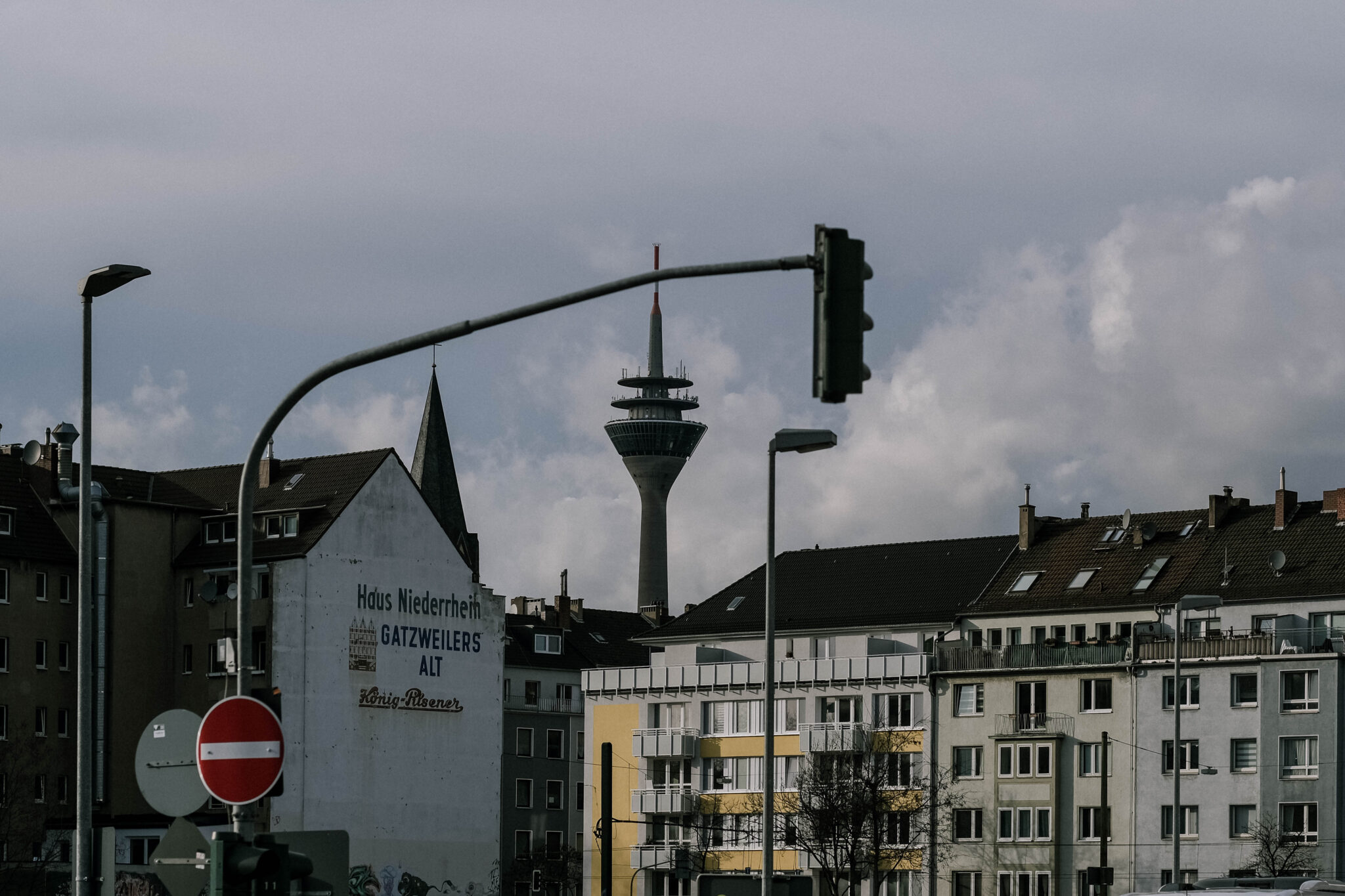
Germany’s 7th largest city, Düsseldorf is a city that is criminally overlooked by tourists visiting the county. From a distance, I can see why; the capital of North Rhine-Westphalia isn’t the prettiest of cities. Many of Düsseldorf’s magnificent architecture and historical centre was destroyed by allied bombing campaigns in the Second World War, meaning that it is often overshadowed by the beauty of neighbouring Cologne, and those looking for a little history are more likely to take a weekend jaunt to Berlin or Munich, despite the fact that Düsseldorf’s own history stretches back well over 700 years.
However, being an underdog has its advantages. These misconceptions keep the city fairly tourist-free and the picturesque, cobbled, Old Town streets free from souvenir hawkers and overpriced tourist-trap restaurants. The classic German beer halls of the Altstadt are definitively local establishments and you’re more likely to mingle with Düsseldorfers while enjoying a drink on the Rheinuferpromenade than DSLR wielding visitors.
I knew nothing about Düsseldorf before I visited and I’m glad that I gave it a chance. What I found was a city that buzzes with life: a city of foodies, night owls, artists, and free spirits. It’s also a city of contrasts; A city that boasts some of Europe’s most exciting modern architecture yet has beautifully preserved churches, palaces and Old Town; A city with hip cafes, boutique cocktail bars and fine dining while retaining the charm of its traditional beer houses and old-school Teutonic restaurants, all set against the picturesque backdrop of the Rhine. It’s a city that is certainly unique.
So, thinking of visiting? Here are my favourite things to do in Düsseldorf.

The Best Things to do in Düsseldorf
1. Climb the Rheinturm
2. See the Gehry Buildings at The Media Harbour
3. Sample Altbier, the City’s Local Beer
4. Check out the Street Art of Kiefernstraße
5. Explore the City’s Other Public Art Works
6. Climb Inside Tomás Saraceno’s ‘In Orbit” at the K21 Ständehaus
7. Explore the Altstadt
8. Eat Incredible Japanese Food
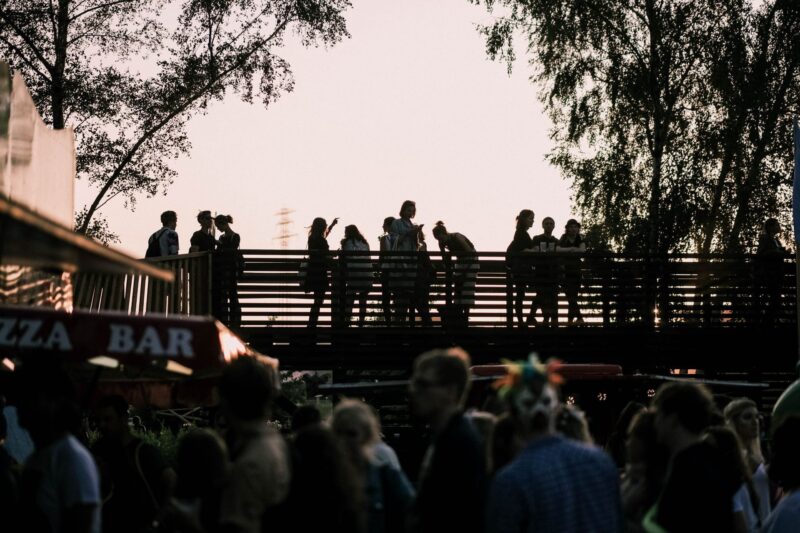
9. Party All Week At Düsseldorf Carnival
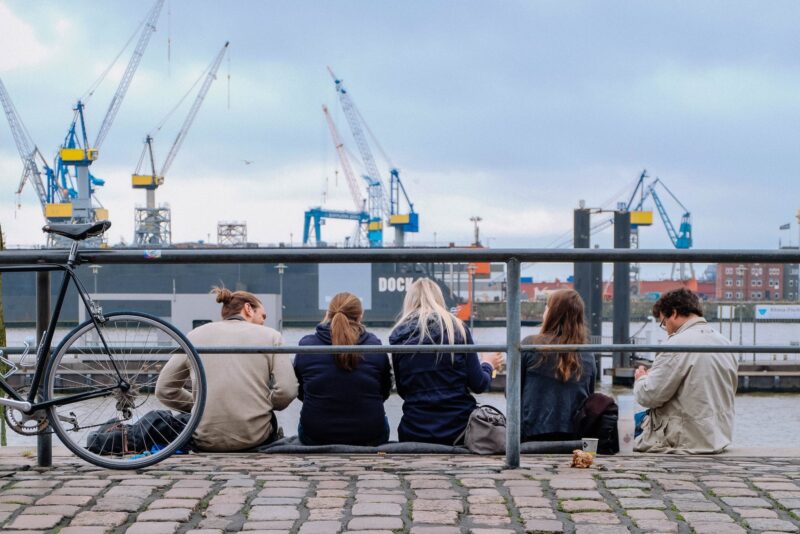
10. Take a Walk Along the Rheinuferpromenade
11. Visit Schloss Benrath
12. Grab a Bite to Eat at Carlsplatz Market
13. Wander Across the Rheinkniebrücke to Oberkassel
Climb the Rheinturm
Built in 1981 and standing a colossal 600 feet high, the Rheinturm (Rhine Tower) towers over Düsseldorf’s Media Harbour as the city’s tallest building. Originally built as a communications tower, the Rheinturm has since been transformed into a viewing platform and revolving restaurant, giving unparalleled views over Düsseldorf and, on a clear day, you can even make out Cologne in the distance. Peak time tickets cost €9 but are slashed to just €5 if you arrive before 11am or after 10pm.
Not many people know, but the tower also doubles as the world’s largest digital clock. Light spots illuminate the concrete shaft in 3 sections, with the top third counting the hours, the mid-section counting the minutes, and the lowest level measuring the seconds as part of a light sculpture by Horst H. Baumann.
See the Gehry Buildings at The Media Harbour
Even if you don’t know the name Frank O. Gehry, you will certainly be aware of his work. The man behind the stunning and iconic Guggenheim Museum in Bilbao, Gehry is one of the world’s most well-renowned architects and has created 3 twisted and unique buildings that stand proud in Düsseldorf’s media harbour; one in red-brick, one in pure white and one in his trade-mark aluminium, representing a family of mother, father and child.
Düsseldorf’s harbour was built at the end of the 19th century and played a huge part in the city’s post-war boom. However, by the 1970s, local industry was on the wane and the harbour’s former glory was fading. While many other cities would have demolished the harbour and put up sets of uniformed office blocks and apartments, Düsseldorf did something a little different. Each lot was treated as its own project, with internationally famous architects like Frank O. Gehry, David Chipperfield, Joe Coenen, Steven Holl and Claude Vasconi given an empty canvas to do as they please and make their creative contribution to the skyline. Many of the harbours old fittings remain – cranes, railway lines, bollards and wrought iron fences – giving the area a nice mix of history and modernity as media companies and enormous multinationals have decided to make the revamped harbour their home.
Düsseldorf Tourism offer a 2-hour long, in-depth tour of the Media Harbour for just £12
Sample Altbier, the City’s Local Beer
Enter any bar and order a beer and you will only be asked one question when you go to order; Alt or pils? You won’t be asked which brand or brewery’s product you would like. Instead, you will just get the binary choice of pils or alt, and even then, not many people will go for a glass of pils. In Düsseldorf, the coppery, malty altbier is the undisputed king.
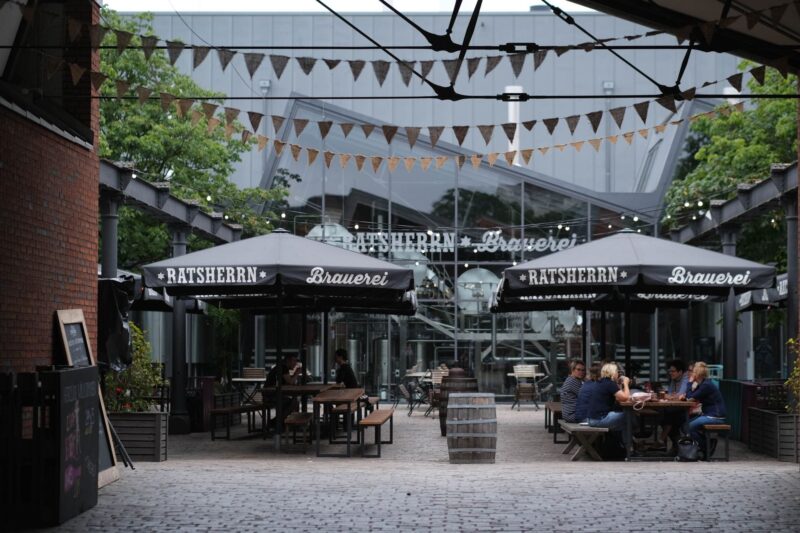
It’s a style of beer that has evolved over almost a hundred years and is fairly unique to the city. In its early years, it was obviously just referred to as “beer” and was christened Altbier to distinguish it from a lager, only after the latter came into existence in the 16th century in Bavaria and subsequently gained popularity all across Europe over the next couple of centuries. It’s a beer that’s sipped by the barrel-load by Düsseldorfers in the city’s many ancient brewpubs and modern bars. In the city’s Altstadt (old town), almost every house, many of which date from the 13th to the 17th centuries, contains a pub. There are more than 200 of them crowded together in an area less than one-mile square. With its cobble-stoned lanes, it is known affectionately as the longest bar in the world and it is there that you can find four of the six Düsseldorf pubs that brew Altbier on their premises: Uerige, Füchschen, Zum Schlüssel and Kürzer. Many of these brewpubs serve just the one kind of beer, so there’s never any question as to what to drink.
Check out this blog post to find out where to drink altbier in Düsseldorf. Otherwise, you can check out this Albier tasting tour around the city that allows you to sample 4 different beers.

Check out the Street Art of Kiefernstraße
The spectacular graffitied walls and facades of Kiefernstraße in Flingern-Süd are the centre of street art in Düsseldorf. Here, you will find an entire street covered in paintings and artwork with barely a single building not daubed with splashes of colour. Although nowadays you will mostly find tourists and visitors to the city milling about here in search of spray-painted murals, Kiefernstraße has a history of being one of the city’s most rough and tumble, run-down areas.


In the 1980s, this area was the domain of squatters, who occupied the buildings here in order to prevent the area being renovated and turned into a commercial district, despite an enormous shortage of housing in the city. Following protests and demonstrations, eventually, a tenancy agreement was put in place between the squatters and the city council. While the area around Kiefernstraße has become commercialised, the resistance lives on here; the street is a residential island in the middle of modernity. Currently, about 800 people of 45 different nationalities are said to live in the 180 meters long street. It is worth a visit, just to see the colourful murals that run the entire length of Kiefernstraße and intricately patterned building exteriors painted by squatters and artists, many of whom still have apartment leases here.

Explore the City’s Other Public Art Works
While many see Düsseldorf as little more than an industrial city, it actually is a place with art and creativity running through its veins. Not only is it home to the world-famous Kunstakademie (art academy), this city has more than its fair share of museums and galleries – there are over 100 – as well as plenty of public artworks to spot on Düsseldorf’s streets. Esteemed artists such as Joseph Beuys, Jörg Immendorff, and Gerhard Richter all cut their teeth in the city’s art scene.
Obviously, with a heritage like this, Düsseldorf has no shortage of world-class galleries and museums; The Kunsthalle contains myriad contemporary art exhibitions, while the Museum Kunstpalast is reserved for fine arts. The stars of the show though, are the K20 gallery, which focuses on the art of the 20th century, or K21, the city’s premier museum for art after 1980, which contains Tomás Saraceno’s incredible, interactive ‘In Orbit’ sculpture.

However, the art in Düsseldorf isn’t reserved for museums. It can be found on street corners and even underground. If you are up for a challenge, you can see if you can find the 10 Säulenheiligen statues that are dotted around the city centre. Designed by artists Christoph Pöggeler, these life-size, ultra-realistic statues depict people that represent different facets of Düsseldof life, such as The Couple, The Bride, The Businessman, The Stranger, and The Vacationer. If like me, you weren’t aware of their existence before visiting Düsseldorf, you may even mistake them for actual people stood atop advertising hoardings.

Then there is the underground art. Back in 2001, a project by local architecture firm Netzwerkarchitekten won a commission to design five stations on the new U-Bahn line. Five artists with links to the Kunstakademie – the city’s renowned art school – were chosen to develop concepts to decorate five different stations, resulting in a free art gallery that is now enjoyed by more than 50,000 people a day. Elsewhere, KIT, standing for Kunst im Tunnel (or Art in the Tunnel) is an 850 square metre exhibition space directly beneath the Rhine Promenade. Around four to six alternating exhibitions are staged each year. The main focus of the programme is the presentation of emerging, contemporary art across a range of genres, such as sculpture, painting, photography, video art and installation.
Climb Inside Tomás Saraceno’s ‘In Orbit” at the K21 Ständehaus
Suspended at a height of 25m above the courtyard of Düsseldorf’s K21 museum is ‘In Orbit’, an enormous art installation by the artist Tomás Saraceno. Inspired by the design and structure of spider’s webs, the work is constructed with 2500m² of steel mesh that interlaces over three levels, spanning the massive glass dome of K21. Five air-filled “spheres” are positioned within the net structure, creating a surreal landscape of floating planetary bodies.
For those brave enough, you can don a fetching jumpsuit and special shoes in order to enter the installation and work your way through it by climbing among the mesh and getting a vertigo-inducing view of the piazza below. According to Saraceno, “Once several people enter the structure simultaneously, it is set to motion, altering the tension of the steel cables and distances between the three levels of the interlaced net. The floating space now becomes a vibrating web of relationships, resonances, and synchronous communication. Like a spider in a web, visitors perceive the presence of others through vibrations.”

Explore the Altstadt
The heart of Düsseldorf lies in its Altstadt, or Old Town. lying between the main shopping thoroughfare of the Königsallee and the Rheinuferpromenade, the Altstadt isn’t as expansive as the old towns of other large German cities – an area of half a square kilometre (which is less than a quarter of a percent of the whole city) due to Düsseldorf being rased by the allies during WWII – but it is a great place to gather your bearings before exploring. Known by locals as the ‘longest bar in the world’, over 200 old fashioned pubs are squeezed onto the cobble-stoned streets, Even if beer isn’t your thing, you can duck into some quiet churches, see the Burgplatz, a square with an old palace tower. or view the beautiful Rathaus. It’s also a great place to pick up some traditional German cuisine. I highly recommend popping into Schweine Janes on Bolkerstraße where you will find the juiciest pork knuckle in town rotating on spits.
One unique thing that you must do in Düsseldorf is to watch one of the Schneider Wibbel clock shows. Originally a comedy play by the German writer Hans Müller-Schlösser first performed in 1913, the character of Anton Wibbel has become a popular symbol of Düsseldorf. and is now immortalised in this beautiful, animatronic clock in which the tailor emerges 5 times a day on Schneider-Wibbel-Gasse at 11am, 1pm, 3pm, 6pm and 9pm.
Eat Incredible Japanese Food
Did you know that around 11,000 Japanese people call Düsseldorf home? ‘Little Tokyo on the Rhine’ is one of Europe’s largest Japanese communities and it all started following the end of World War II. Back then, a few Japanese businesspeople moved to Düsseldorf in order to gain expertise about steel and heavy industry to meet the growing demands back home. The industrial Ruhr region, with its proximity to a number of ports and connections to other significant European cities, proved the perfect place. As the Japanese economy grew, so did the success of these Düsseldorf-based, Japanese businesses. Over time, as more and more Japanese businesses moved to the city, the Japanese population grew.
Although the numbers of Japanese people in Düsseldorf have taken a downward turn in the last couple of decades, the area around Immermann Straße – known as Little Tokyo – is still a fantastic enclave of all things Japanese for the visiting Japanophile. Just a short walk from the Rhine Bank Promenade and the centuries-old pubs of the Altstadt you will find family-run Japanese supermarkets and restaurants, as well as a newly established trendy ramen joints, Japanese bakeries and sushi spots, all looking to capitalize on the rising demand for authentic Asian cuisine as well as serve the huge number of German-Japanese residents that call this neighbourhood home.
The city even holds an annual celebration of Japanese Culture, Japantag, in which hundreds of thousands of people gather to partake in cultural performances, samurai presentations, Japanese cooking classes and to sample mouthwatering Japanese food.
Party All Week At Düsseldorf Carnival
Carnival celebrations happen across Germany every year but none with more passion and humour than the Rhenish Carnival in Düsseldorf. Filled with parades, parties and outrageous costumes, it’s time for some culturally-sanctioned reckless abandon, tongue-in-cheek gags, and witty satirical takes on the political issues of the past year, from both at home and abroad.
If anything betrays the city’s commitment to the carnival, it is the length of the festivities. Although the week leading up to Ash Wednesday is when the main celebrations take place, Düsseldorf’s Carnival officially begins in autumn. At 11 minutes past 11 o’clock on the 11th of November, crowds gather and bars overflow with jesters for the Hoppeditz Awakening. In this ceremony, locals ‘awaken’ the Hoppeditz Fool, who clambers atop his platform and scolds the crowds in front of Düsseldorf’s City Hall. Afterwards, the costumes are packed away until the beer starts to flow and the party starts in earnest on the Thursday before Ash Wednesday.

Düsseldorf’s Carnival is one of the largest and most celebrated in all of Germany and technically dates back to the 13th century when it was known as Fasching, or in modern German Fastenschank; the last serving of alcohol before Lent. However, the modern version of carnival and its traditions date from the 17th century. Back when most of the Rhineland was occupied by the French, the Rhineland carnival’s military-like parades, colourful military-style uniforms, and the “fool’s greetings” shouts were a way to make fun of the French and their militaristic posturing. For obvious reasons, the French decided to ban the tradition.

When the ban was finally lifted in the early 19th century, carnival committees, or Karnevalsvereine, were set up to re-establish the carnival tradition – complete with parades and comical military uniforms.
The main celebration takes place on Rose Monday, when floats – work of satirist and artist, Jaques Tilly, representing different aspects of Düsseldorf and German culture, as well as mocking controversial political topics of the past year – parade through the Altstadt and make their way around the city’s Altstadt, weaving through the cobbled streets as spectators line the roadside screaming the traditional Düsseldorf greeting of “Helau!”
If Rose Monday is the day to gather with family and watch the tongue-in-cheek parade, Sunday is the day to party with friends. Seemingly the entire population of the city descends on the city centre in their finest costumes, dressed to impress, and bringing along as much booze as they can carry for the informal street party. Some people even bring their own homemade floats – really just decorated trolleys filled with kegs of altbier, bottles of spirits and cans of pilsner – a mobile bar to keep them fueled with booze for the entire day.
Take a Walk Along the Rheinuferpromenade
Stretching from the new Media Harbor at one end, all the way to the Old Town at the other, the paved Rhine River promenade on the eastern bank of the Rhine is the perfect place to wander and get your bearings before you dig in deep to explore the city. It also gives a little slice of Düsseldorfer life, as people sunbath, drink, stroll and cycle by the water. The promenade originally appeared at the start of the 20th century, but more recently – since 1993 – road traffic has been redirected underground, meaning that the Rheinuferpromenade is the perfect place to hang out, particularly at sunset when the long line of outdoor beer terraces are packed with people enjoying a few altbiers in the glow of the fading evening sun.
Visit Schloss Benrath
Okay, so this one isn’t quite in Düsseldorf, but sitting just 10km south of the city centre is Schloss Benrath, a stunning mid-18th century, pink Rococo palace, surrounded by beautiful gardens. Built and designed by Frenchman Nicolas de Pigage for elector Carl Theodor and his wife Elisabeth Auguste of Sulzbach as a summer residence, the three-winged palace contains the residential tract (Corps de Logis), where tours offer a glimpse of the elector’s lifestyle, as well as a natural history museum and a museum of European garden history. Tours take place in English at 3pm from Tuesday to Sunday.

Grab a Bite to Eat at Carlsplatz Market
In Düsseldorf’s Carlzplatz, you can find a meal that isn’t just unique to Düsseldorf, it’s unique to just one stand in the city’s Carlsplatz Market; Fladi. Feinkost Fladi opened at Düsseldorf’s oldest market in 2015. Run by the Javaheri family, they specialise in vegetarian antipasti such as marinated olives, oils, spreads and cheeses. However, to set themselves apart, they invented the fladi: slices of flatbread stuffed with your choice of paste (you can choose from a range of cream cheese spreads, two sheep’s cheese pastes, and two eggplant pastes), topped with marinated olives and fillings like tuna salad or Iranian style saffron chicken.
Looking like any old covered market from the outside, Carlsplatz Market is in fact filled with culinary wonders like those served up at Feinkost Fladi. There are over 60 stalls under the complex’s glass canopy. While with some offer just everyday groceries such as selling fruit, vegetables, meat and cheese, it is also known to be a bit of a gourmet paradise for foodies. There are typical German snacks such as currywurst, bratwurst and pretzels for a quick lunch on the go as well as international fare like daals, crepes and falafels. There is a nice beer garden and canteen (apparently the soup is fantastic) which a menu that changes daily as well as a coffee roastery (KaffeeReich) that makes the best coffee in the city.

Wander Across the Rheinkniebrücke to Oberkassel
When I asked my tour guide about Oberkassel, the neighbourhood sitting across the Rhine from the centre of Düsseldorf, he told me “I think of it like the upper-class neighbourhood. In a way, Oberkassel is to Düsseldorf, what Chelsea and Kensington are to London. Only, Oberkassel is a little less snobby.”
One afternoon, I took a walk over the Rheinkniebrücke to Oberkassel to check it out for myself. The area isn’t particularly interesting, but the wide, tree-lined boulevards pastel-coloured houses are much prettier than anything you will find in Düsseldorf city centre. As well as this, in Oberkassel, you will find one of the city’s only altbier breweries not to be located in the Altstadt. Alter Bahnhof Oberkasselm started in 2011 by Jürgen Flohr and Klaus Unterwainig is situated in a beautiful old train station in this part of town.
If you keep an eye out while crossing the Rhine, you may even spot a huge flock of sheep that graze here all year round, in the centre of the city!
WHERE TO STAY IN DÜSSELDORF
During my trip to Düsseldorf, I stayed at the HENRI Hotel Düsseldorf Downtown. Not only is it centrally located in the district of Pempelfort, just a 15-minute walk from the Old Town and a short hop across the road from the to Wehrhahn U and S Bahn train station, it is also incredibly stylish. Here, 60s and 70s design with character meets authentic ambience: A groovy, upbeat office building with 79 studios.
GETTING TO DÜSSELDORF
Düsseldorf’s Airport is located close to the city centre and can be reached easily by public transport, taking a 20-minute U-Bahn ride on U71, U72 or U73 from the city centre. Alternatively, It is a 40-minute bus ride or 15-minute taxi ride.
While much of the city centre is very walkable, getting around by public transport is easy using the local trams, buses and underground system. I highly recommend picking up a Düsseldorf Card (available in 24hr, 48hr, 72hr and 96hr denominations for €10, €15.50, €17, and €21 respectively) that gives you free rides and all public transit systems as well as free entry or discounts to some of the city’s best attractions.

Disclaimer: I visited Düsseldorf as a guest of Düsseldorf Tourism. However, all views expressed are my own.


One Response
Loved reading this post as a local Düsseldorf expat myself! It’s always so refreshing reading about the city from a different perspective! We are in the midst of Karneval season again! 🎉 HELAU – haha!
Cheers,
Jenna