
“Alt or Pils?” is a question that you hear a lot in Düsseldorf.
Enter any bar and order a beer and it will be the only question you will be asked. You won’t be asked which brand or brewery’s product you would like. Instead, you will just get the binary choice of pils or alt, and even then, not many people will go for a glass of pils. In Düsseldorf, the coppery, malty beer is the undisputed king.
If you are the kind of person that follows craft beer trends, you will have noticed that in recent years, some esoteric North German beer styles have joined the craft beer renaissance party. Gose or Weisse are commonplace. Kölsch-style beers are available far and wide (although note that they have to be named Kolsch-style – There was the Kölsch Konvention of 1986 between the city’s Brauhauses that decided Kölsch may not be brewed outside the Cologne region). However, the Düsseldorf-style altbier remains elusive and is yet to hit the mainstream.

It’s a style of beer that has evolved over almost a hundred years. In its early years, it was obviously just referred to as “beer” and was christened Altbier to distinguish it from lager, only after the latter came into existence in the 16th century in Bavaria and subsequently gained popularity all across Europe over the next couple of centuries.
In spite of its ancient lineage, Altbier is considered a modern brew. The beer as we know it today was developed in the 19th century, with the help of modern technology gifted by the Industrial Revolution. Its name was chosen after its fermentation style – top fermentation yeast – which is the old process of brewing beer. The reason that the production of Altbier flourished in Dusseldorf is purely geographical. Dusseldorf never gets too warm, even in summer. Also, it rarely experiences any long periods of freezing temperatures in winter. These conditions are perfect for brewing cold-conditioned ales such as Altbier throughout the year. In warmer parts of Germany, beer is often brewed only in winter, as summer heat turns beer sour. Climate, combined with Dusseldorf’s love for old traditions, made the city the hometown of Altbier. In the mid 20th century, there were around 100 Altbier breweries while today less than ten remain.
It’s a beer that’s sipped by the barrel-load by Düsseldorfers in the city’s many ancient brewpubs and modern bars. In the city’s Altstadt (old town), almost every house, many of which date from the 13th to the 17th centuries, contains a pub. There are more than 200 of them crowded together in an area less than one-mile square. With its cobble-stoned lanes, it is known affectionately as the longest bar in the world and it is there that you can find four of the six Düsseldorf pubs that brew Altbier on their premises: Uerige, Füchschen, Zum Schlüssel and Kürzer. Many of these brewpubs serve just the one kind of beer, so there’s never any question as to what to drink.

It’s an area with such an established brewing history that, when Napoleon visited the Grand Duchy of Bergin one early morning in November 1811, he was surprised to see the street illuminated by light emanating from the windows of nearly every building on Ratinger Straße as brewers were hard at work preparing their beers and the restaurants remained open from the previous evening. He named the street Rue du Matin, or ‘road of the morning’, which the non-French speaking Dusseldorfers changed to Retematäng and later, Ratinger Straße.
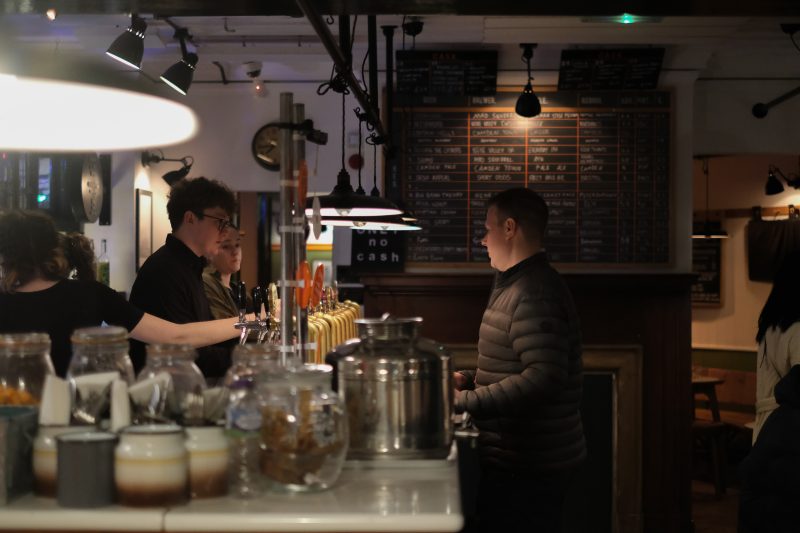
Just a short walk from Ratinger Straße is where I start my Altbier journey, stepping into Brauerei Kürzer. It must be fairly intimidating to be a newcomer on a beer scene that is centuries old and so steeped in tradition, but in 2010, Brauerei Kürzer opened as Düsseldorf’s newest altbier brewery and has already become a firm favourite with some of the city’s younger drinkers. Kürzer forgoes the stuffy, traditional interiors of the Altstadt’s other drinking spots and instead styles itself as a little more modern; all exposed brick and pipework in an industrial-chic style.
Inside the smell of malt overpowers me as I see the brewers busy shovelling spent grain into large plastic bins in the tiny brewery attached to the pub. Other than me and them, the place is empty, with most punters still recovering from the weekend’s carnival celebrations. The city has almost been drunk dry and the brewers are clearly hard at work trying to replenish their stock of alt.
I sidle up to the bar and order a glass of altbier from the seriously depleted keg and take a sip. Kürzer also tries to set themselves apart in the way they brew. The beer is a little more modern; relatively dark, with a quite pokey, hoppy finish. It’s delicious, tasting somewhere between an English pale and brown ale.

However, I want to sample one of the city’s more traditional drinking spots, starting with the historic Uerige brewery just staggering distance away beside the Rathaus on Marketstraße. The brewery’s name comes from its original owner, Wilhelm Cuerten, who in 1862 started serving beer at what had then been a wine bar. He had a reputation for being surly and patrons would often say that they would meet “at the grouch’s place”. His cranky personality became the reason for the name Uerige, which means “grouch” in local slang. It’s an atmospheric place, made up of wood-panelled, interlocking rooms darkened from years of patron’s cigarette, cigar and pipe smoke. There is even a statue of Wilhelm and his wife sitting, beers in hand, in one of the rooms.
Immediately upon sitting, without asking, I have an Altbier plonked in front of me by one of the city’s legendary Köbes, or brewhouse waiters. There is no need to take my order, as altbier is the only drink served here. And what a beer it is; a beautiful amber-coloured beer served in a traditional 250ml glass cylinder called a becher.
Decked out in blue uniforms and aprons, the exclusively male Köbes whizz around the bar, going from table to table, quickly replacing any empty glasses with a full one from the circular trays of Altbier – often full of almost 32 drinks – perched on one hand. No sooner have you taken your last sip, you will have another placed in front of you. With each replacement drink, they mark a pencil line on your beer mat to indicate how many you have consumed. The only way to stop receiving more drinks is to place the coaster on top of the glass, which tells the waiter that you are done and then your bill is totted up. Just make sure you remember to top your glass with the beer mat, or you will find a new drink in front of you before you have time to decline it.
When I ask our local guide why they’re so fast to dish out the drink, he informs me that the Köbes buy the beer from the brewery, so it is in their best interest to sell it as quickly as possible.

Before I finish my first drink, my bar snack arrives; the local delicacy of zwei soleier. To my layman’s eyes, it just appears to be two boiled eggs sitting on a plate (I’m informed that they’re only ever served in pairs). However, these are no ordinary eggs. They’re eggs that are hard-boiled in saltwater and cumin. They’re then served with oil, vinegar and mustard. While this combination seems like it is just indigestion waiting to happen, I watch as my host gently peels each egg, slices them in half – always lengthways – and then hollows out the yolk. In the void that is left, you put a dash of oil, a splash of vinegar and a spoonful of mustard. The yolk is then carefully balanced on top, seasoned with salt and pepper and popped into your mouth whole. It feels ritualistic; a little briny egg ceremony to go along with the drink.
overdo the mustard, and my eyes are starting to stream as I struggle to chew on an entire egg, but surprisingly it works. Mouth full of albumen and yolk, I only just manage to take a sip of the beer.
The bitter mustard and sour vinegar mix is a perfect match for the slightly sweet Altbier. The mustard is instantly tamed. It’s the kind of bar snack I can get behind, although I’m not sure how well this fiddly little preparation ceremony would go down with British pub-goers.
With the egg swallowed and my last drop of altbier supped, I remember to top my becher with my beer mat with lightning-fast speed before the Köbe swoops in. I have other places to go and a hell of a lot more altbier to drink.
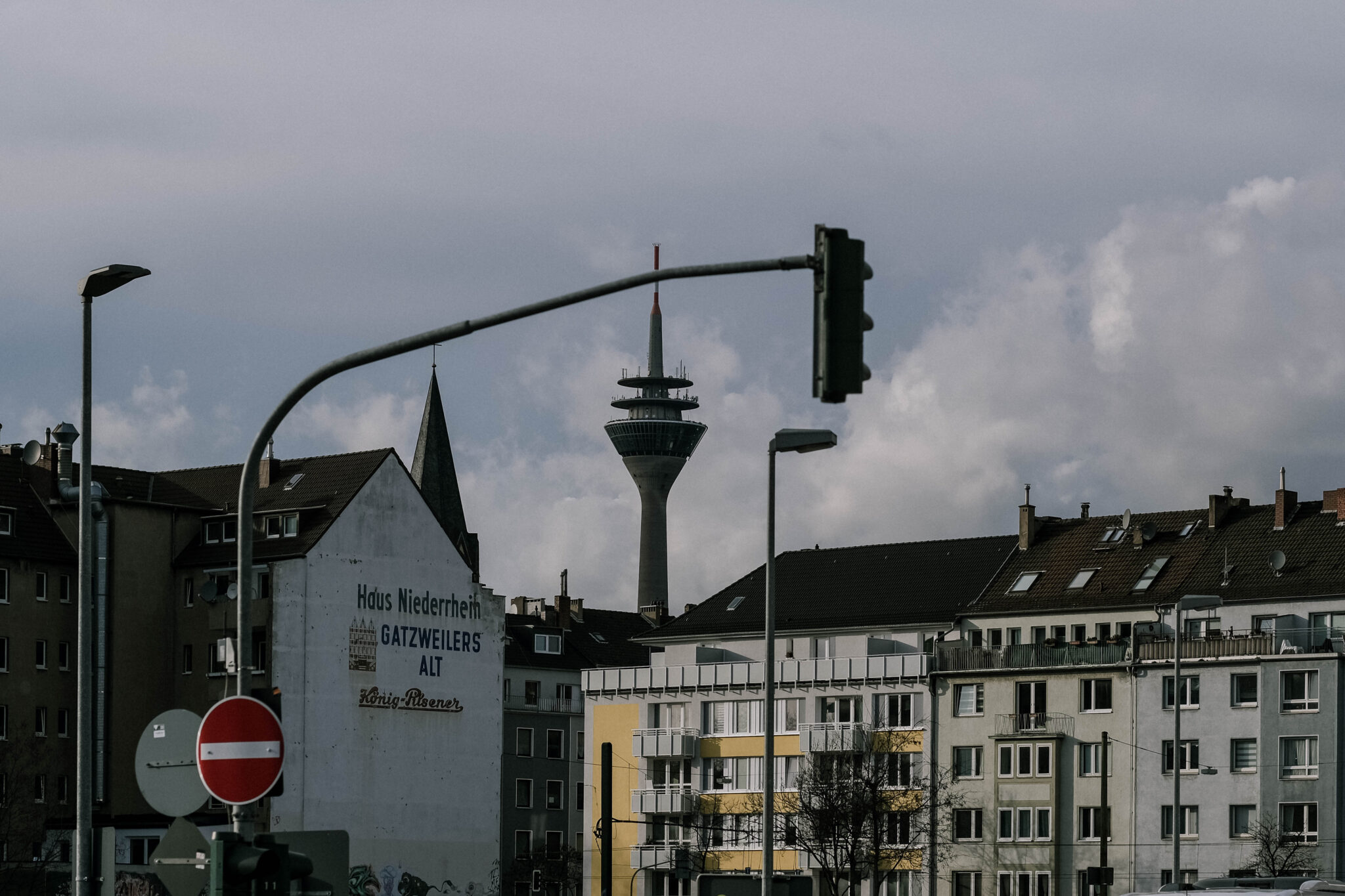
Where to Drink Altbier in Düsseldorf
Zum Uerige
Perhaps the best known, and certainly one of the most popular Düsseldorf house-breweries, Zum Uerige is located in a large Altstadt building not far from the Rhine, and a short walk from the Rathaus. The brewery’s name comes from its original owner, Wilhelm Cuerten, who in 1862 started serving beer at what had then been a wine bar. He had a reputation for being surly and patrons would often say that they would meet “at the grouch’s place”. His cranky personality became the reason for the name Uerige, which means “grouch” in the local dialect’s slang. It’s an atmospheric place, made up of many, wood-panelled, interlocking rooms darkened from years of patrons’ cigarette, cigar and pipe smoke.
Uerige describes its altbier as dat Leckere Dröppke, or “that delicious drop”. Of all the altbiers in Düsseldorf, their dry and hoppy copper brew is one of my favourites. Twice a year, in January and October, Uerige also brews a stronger (6.2%), hoppier altbier called Sticke (secret).
Im Füchschen
Opened in 1848, Im Füchschen is another large, open establishment with two big front rooms and a huge backroom as well as a great restaurant. Known for its Schweinshaxe (roast pork leg), The Little Fox can get very busy and boisterous during the evening, with Köbes rushing from table to table in the high-ceilinged, trying to keep up with the demand for beer.
Brauerei Schumacher
The oldest of Düsseldorf’s altbier breweries, Schumacher opened in the Altstadt in 1838 before moving to a newer, more spacious spot near the train station in 1871. However, they kept their pub in the centre of the Altstadt, which is now Im Goldenen Kessel (The Golden Kettle).
Zum Schlüssel
While most of the city’s breweries have retained their independence, Zum Schlüssel is a subsidiary of the larger Gatzweiler Brauerei, located elsewhere in Düsseldorf. Gatzweiler, in turn, is owned by the larger Hannen Brewery of Mönchengladbach, which itself is owned by the even larger Carlsberg Brewery in Denmark. Schlüssel’s altbier can be found in most of the city’s bars and is clean and malty with some hop bitterness. However, if you’re going to drink it, head to the brewery in the Altstadt, that has been there since 1850. Notably, the köbes at Zum Schlüssel include women as well as men.
Brauerei Kürzer
It must be fairly intimidating to be a newcomer on a beer scene that is centuries old and so steeped in tradition, but in 2010, Brauerei Kürzer opened as Düsseldorf’s newest altbier brewery and has already become a firm favourite with some of the city’s younger drinkers. Kürzer forgoes the stuffy, traditional interiors of the Altstadt’s other drinking spots and is instead styles itself as a little more modern; all exposed brick and pipework in an industrial-chic style.
They also try to set themselves apart in the way they brew. The beer is a little more modern; relatively dark, with a quite pokey hoppy finish. The tubes of alt are slightly shorter & stubbier than those found elsewhere and are carried by the waiters on a long wooden rack rather than a tray. I assume this is to set themselves apart from the city’s other brewhouses, as it is clearly not very practical in a busy pub, full of increasingly drunk customers.
Alter Bahnhof Oberkassel
Another newcomer to the Altbier scene in Düsseldorf, Alter Bahnhof only started producing its own beer in 2009, moving onto only brewing altbier in 2011. While most of the city’s breweries are situated in the Old Town, Jürgen Flohr and Klaus Unterwainig have set up shop across the river in Oberkassel – described to me as “Dusseldorf’s answer to Hampstead, only a little less exclusive” – in a beautiful old train station.
Kreuzherreneck
On a street like Altestadt, heaving with bars and breweries, it can be hard to stand out from the crowd. Kreuzherreneck manages this more due to its size than anything else. I found myself in this tiny corner pub on the Sunday evening of Dusseldorf Carnival, dragged there by a man dressed like a Viking and another in full Jack Sparrow regalia, trying to squeeze up to the bar to order a round of beers amongst the 50 or so revellers that had somehow managed to squeeze into the pub and stood drinking like fancy-dressed sardines. Opened in 1952, this Schnapsausschank was originally a meeting place for artists, writers and bohemians. Not much has changed in the last half a century and the bar is still populated by artists and students from the nearby Academy of Fine Arts. There are only 2 tables and a couple of bar stools for seating, yet somehow they manage to have live music here.
Holy Craft
For a country that is so passionate about beer, it seems strange that the craft beer boom that has been sweeping the globe for the last decade or so has, for the most part, completely missed Germany. Yes, the country does have some great craft breweries, but not many of them seem to be in the Rhineland where heritage beers dominate. Holy craft is a little different, offering up alternatives to the alts and pilsners that litter the menus in most of Dusseldorf’s pubs and serving speciality beers in the city’s one and only dedicated craft beer bar. Beer lovers may find the drinks menu a little lacklustre compared to pubs in other countries (it consisted of relatively bland IPAs and mainstream Belgian beers when I visited) but it certainly makes a change from the offerings found elsewhere in the city.
I visited Dusseldorf as a guest of the Dusseldorf Tourism Board. However, all opinions are my own.


One Response
I’m surprised you missed out Frankenheim, which has the brewery in Am Wehrhahn, and a bar in the Altstadt, but also Schumacher in Oststrasse