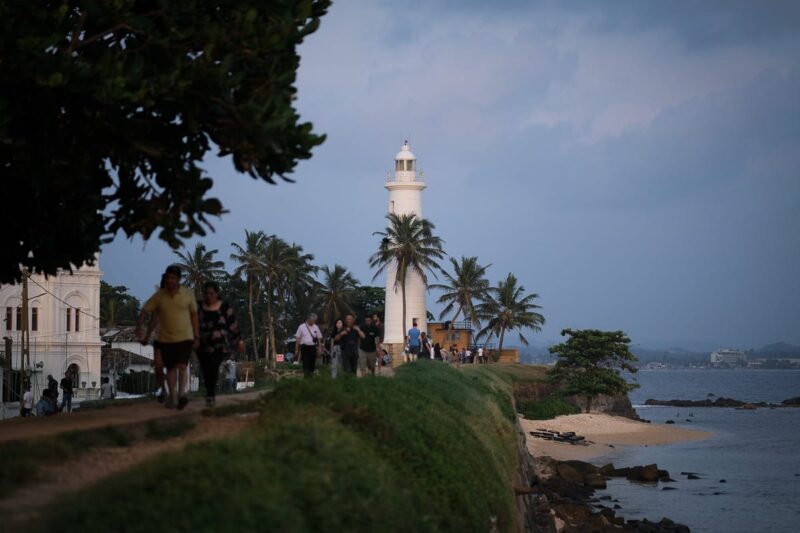
Colombo can seem a far cry from the tea bush-covered hills of Sri Lanka’s interior or the palm-lined beaches of the island’s south. It’s a city that most visitors to the teardrop isle tend to avoid, instead, heading straight from the airport to the beaches of Negombo, or only circling around the city to make their way southwards to Galle or the beaches of Mirissa and Welligama.
However, Colombo is a little hard to ignore. It is Sri Lanka’s largest city, with a population of 750,000. Despite this, it’s not the country’s capital city – that title goes to Sri Jayawardenepura Kotte, although the two cities are so close that they practically merge together. Maybe that’s fitting as Colombo doesn’t feel like a large city, certainly not on the same scale as other Asian capitals like the sprawling metropolis of Bangkok or chaotic and claustrophobic Delhi. Instead, it feels like a patchwork of smaller neighbourhoods whose sum is somehow greater than its parts. Neighbourhoods with intriguing and storied names like Fort, Slave Island, Cinnamon Gardens and Mount Lavinia that once were filled with spice plantations and palm trees but now form part of this commercial capital.

Then again, it’s the subdued nature of Colombo that maybe its strength. While other South Asian cities are always thrumming with noise and traffic, Colombo is calmer. The roads that are full of traffic during the day are clear at night, allowing you to walk the seafront in peace. Even in the daytime, quiet, tree-lined streets and serine parks are easy to find. It’s not a place that, as a visitor, you will love – It doesn’t inspire the same rush of emotions that other major cities do. Then again, it still has something to offer, as all places do. It’s a city with history, a city with culture, and a city that you shouldn’t go out of your way to avoid.
Getting to Colombo
Bandaranaike International Airport is located 35km north of Colombo on the edge of the beach-front town of Negombo. The journey by car should take around 40-50 minutes by car. it is possible to hail an Uber and do the journey for around £10, but a metred cab hailed from outside the terminal will set you back a little more. Buses leave the airport at a rate of approximately one every 15 or 20 minutes. The bus journey takes 1 hour.

The Best Things to do in Colombo
1. Wander Around Fort, The Historic Heart of Old Colombo
2. Get a Feel for Local Life in the Pettah Bazaar
3. Hang Out with Locals on Galle Face Green
4. Sample some Street Food
5. Get a Bird’s-Eye view of the City from the Lotus Tower
6. Visit Gangaramaya Temple, Colombo’s Most Important Shrine
7. Seema Malaka
8. Dutch Hospital
9. Relax in Viharamahadevi Park
10. Jami Ul-Alfar Masjid (the Red Mosque)
11. The National Museum
12. Visit the Independence Memorial Hall
Wander Around Fort, The Historic Heart of Old Colombo
Once the site of the city’s Portuguese defences, Fort is Colombo’s historic heart: During British rule is was the administrative centre of Ceylon, filled with lavish neoclassical architecture, banks and municipal buildings. Following independence, Fort remained the administrative hub of the city but unfortunately fell into disrepair during the country’s long and bloody civil war. Luckily, the regeneration project that began following the war’s end has resulted in Fort being returned to its former glory.

Sitting at the district’s centre is the beautifully refurbished clocktower lighthouse, constructed by Governor Henry ward in 1857. The (possibly apocryphal) story is that is wife was fed up with the lack of time-keeping standard in Ceylon so insisted that Ward constructed the clock. Soon after, a beacon was added to the tower’s summit in order to guide passing ships into port.
Just west of the tower is Fort’s most elegant address – formerly Queen Street, Janadhipathi Mawatha is home to the grandiose president’s house as well as the fancy colonial façade of the city’s general post office. Elsewhere you will find an abundance of grandiose buildings on Chatham Street and York Street, including the red frontage of Cargill’s department store. Now standing empty, it is one of the Fort’s most famous landmarks.
Get a Feel for Local Life in the Pettah Bazaar
The streets of Pettah, with its busy markets, shops, and bazaars have been a trading outpost for centuries. Pettah literally means ‘outside the fort’, derived from the Tamil word pettai (or village), and this dizzying market district, with maze-like streets still configured in a traditional bazaar layout, feels unlike anywhere else in Colombo, yet, it is the beating heart of the city. It retains much of its Tamil flavour but is also the city’s main Muslim area, with Halal restaurants and beautiful mosques standing shoulder to shoulder with colonial churches and Hindu temples.
The area can be rather chaotic: fruit and vegetable stands piled high with produce and porters pushing through the crowds of shoppers and street food stalls with barrows loaded full of boxes. While the district probably isn’t the best place to go souvenir shopping, it is worth walking around here in order to catch a glimpse of local life in Colombo.

Hang Out with Locals on Galle Face Green
Stretching across the seafront from the edge of Fort, all the way to the edge of the sprawling and luxurious Galle Face Hotel, Galle Face Green is one of the city’s most-loved open spaces. Built by Colombo’s former Governor Sri Henry Ward, the park and its seafront promenade are were locals come to hang out, picnic and play. Along the benches at the back of the park, you will find love-struck teenagers smooching under the cover of well-placed umbrellas while beside the waterfront street food vendors cook up fresh delights and salesmen peddle helium-filled balloons. It’s a pleasant place for a seaside stroll, were out to sea you can see container vessels and tankers queuing to enter the city’s port while behind you are the modern, high-rise hotels that makeup Colombo’s constantly shifting skyline.


Sample Some Street Food
Street snacks are a staple of Sri Lankan cuisine and in Colombo, you can find a whole host of stalls lining the waterfront promenade of Galle Face Green serving up local delights from tiny green huts. Kottu is possibly the country’s most popular snack, made by cooking chopped roti, meat, and vegetables on a hotplate, but you will also find delicious samosas, string hoppers and prawn filled buns being fried up.
If you want to get more of a taste for what Sri Lankan cuisine has to offer, then the buffet at Raja Bojun has a dizzying array of dishes and curries. The restaurant may seem a little touristy, but the food is as authentic and delicious as anything you will find elsewhere on the island, giving you a chance to sample as many dishes as possible.
Get a Bird's-Eye View of the City from the Lotus Tower
Looming high above the city and visible from all over Colombo, the enormous green and magenta Lotus Tower is Sri Lanka’s newest landmark, standing 350m tall on the edge of Beira Lake. Aiming to be the city’s answer to the Toronto’s CN Tower or Paris’ Eiffel Tower (which it is just slightly taller than), the tower is the tallest structure in South Asia, topped with a purple-hued lotus bud containing an observation deck and rotating restaurant that becomes beautifully illuminated at night.

Visit Gangaramaya Temple, Colombo's Most Important Shrine
Gangaramaya Temple hosts quite an unusual array of objects, mostly things you wouldn’t normally expect to find in a Buddhist place of worship: display cases filled with vintage cameras, enormous taxidermied elephants, model dinosaurs, stamps, watches and even swords. In fact, parts of the temple – particularly the two-room museum – are more reminiscent of a thrift store than a shrine, stuffed with knick-knacks that were donated to the temple by prominent Buddhists and well-wishers.
The temple itself is one of Sri Lanka’s most important and the focus of the city’s annual Navam Perahera festivities. It contains an eclectic mix of Buddha statues (including the world’s smallest), Hindu deities and sacred objects, one of which is claimed to be a hair from Buddha himself. The serene central courtyard hosts a beautiful bo tree and lovely wooden pavilion containing an old library while the surrounding rooms are occupied by a delightful array of statues and artwork.
Seema Malaka
Sitting on the shores of the southern arm of Beira Lake, the beautiful Seema Malaka temple contains 3 connected, floating platforms containing beautiful wooden pavilions inspired by the design of Sri Lanka’s forest monasteries and roofed with vivid blue tiles.
The temple, designed by Geoffrey Bawa, is generally used for the inauguration of Buddhist monks but was actually funded by a prominent Muslim who, after falling out with a fellow religious leader, spitefully paid for Seema Malaka to be built. In contrast to Gangaramaya, the temple is relatively quiet and a peaceful place to wander amongst the rows of Thai Buddhas while watching the pelicans and egrets that fish in the lake.

Dutch Hospital
Long before British Rule, the Dutch controlled Colombo for over 150 years, ousting the previous Portuguese occupiers in 1656 after a 7-month siege. It was the Dutch that really shaped the Colombo that you see today, reclaiming the land from the river delta, building canals and the city’s tree-lined streets.
The Old Dutch Hospital is the oldest remaining building from this period. It has been beautifully restored and now contains a number of restaurants and cool boutiques. While here, you need to stop for a meal at Ministry of Crab, a restaurant run by one of Sri Lanka’s most popular chefs, Dharshan Munidasa’s. However, reservations are essential.
For more insight into the Dutch history of Colombo, stop by the Dutch Period History Museum that occupies the old Dutch Town Hall, a slightly dishevelled colonial building from 1780. Here you will find a mix of Kandyan and Dutch artefacts and displays outlining what Ceylon was like during the Dutch colonial era, although, the main attraction is the atmospheric building itself.
Relax in Viharamahadevi Park
The largest green space in Colombo, Viharamahadevi Park was formerly known as Victoria Park in honour of the British monarch but patriotically renamed in the 1950s after the mother of King Dutugemunu. Although there isn’t a great deal to see in the park itself other than a beautiful golden Buddha statue, its perfectly manicured lawns and palm-lined paths are a pleasant place to walk or picnic with locals as a way of escaping the city’s busy streets. To the Noth of the park, you will find Colombo’s town hall, a neoclassical structure reminiscent of the US Capitol built in 1927, and the Moorish-style Devatagaha mosque.

Jami Ul-Alfar Masjid (the Red Mosque)
Sitting in the heart of chaotic Pettah, the tall minarets of Jami Ul-Alfar Masjid tower over the markets and bustling streets of one of Colombo’s oldest neighbourhoods. Following its construction in 1908, the building’s brash red and white design – a mesmerising mix of checkerboard brickwork, candy stripes and swirling lines – was seen as a landmark for sailors approaching Colombo’s port.
Known as Rathu Palliya in Sinhala, and Samman Kottu Palli in Tamil, the mosque was constructed in the Indo-Saracenic style, albeit with unique, pomegranate shaped domes rather than the usual onion-dome style. Still today, the colourful patterns inspire awe as they stand out in the narrow shopping streets of Pettah.
As this is a place of worship, please be respectful when visiting. Men should wear trousers and shirts with long sleeves, while women should cover their hair and wear long garments that cover their arms and ankles. The area around the mosque can become a little hectic at prayer times, particularly Fridays, so plan your visit accordingly.


The National Museum
Located just south of Viharamahadevi Park in a beautiful neoclassical building that dates back to 1877, Sri Lanka’s National Museum contains a whole host of artefacts and objects that give an insight into the island’s storied history, from the prehistoric times all the way up to the colonial era and beyond.
Visit the Independence Memorial Hall
The Independence Memorial Hall, a large stone pagoda supported by ornately carved pillars in the style of Kandy’s Audience Hall, stands as a monument to 4th February 1948 when Sri Lanka gained its independence from the United Kingdom. The structure’s nod to Kandy’s famous hall is a reference to the fact that it was there that the Kandyan Convention was signed, handing over control of Ceylon to the British. Now things have come full-circle and the Independence Memorial Hall, sitting beside a beautiful, green, city centre space and flanked by a statue of Sri Lanka’s first president, Rt. Hon. Don Stephen Senanayake, is used for events such as the annual independence day celebrations.

Where to Stay in Colombo
Accommodation isn’t in short supply in Colombo, with lavish skyscraping hotels being added to the city’s shifting skyline all the time in order to cater to the constant influx of business travellers. Dorm beds are a little harder to come by but hostel numbers are on the rise and there are still plenty of chic boutiques and guest houses dotted around the city.
BUDGET / Bunkyard Hostel
This hostel, located in Cinnamon Gardens and just a short walk from Viharamahadevi Park, isn’t anything fancy – the dorm rooms are a little basic – but the private rooms are clean and modern, offering a very good budget alternative to some of the city’s more expensive hotels.
Check Prices and availability
MIDRANGE / Cinnamon Red
Cool and chic, this modern, highrise hotel towers all the way up to the 25th floor of a skyscraper where you will find a stunning infinity pool that gives some of the best views in the city. Even if you’re not staying here, the rooftop bar is the perfect place to relax with a sundowner cocktail.
Check prices and availability
LUXURY / The Kingsbury
Speaking of sundowner views, the cool Skylounge at the Kingsbury offers a fantastic vista overlooking Galle Face Green and the skyscrapers that line the seafront. The hotel itself is nice and lavish, albeit in the style of old-world chic: think uniformed busboys, shimmering marble lobby and little touches of colonial charm. The pool area is fantastic and the hotel’s restaurant has the best Chinese-fusion food in the city.
Check prices and availability
Getting Around
Fort and the surrounding area are very walkable but if you want to go further afield, there is an abundance of tuk-tuks in the city and there is no doubt that you will have them honking at you and offering a ride wherever you go. Most of the tuk-tuks are metred but before travelling, ensure that the metre is switched on, otherwise, agree a price with the driver before you set off.
Safety in Colombo
Tourism in Sri Lanka took a sharp hit following the Easter bombings of April 2019 and as a result, many governments issued warnings against travel to the country. Thankfully, increased security both on the streets of Colombo and at the city’s major hotels – there are now airport style checks at the entry points to the majority of Colombo’s hotels – have meant that many of the warnings have been downgraded and Sri Lanka is once again seen as reasonably safe to visit. From my point of view, Sri Lanka is an incredibly welcoming country and I generally feel safer wandering the streets here than I do in many other destinations. As always, use your head and take precautions when it comes to carrying valuables, but I would give that same advice to people travelling anywhere in the world.

How Long Should you Spend in Colombo?
Although there is plenty to see and do in Colombo, you shouldn’t need more than 24 hours or an overnight stay in order to see the majority of the tourist sights. Colombo is the country’s largest city, but the main attractions are generally centred around Fort, Galle Face and the central districts of Cinnamon Gardens, Colombo 10 and Colombo 11. These areas are walkable, but it is easy and cheap enough to hail a tuk-tuk if you want to see the entire city in a short amount of time.
I visited Colombo as a guest of Sri Lanka Tourism. However, all views are my own.