The first drink eases me into things. A small, 15ml tasting glass emblazoned with the logo of the Modeste Beer Festival, half filled with a fine Belgian amber nectar and topped with a pillowy, pure white foam that flows over the brim, across my fingertips and down the stem.
The brewer that has just poured me my beer is from a brewery that I don’t recognise: LePlan-Vermeersch, a microbrewery from Malle, about 30km east of where I’m currently standing, sipping one of their IPAs. Even though I don’t recognise the brewery, the owner should maybe be a little familiar to anyone who’s a keen follower of motorsports.
In 1977, just two years after starting his racing career, 1977 Dirk Vermeersch had already climbed the top of the podium and won the first 24 Hours of Zolder. However, his life in the fast lane would come to a halt after a rally accident in 1986. Seeking a slower pace, Dirk bought half a hectare of 40-year-old Carignan vines in the Rhone Valley and began producing wine. Typical of his victorious past, less than two years later, one of his wines – GT-Syrah – would be winning awards.

It wasn’t until 2020 that Dirk decided to move back to Belgium and dip his toes into the brewing industry. Beer was not entirely unfamiliar territory for someone who wore Carling’s livery on his very first podium at the 24 Hours of Spa-Francorchamps and had the Westmalle Trappist logo on his racing suit at Daytona. It took just 6 months of self-study and an online brewing course during the lockdown of the COVID pandemic before he released the first brew, his LePlan Triple, which is now sitting in my glass.
With my second drink, I leaned into things a little further. It’s Rubi, a red ale from Antwerp’s own Inglorious Brew Stars, and feels a little more traditional. A fitting tipple to be drinking at an event organised by Antwerp’s Bier College.


The third drink is perhaps an even more suitable tribute to my current location. Bollecke is an iconic beer from the equally iconic Brouwerij De Koninck. It’s an Antwerp classic and emblematic of the city. The marketing material claims that it’s ”the taste of rough docks and full terraces. Of cargo bikes and summer evenings near the river bank”. That it’s “Antwerp in a bottle”.

Taking my first sip, the aroma profile is complex but not overly so; it’s slightly malty and hoppy with a hint of banana. There are also hints of chestnut, toffee and a slight smokiness. However, these aromas are all balanced out with some fruit and spiciness from the Saaz hops.
As for the taste, it’s easy to see why this Spéciale Belge is the city’s favourite tipple. It’s rather bitter and the finale is creamy. However, this is all The bitterness is counteracted by the sweetness of toffee along with the notes of cinnamon and caramel. It’s refreshing and easy to sip.
Founded in 1833, De Koninck Brewery has a rich history almost as old as Belgium itself: the brewery is intertwined with the city’s past and embodies its unique character.

On June 26, 1827, Joseph Henricus De Koninck, then husband to Elisabeth Cop, bought De Plaisante Hof (The Merry Garden), an inn that sat on the edge of Antwerp, along the road to Mechelen. Despite its quaint name, the inn was situated right across from the notorious gallows field (now King Albert Park) where, in the Middle Ages, murderers and other convicts were hanged. On this boundary between Antwerp and Berchem, in front of De Plaisante Hof, stood a stone boundary post showing an upright hand, which was a token for merchants entering the town to pay the toll. This ‘toll hand’ is now seen as the symbol of the city, whose name is, according to some, derived from the Dutch for ‘hand’.
Following Joeseph’s death shortly after buying the inn, his widow was remarried to Johannes Vervliet who set about turning the inn into a brewery which he named ‘De Hand’, after the nearby toll sign. At that time Belgium was barely three years old.
The brewery became a success and following Johanne’s death in 1945, it was passed down to generation after generation of De Koninck’s. The name De Koninck appeared on the brewery for the first time with Vervliet’s stepson, Carolus De Koninck, who continued the business.

Their classic beer was launched in 1913. Although it was officially called De Koninck or APA (short for Antwerpse Pale Ale), residents of the city quickly began referring to it exclusively as Bolleke, due to the fact that it was always served in a spherical beer glass, the bolleke. It’s a word that comes from the Brabant dialect meaning a small ball and has been used by beer drinkers in Antwerp to order this drink for so long, that the original name was all but forgotten. This nickname became the official name of the beer in 2019 with the opening day of the Antwerp city festival, the Bollekesfeest.


De Koninck has come a long way since its humble beginnings almost 200 years ago. You’ll still find it on Mechelsesteenweg, opposite the same park, but the city has seemed to grow around it, engulfing it within the urban sprawl. By the 90s, the brewery reached production volumes of 130,000 hectoliters
In August 2010, the brewery was sold to Duvel Moortgat, brewers of Duvel and several other Belgian beer brands, who announced their intent to reinvigorate the brand. It seems to have worked. The brewery complex as it stands today is a fantastic place to visit, and much larger than I expected; It’s modern, sleek and stylish, hosting a cheese shop, bakery, chocolatier, cycling shop, butcher’s shop, and both a BBQ restaurant and Michelin starred restaurant. There is also a state-of-the-art brewery experience, with 10 interactive rooms discovering the history of the brewery and its umbilical connection with the city.


I have a fast trip through the brewery experience, and it is an impressive way to learn De Koninck’s history and much more enjoyable than similar experiences I have had at places such as Staropramen in Prague, if not quite on the level of the Pilsner Urquell brewery tour in Plzen, before settling in the breweries bar-cum-restaurant to slowly sip the two free beers: The Bolleke and a Tripel d’Anvers.
Set within the former brewing hall, it’s a characterful place to have a beer. Old beer posters and pub signage adorn the walls, and you can take a seat in an old brewing kettle or next to the shredding mill to enjoy a drink from one of their 17 taps.
However, I didn’t come to De Koninck to sit in their bar. The reason I’m here is for the Modeste Beer Festival. Now in its 12th year, the festival is an annual celebration organised by the Antwerps Bier College which sees them invite 30 of the nation’s finest small, craft breweries to showcase their best beers.
In a way, that’s why the name is the perfect fit for the festival. With ‘Modeste’ meaning humble, many of the beers on display are crafted by relatively small, family-run breweries. However, it is actually a nod to the much-loved Modeste van den Bogaert, who ran De Koninck for 50 years from 1949 to 2000 and is well known as the father of the ‘bolleke’.


Each Year, the Modeste Beer Festival sees over 4,000 beer lovers descend on Antwerp’s Iconic De Koninck Brewery to sample some of the best beers from craft and micro-producers that Belgium has to offer.
Walking into the festival from the brewery’s entrance on Mechelsesteenweg, a crowd is already beginning to form. People jostle around the ticket stall to collect their branded tasting glass and begin to wander through the small alleyway that is tucked between the De Koninck Bar and the ‘brewery experience’ building. I find around 4 or 5 stands from small breweries, each peddling their bottles and keg lines. It’s here that I sample my first couple of beers, from LePlan and Inglorious Brew Stars, while wedged between a few tipsy Belgian beer aficionados who natter at me in Flemish, presumably about the virtues of their chosen tipple over the beer that occupies my glass.

It all seems relatively quiet and sedate compared to what I was expecting, so I excuse myself to follow the steady flow of fellow patrons past the brewery buildings and through a passageway that opens out into the main brewery yard. This is where I see the true scale of the festival: Between the towering conditioning tanks and warehouses, a large marquee hosts a dozen or so brewers with their stalls organised at the centre of the outdoor area; tables and benches stretch the entire length and not a single seat is unoccupied as people gather to sample new and unique beers.

There are a few local, Antwerp-based breweries that I recognise and had visited the previous day. I had previously had fantastic visits to Gistgeest and Cabardouche, but the vast majority are brewers that I have never heard of, so I take my time to browse the stands to see what I can sample. It seems to me that the Antwerpse Bier College has done a fantastic job of sourcing a huge variety of brewers and beers for this year’s festival, meaning that any beer lover is likely to find a new favourite drink, no matter their beer preference. Alongside the typical Tripels, dubbels, lambics, and blondes, there are styles not so closely associated with Belgium’s typical beer roster; DIPAs, TIPAs, cask ales and experimental sours.
Despite the fact that there are thousands of people gathered around, laughing and joking with friends, having sips and tasters of each other’s drinks while sharing cigarettes and jokes amongst an electric atmosphere, I find that it is incredibly easy to get a few minutes to speak to each brewer, and even easier to make conversation with Antwerp’s beer lovers the more I drink. At this moment, the yard is one giant beer garden packed with all manner of people; couples, groups of friends, families, and solo drinkers; all here to see what Belgium’s small craft breweries have to offer and all having a fantastic time.


I take in my 4th and 5th drink, sampling some of the country’s smaller breweries while a brass band, dressed in matching red shirts and black suspenders, honks out some Flemish classics while marching through the festival.
Between the music, I find that it is incredibly easy to get a few minutes to speak to each brewer, and even easier to make conversation with the Antwerp locals the more I drink. After a couple more tasters, the yard began to feel like a community; a group of people that all have the same goal of drinking the best beer possible.
There’s always the feeling that Belgian beer should come with a warning, such is its strength. By the next couple, I’m already feeling unsteady on my feet. Between the 6th and 10th I’m somewhere on either side of a plateau of inconsiderable joy and a determination to stay relatively temperate.

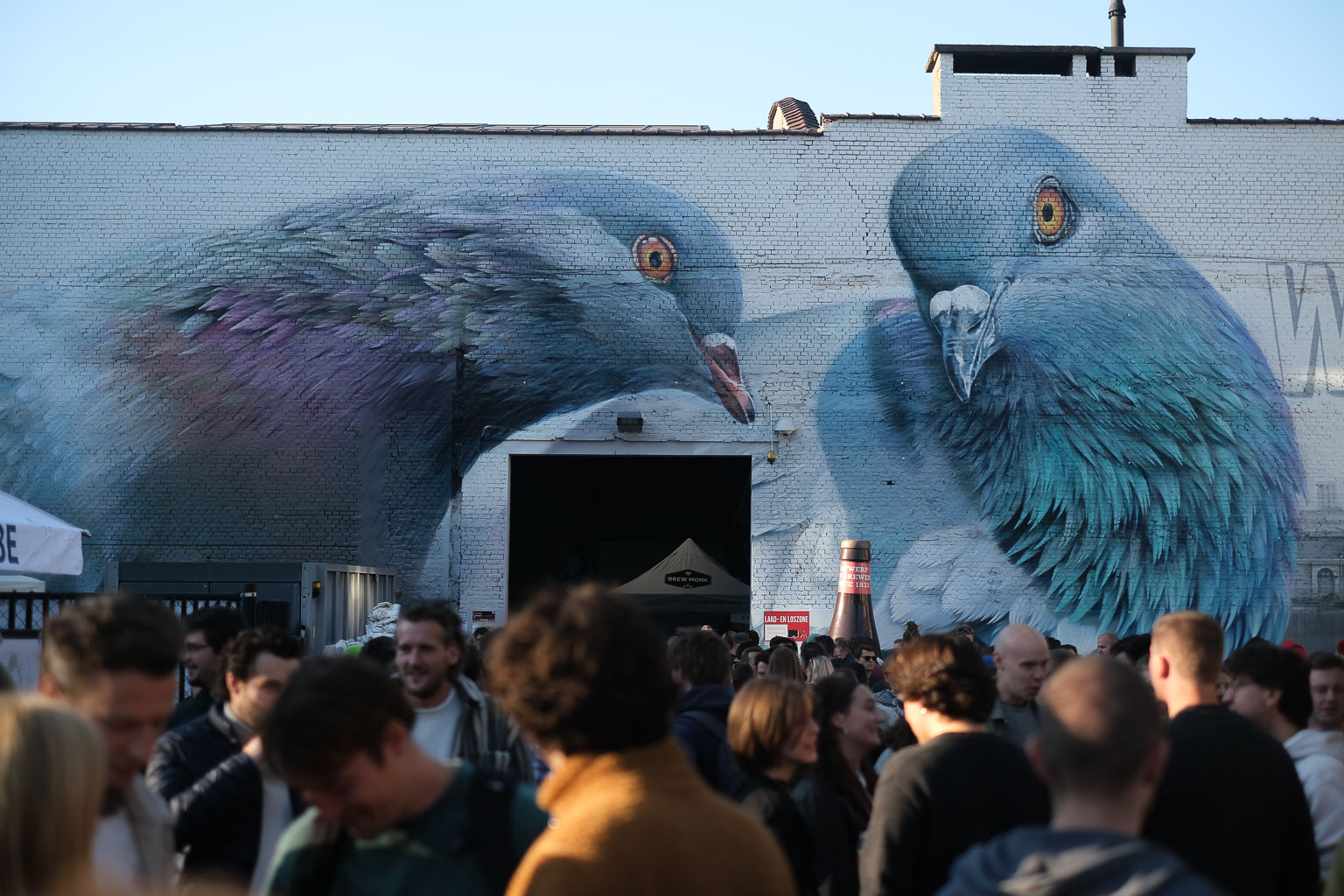
I make my way inside one of the warehouses where the walls are covered in an enormous mural of pigeons, a nod to De Koninck’s Wild Jo Blonde. Here, there are just as many breweries on offer, with stalls and taps lining the walls that are usually occupied by stacks of malt and hops.
It’s a little quieter inside, with most people opting to enjoy the outdoor party atmosphere and soak up the early autumn sun. However, the beer offering inside is even greater than what is found in the yard. Alongside the smaller producers such as the city’s own SE10, Uncharted, and Blacksmith Meadery there are some of Belgium’s heavy hitters; Brussel’s Brasserie de la Senne have a bar, as Mechelen’s famed Het Anker Brewery, whose stand is decked out in banners celebrating their iconic Gouden Carolus ale.


The Golden Charles is named after Charles V, the Holy Roman who was said to enjoy imbibing a bit of Mechelsen Bruynen. It’s light but incredibly deep, hinting at flavours of caramel and figs. Typically you will find it in 2 varieties around Mechelen’s bars; Gouden Carolus Classic and Tripel, although the brewery pumps out a vast quantity of variations including the hoppy Hopsinjoor, as well as Christmas and Easter editions and there are plenty on display at the festival.
Unsurprisingly, another Belgian heavyweight takes up a good chunk of real estate right in the centre of the beer hall. Duvel Moortgat purchased De Koninck in 2010 and while they are still very much an independent family business with a distinctive focus on speciality beers, their portfolio encompasses 10 breweries – Duvel Brewery in Puurs, Achouffe Brewery in Houffalize, De Koninck Brewery in Antwerp, Liefmans Brewery in Oudenaarde, Bernard Brewery in the Czech Republic, Brewery Ommegang in New York, Boulevard Brewing Company in Kansas City, Firestone Walker in California, Brewery ’t IJ in Amsterdam and Birrificio del Ducato in Italy – with the beers of Duvel, Liefmans and Achouffe on display here.

I decide to give these bigger name brews a miss on account that I can find the majority of Duvel’s beers back home in Britain, instead, heading back outside to join the party and sample something a little more obscure. By this point, the sun is just beginning to set over De Koninck but the revelries are showing no sign of slowing down. Reaching double figures in my beer-tasting odyssey, there’s a noticeable deterioration in my cognitive function and even the most simple words feel like tongue twisters, such is the effect of an afternoon on the tripels and dubbels.


Feeling a little unsteady on my feet and full of beery joy, I navigate through the shoulder-to-shoulder patrons and decide to head towards the brewery’s sister restaurant, Repasse in an effort to fill my stomach and counteract the alcohol. Standing firmly in between fine dining and hearty brewpub fare, this dining spot is a throwback to the days when waiters would give you a second serving if they saw your plate was empty; all the main dishes – from perfectly fried sole to succulent chicken off the spit – is served en repasse, meaning you are guaranteed an extra serving.
It’s gluttonous and extravagant, but after an entire day of sipping some of Belgium’s best beers, it’s par for the course. I tuck into my second serving of chicken and decide to order a cold glass of Tripel d’Anvers to wash it down. By this point, I’ve lost track of how many drinks I’ve imbibed, but it would be doing De Koninck a disservice not to carry on.
About the Modeste Beer Festival
The Modeste Beer Festival is traditionally held on the first weekend of October each year at the iconic De Koninck Brewery, located on the boundary between Antwerp and Berchem. It is just a 30-minute walk from the city’s stunning Centraal Station. The entry point of the festival is usually at the entrance to the brewery on Mechelsesteenweg and it is open on Saturday and Sunday from 11am until 7pm.

There is a glass stand located at the entrance where you can buy your 15cl tasting glass €7 which will also get you a bracelet to access the on-site toilets.
Hosting around 30 breweries – both modern and family brewers – each year, it is also considered one of the cheapest beer festivals in Belgium; Most beers cost around €1.50 (although some can reach €3). It’s recommended that you bring cash as I found that most stalls did not accept card payments.
How to Get to Antwerp
Antwerp has great transport links and is easy to reach by train. International railway lines such as Thalys and Eurostar connect Brussels and Antwerp to several other major European cities.
By Air
If travelling by air, Brussels International Airport is the main airport for accessing Antwerp. From the airport, there are direct trains to the city which take between 20 and 30 minutes.
You can also travel from Brussels Airport Zaventem to Antwerp with the Airport Express bus. There are two stops in Antwerp: Franklin Rooseveltplaats (next to the opera house and 400 metres from the central train station) and the Crowne Plaza Hotel.
Antwerp does have its own Airport, Deurne, located 7km east of the city. Flights from the UK are few and far between, although there are some scheduled flights from London, Manchester, and Liverpool via local carrier VLM but very few other international flights.
By Train
There are trains running every half an hour or so from both Brussels and Ghent with the journey taking approximately 30 minutes from either city.
Antwerp is also on the Thalys high-speed train network that connects Paris, Brussels, and Amsterdam. From Paris, you can take the Thalys high-speed train direct to Antwerp but if you opt for one of the cheaper international trains, you will need to change in Brussels.
From Amsterdam, both the Thalys and the international/intercity trains serve Antwerp directly. The Thalys trains generally stop at Antwerp-Berchem rather than Centraal Station.
By Eurostar
Travelling to Antwerp from London via Eurostar is possibly the easiest way to get to the city from the UK. Trains from St. Pancras to Brussels take less than two hours and just require a quick change at Brussels-Midi/Zuid.
On arrival at Brussels-Midi/Zuid, take the stairs down to the main station and check the departure boards for the next train to Antwerp. The Eurostar ticket covers the local train to Antwerp, so you do not need to buy an additional ticket.
Getting to the Modeste Beer Festival
The Modeste Beer festival is hosted at De Koninck Brewery, on the edge of Antwerp’s Berchem neighbourhood, around 3km south of the city’s central station.
The distance is easily walkable in 30 minutes, however, if you are travelling by public transport then Antwerp-Berchem station is just a 10-minute walk from the brewery and there are tram/bus stops beside the entrance (trams numbered 2 or 6 to stop ‘Harmonie’) as well as a VELO station.
Where to Stay in Antwerp
Thanks to its extensive public transport system, you can choose to stay in almost any of Antwerp’s neighbourhoods and still be just a short tram ride from most of the major attractions.
The majority of visitors choose to locate themselves close to the historic centre or Antwerp’s central station, but if you are visiting soley to come to the Modeste Beer Festival, it may be worth looking into accomodation in Bechem or the up-and-coming Green Quarter.
Central Location
NH Collection Antwerp Centre
Not many hotels have a location as convenient as The NH Collection. Sitting directly across the road from Antwerp’s Centraal station, it is just a few minute’s walk from the platform to your bed. I spent two nights there during my visit to Antwerp and really appreciated its position in the diamond district, close to both the historic centre and the city’s main transport hub.
While this is a very much a typical business hotel, the rooms – 186 of them spread across 8 floors – are well appointed, modern, and the suites on the top floor offer fantastic views over Antwerp Zoo and Antwerp Centraal Station.
Boutique
August
Antwerp’s Green quarter may feel a bit far from the action, but this leafy, mostly residential neighbourhood is up and coming and has enough going for it to make it a destination in its own right. The adjoining Zurenborg, with its trendy bars and restaurants, is just a few minutes walk away, while the converted industrial site PAKT, is buzzing with fantastic cafés and dining spots. Plus, Antwerp’s historic centre is only a short distance by tram, thanks to the city’s fantastic public transport network.
August is a sister hotel to Antwerp’s much coveted Hotel Julien and is the first hotel project by Belgian architect Vincent Van Duysen. Set within a former Augustinian convent, the hotel is spread across buildings where many of the buildings original features have been retained and complimented by new, modernist touches.
The highlight is the old nun’s chapel which now houses a stunning bar and lounge while elsewhere you will find a serene spa and on-site restaurant overseen by the team behind the Michelin-starred Jane.
Eclectic
Hotel Pilar
To get away the bustle of the historic centre and the crowds of fellow tourists, the stylish and fashionable Het Zuid district provides a quiet escape. Here you will find wide, tree-lined boulevards and grand 19th century mansions that are now home to fantastic cafes, restaurants, and galleries. This is an area of the city with an artistic flair and is home to some of Antwerp’s finest galleries, such as the Museum of Fine Arts, the FOMU Fotomuseum, and Museum of Contemporary Art.
The stylish and eclectic Hotel Pilar, occuping a grand, bright white townhouse opposite the KMSKA is perfectly suited to its Het Zuid location. It is the brainchild of architect Sam Peeters and hospitality expert Christophe Ysewyn who have created a hotel that manages to be both homely and forward thinking. None of the 17 rooms are the same, with each of them mixing retro and vintage pieces with fresh design elements.
I visited the Modeste Beer Festival as a guest of Visit Flanders and Visit Antwerp. However, all views expressed are my own.

One Response
Thank you for this incredible article! Your vivid descriptions of the Modeste Beer Festival really brought the experience to life. I felt like I was right there with you, exploring the unique beers and learning about the history of De Koninck Brewery. The personal anecdotes and the way you captured the lively atmosphere of the festival made it such an enjoyable read. I’m grateful for the insights you’ve shared about Belgium’s craft beer scene – I’m definitely inspired to visit next year!