
Paris. London. Tokyo. Ehrenfeld.
The sign above ‘Ehrenfeld Apparel’ was a tongue-in-cheek ode to this small district on the outskirts of Cologne. Inside were T-shirts printed with pastiches of world-renowned logo’s; The Disney castle with Ehrenfeld printed below in the famous curly script, the logos of American sports teams given a new German twist, and the famed Shepard Fairey ‘Hope’ image reimagined to show the Colonius telecommunications tower rather than a sanguine Barack Obama.
Although the comparisons between here and some of the world’s major cities can be taken with a pinch of salt, they may not be all that disingenuous. “Most people show pride in their city or country,” said Jesse as he gestured towards the stacks of memorabilia, “but the people of Ehrenfeld most strongly associate themselves with Ehrenfeld.”
While this district pride can be fairly common in larger cities – people associating themselves with certain London or New York boroughs – it seems even more prevalent in Germany. In Hamburg, I had seen people walking the streets in similar clothes, only plastered with the names ‘St. Pauli‘ and ‘Sternschanze’. It seems that whenever a neighbourhood is on the cusp of becoming a hipster darling, people want to latch on.
Earlier that afternoon, Jesse had spread a map of Cologne across a coffee table in the tourist information centre. He works here during the week, moonlighting as a tour guide on weekends. At one point he had wanted to convert his love of history into a teaching career, but found that showing tourists the sights of Köln was much more satisfying. “This way I get to teach, but when it’s over, I don’t have to see the kids again.”

He worked his way across the map, circling some of the major attractions – The cathedral, the old town and the Triangle Tower – before looking up from his careful planning, “Is there was anything in particular that you want to see?”
From my minimal research on the city, I had read numerous accounts on how the Belgian Quarter, or Belgisches Viertel, was considered the coolest area to spend some time. Those people that read this blog regularly will know that I have a habit of eschewing museums and landmarks in an attempt at seeing more offbeat areas of a city. I mentioned this to Jesse and was met with a sympathetic look, the kind I give my nan when she asks me what the internet is, or refers that certain social media behemoth as ‘the Facebox’ – It’s a look that tells me that I’m a little out of touch.
It turns out that the Belgian Quarter has become a little passe, a gentrified version of its once-gritty self. Those in the know are now more inclined to kick it in nearby Ehrenfeld instead, and Jesse was keen to show me what it had to offer.
Despite his misgivings, we began our tour in Brüsseler Platz, a square at the heart of Belgisches Viertel, dominated by the neo-Romanesque St Michael’s Church. On summer evenings, the crowds of students and younger residents of the quarter descend on the plaza, beer in hand and music playing, to make the most of the elongated evenings.

However, the growing popularity of the Belgian Quarter may be its downfall. Residents have complained about the disruption caused on these summer evenings, with the community gardens surrounding the church being damaged or littered by the youthful revellers. As the neighbourhood gained its reputation of being cool, more and more people descended on it each evening. Jesse informs me that it is seen by many, including those travelling in from outside of the city – as the place to go drinking. The area surrounding Rudolphplatz and Aachener Str. can become a crowded and rowdy affair come evening time.
As a steady stream of rainfall saturated both my coat and woolly hat, it was hard to imagine a carnival atmosphere in this damp, grey square.
Ducking inside of St Michael’s to avoid the downpour, I found myself encircled by upright fluorescent tubes, like a bizarre cross between Stone Henge and Bladerunner. Kaleidoscopic projections swam across the walls above the altar and droning music echoed through the cavernous nave.
What was once a house of worship has become a community art space, home to gigs, exhibitions, and pop up galleries. This weekend it was part of Passagen, the interior design week taking over most of central Cologne, with shops and cafes all hosting their own art shows. The crowds were out in force in the Belgian Quarter to sample the local talent.

As we made our way towards Ehrenfeld, I could see that Jesse’s misgivings were a little unfounded. Belgisches Viertel is still infinitely cool. There are awesome cafes such as l’Aristokrassie, Hallmackenreuther and Salon Schmitz. Thrift stores and chic boutiques line most of the streets. Even the laundrettes have a hip spin on them. In Waschsalon-Cleanicum the washing machines are set in a sleek, Moroccan tiled interior – a far cry from the grimy establishments we see in Leeds – with a glass wall separating the customers folding their clothes from the trendy art space/interior showroom in the back. Then there is Rock On, which is part laundrette/part clothing store.
While many new shops have tried to incorporate the establishments that they have replaced like these laundrettes have, most of the streets here are lined with pricey boutiques, cool cafes and hip bars. Many of the historic stores have been priced out of the quarter. The same is happening to the immigrants, students and artists that once lived here cheaply and helped to make it what it is today. The majority of these people have moved on to Ehrenfeld.

“What makes Cologne unique, and something that we are proud of, is that we accept everyone. It doesn’t matter their colour race or background.” That is the message I received on social media when arriving in Cologne after I asked what were the best things about the city. This isn’t all too clear in the historical centre but in Ehrenfeld it is plain to see. This is a diverse, multicultural neighbourhood and all the richer for it.
On Venloer Strasse sits Cologne Central Mosque, the largest in Germany. It’s a vast, concrete and glass structure built by famed architect Paul Böhm. Although its planning wasn’t without controversy, in this day and age it almost feels like a declaration of the city’s welcoming nature.

Cutting down Koernerstrasse, a residential street where festive bunting is strung between cosy brunch spots this neighbourhood spirit is obvious. We wander past community noticeboards advertising language classes and local meetings, phone boxes stacked with books acting as a free library, a community centre set up to assist the new influx of refugees and even a pop-up shop, its shell rented out at a cheap rate on a weekly basis to allow vendors the opportunity to trial their business before forking out for expensive overheads.
This may still be early days for Ehrenfeld. Now that the hip, young things of Cologne are moving in, only time will tell if it will retain its diverse appeal. So far though, the old and the new are mixing well.
At first, there was some resistance to the changes. During the 2011 Cityleaks festival, some of the world’s most well-renowned street artists descended on Ehrenfeld to cover its walls in vast, colourful murals. Not all of the residents were happy about the new artwork, with one bone of contention being Belgian artist ROA’s depiction of a hanging, skinned rabbit on Senefelderstrasse. While many initially saw it as an eyesore, they soon came around to the idea once they realised that it brought people to the neighbourhood and added value to the buildings. Soon, local graffiti collectives such as Captain Borderline were being commissioned to do the same and being paid handsomely for it. Almost every blank street corner is decorated by artists as famous as INTI or El Bocho


Now the art scene here is thriving. We stopped by K101, the old, disused World War 2 bunker on Koernerstrasse where a street photography exhibition was taking place, and walked the paint covered railway arches near Ehrenfeld station. Right beside the station, these two sides of Ehrenfeld collide beautifully. It is here that the community came together to fund and paint a tribute to Edelweißpiraten, a loosely knit youth-group that had been organised to oppose the predominance of the Hitler Youth. Unfortunately, on November 10, 1944, 13 members were captured and executed without trial in a public hanging next to the Ehrenfeld train station.
It is this eclectic mix of community spirit, acceptance and bohemian vibes that make Ehrenfeld truly compelling. As gentrification gradually starts to seep in, I can only hope that Ehrenfeld retains what makes it great.
It may not be Paris, London or Tokyo but the people of Ehrenfeld have a neighbourhood that they can shout about.
Where to get Coffee in Ehrenfeld and the Belgian Quarter
Van Dykes
With high-end coffee and in-house roasting being the drink du jour, it is hard to remember a time when people would be content with a regular Starbucks or Costa. In 2010, Van Dyke’s brought this relatively new concept to Cologne and are now the leading purveyors of caffeine. The interior is sparse and chic, reminiscent of the buildings past life as a hair salon, making it a seriously cool spot to stop off for an espresso.
Café Rotkehlchen
In a country intent on eating as much pork as it can in varying forms, it is always nice to find a cafe catering heavily for the vegan contingent. I wandered into Café Rotkehlchen on the recommendation of an Instagram follower and instantly loved it. The compact interior gives it a cosy feel and the staff couldn’t be friendlier. Try one of the wide selection of vegan cakes.
Goldmund LiteraturCafé Restaurant
Halfway between a café and a well-stocked public library, Goldmund is the perfect place to relax with a coffee after a busy day of exploring and peruse one of the many books on its heaving shelves.
Café Sehnsucht
One of the pioneers of Cologne’s slow-food movement, Café Sehnsucht is a cosy bio-cafe that is a perfect brunch stop while exploring Ehrenfeld. The coffee is from the nearby Van Dyck roastery and the local bakery delivers fresh bread every morning. Despite its reputation for slow cuisine, they do a delicious and speedy €7 lunch.

Where to Drink in Ehrenfeld and the Belgian Quarter
Braustelle
In a city so infatuated with beer – more specifically, the local brew Kölsh – It would be remiss not to visit the Cologne’s smallest brewery and sample a tiny glass. It is also the perfect place to indulge in some of Cologne’s local delicacies such as Himmel un Ääd (Heaven and Earth) or Halve Hahn.
Underground
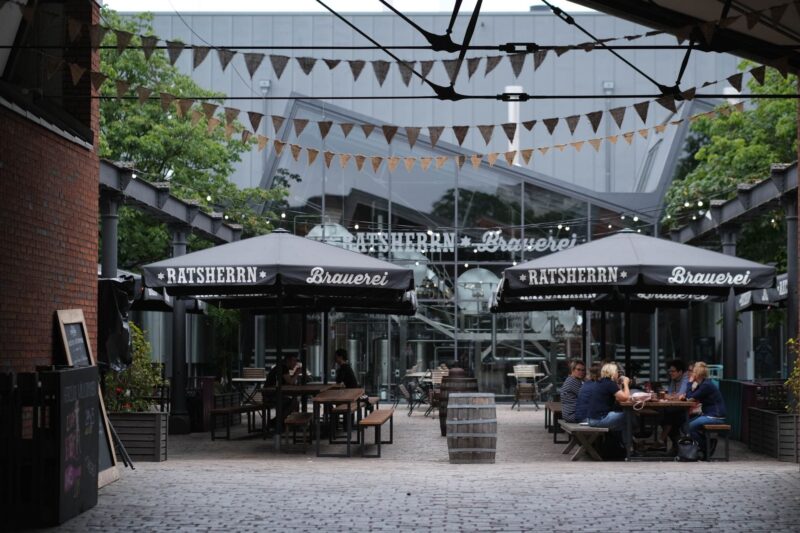
A classic in Ehrenfeld’s alternative scene, Underground combines a pub, beer garden and two gig venues in one big complex. Open 5 days a week, it plays a variety of music from pop to punk.
Sonic Ballroom
In an area of the city that is a melting pot of so many subcultures, it is fitting that Cologne’s only real punk club is located in Ehrenfeld. Expect local bands playing on the weekend and a flea market on the occasional Sunday.
Club Bahnhof
Typical of Ehrenfeld’s ability to transform once disused spaces into a vibrant art and social spaces, Club Bahnhof (literally translating to Club Railway Station) is squeezed into space under the railway lines that looks like it was once a disused station. There’s a nice beer garden outside, while inside they cater to a wide range of varying music tastes, from techno at a weekend to hip-hop, indie, and metal

One Response
Also from Leeds and looking for cool places to check out when visiting Cologne next month. Thanks for sharing these!