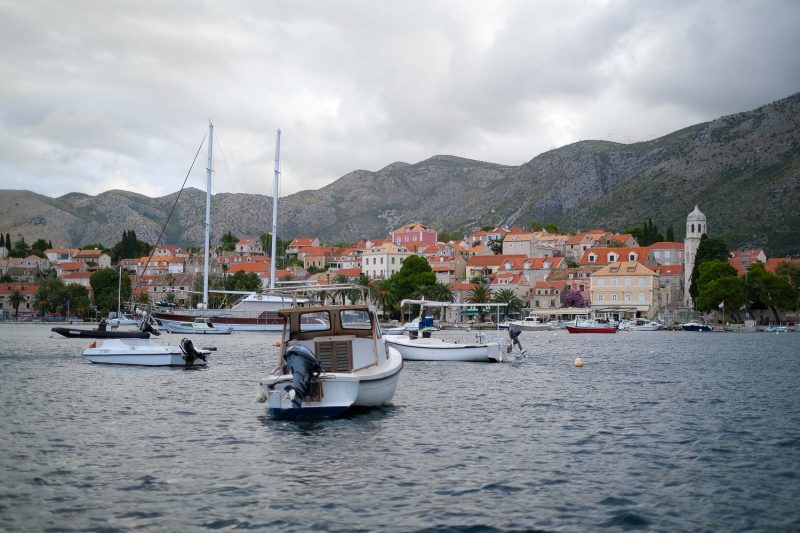
I rise early from my cabin and take myself to the deck of the boat just after 7am, when the light on the water is still doing that particular Adriatic thing, turning everything gold with a glow that looks slightly implausible. It’s the kind of light that makes you distrust your own photographs because nothing will look like this when you get home. With that in mind, I decline to take out my camera and continue to sit with a coffee that I haven’t touched yet, watching Trogir arrange itself for the morning.
Across the water from the marina, the shadows are long, and the ornate riverside buildings are illuminated with the same orange hue. Kamerlengo Castle looms over the promenade. The spire of St. Lawrence’s Cathedral pierces the sky. At ground level, the town is slowly waking up along with me, although the waterfront is much quieter than it will be in a few hours, when the day trippers and boatloads of tourists arrive.


It does this steadily. From my vantage point, I watch couples walking hand in hand, enjoying the morning light; A man with a broom works his way along the stone quayside with the unhurried efficiency of someone who has been doing this every morning for thirty years; gaggles of elderly men gossip and sip espresso outside waterfront cafes.
I had arrived the previous evening by boat, traversing from the harbour in Čiovo on foot over the short bridge that connects Trogir to the rest of the world, that brief crossing being, in its simple way, one of the more significant thresholds you can step across in Dalmatia. On one side: the twenty-first century, where you find takeaways and traffic and people going about their ordinary lives. On the other is eight hundred years of history all pressed onto one tiny patch of land. The transition happens in about forty steps, which is not enough time to prepare for it.
Even in the dark, dimly lit, with its alleyways concealed by shadow, it impresses.

There’s a cumulative historical weight to the place that feels considerable. Trogir boasts over 2,300 years of continuous history, a fact that is easy to read and almost impossible to comprehend until you are actually standing amongst it. The town was originally a Greek settlement in the third century BC, founded by colonists from Issa, the island of Vis, who were themselves the descendants of settlers from Syracuse in Sicily.
They called it Tragurion, from the Greek word tragos, meaning male goat, and they laid it out in the grid pattern that still governs the old town’s street plan today; This perpendicular logic of Greek urban planning remains preserved beneath – and on top of – centuries of Venetian stone. You are walking, without necessarily knowing it, on a map drawn by people who arrived here before Rome was even an empire.


The subsequent history ran generally in parallel with that of its region: Roman rule, then Byzantine, a period under Croatian control, followed by a long era of Venetian domination from the 15th to the early 19th century. When Venice essentially bought Dalmatia in 1409, Trogir refused to accept its new ruler, which prompted Venice to lay siege to the town; finally, in 1420, the triumphant Venetians entered and ruled until 1797. It was during this long Venetian period that most of what you see while wandering the town was built. The architecture that so impresses visitors dates from the 13th to the 16th centuries, when the town’s cultural life flourished despite Venice’s incessant wars with the Turks.

If this wasn’t enough, after Venice fell, the French arrived briefly, demolished the old city walls, and departed. Then came the Habsburgs, and then Yugoslavia, and then, in 1991, Croatian independence. In 1997, Trogir was granted UNESCO World Heritage Site status, the organisation describing it as a remarkable example of urban continuity. It has passed through far too many hands, and the history is a little complex, especially when described in a few sentences here.
All of this happened on an island not much larger than a couple of city blocks.
All of which is to say: the lanes are narrow enough that the buildings on either side feel like they could almost touch overhead, and the pale limestone absorbs the dwindling evening light. That evening, as darkness fell, I walked without a map, which is the only sensible approach, and found myself lost in a labyrinthine maze of streets, standing in small squares with no one else around. There was a particular feeling of satisfaction of having arrived somewhere that has not been arranged for your benefit; somewhere that existed, in one form or another, long before the concept of tourism was invented and, I assume, will go on existing in much the same way long after you’re gone.

Trogir is a UNESCO World Heritage Site and the designation is wholly deserved. The orthogonal street plan dates back to the Hellenistic period, embellished by successive rulers with fine public and domestic buildings and fortifications, Romanesque churches complemented by outstanding Renaissance and Baroque buildings from the Venetian period, but the designation tells you nothing about what it actually feels like to be here on a warm evening in late May, with the swifts screaming overhead and a glass of pošip on the table and the whole of the Adriatic apparently conspiring to make the light as beautiful as possible for as long as it can.
What the designation cannot capture is the quality of ordinariness that gives Trogir its particular character: while it is packed with sights that would be the jewel in the crown of any similarly sized place, this is not a museum town. People live here. They string washing overhead, drying between the medieval facades. They drive mopeds through the ancient gates, the same gates, more or less, that Venetian merchants rode through six centuries ago. They sit on plastic chairs outside their front doors in the evening and watch the tourists walk past with the benign indifference of people who have been doing this for decades and are confident they will still be here when the tourists have gone home.


Back on the Riva, my coffee has gone cold, and I have not moved for forty minutes. A waiter appears without being asked and removes it, and brings another one. By now, the wandering couples and man with the broom have finished their morning activities and have been replaced by the first surge of visitors. Once again, I begin to walk aimlessly passing a sitting on the steps of the monastery, reading something on his phone, his shopping bags eaning against the wall beside him. Local cats laze in the sun just metres away. The boat that arrived in the mid morning have unloaded their passengers and is headed back out into the channel, cutting a white line in the turquoise water.


This, I think, is the thing about Trogir. It has been here since Neanderthal people left stone tools in the immediate area 45,000 years ago, give or take a few civilisations. It has been Greek, Roman, Byzantine, Croatian, Venetian, French, Habsburg, Yugoslav, and Croatian again. It has been besieged, sold, rebuilt, and awarded a UNESCO plaque. And through all of it, the stone has stayed, and the light has done what the light always does, and someone has always been sitting on the waterfront in the morning, watching the boats come in.
Getting to Trogir
One of Trogir’s main draws, other than its beauty, is that it is implausibly easy to reach despite being on a small island. It’s connected to the mainland and the larger island of Čiovo by two short bridges and it sits just 27 kilometres west of Split, meaning it’s an even shorter distance from Split Airport’s runway than the city itself, making it a convenient day trip, or an ideal base for exploring the region.
From Split
The easiest and cheapest option is the number 37 bus, which runs directly from Split’s main bus station and from the Sukoišan stop near the old town, terminating close to Trogir’s market and the land gate entrance. Buses run frequently throughout the day, roughly every 20 to 30 minutes during summer, and the journey takes has little as half an hour if the traffic is good. Tickets can be bought on board.
If you’re driving, the coastal road (D8) is scenic and straightforward enough to navigate, though parking inside the old town is not possible. It’s best to leave the car in one of the car parks just outside the gates and walk in.
From Split Airport
The airport sits almost exactly between Split and Trogir, making it arguably closer to Trogir than to Split itself. The same 37 bus stops directly outside the terminal, meaning you can step out of the airport from your flight and be walking through the old town’s gates within 15 minutes. There is very little reason to take a taxi unless you’re arriving late at night with heavy luggage, and even then, it shouldn’t cost you much more than €15–20.
By the Water
Many charter services and sailing trips arrive and depart from Trogir’s harbour rather than Split’s – which is how I ended up in Trogir – and I found that arriving by water is, without question, the finest entrance to Trogir. In summer, numerous boat operators run day trips and transfers from Split’s Riva waterfront, delivering you directly to Trogir’s own harbour. If you’re island-hopping along the Dalmatian coast, Trogir also makes a natural stop on routes connecting Split with Šolta, Brač, or the Drvenik islands.
From Dubrovnik
It’s a long travel day by road, taking around three to three and a half hours, but the drive north along the Adriatic Highway is one of the great coastal drives in Europe, passing through Makarska and the limestone ridges of the Biokovo massif before the coast flattens and you get to Trogir.
Getting Around Trogir
The first thing to understand about getting around Trogir is that the old town is tiny. At roughly 700 metres long and 300 metres wide, you will not need a map to find your way around.
This is one of Trogir’s great selling points. In a country where the most popular destinations can make you feel like you’re constantly battling crowds and distances, its compactness can actually come as a bit of a relief. Everything, from the cathedral, the fortress and the Riva, to whatever konoba you decide to spend your evening in, is within a ten-minute walk of everything else. Make sure you wear comfortable shoes for the uneven, stone-paved lanes and just go for a wander. It won’t take long before the town stops feeling like a maze and you begin to get your bearings.


On Foot
Walking is essentially the only way to get around Trogir. While you may get the occasional bike or moped whizzing around, the old town’s lanes are too narrow for cars, which is the reason why it retains its medieval character and keeps a relatively calm and subdued atmosphere, even at the height of tourist season. As I mentioned above, give yourself some time to wander around without an agenda and just explore the alley ways or any streets that look promising.
Crossing to Čiovo
The island of Čiovo sits directly across a narrow canal from Trogir’s old town, connected by a short bridge about two minutes to reach. It’s quieter, more residential, and noticeably less touristy. You’ll find cheaper accomodation, better-value restaurants and a handful of small beaches. If you’re staying on Čiovo, the walk into the old town is easy.

Taxis
Taxis are available but aren’t really needed for getting around the town itself. They’re mostly useful for reaching beaches or villages further along the coast, or for late-night journeys if you’ve based yourself somewhere outside the centre. Uber and Bolt both operate in the wider Split-Trogir area during the summer season, and tend to be cheaper than traditional taxis.
Where to Stay in Trogir
The question of where to stay in Trogir depends on the kind of trip you want to have. If you stay inside the old town, you will wake up to the sound of church bells and find the cathedral ten minutes from your door, and experience the city in its best way; before the day-trip crowds arrive from Split. Stay on Čiovo, the island across the bridge, and you trade some of that atmosphere for sea views, a pool, and the view of the old town glowing from across the water as the sun goes down. Both are have their benefits, and here are some of the best options:
XII Century Heritage Hotel
If the thing you most want from Trogir is to be inside it, waking up to the waterfront rather than looking at it from across the river, then the XII Century Heritage Hotel earns its place at the top of the list. Situated in the heart of the UNESCO-protected medieval old town, the hotel sits directly along the Riva, and the front rooms deliver exactly the harbour views you would expect.
It’s a small boutique hotel and given how compact the town is, everything that Trogir has to offer is right on your doorstep. Staff are friendly and generous, while the breakfast is served with the Riva directly in front of you. Be aware that like almost all buildings in the protected old town, there is no lift, and although the staff will carry luggage, it’s worth knowing before you book.
Heritage Hotel Pašike
The Pašike began life as a family home before being carefully reconstructed and reopened as a hotel, and that history shows. The rooms are full of quirky antiques, and the courtyard restaurant is one of the better places in the old town to eat. The house speciality, octopus with ham, is worth ordering for dinner, and some rooms come with a small balcony with a semi-waterfront view. There are just 15 individually decorated rooms, each with its own character, which gives the whole place a scale that feels more like staying with a particularly well-organised family than checking into a hotel.
Brown Beach House
Away from the old town and built within the elegant shell of a former tobacco warehouse on the Čiovo waterfront, the Brown Beach House has been converted into a stylish 42-room boutique hotel that manages to somehow feel both genuinely design-led and genuinely relaxed. At times, it looks like something out of a design magazine, with a black-and-white tiled outdoor pool set directly beside the sea, and staff who are, for the most part, polished and attentive. The spa and wellness centre is a serious offering, there’s a beach club and a pool bar, and the hotel runs a summer programme of events that makes it feel like a destination in its own right.
City Hostel Trogir
Trogir is not a backpacker hub in the way that other European towns can be, but that does mean budget options are limited. The one that stands out, and stands out convincingly, is City Hostel Trogir. Housed in a building dating back to the 14th century, it sits right in the heart of the old town, and its location alone would justify a stay: roughly a minute’s walk from the central square and the cathedral, in the middle of everything the old town has to offer. The hostel itself is well run and consistently clean, with comfortable beds, large working lockers, and a fridge in each dorm room. There’s no proper kitchen, but there are tea and coffee facilities, and the friendly hosts are the kind who draw directions on maps, ask about your day, and point you towards the best spot for cheap eats without being asked.
Apartments & Rooms
Trogir has a well-developed network of private apartments and rooms, both inside the old town and along the Riva, where you’ll find everything from heritage apartments in centuries-old stone buildings to simpler, well-kept rooms above restaurants and shops. The trade-off with old-town apartments is noise: the Riva comes alive in the evening and stays that way until late in summer. Ask for a room on an interior courtyard if you’re a light sleeper. On Čiovo, the apartments tend to be quieter and more spacious, often with terraces and parking, which is a better bet for families or anyone staying more than a few nights.
What to See & Do in Trogir
Despite its small size, Trogir packs an impressive amount into its UNESCO-listed Centre. You’ll find centuries-old cathedrals and Venetian fortifications alongside bustling waterfront promenades and nearby Adriatic beaches. The town offers far more than a quick stroll through its historic centre. Whether you’re interested in history, architecture, food or simply soaking up the atmosphere of one of Croatia’s most beautiful coastal towns, there’s plenty to keep you occupied.
Cathedral of St Lawrence
The Cathedral of St Lawrence occupies prime real estate on the main town square, and it stands out against everything else thanks to its height and its construction style. It is assumed it was built where an old Greek temple once stood and the scale of the project reflects Trogir’s medieval ambition. Construction began in 1213, lasted until 1589, and because of this the cathedral showcases all of the styles that succeeded one another in Dalmatia, from Romanesque through to Gothic to Baroque.
Most people will first be drawn to the Radovan Portal, the west-facing entrance to the cathedral, and arguably the single greatest work of medieval sculpture on the eastern Adriatic. It is named after its creator and dated by inscription to 1240. The portal is framed by two rows of jambs decorated with reliefs and depictions of the apostles, and two columns with depictions of hunting scenes. On the outer edges of the jambs, consoles with lions support sculptures of Adam and Eve. The upper section of the portal depicts scenes from the Gospels, bringing biblical stories to life with extraordinary detail, while the inner doorposts contain representations of the seasons of the year, symbolising the cyclical nature of time. It is worth standing in front of it for a few minutes to attempt to take it all in.
Inside, the highlight is the Chapel of St John of Trogir, a Renaissance chapel built between 1461 and 1497 by Firentinac and Duknović, featuring fine paintings of St Jerome and St John the Baptist and decorations of exceptional quality. The three-tiered bell tower took 200 years to complete, finishing only in the 16th century, and the climb to the top rewards those willing to attempt the vertiginous staircase with panoramic views over the old town.
Kamerlengo Fortress
Built by the Venetians in the early 15th century to protect against Turkish invasions, Kamerlengo was named after the camerlengo, the official responsible for the town’s financial and administrative affairs. It is constructed in a characteristic Gothic-Venetian style, with four massive walls connected by three towers and an inner courtyard.


Today the fortress earns its entry fee primarily for its views. From the walls you can look out over the harbour, the old town rooftops, and the sea. Adult entry is around €5. The interior courtyard doubles as a cultural venue: during the summer months it transforms into a space for concerts, theatre performances, film screenings, and other events. If you’re visiting in July or August, it’s worth checking the programme.
The Town Loggia & Clock Tower
Standing alongside the cathedral on the main square, the Town Loggia is a covered, open-sided structure where, for centuries, Trogir’s citizens would congregate to discuss civic affairs, and where the local court would meet on certain days to proclaim laws and proceed with cases. Inside, a large bas-relief on the central wall depicts Petar Berislavić, the viceroy of Croatia in the early 16th century, and was later recarved by Ivan Meštrović in 1938. The columns, the carved reliefs, and the Renaissance stonework make it one of the most photographed spots in the old town


The Clock Tower alongside was once part of the Church of St Sebastian and is notable for its domed roof and a statue of Liberty crafted in 1471 by Nikola Firentinac, one of the most significant Renaissance sculptors working in Dalmatia. The clock face, with its distinctive blue, functions as one of Trogir’s most recognisable symbols.
Cipiko Palace
Directly across the square from the cathedral, you’ll find Cipiko Palace, the former home of the wealthy and influential Cipiko family. They were Trogir’s most prominent noble dynasty during the 15th century. The palace is actually a combination of two buildings: the second was added as the family’s wealth increased, and together they span Gothic, Romanesque, and Renaissance architectural styles. The interior is not open to the public, but the exterior facade rewards proper attention: the Gothic windows, the Venetian carved stonework, and the sheer scale of the building reveal that the town was once a place of genuine commercial and political weight on the Adriatic; On the same square in a space of about fifty metres you have a cathedral, a loggia, and a palace, each of them significant.
Green Market
If you want a small taste of local life, cross the footbridge over to the mainland where you will almost instantly find yourself amongst Trogir’s Green Market, known locally as Tržnica. While there are a fair number of stalls selling trinkets aimed squarely at tourists, you’ll also find tables brimming with seasonal fruits, vegetables, aromatic herbs, and jars of local honey or jam, all from nearby farms. You’ll also find local meats, olive oils, cheeses, dried figs, and nuts that are perfect for snacking or taking home as gifts.


Just steps away from the Green Market is Trogir’s Fish Market. It’s a small but essential part of the town’s food scene. Local fishermen deliver their daily catch here, and you’ll find everything from glistening sardines and anchovies to shrimp, mussels, and larger fish like tuna and sea bass. Even if you have no intention of buying, a walk through the fish market is a good look at what the Adriatic actually produces


Don’t miss local olive oil, Croatian wines and liqueurs like rakija, dried fruits, and artisanal honey, as these are the things worth carrying home, and the market is almost always better value than the souvenir shops in the old town lanes. The market usually stays open until around 4 or 5pm, but having said that, it is best to arrive early for the best selection and the best atmosphere.
Top Tip: prices can be inflated for tourists, and it’s worth keeping an eye on your change. Buy from vendors who display their prices clearly and don’t be shy about moving on if something feels off.
Benedictine Monastery of St Nicholas
This is the stop that most day-trippers and people on a flying visit miss. The Benedictine Convent of St Nicholas is run by nuns, and its small museum contains the celebrated Kairos relief; a 3rd or 4th century BC marble carving of the Greek god of opportunity, modelled after a bronze by Lysippos, the court sculptor of Alexander the Great. The iconography is the origin of the phrase carpe diem, given physical form in orange marble and somehow preserved in a convent in a small Dalmatian town for over two thousand years. The convent’s southern courtyard wall also incorporates a 2nd century BC Greek inscription mentioning the city magistrates, evidence of the extraordinary depth oI history that can be found in Trogir beneath its medieval facade
The collection is relatively small but entry is only around €5. You only need to allow 30 minutes to see everything, but go quietly as you explore because nuns still live and work here.
The Riva
The Riva is most people’s entry point to Trogir’s Old Town and generally where they end their experience in an evening. The long waterfront promenade runs along the southern edge of the old town’s island, lined with cafe bars, moored boats, and the unobstructed views across the channel to Čiovo. It functions differently at different hours: in the early morning it belongs to locals and fishermen; by mid-morning the cafes fill with tourists and the ritual of Croatian coffee begins; in the evening it becomes the passeggiata, everyone walking slowly in both directions or stopping for a drink by the water. The Dominican monastery bar at the waterfront end is the place for a sundowner; the further from the tourist clusters you sit, the better the experience tends to be.
The Blue Lagoon & Surrounding Islands
Trogir’s position on the coast means that it’s within easy reach of some of the most beautiful water in the Adriatic. The Blue Lagoon, off the island of Drvenik Veli, is probably the most popular day trip from Trogir. It’s a beautiful shallow bay on the southeastern side of Drvenik, enclosed by two small islets, where the seafloor of crushed sea shells mixed with sand produces an incredible blue and turquoise colour that give it its name.
Most trips go by speedboat, taking around 30 minutes, and is genuinely as beautiful as the photographs suggest, though it can get fairly crowded in July and August. A majority of the tour companies run half-day tours from the Trogir promenade that combine the Blue Lagoon with a stop at Duga Bay on Čiovo and the village of Maslinica on Šolta which give a varied itinerary without spending an entire day on a boat. Alternatively, hire your own small motorboat from the Riva and do it yourself.
Where to Eat & Drink in Trogir
Trogir’s dining scene is better than its size suggests, and although its visitor footfall might lead you to expect tourist traps, you’ll be pleasantly surprised. Yes, there are restaurants on the Riva aimed squarely at passing trade, with laminated menus featuring photographs that are usually a reliable warning sign, but step a lane or two back into the old town and the picture changes considerably. The local cooking here is Dalmatian, fresh seafood landed that morning, slow-braised meats, handmade pasta, good olive oil, and wines from the surrounding hills.
Konoba Trs
Where: Konoba Trs više nije na ovoj adresi, Ul. Matije Gupca 14, 21220, Trogir
When: Sunday & Monday 4pm – 11pm; Tuesday to Saturday 11am – 11pm
This is the name that comes up first when you ask anyone in Trogir where to eat, and with good reason. Exposed stone walls, and a beautiful shaded outdoor courtyard that is, particularly in the evening, one of the nicest places to sit in Dalmatia, add a certain elegance, while the family-run kitchen combines traditional Dalmatian cooking with modern ingredients sourced from the owner’s family farm. The menu leans on regional meat and fish dishes alongside handmade pasta and fresh seafood. It’s Mediterranean at heart; traditional, but with some thoughtful modern touches, and is offered mainly through a short à la carte menu or one of three three-course set menus.
Casa Don Dino
Where: Ul. Matije Gupca 14, 21220, Trogir
When: Daily 8am – 12am
Hidden behind centuries-old stone walls on a narrow lane just off the main square, Casa Don Dino has become one of the town’s most sought-after reservations. The kitchen takes classic Dalmatian flavours and presents them with a lighter, more modern touch, placing particular emphasis on the Adriatic’s bounty. Fresh wild tuna is a recurring star, appearing in dishes such as tartare and carpaccio, while whole fish, seafood risottos and traditional specialities are elevated through careful sourcing and restrained presentation.
Franka
Where: Šubićeva ul. 30, 21220, Trogir
When: Monday to Thursday 11am – 11pm; Friday & Saturday 11am – 12am
Despite featuring in the Michelin Guide, stumbling upon Franka can feel a little like finding a hidden gem. It’s tucked away to the side of one of the Old Town’s alleyways, offering distinctly Mediterranean cuisine in an authentic setting of typical Dalmatian stone, with the late afternoon and evening atmosphere in its small courtyard particularly pleasant. It’s a family operation, and it shows in the details: fresh flowers on the tables, staff who know the menu and the wine list with genuine fluency, and a kitchen that leans on local, Croatian produce with occasional nods to Italian influence.


The fact that they offer a daily, changing lunch menu of a starter and a main for just €30 makes an even more compelling case for why this is a must-visit. I never knew I needed aubergine creme brulee in my life until I visited, and the mains were just as delectable – especially considering the bargain set menu price. Along with Konoba Trs, the two restaurants together are what elevate Trogir’s dining scene beyond what such a small town should be capable of.
Restaurant Mare
Where: Bifora Heritage Hotel 4, Lučica 11, 21220, Trogir
When: Monday to Saturday 12.30pm – 4pm & 6pm – 11pm; Closed Sunday
Located in the Bifora Heritage Hotel, a finely restored 14th-century building on Čiovo just five minutes’ walk from Trogir’s historic centre, Restaurant Mare is the vehicle for chef Robert Predag Zmire’s refined, contemporary take on Adriatic cuisine. As the name suggests, fish is the undisputed star, though you will still find a selection of well-crafted meat dishes and vegan options on the menu.
Zmire uses the Japanese Ikejima technique to dispatch fish in a way that preserves the quality of the flesh, a commitment to ingredient integrity that runs through everything ingredient. The wine list too, while not extensive, is well curated with strong Croatian labels.
Il Ponte
Where: Kardinala Alojza Stepinca 15a, 21220, Trogir
When: Daily 12pm – 12am
Named after Trogir’s iconic wooden bridge, Il Ponte is just a short walk from the town centre and offers a beautiful veranda room with refined furnishings in shades of yellow and blue, an outdoor glazed terrace overlooking the sea and old town, and, unusually for Trogir, some seats that sit below sea level. The kitchen interprets Mediterranean flavours and traditions through modern technique, with the open-fire grill being the focus, where you can watch the chefs work.. Alongside à la carte options, there’s a three-course menu and a five-course tasting menu available with wine pairings. It’s another Michelin selection, and perhaps the most visually dramatic setting of Trogir’s better restaurants. The slow-cooked beef ribs are worth noting if you’re not in a seafood mood.
Tinel Specialty Coffee
Where: Šubićeva ul. 2A, 21220, Trogir
When: Daily 7am – 9pm
It’s often not too easy to find good speciality coffee in Croatia’s smaller towns, but Trogir, to its credit, has a few good options. Tinel stocks whole beans from different regions, freshly roasted, and served in any way you can imagine, from a standard espresso, to a well-balanced V60 pour-over. It’s a small spot, hidden away in the corner of an alley in the centre of the old town with a handful of outdoor seats, but it is worth seeking out. They have a good selection of local craft beer bottles and a decent enough wine list if coffee isn’t your thing.


Agape Specialty Coffee & Matcha
Where: Lučica 7, 21220, Trogir
When: Monday to Saturday 8am – 1pm; Sunday 8am – 12pm
If Tinel is the destination for coffee purists, Agape is the one you’ll find yourself returning to each morning without quite planning to. Run by Jelena and Raffael, roasting 100% Arabica beans fresh daily in a spot that I stumbled upon while walking between the marina and old town, this is a place for those who appreciate high-quality single origin coffees. It’s stylish and minimalist, while the quality of the coffee, thankfully, manages to live up to the place’s aesthetic. Stop in for a morning matcha and pastry, then pull up a chair on the small terrace out front. You won;t be disappointed.


Corte Bar
Where: Gradska ul. 35, 21220, Trogir
When: Daily 7am – 2am
Spilling out of the dimly lit, stylish bar onto the plaza near the Cathedral of St Lawrence, Corte Bar is the best place in town if you’re seeking out well-mixed, innovative cocktails. It’s the kind of place that works across the day; coffee in the morning, a light lunch, and alfresco cocktails as the evening comes in, set directly against the historic surroundings of the old town. Although the mixed drinks are the main draw (and the staff seemed surprisingly knowledgeable), the beer list is also one of the best in Trogir, as this is one of the very few places I have found that regularly has Augustiner on tap.


The Best Traditional Dishes to try in Trogir
In Trogir (as in any destination, really), it’s always best to opt for the local cuisine, which takes full advantage of the abundance of local produce that is either farmed here, or pulled from the sea. The olive trees that silver the hillsides above Trogir produce the oil that dresses almost everything. The fish that land on the quayside each morning are the fish that appear on plates at lunchtime. The wines come from islands you can see in the distance. Follow what’s local and seasonal, and you will eat very well.
Rafioli
At first glance, rafioli may bear a striking resemblance to Polish pierogi, but these are a sweet treat that is specifically and proudly a Trogir speciality, which gives them a particular significance in a town where most things have been around since the medieval period. They’re now even an officially protected part of Croatian cultural heritage.


These small, half-moon-shaped pastries are made from a delicate shortcrust dough and filled with a mixture of ground almonds, sugar, eggs, and lemon zest, occasionally with a splash of maraschino liqueur, which has its own significance in Dalmatian food culture. Rafioli are at their best when made by hand in small batches and picked up from a local bakery rather than pre-packaged. If you see them in a pasticceria that looks like it baked them that morning, buy some. I have to say that all of the ones I tried were a little too dry for my taste, but that can all be solved by pairing them with a good cup of coffee.
Fritule
Fritule are small, deep-fried doughnuts flavoured with rakija (fruit brandy), citrus zest, and sometimes raisins, that are a fixture of Dalmatian celebrations and, increasingly, of the old town’s market stalls and bakeries. They are cheap, ephemeral, and best eaten warm from the paper bag, standing in an alley somewhere in the old town.
Crni Rižot (Black risotto)
If there is a single dish that functions as the benchmark for any Dalmatian kitchen, it is crni rižot: risotto made black with cuttlefish ink, the rice cooked slowly in a base of cuttlefish, onion, garlic, and white wine until it reaches a consistency somewhere between a risotto and a stew. It looks dramatic on your plate (even unappetising to some) but the flavour is briny, deeply savoury, and more subtle than the colour suggests. I didn’t get to sample any in Trogir, but have gorged on this dish during previous visits to the country, and saw it on most menus across town.

Peka
Peka is the menu item that Dalmatia is most proud of, and with good reason. Meat or seafood (typically lamb, veal, or octopus) is placed in a heavy cast-iron dish, covered with vegetables and aromatics, sealed under a domed bell-shaped lid (the peka itself), and buried in hot embers to slow-cook for several hours. The result is extraordinarily tender, deeply flavoured, and essentially impossible to replicate at home without the right equipment. The one catch is that peka must be ordered at least 24 hours in advance, sometimes more.
One Day in Trogir - The Perfect Itinerary
While Trogir may be small, but its maze of medieval streets, historic landmarks and waterfront promenades easily fill a day. There isn’t a great deal to see, so there’s no need to rush between attractions. Instead, spend the day walking around, climbing fortifications and enjoying long lunches and dinners of fabulous Dalmatian cuisine beside the Adriatic.
Morning: Explore the Heart of the Old Town
Start your day by crossing the small bridge that connects the mainland to Trogir’s UNESCO-listed old town. From the Riva waterfront, nip through one of the tiny streets to find yourself within a labyrinth of narrow lanes, hidden courtyards and honey-coloured stone buildings that reveal centuries of Greek, Roman and Venetian influence.


Make your way first to St Lawrence Cathedral, the town’s most impressive landmark. Construction began in the 13th century, and its ornate Romanesque portal, carved by the master sculptor Radovan in 1240, is considered one of Croatia’s finest medieval artworks. Climb the cathedral’s bell tower for sweeping views across the rooftops, the harbour and the surrounding islands.


Afterwards, spend some time getting lost amongst the old town itself. Pass through St John’s Square, admire the Gothic and Renaissance architecture of Cipiko Palace and pause at the Town Loggia, which has served as a gathering place for locals for centuries.
Lunch
By midday, you’ll have worked up an appetite, so it could be worth heading towards the waterfront promenade, known locally as the Riva. Lined with cafés, restaurants and moored yachts, it’s one of the best places in town to soak up the atmosphere.


To sample some local delicacies, choose a traditional konoba for lunch and try specialities such as black risotto, grilled Adriatic fish or octopus salad. If you’re visiting during the warmer months, a shaded terrace overlooking the harbour is the perfect place to escape the midday heat while watching boats come and go. Alternatively, I would suggest dining on the outdoor terrace of Franka, who, despite being listed in the Michelin Guide, offer a rotating daily lunch menu that gives you two courses for the bargain price of €30.
Afternoon: Fortresses, Sea Views and Čiovo Island
After lunch, continue to Kamerlengo Fortress, the imposing 15th-century Venetian stronghold that guards the western edge of the old town. Walk along its stone walls and climb the tower for panoramic views across Trogir, the Adriatic and the islands beyond.


From the fortress, follow the waterfront or pass back through the town and cross the pedestrian footbridge over to Čiovo Island. While technically connected to Trogir, Čiovo feels noticeably quieter and offers a welcome change of pace. Depending on how much time you have, stroll along the coast, stop for a swim at one of the nearby beaches or simply enjoy the views back towards the old town. For a taste of local life, I recommend popping into the outdoor market, which is the ideal place to pick up some fresh fruit or a few local treats such as cured meats and cheeses.
Evening: Sunset and Dinner on the Harbour
As the day begins to cool, return to the waterfront for a sundowner. The golden light reflecting off Trogir’s stone buildings and shows the town at its most photogenic, particularly around the harbour and fortress walls.
Round off your day with dinner, either overlooking the marina or down one of the narrow backstreets. Fresh seafood, local wines and relaxed dining make for a fitting end to a day in one of Croatia’s most beautiful historic towns. Afterwards, take one final stroll through the softly lit streets of the old town before heading back to your accommodation or catching transport onwards to Split.
When is the Best Time to Visit Trogir?
Trogir is, in the most literal sense, a Mediterranean town, which means that I would follow the same logic I do when visiting any other coastal destination in this part of the world. Generally, it depends what kind of holiday you want to have: A few days in the unhurried warmth of early summer, when the old town feels calm and you have it mostly to yourself; in the full heat and social intensity of August, when the Riva is busy until midnight and the Adriatic is packed with boat traffic; or in the quieter weeks of September and October, when the crowds are thin.
May & Early June
This is, in my personal opinion, the best time to visit Trogir. During May and early June, Trogir reliably gets pleasant weather with average temperatures ranging from 20°C to 25°C (although you can still expect a bit of rain). It’s warm enough for the outdoor tables, but still comfortable enough for a full day of walking around the old town without the brutal midday heat that you get in July . The sea is warming up, restaurants and hotels are open, there are far fewer crowds and more accommodation availability. The morning market is full of early summer produce such as strawberries, asparagus, the first courgettes, and the Riva in the evening is bustling without being overwhelming.
July & August
The busiest month for tourism in Trogir is July, followed by August, and the difference from the previous two months is quite noticeable. Firstly, it is considerably warmer: average daytime temperatures reach 28°C in August, with July enjoying approximately 11.7 hours of sunshine daily. This is when the Adriatic is at its most swimmable. The atmosphere on the Riva shifts from quiet drinks by the water into something closer to a festival: There are boats everywhere and restaurant tables are packed. There is genuine energy to it, and for some people, those who want Croatia at its most alive, who don’t mind queuing for the cathedral and paying high-season prices for a cold beer.
However, go in clear-eyed. Even smaller towns like Trogir can’t escape the day-trippers in these months; it can be fun, but also crowded and expensive. Hotel and accommodation prices are at their highest during these months, and the old town’s lanes can feel genuinely congested between 11am and 4pm when the coaches from Split have unloaded.
September & October
Although I have already said that Early sumer is the sweet spot, but for many people, September is the single best time to visit. September offers consistently warm weather averaging 24–27°C, pleasant sea temperatures of around 23–25°C and a town that is perceptibly, noticeably quieter. The restaurants are still fully open, the boat trips still run, the evenings are still warm enough to sit outside until late, but there is space. The light in September is also different. It’s lower, more golden, and looks particularly good on the pale limestone walls in the late afternoon.
In October, the Festival of St Luke takes place in Trogir. This is a religious and cultural celebration including processions, concerts, and local markets, offering an insight into Croatian traditions and heritage.Unfortunately, the weather becomes increasingly variable at this time of year, so pack a layer and expect some grey days alongside the good ones.
FAQs
Although Trogir is a small and relatively simple place to visit, there are a few questions that tend to come up repeatedly, particularly among first-time visitors trying to work out how it fits into a wider Croatia itinerary.
Is Trogir worth visiting?
Although many people go to Trogir as a day trip from Split, the town is one of Croatia’s most rewarding destinations in its own right and certainly worth visiting. Its maze of medieval streets, Venetian architecture, historic landmarks and waterfront create a more relaxed atmosphere than some of the country’s larger coastal cities.
How many days do you need in Trogir?
You can see Trogir’s main attractions in a day, however, spending one or two nights means you to experience the town when it is quieter, after the day-trippers have left, enjoy its restaurants and bars at a slower pace, and take boat trips to nearby islands and beaches.


What is Trogir famous for?
Trogir earned UNESCO World Heritage status in 1997 and is best known for its remarkably preserved medieval old town, in particular, for St Lawrence Cathedral, Radovan’s Portal, Kamerlengo Fortress and its blend of Romanesque, Gothic, Renaissance and Baroque architecture.
Is Trogir expensive?
Compared with Dubrovnik and some of Croatia’s better-known tourist destinations, Trogir is relatively affordable. Accommodation, dining and drinks are generally reasonably priced, although costs can rise during the peak summer season.

Does Trogir have beaches?
Although Trogir’s historic centre is focused on culture and sightseeing, several beaches are located nearby on Čiovo Island, which is connected to the old town by bridge. Okrug Gornji Beach is the most popular.

Is Trogir suitable for families?
While Trogir isn’t as family friendly as some of Croatia’s resort-focussed destinations, it still works for families. The old town is compact and easy to navigate, there are nearby beaches for swimming and plenty of boat trips and outdoor activities suitable for children.