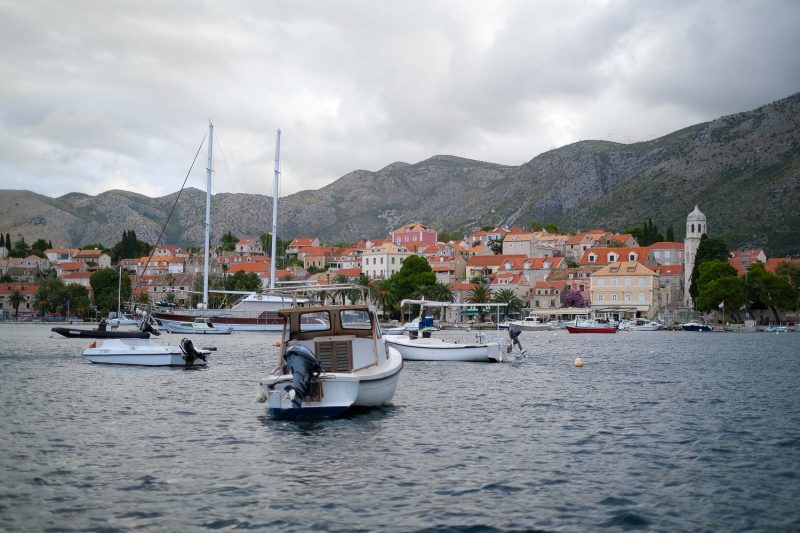
Jutting out from the Southern Dalmation coast into the blue waters of Adriatic towards Korčula island, the rugged and sun-drenched Pelješac peninsula is an area of Croatia often overlooked by tourists despite sitting a mere 35km north of Dubrovnik. Thankfully, the lack of development only adds to Pelješac’s appeal. It is a slice of Croatia that offers calm blue waters, picturesque fishing villages, and hillsides dotted with vineyards, pine forest and sprawling olive groves.
Sitting at the gateway to Pelješac are two twin settlements, Veli Ston and Mali Ston, linked by an imposing stretch of fortifications. Hugging the hillside for 4 miles between the two villages, this is the longest defensive wall in Europe and the second longest in the world after the Great Wall of China. Construction began in 1333, when Pelješac was ruled by the Republic of Ragusa, and continued for almost four centuries, as the builders had to adapt to the rough terrain and advancements in warfare technology. By the time the walls were completed, they would span 7 kilometres and include three fortresses, 41 towers, 7 bastions and a system of moats, all designed to repel invading forces and protect the salt pans that provided the town with its wealth.


Nowadays the walls are a little redundant. Ston and Mali Ston are sleepy fishing villages known for their quaint streets and world-renowned seafood, particularly Mali Ston’s oyster beds. The salt pans remain at the edge of the town and are still producing a hefty yield of ‘white gold’ each summer using traditional methods 4,000 years after they were first established.
The walls still encircle the town too, but instead of keeping out invaders, they are a tourist draw. THe imposing structure climbs the hillside and its bastions tower high above Ston’s red rooftops. From the highest point, visitors can enjoy spectacular views of across the 58 shimmering salt pools and out across the peninsular to the Adriatic on one side and Mali Ston Bay on the other.

How to Get to Ston
Ston is the easternmost town on Pelješac, a peninsula located just 35km north of Dubrovnik. Until recently, travellers heading to Ston from the north of Croatia would have had to pass through a 9km stretch of Bosnia and Herzegovina’s coast (and two border crossings) in order to reach the country’s southern regions, however, thanks to the construction of the much-anticipated Pelješac bridge that opened to the relief and delight of Croats in 2022, the peninsula now acts as a viable link between these two previously-separated halves of the nation.
It is a relatively short 34 mile journey from Dubrovnik’s old town to Ston, which makes it an easy day trip. This easy drive hugs the Adriatic coast along the D8 until you reach the Peninsula. There are a number of interesting stops along the way. If you are travelling by public transport, there are a number of bus companies that service this route with multiple departures leaving Dubrovnik’s bus station each day during the peak summer months. After October, the services may be severely reduced so be sure to check the website of Dubrovnik’s main bus station before making plans. The Flixbus to Zagreb runs year-round and makes a stop at the Peninsula.
Due to Split and Ston both being popular tourist destinations on Croatia’s Dalmation coast, there are regular bus services between the two, running up to three times a day during the peak season. In the winter months, you may need to catch the Flixbus from Split to Dubrovnik and then change services to the Dubrovnik/Zagreb bus that stops in Ston. This journey takes around 6 – 7 hours.
By car, the fastest route is the E65 toll highway where you will exit at Mali Prolog for the D425 and then the D8 towards Dubrovnik. You will no longer have to cross the border and drive through a section of Bosnia and Herzegovina, instead cross the newly built Pelješac bridge and continue along the D674 until you reach Ston.
Getting Around Ston & Mali Ston
Ston’s walled-off centre is compact and easy to navigate with a walk from one side to the other taking just a few minutes. The main streets are interconnected by a grid of narrow lanes and alleyways that can be difficult to distinguish from one another, but the town is so small that getting lost is almost impossible.
To reach Mali Ston from Ston, it is a relatively short 45-minute walk over the ramparts and across the hill that separates them. It is a steep climb, but the views of Mali Ston Bay make it worthwhile.


Where to Stay in Ston & Mali Ston
Hotels are few and far between on this part of the Pelješac Peninsula but there are plenty of apartments and home rental options available. Many people instead opt to stay further along Pelješac in Orebić, a picturesque village on the southwest coast where local sea captains built their beautiful 19th century villas and surrounded them in palms, wisteria and bougainvillea. However, If you choose to base yourself in Ston or Mali Ston, you can’t go wrong with the below options.
MALI STON
Villa Koruna
Sitting in a prime location beside the city walls at the entrance to Mali Ston, Villa Koruna may be a little outdated and old fashioned, but this 6-room hotel has fantastic views of the nearby bay. The family that runs Koruna also owns the nearby salt pans, even offering guided tours to interested guests. Their vast restaurant on the ground floor is a great place to sample fresh Mali Ston oysters.
Mali Ston
Hotel Ostrea
Mali Ston is so closely associated with oysters that it seems inevitable for this family-run hotel is named after the village’s primary produce. Its owners also manage the award/winning restaurant Kapetanova Kuća (‘the Captain’s House’) and the hotel’s position on the Malostonski Bay makes it the perfect place to stay for mollusk aficionados.
The Best Things to do in Ston & Mali Ston
Walk the Wall of Ston
Ston and Mali Ston are connected by a stretch of 3km-long fortifications that straddle the hillside between the two settlements. The walls were first constructed when the Republic of Dubrovnik took charge of Ston in 1333 in the hope that the defences would protect saltpans that were instrumental in the Republic’s growing fortunes.
Originally, over 7km of wall were built and this included three fortresses – Veliki Kastil (in Ston), Korula (Mali Ston) and Prodzvizd Fort – 7 bastions, and over 40 towers, although many of these were destroyed following the fall of the Republic of Ragusa, with much of the damage stone being used to construct new buildings in the 19th century.
In modern times, the walls have been protected and the stretch linking Ston and Mali Ston has undergone extensive renovation. This section can be walked in its entirety and is open to visitors year round. Entry costs 70,00 HRK.

Visit the Saltworks
The vast saltworks of Ston, spread out beneath the city walls and shimmering white in the Croatian sun, have existed since the 13th century but it is thought that the harvesting of salt here has been a constant for over 4000 years, making them the oldest salt pans in Europe. It is this abundance of Salt that inflated the wealth of the of the Republic of Dubrovnik and the methods of harvesting has remained unchanged since the middle ages – the pans are gradually flooded with seawater which is then left to evaporate in the sun. The residue of salt is then shovelled into carts and moved offsite by mule on sets of railway lines that run between the pans. Visitors can walk amongst the pans but if you are particularly keen to experience the salt harvest first-hand, the Gathering Salt Summer Camp runs between July and September – expect a bit of manual labour and 6am wake up calls though.


Fort Kaštio
An impressive fort that sits at the entrance to the town, the recently renovated Fort Kaštio may not contain many interesting displays or exhibitions within its walls but the view across the salt pans from one side of the ramparts and the sight across town to the towering walls of Ston make a climb up its steps worthwhile. Entrance is included with a ticket to the walls.
Eat Freshly Harvested Oysters in Mali Ston
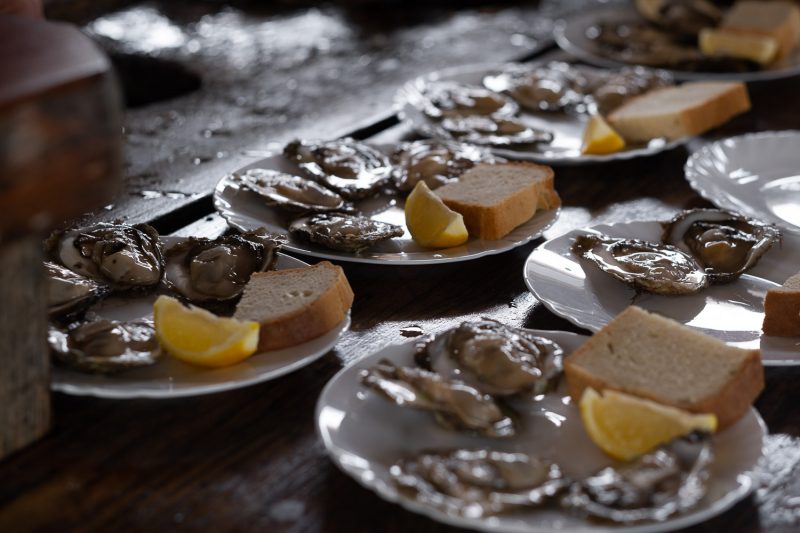
While salt generated a large percentage of the Republic of Dubrovnik’s wealth, it was oysters that it was known for. They are such a delicacy that, in the late Middle Ages, nobles from Dubrovnik would fund oyster farms in Mali Ston Bay, taking their payment in oysters instead of cash. These oysters – known as Ostrea edulis, or European flat oysters – are considered to be some of the best in the world and have a Protected Designation of Origin mark and are inscribed into EU Geographical Indications Register.
However, cultivation of molluscs was taking place here well before the Middle Ages. Roman Emperors were known to construct farms off the coast of Pelješac and later, the Austrian Emperor Franz Josef would get boxes of oysters shipped to him in Vienna on a monthly basis.
But why are these Oysters in particular so highly sought after? It is mainly due to the fact that the water of Mali Ston bay provides a unique nutrient blend when its heavily salted water mixes with the mineral-rich discharges from the nearby karst springs. This, along with the phytoplankton packed sea bed here create the perfect conditions to produce the world’s best oysters.
Now, only 40 families have permission to grow Oysters in Mali Ston and farming has waned in recent years due to the prevalence of the dorada fish, an intrusive species that is able to crush shells with its mighty jaw and devour the meat inside.
Although you can taste raw oysters at any of the restaurants in Ston and Mali Ston, they are best experienced out on the open water. A number of the village’s oyster farmers offer guided tours where you will be taken out to the farms by boat and, after an explanation of the farming process, be able to taste freshly caught molluscs paired with a selection of local wines. Typically, these tours cost €25 for a short excursion (45 minutes) and €50 for a longer one (90 minutes).

Sample the Wines of the Peljesac Peninsula
In Croatia, the Pelješac peninsula is famous for its Plavac Mali grape, Dingač, a black variety that produces a rich, full-bodied wine. Dingač vineyards line many of the eastern, sun-drenched slopes that sit between Ston and the newly constructed Pelješac Bridge with many of the steep, terraced fields concentrated around the village of Potomje.
Putniković, at the heart of the rocky Pelješas, has been producing wine for centuries and its history can be explored at the rudimentary Croatian Museum of Viticulture and Winemaking. Run by the Putniković agricultural cooperative – whose founders and owners are families from Putnikovići and surrounding area – the museum aims to enable the life and work of many young families who have decided to continue living on Pelješac. Here you will find exhibitions that explain the role that wine has played in rural and civic communities as well as the opportunity to have a guided wine tasting of the cooperative’s produce.
Elsewhere on the peninsula, in the village of Potomje, you can taste Dingač at Matuško as well as take a tour of its cellars. In Orebić, the grand Korta Katarina Winery offers tours and tasting as well as dinner, although reservations are recommended.


Where to Eat & Drink in Ston & Mali Ston
Both Ston and Mali Ston are considered gourmet destinations thanks the superb oysters that are farmed in Mali Ston bay and the divine Dingač wines produced along the Dingač peninsula. This is one of the best spots in Croatia for seafood and is even home to a very unique desert: Ston cake.
Konoba Bakus
A must when visiting Ston. This classic of the peninsular’s culinary scene is known for its seafood specialities and some of the best shellfish on the Adriatic coast. Diners spill out of the restaurant to dine on long tables in the alleyway outside beneath the shade of the restaurants canopies. Here they can indulge in a broad wine list and what I was told by a local is the finest squid ink risotto on the entire Dubrovnik Riviera.
Where: Ston 5
When: Daily 9am – 12am

Kapetanova Kuca
The home that now houses Kapetanova Kuca once belonged to the captain in charge of Ston’s defensive wall. Now the building belongs to the Kralj family who also own the nearby hotel Ostrea. As such, this is a great place to sample local Mali Ston oysters, particularly because the restauraunt has previously been named one of the 100 best in Croatia.
Where: Obala dr. Ante Starčevića 9
When: Daily 11am – 11pm
Wine Bar Cardo Ston
A small, hole-in-the wall wine and oyster bar that sits on the edge of Ston’s Park Komarda in full view of the town’s magnificent walls. Although there is only space for a few people inside, the bar extends out onto a sundrenched patio that is the perfect place to sip a cocktail or a glass of Dingač after an afternoon of scaling steps.
Where: Prolaz lukše Beretića 6
When: Daily 9am – 12pm
Bota Šare
Since opening their first restaurant in the 1980s, the Šare family has created a small gastronomic empire by expanding to three more sites in Dubrovnik, Zagreb, and Split. Their original restaurant is in Mali Ston, located in an old medieval castle beside the water. The family’s culinary credentials developed from a history of wine making and oyster farming and people flock from all over the Dubrovnik Riviera to sample their seafood dishes. While their black risotto is one of the best in the region, be sure to try their more unique black gnocchi with Adriatic scampi. It is also one of the few places in the country that you can sample a traditional Ston cake.
Where: Mali Ston b.b
When: Daily 10am – 12am
MAKE SURE TO SAMPLE STON CAKE
A cake made with pasta may not sound all that appetising – and trust me, it is a bit of an acquired taste – but the sweet and savoury Stonska torta (Ston Cake) is a medieval recipe unique to this town that has been prepared by its residents for centuries.
At a time when ingredients were hard to come by and cakes were considered a luxury, Stonska torta reserved for festivities and celebrations (Christmas, Easter, weddings). The poor of the town used pasta as a filling in order to bulk up the cake and economize on ingredients, mixing penne or zitone pasta (known locally makaruli) with mixed with nuts, lemon zest, sugar, and occasionally chocolate if the baker could afford the expense. This was then enveloped in a layer of thin, unsweetened pastry. Every household had its own recipe but nowadays, it can be found in most restaurants around Ston.
When is the Best Time to Visit Ston?
The weather is at its best during the peak summer months – typically June, July and August – but you will have to expect higher priced accomodation and limited availability. Thankfully, the shoulder season on the Dubrovnik Riviera can still provide a bit of sun, with the temperatures remaining reasonably high until late October. From April to late may or mid-Septemeber to late-October, you will find fewer tourists, cheaper hotel rates and and all bars, restaurants, and services are still operating.
The Festival of Oysters takes on and after 19th March each year, where you can sample oysters and local wines.


How Long Do You Need to Spend in Ston?
You can experience everything that Ston has to offer in just one day, making it the perfect day trip from Dubrovnik. Give yourself at least the morning to wander the tiny village of Mali Ston and take a boat trip out into a bay to witness the harvesting of oysters and enjoy a degustation over a few glasses of local wine. Afterwards, climb the ramparts over to Ston where you can have a leisurely lunch of squid ink risotto to explore the town and its sights. By evening time, you will be ready for more wine, which can be found at the Wine Cooperative in nearby Putniković.
The Pelješac peninsula as a whole deserves a few more days of your time. Orebić, on the southwest coast, has a lovely seafront promenade is lined by gracious 19th-century villas and an interesting maritime museum (a fleet of 90 tall ships was once based here). Behind Orebić you will find the highest peak of the peninsula, Sveti Ilija, which makes for a nice hike thanks to the network of well-marked trails take you up to the top for stunning views of the Adriatic. Heading east of Orebić, you can easily spend a day flitting between the multiple Dingač vineyards that occupy the slopes around Potomje.