Mallorca can suffer from an unfairly negative reputation. Many people consider Mallorcan holidays as a synonym for the tightly-packed highrise hotels of Magaluf and the beaches surrounding the Badia de Palma where young sunseekers head for a week of booze, sex and partying without realising that the Balaeric’s largest island has boundless diversity and a rich cultural history.
Consider the island’s southern shores; the area sandwiched between Palma de Mallorca and Far des Cap de ses Salines is relatively undeveloped. High, rugged cliffs disguise hidden coves and pristine beaches while the rough scrub of pine and juniper provides habitat for a wide range of flora and fauna.
Then there is central Mallorca. While many people only pass through the island’s interior, it is home to beautiful rural towns hewn from golden sandstone, traditional churches, and hilltop monasteries surrounded by fields of olive trees where the more intrepid explorers can entertain themselves for weeks with countryside hikes, wine tastings at idyllic fincas and even partaking in some of Mallorca’s most exuberant fiestas.
If you’re looking to get away from the poolside of your resort – even just for a day – here are some of the best day trips in southern and central Mallorca.
The Best Day Trips from Cala D'or, Mallorca
1. Coves del Drac
2. Cala Figuera & Cala Santanyi
3. Caló d’es Moro
4. Felanitx & The Sanctuary of Sant Salvador
5. Palma de Mallorca
6. Sineu Market
7. Cala Pi
8. Es Trenc & Platja de Sa Ràpita
Cuevas del Drac
The Cuevas del Drac, or Caves of the Dragon, are easily the island’s most popular tourist attraction outside of Palma de Mallorca. Located on the east side of Mallorca just outside of the town of Porto Cristo, this impressive collection of four caves – Black Cave, White Cave, Cave of Luis Salvador, and Cave of the French – reach depths of 25 metres and are all interconnected. It is thought that the caves date back to the Miocene Epoch and were formed by water being forced through the entrance from the Mediterranean Sea.
Although there is no guided tour on offer for visitors, a trip around the caves does end in a classical music performance from four musicians on a boat as they glide across Martel Lake, one of the world’s largest underground lakes, as it is gradually illuminated. Despite being a little kitsch, the scale of the cave and lake do make for an impressive spectacle. Afterwards, you are able to take a short boat ride.
The caves get very busy so I would advise arriving early. From the village of Porto Cristo, Cuevas del Drac are well signposted.
When: 10am – 5pm in summer and 10.45am – 3.30pm in winter
Price: 15 Euros
Cala Figuera & Cala Santanyi
Low, whitewashed houses line the long, fjord-like, Y-shaped bay of Cala Figuera, possibly Mallorca’s most picturesque fishing village. Named for the fig trees that perch on the low cliffs bounding the two inlets (Caló d’En Boira and Caló d’En Busques), Cala Figuera is still very much a working fishing village despite the surge in rental properties popping up along the harbour front; lines of colourful washing hang from the green shuttered windows, ropes and nets litter the waterfront walkways and the garages of the fishermen’s homes still house small boats. stick around until the late afternoon – usually between 3 and 5pm – if you want to catch a glimpse of the boats returning with their catch.
Expect to find plenty of this fish and seafood served in the harbour restaurants, which are stocked by the local fishermen and offer some of the freshest seafood on the island.

Just 5km north of Cala Figuera and accessible by train is the idyllic and tranquil Santanyi. A town with a slow pace of life, Santanyi is typically Mallorcan; quiet, cobbled streets run through the rows of gold stone buildings and a stunning church of Sant Andreu sits at the village centre. The weekly market that occupies the pedestrianised streets around the church each Wednesday and Saturday is worth a visit.
If You would prefer to get out in nature, the 760-acre Parc Natural de Mondragó begins just north of Cala Figuera and is home to a wide range of flora and fauna, from wild goats and weasels to Mediterranean turtles.
Caló d'es Moro
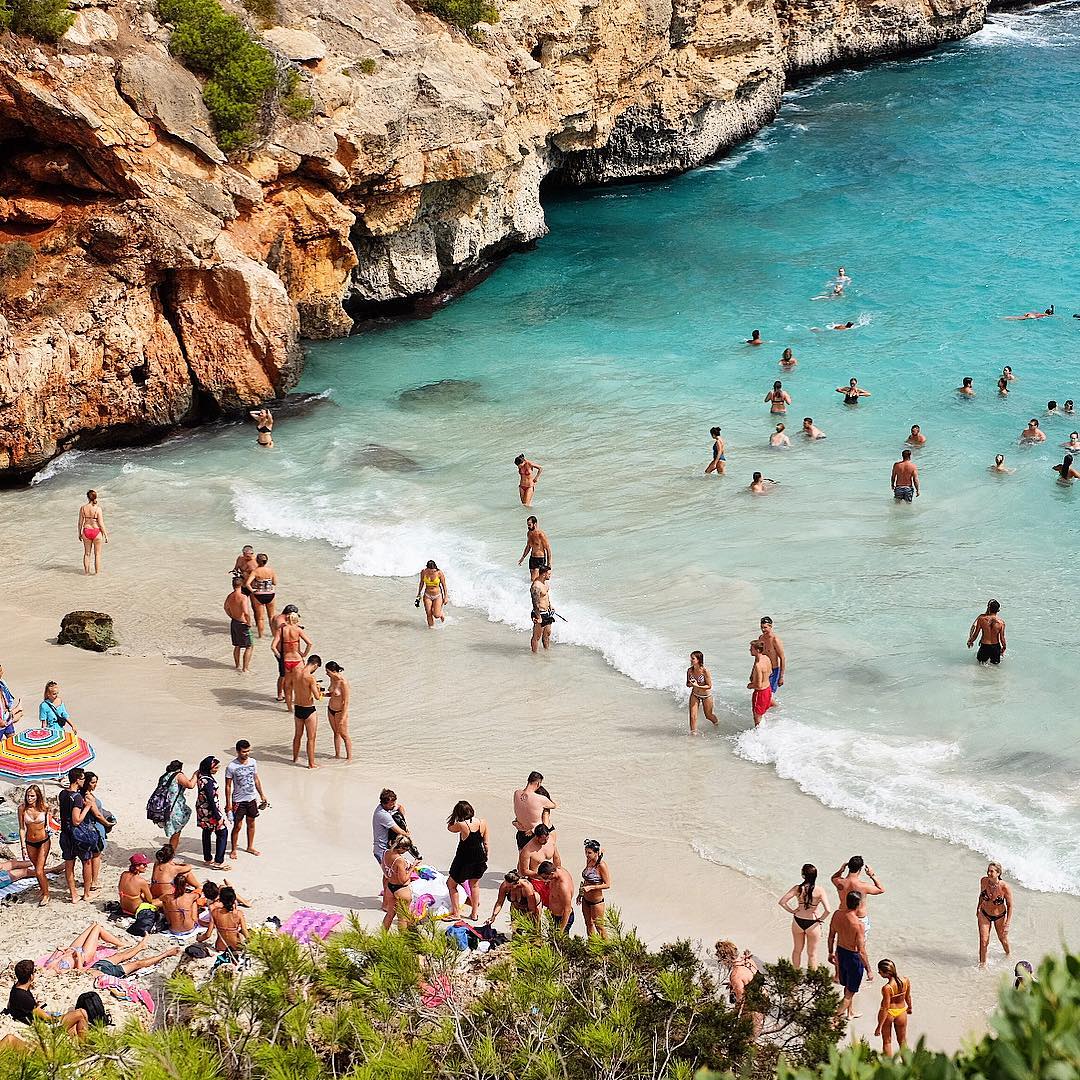
On an island famed for its stunning beaches, the argument of which stretches of sand are Mallorca’s finest are always going to be hotly debated. However, one that is often cited is Caló des Moro. This tiny cove of virgin sand and crystal clear turquoise water is hidden by steep cliffs at either side ad is not easily accessible, except by descending narrow ‘steps’ in the cliff face. Despite this, it is fairly popular with locals and due to its tiny size – just 15m wide and 50m long – getting a spot for your beach towel can be a struggle in the summer months.

Thankfully, just across the headland from the sandy beach, a minuscule small cove populated with a small number of boat sheds provides another bathing spot while many people decide to sunbathe the elevated rocks that surround another calm and tranquil cove.
As it is not well signposted, getting to Caló des Moro can be a bit of a struggle. The best option is to head towards Cala Llombards from Santanyí and park in Sa Comuna. Caló des Moro beach is a short 1km walk from the S’Almunia road and if it is a sunny day, you should be able to follow the trail of people wandering down to the cove.


Felanitx & The Sanctuary of Sant Salvador
Despite appearing sleepy and rural, the town of Felanitx is actually one of the largest in south Mallorca with over 17,000 inhabitants and a bustling weekly market that surrounds the church of Sant Miquel sees crowds descend on the historic centre every Wednesday. Expect to find plenty of capers, the local speciality and local pottery displayed on the church steps.
Although Felanitx relies mostly on tourism nowadays, the town is known for its agricultural history and remains a prominent producer of wine, sitting at the centre of Mallorca’s second-largest wine region. It is these vineyards that put Felanitx on the map and during the 19th century, quickly becoming Mallorca’s third city after Palma and Alcudia. However, the town’s history goes back much further, with settlements here both in the bronze age and during the time of the Roman Empire. During Muslim rule between 902 & 1229, Felanitx had a mosque and the site of Santuari Castle was a fortress.
Beyond the town itself, there are a number of attractions in the area around Felanitx. Santuari Castle – dating from 1228 – sits on a hill overlooking the town and the monastery of Sant Salvador has existed since 1348, with the current structure being built in 1707-34. It was the senior house of Mallorca’s monastic order despite losing its last monks in the early 90s, remains a popular place of pilgrimage for Christians. Even if you are not religious, the views from the terrace take in Cabrera, Cap de Formentor and several other hilltop sanctuaries dotted across the region.
Palma de Mallorca
Considered by many to be one of the prettiest cities in the Mediterranean, the medieval city of Palma is the beating heart of Mallorca. Brimming with history, culture and foodie delights, this vibrant city is the ideal city break.
Towering over the coastline of Badia de Palma, Palma de Majorca dates back to the 13th century when Christian invaders reclaimed the island from the Moors and set about leaving their mark on the city and its skyline with the construction of the towering La Seu Cathedral.
However, before this, plenty of diverse cultures and occupants left a lasting legacy in Palma. The Romans and Vandals have both called this corner of Mallorca home at some point or other.
The sundry historic influences have created a melting pot of architectural styles. Wandering the maze-like, pastel-hued streets that spider-web out from La Seu and its gothic surroundings, you will find narrow medieval streets punctuated with beautiful plazas and ornate churches.
If you’re short on time, various walking tours offer to show you the city from varying perspectives; whether a deep dive into Palma’s Jewish district, a closer look at the beautiful Art Nouveau architecture or tapas bar and market hopping on a foodie adventure around the city centre.
Beyond Palma’s fascinating history, you will find a vibrant, modern city that boasts an energetic nightlife, edgy bohemian neighbourhoods, art galleries and a food scene that will have you salivating.
Getting to Palma
The majority of roads in Mallorca converge in Palma – after all, almost half of the island’s residents live here – so it is very well signposted and easy to reach from the south coast. If travelling by car, head north towards Campos where you can join the eastbound Ma19 in the direction of the coast and Palma de Mallorca.
Traffic reduction measures mean that much of the narrow city centre streets are car-free so you are better off parking in one of the blue parking zones or underground car parks on the outskirts.
By bus, the 501 service provides transport from Manacor (once per hour), Campos and Felantix (every half an hour) to Palma and takes approximately 1 hour 25. From Cala D’or you can take the 514 to Felantix or 515 to Campos and switch to the 501.

Es Trenc & Platja de Sa Ràpita
With many of South Mallorca’s best beaches being littered with hotels apartment buildings, you may have to travel a little beyond the well-trodden resort towns to find a stretch of unspoilt sand. Luckily just 11km south of Campos, you will find Es Trenc and Platja de Sa Rapita, two adjoining natural beaches that together make up a 5km long, pristine beach ideal for a little relaxation or a long walk. This is one of Mallorca’s most beautiful dune beaches so can become a little crowded during the summer months. There are car parks nearby (6 Euros per day) but it is possible to park at Sa Rapita’s yacht harbour if these become full and take the free shuttle bus to Es Trenc.
Sineu Market
Sitting at Mallorca’s centre, the rural town of Sineu is one of Mallorca’s most historically significant settlements, known as Sinium to the Romans and Yiynau by the Moors. It even hosted a royal residence during the era of King Juame II. Although the palace is now a nunnery the town still bears many hallmarks of its time as an important hub, particularly in its architecture. Sineu was home to the first hospital in Mallorca and a particularly impressive parish church, which dates back to 1240, is amongst the oldest anywhere on the island. The large main square of Sineu, Plaza Des Fossar, is a fantastic place to relax and soak up the atmosphere.
Sineu’s main draw is the weekly market that is held each Wednesday in Plaza Des Fossar. Started in 1306 by Jaume II, Sineu market is one of the oldest in Mallorca. Although traditionally dedicated to agriculture and animal farming, the market is now is more of a tourist attraction; Spilling away from the main square, the maze of side streets is crammed with stalls selling a huge range of goods such as fruit and veg ceramics, clothes, and artisan foods such as cheese and meats.
At its heart though. Sineu market is still very much a farmer’s market and the only remaining open market in Mallorca where farm animals are bought and sold so expect to see chickens, doves, lambs, goats and even cows up for sale.

Cala Pi
Cutting half a kilometre inland where the glittering turquoise water is framed by steep-sided cliffs just 100m apart, the natural harbour of Cala Pi is one of Mallorca’s most picture-perfect coves.
The beach itself is rather small – measuring just 140 metres wide and 45 metres long – and is accessed by a steep 147-step staircase that leads down from the villa-lined ridge that shelters the fjord-like estuary. The pines, oaks and maquis that surround the bay add a secluded, as does the fact that the Torrent de Cala Pi’s curve shelters the fine, white sand beach from the open sea.
Although the beach and the4 pretty, white-washed boat houses that surround the bat are Cala Pi’s principal attractions, the small town itself has the interesting claim of being one of Mallorca’s oldest settlements (the nearby Bronze Age settlement of Capocorb Vell is considered to be one of the most important archaeological sites on the island and can be visited). Only around 600 people currently call the village home but there is a small church, Nostra Senyora des Angels, and a number of shops.