Towering over the coastline of Badia de Palma, Palma de Majorca has a long history, dating back to the 13th century when Christian invaders reclaimed the island and set about leaving their mark on the city and its skyline with the construction of the towering La Seu Cathedral. However, before this, plenty of diverse cultures and occupants left a lasting legacy in Palma. The Moors, Romans, and Vandals have all called Mallorca home at some point.
The sundry historic influences have created a melting pot of architectural styles and wandering the maze-like, pastel-hued streets that spider-web out from La Seu and its gothic surroundings, you will find, narrow medieval streets punctuated with beautiful plazas and ornate churches. Beyond Palma’s fascinating history, you will find a vibrant, modern city that boasts an energetic nightlife, edgy bohemian neighbourhoods, art galleries and a food scene that will have you salivating. It would be easy enough to spend weeks exploring Palma de Mallorca alone, but here’s how to find the best of what the city has to offer in just a few short days.

The Best Things to do in Palma De Mallorca
1. Visit Palma’s Magnificent Cathedral
2. Fundació Pilar i Joan Miró a Mallorca
3. Wander Palma’s Old Town
4. Feast on Tapas at San Juan Mercado Gastronomico
5. Have Rooftop Cocktails with a View at Nakar Hotel’s Cuit Bar & Restaurant
6. Hang Out in Santa Catalina
7. Try an Ensaimada
8. Palau de l’Almudaina
9. Castell de Bellver
10. Shop at Mercat de l’Olivar
11. Sample Spanish Brandy at Bodega Suau
12. While Away the Afternoon in the City’s Beautiful Plazas
Visit Palma's Magnificent Cathedral
Palma’s majestic sandstone centrepiece, La Seu, is the iconic symbol of the city and dominates the waterfront. Looking at the enormous structure, it’ understandable why it took almost 6 centuries to build. Consecrated on the site of the old Moorish grand mosque in 1230, work continued until modern times, with baroque altarpieces added in the 17th and 18th centuries and Gaudí setting about leaving his mark on the cathedral between 1904-1914, although much of his work was not completed.
The majestic sandstone edifice and its soaring spires contain an impressive 83 windows – including one of the world’s largest rose windows made up of 1236 separate glass shapes – that bathe the interior (which includes an impressive Gaudi chandelier) in colourful rays of light.
Entry fee: 7 Euros
Skip-the-line entry tickets can be booked here in advance.

Visit Fundació Pilar i Joan Miró a Mallorca
Despite being born in Catalonia in 1893, Joan Miró considered himself a Mallorcan and moved here in later life to establish his studio. The world-renowned painter, sculptor, and ceramicist wished for the building to be transformed into a ‘place where people live, create and talk together’ following his death in 1983 and his wish has been granted, with part of the building converted by both his wife and Rafael Moneo into a stunning museum with rotating exhibitions.
At certain times Miró’s studio is open to the public, allowing them to see his workspace, including unfinished canvases still on easels and sketches littered across tables. There is also a gallery and sculpture garden that has magnificent views over the city.
Wander Palma's Old Town
The inner city, particularly casco antiguo and its narrow lanes, are the heart of Palma de Mallorca. This area is one of the largest preserved medieval cities in the Mediterranean and it’s easy to lose your sense of direction while wandering the cobbled streets. It doesn’t really matter though, around every corner and through every archway there is something to delight: hidden palm tree-filled courtyards, gothic churches and quaint, shady squares where you can rest and sip on a cold cocktail after a long day of sightseeing. The best way to see the old town is to take a guided tour with a knowledgeable host that will give you then ins and outs of the city and its streets but just walking and getting lost in the labyrinthine, pastel-coloured lanes is a perfectly pleasant way to spend the day.

Feast on Tapas at San Juan Mercado Gastronomico
Located 20 minutes’ walk north of the old town in what was once a former abattoir, this cornucopia of 17 food stalls offers all kinds of Mallorcan cuisine, from fresh seafood and oysters to hams, croquette and wood-fired pizza. It took a 2-million-euro renovation to turn this crumbling, 100-yar-old building – now the S’Escorxador cultural centre – into Palma’s first gourmet food market but now the vaulted ceilings and tiled hall are almost as much as an attraction as the food itself. Almost.
The Mercado Gastronómico San Juan claims that it serves 260 dishes and 361 wines through its various vendors. It’s a great place to stop off for a quick lunch and an even better place to spend an evening grazing, as regular live bands and DJs play on an evening.
Have Rooftop Cocktails with a View at Nakar Hotel’s Cuit Bar & Restaurant
Located on Avenida Jaime III, one of the most prestigious streets in Palma, somehow the swanky Nakar Hotel has remained one of the city’s best-kept secrets. This hip urban hotel opened in 2016 but even if your accommodation budget doesn’t stretch to staying here, you can make the most of the hotel’s cooler-than-cool roof terrace bar which opens at 7pm each night for non-residents.
An elevator from the hotel’s reception takes you up to the 8th floor. Here, you emerge into a stylish and light-filled restaurant/bar, Cuit, run by Mallorcan chef Miquel Calent. Calent trained in his home town of Campos in Southeast of the island where he opened his first restaurant Ca’n Calent, which has become well-renowned island-wide for its dishes.
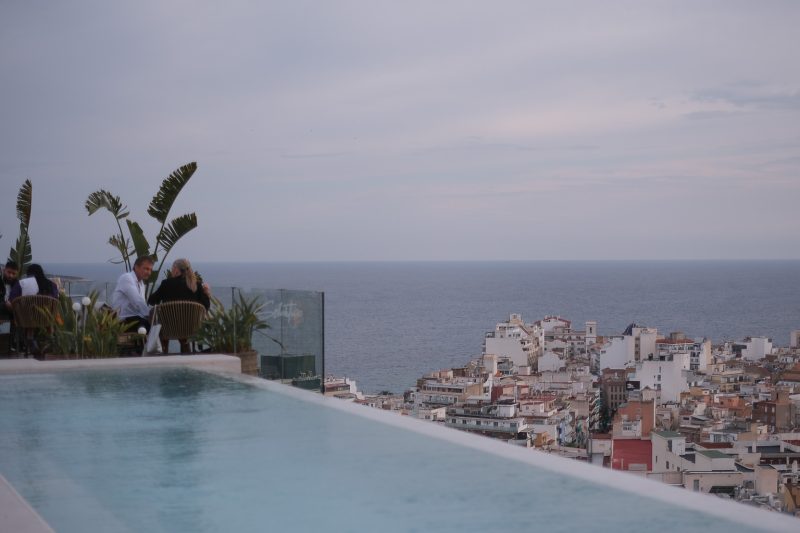
However, if you don’t plan on eating here, stop by at their roof terrace for a sundowner cocktail as the bar is in prime position to offer an extraordinary view over the city and famous local landmarks like the cathedral, Bellver Castle, and the Bay of Palma illuminated in the evening light.

Hang Out in Santa Catalina
Just outside of Palma’s La Lonja old town area, a 15-minute walk from the city’s centre is Santa Catalina. This old fishing district is one of the city’s best neighbourhoods for bars, cafes and restaurants with a cosmopolitan mix of eateries ranging from Mexican, Asian fusion and Indian to fantastic tapas and pintxo bars.
For one of the best coffees or brunches in the city, head to Mama Carmen´s on Carrer de Cervantes. However, my main recommendation is to arrive here after dark, when the pavements of Career Fabrica are buzzing and lively, packed with tables and diners. After dinner, pop into a few bars, making sure to stop off at the Sky Bar at Hotel Hostal Cuba for mesmerising views over the Bay of Palma.
Also, at the heart of Santa Catalina is the market hall, which has a couple of fantastic tapas bars such as the always-busy Can Frau that has been serving tapas here for over 50 years.

Try an Ensaimada
You can’t come to Mallorca without tucking into an ensaimada, the island’s most famous treat. These spiralling pastries can be found filled with cream, custard or cabell d’angel, a local delicacy of sweet pumpkin jam. The best place to sample one is C’an Joan de S’Aigo in Palma’s old town. Dating back to 1700 and still decked out in old-school tiles and wood panelling, this café and ice cream parlour serves the best ensaimadas in the city.
Palau de l'Almudaina
Although from a distance the Royal Palace of Almudaina may look as though it is part of the city’s cathedral, the alcázar was originally built by the Moors but converted into a Gothic-style palace after Christian crusaders seized power at the end of the 13th century and used a residence for the Mallorcan monarchs. After the death of Jaume III in 1349, no king lived here permanently, although The King of Spain still stays here on his visits to the island. It is worth visiting Almudaina for the gothic chapel of Santa Ana and the royal chambers alone but the palace courtyard – complete with a lion fountain that is one of the palace’s rare Arab remnants – is one of the most beautiful spots in the city.

Castell de Bellver
Towering high over Palma from a wooded hillside, the imposing, 14th century Bellver castle was built by James I and used as a royal residence by James II before being converted into a dungeon and prison used to inflict great suffering on Palma’s residents, particularly the Jewish population. The Castle now contains Mallorca’s historical museum and regularly hosts concerts in the main courtyard. The best way to reach the castle is an enjoyable hike on foot through the surrounding forest.
Shop at Mercat de l'Olivar
If you’re bored of tourist sights and want to get a bit of local flavour, you can’t do much better than heading to Palma’s largest covered market – Mercat de l’Olivar – located on the square of the same name, between Plaça d’Espanya and Sant Miquel Street in the heart of the city.
Delicious aromas, colourful vegetable displays, and the sound of lively banter among customers and traders make this place a feast for the eyes and ears as well as your tastebuds. The market, opened in 1951, and built under the direction of the city architect Antonio García Ruiz Rosselló contains over 115 stalls selling some of the best Mallorcan and Spanish food produce: cheeses, meats, and fish as well as flowers and souvenirs.
It’s not just a place to shop, it’s also a place to linger, as cafes, tapas bars and vermouth stalls are spread amongst the fresh fruit and veg stands.

Sample Spanish Brandy at Bodega Suau
We may mostly associate brandy with old aged pensioners and Christmas, but in Spain, it is far from our Anglocentric perceptions of the drink. Spanish brandy has a long history, with the country being the first to produce the spirit way back in 16th century, although some think that the process of distillation was introduced to the Iberian Peninsula by the Moors as far back as the 8th century. Nowadays, Spanish brandy is a big deal, with the country producing 80 million bottles per year.
Bodega Suau story that dates back almost as far as the drink itself – walking down the 15 stairs that separate the outside world from their cellar is like travelling back in time 165 years. It began back in 1840 when sailor and explorer, Captain Don Juan Suau y Bennaser, started to export Cuba’s renowned rum to Europe and the rest of the Caribbean, using his ship El Mallorquin, one of the first commercial steam and sailboats in Spain. After meeting a woman on his home island of Mallorca during one of his expeditions from Cuba, he decided to sell his boat and move his distillery to the island and continue to produce liqueurs. Bodegas Suau moved around different premises in Palma before finally settling at the current location in Pont d’Inca about 70 years ago.
The listed building that now hosts the Suau cellars is certainly unique and worth visiting. It features include a striking 40-metre-high outside chimney, a remnant of the building’s past as a flour factory, and the cellar where bottles and wooden barrels are packed in. This area is where the brandies are left to slowly age, and some of the casks are more than 150 years old.

While Away the Afternoon in the City's Beautiful Plazas
What could be a better way of sitting and whiling away the afternoon while nursing a coffee, beer or glass of red in one of Palma’s beautiful squares? It’s the favourite pastime of both tourists and locals alike and Palma has no shortage of great plaças.
A favourite of mine is the off the beaten track Plaça de la Drassana, the spot where boats were built and repaired during the Middle Ages and today, the statue in the centre of this square – hidden beneath the shade of a sprawling tree – is dedicated to the famous Majorcan navigator Jaume Ferrer. However, my main reason for coming here to enjoy the expansive beer menu of the quirky Bar Café Coto.
Elsewhere, the small and charming square of Plaça Cort, located in the heart of the city, named ‘Cort’ because it was here where the feudal court once gathered. It is home to the town hall but is most famous for the ‘Olivera de Cort’. This six hundred-year-old tree was transported to Palma from the Pedruixella Petit estate in Pollença in 1989 as a symbol of peace. Although there are a few bars and cafes surrounding the square, make sure to stop off at Giovanni’s ice cream parlour.
Plaça Major is the city’s main square, encircled by the pastel yellow facades and green window shutters of the surrounding houses. This square has been the centre of the city life in Palma throughout the centuries: It stands where the San Felipe Neri convent was once located which then became the seat of the infamous Spanish Inquisition in Mallorca until 1823. Nowadays the square is almost exclusively occupied by tourists and hosts a craft market every day throughout the summer.

This post is part of a paid campaign to promote the Balearic and Canary Islands, as part of their #SpanishIslands Campaign. Although all views are my own and I have not been instructed what to include.