From the summit of the Arkamas Peninsula, the cliff faces drop sharply, giving way to a green plateau hundreds of meters below, where the rugged coastline meets the sea. Here, the light is soft and the salt-washed Mediterranean sun spills across the hills, turning dusty browns into gold and pulling the sea on the horizon into sharp, impossible shades of blue.
Standing at the Baths of Aphrodite, just before the trail begins its steady climb into the hills, it’s easy to understand why the ancient Greeks believed this corner of Cyprus belonged to the goddess of love herself. The air feels ancient here, and the place feels disconnected from the island’s resorts, scented with pine, thyme and the salt of the sea. As the path winds upward through rugged slopes and sweeping coastal views, you quickly feel as though you’re stepping away from civilisation and into one of the most myth-soaked landscapes in the Mediterranean.


Cyprus has long been tied to the legend of Aphrodite, the Greek goddess of love, beauty and desire. According to myth, she rose from the sea foam off the island’s shores at Petra tou Romiou near Paphos, but the Akamas Peninsula is said to have been one of her favourite retreats. Hidden grottos, secluded beaches and forested hills made this a private sanctuary and a place where the goddess could wander far from the watchful eyes of Olympus. The small pool at the Baths of Aphrodite, shaded by fig trees and vines at the start of the trail, is believed to be where she bathed, and where she first encountered Adonis, the handsome young hunter who would become one of the most tragic love stories in Greek mythology.

Legend says that Aphrodite fell deeply in love with Adonis after meeting him in these very hills. Together they hunted through the forests and roamed the peninsula, their romance unfolding against the same dramatic landscapes that are now a popular excursion from Paphos for hikers and daytrippers. But as myth often goes, their story ended in heartbreak when Adonis was fatally wounded during a hunt. Grief-stricken, Aphrodite’s tears were said to have stained the earth red. In a way, this is a poetic explanation for the wild anemones that bloom across Cyprus each spring. Even now, as you climb higher along the Aphrodite Trail and look out across the peninsula, it’s easy to imagine these ancient stories taking shape among the cliffs and hidden coves below as a way of explaining the area’s natural beauty.
However, despite the fantastical stories of Greek goddesses, this isn’t the main reason so many people are drawn to the Aphrodite trail; most hikers come to experience the raw beauty of modern Cyprus. The route loops high above the coast, offering sweeping views across Chrysochou Bay and deep into the untouched interior of the Akamas Peninsula, which is one of the island’s last truly wild landscapes. It’s a place where eagles circle overhead, herbs grow wild along the path, and the Mediterranean stretches endlessly beyond the ridgeline.

While the connection between historic tales and the present fascinates me greatly, imagining ancient settlers clutching at legends in order to explain the world around them, this is a trail that I would be happy to traverse without its mythological context; it feels like an interesting addendum to an already glorious hike. At one moment, I was catching my breath on a rocky switchback, focused purely on the physical effort of the climb, while at the next, I was pausing at a panoramic lookout, taking in one of the most spectacular vistas that Cyprus has to offer, imagining the ancient stories that shaped this landscape long before hiking boots and GPS apps existed. There’s a rare sense of continuity here — a feeling that people have been drawn to these hills for thousands of years, whether for myth, solitude or simply the pull of the sea.
Here, you’ll find everything you need to know about hiking the Aphrodite Trail, from practical route details and safety tips to the best times to walk and where to eat or swim afterwards. But more than anything, this trail offers a chance to experience Cyprus at its best and most rugged. So lace up your boots, start early and follow the path into the hills; you might not encounter gods or ancient lovers along the way, but the sense of history woven into every step makes the route feel just as timeless.
What is the Aphrodite Trail?
The Aphrodite Trail is one of Cyprus’ most popular circular hikes, tracing a high coastal loop through the wild heart of the Akamas Peninsula National Park on the island’s north-west tip. Beginning and ending at the legendary Baths of Aphrodite, the route combines mythology with sweeping Mediterranean views and classic Cypriot landscapes into a wonderful half-day walk. Named after the Greek goddess of love, who, according to local legend, once bathed in the shaded grotto at the trailhead, the route blends natural beauty with mythology.
The trail is typically around 7–8km long and takes three to four hours to complete at a relaxed pace, though the viewpoints along the way may distract you. From the start, the route climbs steadily through pine forest and rocky hillsides before reaching panoramic ridgelines overlooking Chrysochou Bay. These elevated sections are most people’s main reason to hike the Aphrodite Trail, where uninterrupted views across the Akamas coastline and its deep blue sweep of the Mediterranean are some of the most beautiful sights on the island.
Quick Facts
- Location: Akamas Peninsula National Park, Paphos District
- Distance: ~4.7 miles / 7.5 km
- Time: 3–4 hours at a moderate pace
- Elevation Gain: Roughly 300–400m ascent depending on route variation
- Summit Height: About 333m above sea level
- Difficulty: Moderate
- Route Type: Circular
- Terrain: Rocky paths, forest tracks, exposed hillside sections
- Best For: Suitable for active walkers with reasonable fitness
Where Is the Aphrodite Trail & How to Get There
The Aphrodite Trail lies on the rugged north-western edge of Cyprus, deep within the Akamas Peninsula National Park. Compared to the country’s cities and coastal resorts, it can feel like one of the island’s last truly wild landscapes. The trail begins at the Baths of Aphrodite, a small natural grotto just outside the coastal town of Latchi, around 45 minutes from Paphos by car. This remote setting is a big part of the trail’s appeal, but it also means getting there requires a little planning.

Most hikers will approach the Aphrodite Trail by car. From Paphos, the drive winds north through Polis Chrysochous before following the coastal road towards Latchi and Fontana Amorosa. The final stretch leads directly to the Baths of Aphrodite car park, which serves as the main trailhead. The road is fully paved, which makes driving easy.
Public transport options are a little more limited. There are buses running between Paphos and Polis, but reaching the Baths of Aphrodite from there would mean either booking a taxi or a long walk along the coast, which isn’t all that practical when you have a hike ahead of you. I would recommend renting a hire car anyway if you are looking to explore Cyprus beyond Paphos, but there are also organised excursions to the peninsula, which give you another option if you’re unable to drive.
Once parked, the start of the trail is clearly signposted near the Baths of Aphrodite, making it easy to find your way even on a first visit.
Driving Directions
From central Paphos or the harbour area, head north on the B7 towards Polis Chrysochous. Continue through coastal villages until you reach Polis, then follow signs for Latchi / Neo Chorio / Baths of Aphrodite along the E713 coastal road. The route hugs Chrysochou Bay, offering sweeping sea views as you approach the Akamas Peninsula. After passing through Neo Chorio, continue following brown tourist signs for the Baths of Aphrodite until you reach the dedicated car park at the end of the paved road. The total drive is approximately 45–60 minutes, covering about 46km from Paphos.
The Aphrodite Trail Route
The Aphrodite Trail begins beside the shaded waterfall grotto of the Baths of Aphrodite, where a short stone path leads past fig trees and dense greenery before the real climb begins. The first section wastes no time gaining elevation, zigzagging steadily uphill through low woodland and scrubby Mediterranean vegetation. This early ascent is easily the toughest part of the hike, a sustained incline on rocky terrain, but it rewards you quickly, with glimpses of Chrysochou Bay opening behind you as the coastline starts to fall away below.


As the trail rises higher, the path narrows and becomes more rugged, winding across exposed hillsides dotted with juniper and wild herbs. Wooden signposts and painted markers make sure to keep you on track and are easy to follow, and occasional benches are dotted around to give you a welcome break to catch your breath and take in the views. Within the first hour or so, you should reach the ridge, which is the defining section of the Aphrodite Trail, where the landscape opens dramatically and the Akamas Peninsula stretches out in every direction.

Here, the route levels out into a more gentle incline. To one side, steep slopes plunge towards the Mediterranean; to the other, the interior of Akamas is a mix of rolling hills, scattered pine forest and distant landscapes. On clear days, the light dances across the water in shifting shades of deep blue and turquoise, making this one of the most photogenic stretches of any hike in Cyprus. Along the way, you’ll pass natural viewpoints and a few small historical curiosities, including the ruins known as Pyrgos tis Rigainas, thought to be a medieval lookout tower, and an ancient oak tree that has stood here for centuries.
After the ridge section, the trail begins its gradual descent, curving inland before looping back towards the coast. The terrain alternates between rocky paths and wider forest tracks, offering a change of pace after the exposed high ground. Sections of pine woodland provide intermittent shade, particularly welcome during warmer months, and you may notice a richer variety of plant life as the elevation decreases. Depending on the season, wildflowers, orchids and aromatic shrubs line the path, attracting butterflies and birds of prey circling overhead. You’re also likely to see quite a few goats scrambling up the steep slopes.
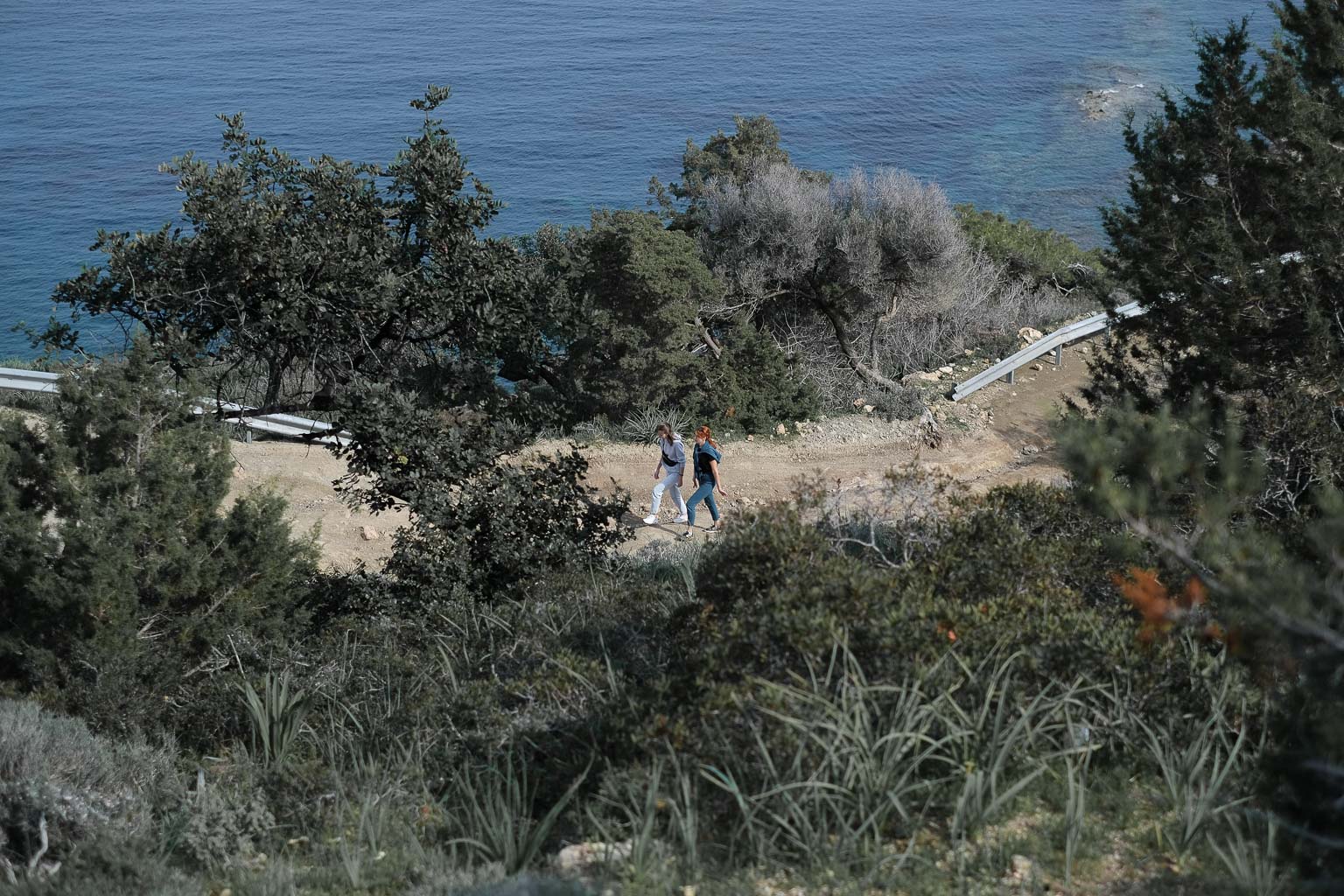
After the ridge section, the trail begins its gradual descent, curving inland before looping back towards the coast. The terrain alternates between rocky paths and wider forest tracks, offering a change of pace after the exposed high ground. Sections of pine woodland provide intermittent shade, particularly welcome during warmer months, and you may notice a richer variety of plant life as the elevation decreases. Depending on the season, wildflowers, orchids and aromatic shrubs line the path, attracting butterflies and birds of prey circling overhead. You’re also likely to see quite a few goats scrambling up the steep slopes.
As you near the end of the loop, the trail reconnects with lower coastal slopes, eventually bringing you back towards the Baths of Aphrodite. The final stretch is gentler and more sheltered, easing you back into the starting area. Many hikers finish by exploring the small grotto itself or stopping at the nearby restaurant overlooking the sea, which is a relaxing and rejuvenating end to several hours spent immersed in one of Cyprus’ most dramatic landscapes.
Is the Aphrodite Trail Difficult?
I’d consider the Aphrodite Trail to be an easy-to-moderate hike, striking a balance between accessibility and a slight challenge. While it doesn’t require technical climbing skills or specialist equipment, it is beyond a casual coastal stroll. The main difficulty comes from the steady initial ascent, which climbs sharply away from the Baths of Aphrodite and gains most of the trail’s elevation within the first section. This uphill stretch can feel demanding and sweaty in warm weather, but once you reach the higher ridgeline, it flattens out and can feel much more relaxed.

Underfoot conditions also add to the challenge. Much of the route follows rocky, uneven terrain, with loose stones and narrow paths along exposed hillsides. Good footwear with grip is essential, especially on the descent, where your legs can tire and footing can feel less secure. The trail is clearly signposted and easy to follow, but the combination of heat, limited shade and continuous elevation changes means a reasonable level of fitness is helpful to fully enjoy the experience.
With all of this in mind, the trail is best suited to walkers with at least a moderate level of fitness who are comfortable spending several hours on uneven ground. Confident beginners who are prepared for the climb and take regular breaks should find it easily achievable, while experienced hikers will likely see it as a scenic half-day stroll rather than a demanding expedition.
When is the Best Time to Hike the Aphrodite Trail?
Weather plays a significant role in how difficult this hike can feel. During Cyprus’ hot summer months, temperatures can quickly rise, and much of the upper trail is exposed to direct sun, making the walk feel quite strenuous. Starting early in the morning and carrying plenty of water will make things much easier. In cooler seasons, particularly spring and autumn, the same route feels far more manageable and is suitable for most active walkers.
The best time to hike the Aphrodite Trail is during spring and autumn when temperatures are at their most comfortable. Spring in particular transforms the landscape as the hillsides burst with wildflowers, the smell of herbs and pine fills the air. Daytime temperatures are warm enough for hiking without the intense heat that you get in the summer months. Add to this, clear skies and fresh greenery, and you have one of the most photogenic times to tackle the trail, with excellent visibility across Chrysochou Bay.


I hiked the trail in winter (mid-February) and even then, temperatures reached almost 20°C, and I was blessed with clear skies for the entirety of the walk. However, this time of year generally brings cooler temperatures, with the bonus that the area is pleasantly quiet and comfortable for walking. Occasional rain and stronger winds can affect conditions, and sections of the path may feel more slippery after storms. On clear winter days, though, visibility can be exceptional, with crisp air and dramatic coastal views.
What to Pack when hiking the Aphrodite Trail
The Aphrodite Trail may be a relatively short circular hike, but its exposed ridgelines, rocky terrain and limited facilities mean thnat is is best to come prepared. Although there is a restaurant and a few stalls beside the carpark at the strat of the trail, there are no shops or reliable water sources once you set off, and the Mediterranean sun can feel intense. Packing a few well-chosen essentials will make the difference between a comfortable, enjoyable walk and a long, tiring slog.
Sturdy Footwear
Good footwear should be at the top of your list. The trail surface is uneven in most places, with loose stones and narrow sections along the hillside, so proper hiking shoes or trail trainers with good grip are strongly recommended. Lightweight trainers may be manageable for experienced walkers, but ankle support and traction will make the climb and the long descent far more manageable.
Water
Plenty of water is essential year-round. Aim for at least 1.5–2 litres per person, more during warmer months or if you plan to walk slowly with plenty of photo stops. There are fountains along parts of the route, but they’re not always reliable or potable, so it’s best to be fully self-sufficient.
Sun Protection
Given the limited shade on the upper sections, sun protection is just as important as hydration. Make sure to bring a wide-brimmed hat or cap, sunglasses and high-SPF sunscreen, particularly from late spring through early autumn. Lightweight, breathable clothing will help keep you cool during the initial climb, and a light layer can be useful on breezier ridge sections outside of summer.
Food
Bring snacks or a light picnic, especially if you enjoy taking your time at viewpoints. Energy bars, fruit or sandwiches are ideal for a scenic break overlooking the coastline. Even though the hike can be completed in a few hours, having food on hand helps maintain energy levels on the uphill sections.
Navigation and Extras
For navigation, the trail is clearly signposted, but if you’re like me and get easily lost, it’s wise to carry a downloaded offline map as mobile signal can be patchy in parts of the Akamas Peninsula. A fully charged phone and a small power bank are always helpful.
Backpack Essentials
Finally, consider packing a few comfort extras: a small daypack, basic first-aid kit, blister plasters, insect repellent in warmer months and a camera for spotting wildlife.
Combining the Aphrodite Trail with Other Akamas Walks
While the Aphrodite Trail works perfectly as a standalone half-day hike, it also sits at the heart of one of Cyprus’s best walking areas, making it easy to combine with other routes across the Akamas Peninsula if you’re looking to extend your time on the trails. With careful planning, you can turn a single scenic loop into a full-day hiking adventure that covers much of the peninsula.
Adonis Trail
The most natural extension is the nearby Adonis Trail, which shares the same starting point at the Baths of Aphrodite. This neighbouring route climbs higher into the hills and is slightly longer and more demanding, but linking sections of both trails creates a more varied circular walk with wider inland views and fewer crowds once you leave the main peak. Strong hikers sometimes combine both of them in one go, effectively doubling the distance and elevation gain.
Smigies Nature Trails
For a gentler follow-up walk, consider heading further into the peninsula towards the Smigies Nature Trails, found a short drive away near Neo Chorio. These shorter routes wind through pine forest and shaded hillsides, offering a completely different experience from the Aphrodite Trail. The Smigies circuits are well signposted too, and ideal if you still have energy after your main hike but want something less physically demanding.
Akamas Coastal Paths
If you’re keen to build a full-day itinerary, another option is to combine your hike with sections of the Akamas coastal paths near Fontana Amorosa or the Blue Lagoon area. While these aren’t always formal trails, they provide spectacular sea-level walking with views back towards the cliffs you’ve just explored. Many walkers choose to hike the Aphrodite Trail in the morning, then spend the afternoon exploring shorter coastal walks or swimming stops nearby.
After the Hike: Where to Eat & Swim Nearby
If completing the Aphrodite Trail feels like a proper achievement, you’re fortunately perfectly placed for a refreshing swim and a well-earned meal. The Baths of Aphrodite trailhead sits on the edge of the Akamas Peninsula near Latchi and Polis, meaning you’ve got a handful of relaxed seaside spots within a short drive (or even walking distance).
If you’re craving something immediately after your hike, Baths of Aphrodite Restaurant is the closest option, located right next to the Baths of Aphrodite site and the trail’s starting point. We ate lunch here and were served wonderfully fresh fish as part of a sprawling Cypriot mezze. The biggest draw is the terrace overlooking the coastline and forested slopes of Akamas. Many hikers pop in straight after finishing for a refreshing drink or quick lunch without needing to drive anywhere.


Just a short drive back towards the coast, the harbour town of Latchi has a relaxed, seaside atmosphere with a string of tavernas facing the water. Fresh grilled fish, mezze platters and cold local beer are the order of the day here, making it a satisfying spots to unwind after a strenuous walk. Tables overlooking the marina provide an easygoing setting to watch fishing boats drift in and out while you recover from the climb.
If you prefer something a little quieter, the nearby town of Polis Chrysochous has a more laid-back village feel, with traditional tavernas and shady squares ideal for a slower post-walk lunch. Expect hearty Cypriot classics such as souvlaki, halloumi, seasonal salads and freshly baked bread.

For a refreshing swim, you’re spoiled for choice; This is Cyprus afterall, an island with some of the clearest, cleanest waters in the Mediterranean. Latchi Beach is one of the easiest options, with calm, clear water and plenty of space to spread out after the trail. The long pebble-and-sand shoreline is ideal for a gentle dip to cool tired legs, and its proximity to cafés means you can combine a swim with an afternoon drink by the sea. If you’re willing to venture a little further into the Akamas Peninsula, more remote coves and viewpoints appear along the coastal road, offering wilder, quieter swimming spots framed by rugged cliffs and crystal-clear Mediterranean water.
FAQs
How long is the Aphrodite Trail?
The Aphrodite Trail is approximately 7–8km long, depending on the exact loop variation you follow. Most hikers complete the circular route in three to four hours, although it can take longer if you stop frequently for photos or rest breaks along the ridge.
Do you need a guide to hike the Aphrodite Trail?
Although I had a guide for my hike, they aren’t necessarily needed. The route is well signposted and straightforward to follow for independent hikers. That said, a guide is useful if you would like to gain a good knowledge of local flora and fauna as well as an insight into the area’s history and geology.
Where Does the Aphrodite Trail Start?
The trail begins at the Baths of Aphrodite, just outside the village of Neo Chorio near Latchi on the edge of the Akamas Peninsula. There’s a dedicated car park and clear signage marking the start of the circular route.
Is the Aphrodite Trail suitable for beginners?
Confident beginners with a basic level of fitness can complete the hike, especially in cooler months. However, the rocky terrain, exposed sections and steady elevation gain mean it’s better suited to walkers who are comfortable spending several hours on uneven ground.
Can you hike it in summer?
Yes, but it can be extremely hot and exposed. If hiking in summer, start early in the morning, carry plenty of water and avoid midday heat. Spring and autumn are generally more comfortable and enjoyable seasons for most walkers.
Are there facilities along the trail?
Facilities are limited once you leave the trailhead. Toilets, parking and a café can be found near the Baths of Aphrodite at the start and end of the route, but there are no shops or reliable drinking water sources along the trail itself.
Can you combine the Aphrodite Trail with other hikes?
Yes, the route connects with the nearby Adonis Trail, allowing more experienced hikers to create a longer, more challenging circular walk through the Akamas Peninsula.
Is the Aphrodite Trail Worth It?
For people wanting to step beyond the city and immerse themselves in Cyprus’ nature, absolutely. It doesn’t really matter if you are a hiking enthusiast or not; the chance to explore a wilder region of Paphos and the views that are achieved make this entirely worthwhile. The combination of mythological history, panoramic coastal vistas and a sense of isolation makes it one of the most rewarding hikes in Cyprus.