Budapest’s Jewish Quarter is a neighbourhood filled with contradictions. Despite being the smallest District, it also has the highest population density. As well as being home to a conservative Jewish community, it is also an eclectic, hedonistic party hub.
It is not clear when a Jewish community first appeared in Budapest. It is thought that they may have settled during the 12th or 13th centuries. They have been present in the area that is now Hungary for hundreds of years longer than Hungary has even existed. When Budapest was formed in 1873, there were about 45,000 Jews living in the city. By 1930 this number had grown to 200,000. As business owners, doctors, lawyers, musicians and journalists, Jews were by far the most visible of Budapest’s minority groups. Due to their success, they quickly found themselves being used as scapegoats by Hungarian leaders. The Arrow Cross began to attract more followers and anti-Semitic policies were put in place. The community here has always faced an uphill struggle against discrimination; the very reason that this was established as the city’s Jewish quarter is that it fell outside of Pest’s city walls.
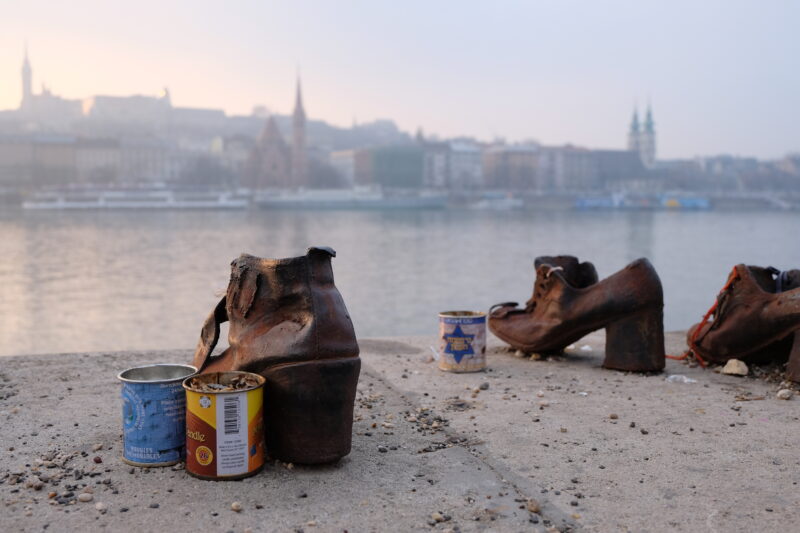
Following German Occupation in WWII, a ghetto was created by decree of the Royal Hungarian Government. Several blocks of the old Jewish quarter, which included the 2 main synagogues of the city – the Neolog Dohány Street Synagogue and Orthodox Kazinczy Street Synagogue – were fenced and guarded so that the occupants could not escape. No food was allowed in and the dead lay in the street, uncollected. More than half of those that were forced into the ghetto in 1944 were sent to concentration camps. Those that weren’t often died of starvation, disease or the freezing conditions. Within only 56 days of German occupation, 437,000 Jews were deported from Hungary. In addition, Arrow Cross militiamen shot 10,000 to 15,000 Jews, often forcing them to strip naked on the banks of the Danube and face the river, before being shot at close range so that they fell into the water to be washed away. In just a few months, the population of the ghetto fell from 200,000 to just 70,000 people.

The area that was once the Jewish Ghetto It is still the city’s Jewish Quarter. None of the old walls remain – the last section was demolished in 2006 – but district VII, or Erzsébetváros as it is more formally known, lies roughly within the borders that were established in those few horrific months of 1944.
Back in the early 2000s, a group of local artists started to rent one of these dilapidated buildings, an old factory, in the hope of creating an art space. This was to be a place to screen movies, hold musical performances, art exhibitions and a place to drink. As the building needed extensive renovation and decoration that the tenants couldn’t afford, they set about decorating the walls and rooms with whatever they could find; flea market furniture, junk, and graffiti on the walls. The ruin pub, and Szimpla Kert, was born. Szimpla Kert proved hugely popular and soon, copycats were popping up all over District VII, truly putting the neighbourhood on the map for both tourists and locals alike.
This mix of cheap rental property and the proliferation of hip new bars seem to have been the turning point in the Jewish Quarters fortune. Soon, artists and students were moving in. More hip boutiques, cafes, and bars sprang up all over the district attracting a further influx of people. It is a cycle that has continued for almost 20 years, resulting in the Jewish Quarter going from strength to strength.
Hungary is still home to one of the largest Jewish communities in Europe, with 50,000 Jews calling Budapest home. As well as Dohány Street Synagogue, the largest in Europe, there are two other synagogues; Rombach Street Orthodox Synagogue and one on Kazinczy Utca. In reaction to the growing ethnonationalism that is rearing its head in many parts of Europe, many of Budapest’s young Jews are embracing their identity and becoming more visible. Some are even stamping their own mark on District VII by opening Kosher restaurants and cafes.
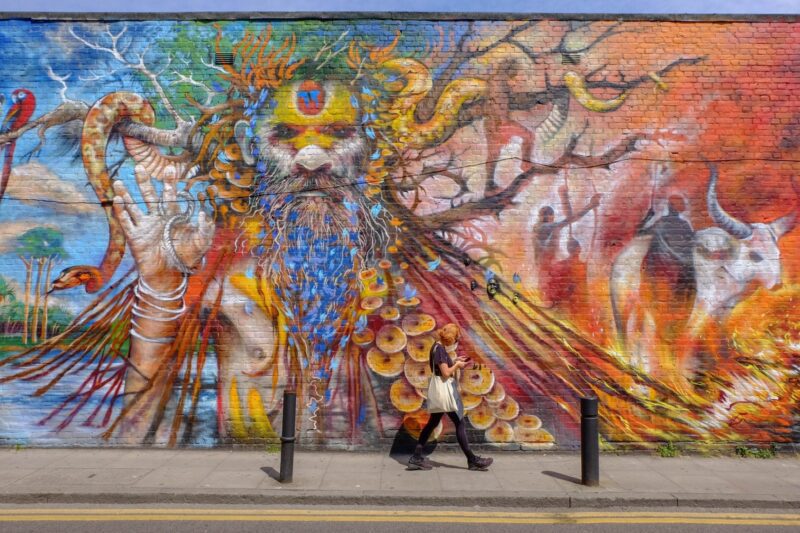
On a street art tour of the district, my guide pointed to one of the colourful murals adorning a firewall of an empty lot. “This will not be here for much longer. in a few months, there will be a new apartment building in this lot and the wall will be completely hidden.” I suppose this is a good metaphor for the neighbourhood as a whole. It is constantly evolving, constantly gentrifying. Each time you visit, one of your favourite artworks, cafes or ruin bars may be gone, but there will be multiple new things to discover in its place. Artists and entrepreneurs are constantly clambering to leave their mark on the area, so what it will look like in the future is anyone’s guess.

Where to Stay in Budapest's Jewish Quarter
If you’re wondering where to stay in Budapest, each of the city’s different quarters, from Castle Hill to Downtown, has its own atmosphere and all contain a good mix of luxurious hotels, budget hostels and serviceable rental apartments. However, for cheap digs in the Jewish quarter, there is one hostel that is head and shoulders above the rest.
Wombats CITY HOSTEL
For centuries, Király street – or King’s Street – has been one of the most important thoroughfares in Budapest. Even today it is constantly buzzing, filled with trendy boutiques, cool bars, and an endless supply of cafes and restaurants. This historic road remains the cultural heart of modern Pest, running perpendicular to the ruin pub filled Kazinczy and Akácfa Streets.
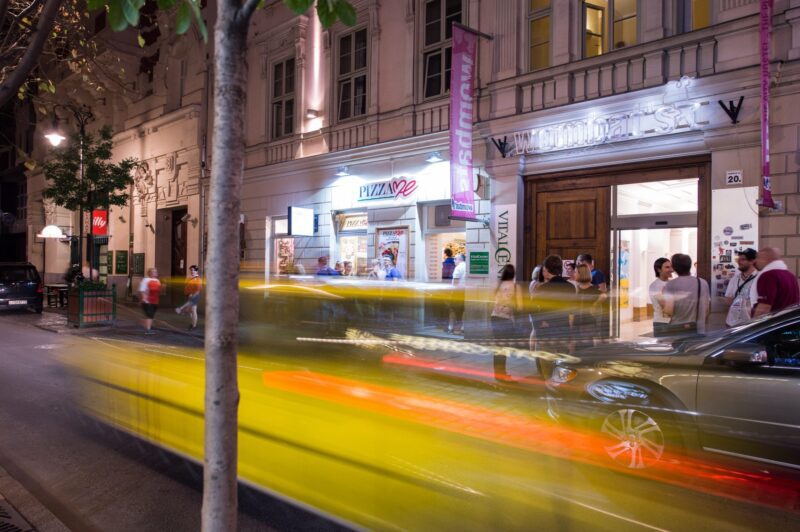
Its location at the centre of Király Street is what makes Wombats the perfect choice for anyone looking to explore the Jewish Quarter and its nightlife. It is just a few minutes walk to the ruin bars like Szimpla, Ellato and Koleves Kert, while directly across the street is the passage of Gozsdu Udvar, a burgeoning network of bars and eateries that have cropped up on the ground floor of a sprawling apartment complex.
Wombats offer both private rooms and dorm beds to fit with whatever style you like to travel. For the best prices (up to 15% cheaper than other booking platforms) book directly through their website.
Where to Eat in Budapest's Jewish Quarter
When most people think of Hungarian cuisine, only two things come to mind: Paprika and goulash. While it is easy to stumble upon traditional restaurants in District VII, you will also find every type of international cuisine that your stomach could desire. Walking from the grand Dohány Street Synagogue on the neighbourhood’s boundary, you will soon come across the restaurant-lined, interconnecting courtyards of Gozsdu Udvar and emerge onto the bustling Király street where you will find a good mix of independent eateries and international chains.

Karavan
Most people come to Kazinczy Street, one of Budapest’s most chaotic nightlife hubs, to party in the city’s infamous ruin bars. However, Karavan – a courtyard next to Szimpla Kert populated with a dozen of the Pest’s best street food vendors – is another great excuse to visit the area or the perfect stop off if you need something to soak up all that Dreher. You will find stalls serving up Hungarian classics such as lángos & goulash, as well as an Italian kitchen and vendors dishing out vegan burgers, sausages, nachos and chimney cake. If you still need a beer after trawling the areas ruin pubs, there’s even the Karaván Drink Bar.
Igen
As Karavan shows, it’s not hard to find good street food in District VII. Kazinczy and Akácfa Streets are packed with eateries dishing out giros, burgers, and pizzas as well as Hungarian fare such as langos. However, until now, those hanging around Madách Square have had to wander a little further to find a quick bite to eat between beers. Recently, Igen joined the other hipster hangouts on the Madách strip when 5 Budapest locals decided they wanted to inject the Jewish Quarters food scene with some authentic Neapolitan-style pizza. Igen, meaning “Yes” in Hungarian, is also the only place in the city to be awarded a certificate of authenticity from Naples itself!
Mazel Tov
Although this relatively new addition to the Jewish Quarter’s food scene is sleek and stylish, it also engages with the area’s Jewish Heritage. Mazel Tov serves a range of delicious middle eastern cuisine – Felafel, hummus, and kebabs. On an evening the outdoor space turns into the perfect spot for a garden party and if you look closely you touch the section of the old Budapest ghetto wall at the end of the courtyard.
Fröhlich Cukrászda
Just a short walk from the Dohány Street Synagogue you will find this Jewish bakery trading in traditional specialities such as flódni, an apple-walnut-poppy-seed cake.
Café Noé
If you’re in the mood for even more flódni, then head to Café Noé, a tiny cafe that also specialises in Jewish deserts such as Matzo apple cake, beigli and babka. The owner, Rachel, is the daughter of a local Rabbi and is well known for her delicious cakes and sandwiches.
Kőleves
I ate at Kőleves after it was recommended to me by a tour guide and was glad that I did. Beyond its charming interior atmosphere and buzzing atmosphere, the food was pretty great (and reasonably priced for what you got). It isn’t kosher, but offers ‘kosher style’ cuisine – traditional Hungarian and Jewish specialities. They have a good range of vegetarian choices.
Kádár
Don’t let the shabby exterior fool you, Kádár is a well respected and legendary restaurant among the residents of district VII. Expect a small menu of homemade dishes and be prepared to share a table with anyone that wanders in.
Where to Find the Best Coffee/ Brunch in Budapest's Jewish Quarter
Coffee culture in Budapest dates back centuries. It is estimated that in the years between 1910 and the early 1930s, there were over 500 cafes in the city. Most were cradles of culture and literature with the city’s creatives meeting there. Most writers had their own favourite cafe and prefered table and the cafes even provided a ‘writer’s menu’ of cheese, bread and meats at a discount price for them. Many of the cafes were situated in extravagant buildings covered in opulent, decorative fittings. unfortunately, most of the coffee houses were lost during the war. In the communist period that followed, they didn’t fare well either. As they were the meeting place of intellectuals, the communist regime considered them a centre for underground organisations and quickly closed a lot of the remaining cafes down.
In recent years many, once-impressive places have been restored to their original splendour and try to revive the coffee culture.
Although you won’t find many of these classic coffee houses in District VII, there has been a boom in the new wave of speciality coffee shops cropping up in the Jewish Quarter, most of them focusing on light roast single origin coffees and alternative preparation methods.
Most of them are situated on Rumbach Sebestyén Street or the hipster hub that is central Pest’s Madách Square.
Printa
Budapest is well known for its elaborate and ornate coffee shops serving perfectly baked slices of cake. You won’t get this at Printa, but what you will get is a perfect cup of coffee. Part shop, gallery, studio and a café, Printa was one of the first places in Budapest to realise that selling high-quality coffee alongside unique Hungarian products was a winning combination. Think clothing, limited edition art prints and homeware made by local designers. It is also a great place to pick up a unique souvenir of your time in the city.

Bluebird Cafe
As well as having an incredibly cool spot in the centre of the Jewish Quarter, Bluebird Cafe is also known as one of Hungary’s top coffee roasters. Their small space on Rumbach Sebestyén u. serves as a cafe, a store for pre-packaged beans as well as a roasting facility. These guys take their coffee very seriously. As well as selling 11 types of premium Arabica, they also have a rotating ‘speciality’ coffee.

My Little Melbourne
As I was visiting Budapest with an Australian, it was a no-brainer to visit My Little Melbourne, and I found that this little cafe is the perfect homage to Melbourne coffee culture. Opening way back in 2012, this was one of the first speciality coffee shops to open in Budapest and as such, it has gained a bit of a cult status. You will find the place constantly heaving with tourists and locals alike. They have even opened a small brew bar next door focusing on cold brews and filter coffee.
Cirkusz
I knew that I had to visit Cirkusz as it came highly recommended by the staff at Bluebird Cafe. This is another place that takes its coffee seriously. They roast their own brand of coffee, Bagira, in-house and one of their baristas placed 3rd at the Barista World Championship in 2014. If coffee isn’t your thing, they serve a fantastic brunch.

New York Cafe
With gleaming marble surfaces, gilded light fittings and frescoes on the walls, it’s no surprise that New York Cafe is considered one of the most beautiful coffee houses in the world. Situated on the northern edge of district VII, this was once the meeting point of renowned writers and the Nyugat crew in the early 20th century. Legend has it that on the opening day in 1894, Ferenc Molnár stole the cafe’s keys and threw them in the Danube, declaring that it should remain open 24/7. It is worth a visit if you want to really immerse yourself in authentic 19th-century coffeehouse culture but be warned, it gets very busy and you may have to queue to get in.
Where Drink in Budapest's Jewish Quarter
The bar scene in the Jewish Quarter can seem a little overwhelming. Almost every street is dotted with busy, popular looking drinking spots. While most people gravitate to the neighbourhood in order to drink at the quirky ruin bars, the district also has a really good selection of dive bars and has recently seen a boom in places serving Hungarian and international craft beers.
Szimpla Kert
The original and granddaddy of all ruin pubs. Szimpla was the first to set up in the 7th district back in the early 2000’s and has gone from strength to strength since then. With this reputation comes a crowd, usually more tourists than locals, but with good reason. The decor and art installations alone make it worth a visit but you can also expect an open-air cinema, huge outdoor garden (complete with a seating area made from an old Trabant car), galleries and live music.


Ellato Kert & Taqueria
Ellátó Kert came highly recommended by our guide as a newcomer to the ruin pub scene and his favourite place to drink. A huge open-air drinking area makes up the majority of this place and is apparently packed in the summer (it was freezing when I was in there). If you wander inside you will find Mexican themed decor, table football, and the taqueria churning out delicious smelling tacos and nachos. It’s a favourite of locals for good reason.
DZZs Bar
DZZs isn’t a ruin bar of the same scale and size to the others on this list, more a cosy dive bar. However, that’s part of its appeal. It is a great antidote to the crowded and touristy atmosphere of its neighbours. If you’re after something a little more low key, friendly and local – you can’t go wrong with DZZs.
Léhűtő
The craft beer scene in Budapest is still in its infancy compared to many other European capitals but one of the mainstays is Léhűtő. If you’re sick of sipping Dreher or Soproni, drop into this friendly (and usually very busy) basement bar.
360 Bar
If you fancy drinks with a view, then 360 bar probably has the best vantage point in the whole of the Jewish Quarter. Located on the roof of the Alexandra bookshop eight floors above Andrássy út 39, 360 Bar is the perfect place to watch the sunset over District VII while sipping a cocktail.

Anker’t
Anker’t manages to avoid the ramshackle design of some of its ruin bar competitors, instead opting for a more upmarket, minimalist and somewhat low-key approach. That isn’t to say that it doesn’t fit the ruinous nature of District VII. Anker’t is named after the romantically dishevelled shell of the three-story Anker Palace that the bar now inhabits.
Koleves Kert
The restaurant of the same name, meaning ‘Stone Soup’ in Hungarian, is a Jewish Quarter mainstay and now, it seems the owners have decided to expand their enterprise, taking over the disused lot next door and creating one of the most appealing outdoor beer gardens in the city.
The best thing about Koleves is that it never takes on the riotous club vibe of some of the other ruin bars. As evening draws in and the venue fills, it remains subdued and friendly. There’s still buzz, but one of people chatting excitably rather than partying, huddling on the swings and hammocks lining the large, octagonal bar or hunkering down in their favourite booth.
Things to do in Budapest's Jewish Quarter
Check Out the Street Art
Whether it is London’s Shoreditch or Cologne’s Ehrenfeld neighbourhood, it is always the case that when an area undergoes gentrification, street art is one of the factors that accelerates the process. This is certainly the case in the Jewish Quarter. As the popularity of the ruin bar grew, it attracted artists that set about beautifying the District in their own unique way.

What makes the Jewish Quarter so appealing to artists is that, following the war, crumbling buildings were torn down, leaving empty lots with vast, exposed firewalls on either side. This gives street artists a lot of space to work with.
Urban art groups such as NeoPaint Works and Colorful City have set about brightening up the district and you can find their work on almost every street or vacant lot. As street art is very much illegal in Hungary, many of the largest pieces are commissioned by local authorities and so have a historical context or an educational message. This doesn’t make them any less interesting as the artists are still able to express themselves in their own unique styles. The largest of the murals is the piece dedicated to the “Match of the Century”, when Hungary defeated England in Wembley Stadium in 1953, on Rumbach Sebestyén Street, or the depiction of a bull scoffing greens beside Mika Kert that was painted to encourage people to eat more vegetables.


The best way to see the murals scattered around the district is to just wander the streets and stumble upon them. However, you would like a little more information about each piece, Free Walking Tours Budapest do a great street art tour on a pay-what-you-feel basis.
Take a Tour of the Neighbourhood’s Jewish Heritage
Although it is hard to tell when wandering the streets today, District VII has a long history that is both fascinating and harrowing. Despite the best efforts of the Nazis during WWII, a fair amount of the neighbourhoods Jewish heritage still remains in the form of synagogues, kosher restaurants and historical buildings.
The most obvious place to start is the Dohány Street Synagogue and its memorial garden. From there, you can wander down Kazinczy Street to the much quieter Kazinczy Street Orthodox Synagogue. While you’re there, it is possible to trace the old ghetto by visiting the last remaining piece of ghetto wall at 15 Király Street and the Ghetto Memorial Wall located on Dohány Street. To get the best insight into the neighbourhood’s history, I highly recommend taking a guided tour. I have suggested a few below.
Dohany Street Synagogue
Marking the outer edge of the Jewish Quarter, the Dohany Street Synagogue is not only the largest Synagogue in Europe, it is also the second-largest in the world. Other than its size, what makes it so interesting is its Moorish Revival style. Due to ongoing antisemitism in Hungary, the Viennese architect, Ludwig Förster, believed that no distinctively Jewish architecture should be identified and instead used Islamic designs from North Africa. There were other attempts made by the Jewish community to assimilate here; you can see the efforts made to integrate; holding services in Hungarian, having a choir, and the little touches of Catholic architecture such as an organ and pulpit.
Elektrotechnikai Muzeuma
The Museum of Electrical Engineering is easy to miss as you walk down Kazinczy Street, but if you look a little closer at the U shaped courtyard of Bauhaus building, which used to supply direct current to downtown Pest, you will see refurbished neon signs on the walls. The exhibitions are quirky and may not be everyone’s cup of tea unless they’re a dedicated engineering anorak, but the displays of old household appliances and electrical items may just be weird enough to warrant a visit.

Shopping
Massolit Budapest
Massolit is probably one of the best places to pick up second hand, English language books in Budapest, especially as they stock plenty of Hungarian literature and history books in translation. It’s also worth noting that they have a lovely garden where you can enjoy coffee and cake as you thumb through your purchases.
Szimpla Farmers’ Market
Although Szimpla Kert is best known for being a ramshackle drinking spot, every Sunday it transforms itself into a farmers market where you can find all manner of local produce such as bread, cheese, jams, and cured meats. There are also a few stalls selling souvenirs and trinkets for those looking for a memento of their time in Budapest.
Vintage Stores
Fitting for a neighbourhood packed with thrift-store furniture decorated ruin bars, District VII is a haven of vintage shops and pop up flea markets. Most of them contain a good mix of hand-curated clothing, eclectic antiques and even communist-era mementos. The best of the bunch is Retrock, where you will find clothing made by local designers alongside the retro outfits, and Szputnyik where you will find a good mix of modern and old pieces. If you fancy sipping tea from antique porcelain while shopping, then head to the quirky Cydonia Tea Room. If art and antiques are more your thing, the Gozsdu Courtyard plays host to a weekly Sunday market with stalls set up among the bars and restaurants of this popular thoroughfare.
Printa
Not only does Printa sell amazing coffee (sourced from the Blue Bird Cafe next door), this ultra-hip cafe, studio and design shop focuses on local talent, selling silkscreened posters, bags and clothing.
Csak a Jó Sör
Csak a Jó Sör, meaning ‘only the good beer’ is the perfect place to stop if you want to buy some booze on the go. They have shelves stacked high with a good mix of both international and local brews as well as a few guest beers on tap.
This post was brought to you as a result of the #wombatsTraveller blog trip, created and managed by iambassador in partnership with Wombat’s CITY HOSTELS. However, all views expressed are my own.