
Bleary-eyed, I squint through the rising steam and smoke as the street food vendor pushes mounds of ghee soaked, cubed potatoes around a blackened skillet. He does so in a thoughtless manner, using a muscle memory that comes with making this one, single dish for hours on end every day.
The narrow lane I’m stood on is a tangle of telephone wires and traffic. Rickshaws whizz past me with just inches to spare, dodging wandering cows and queues of hungry diners. The sounds of the latest Bollywood hits ring out from storefronts and through the windows of passing cars, punctuated by a steady stream of honk and beeps. Just a few hours after landing, I’ve found myself – half delirious with jetlag – in the centre of Delhi. This is chaos. This is India.

I watch the chef intently, suspicious of the pan and his ingredients, even of the wooden spatula he uses to agitate the vegetables. No meal in India is without its risks. Each stomach rumble or bowel movement is met with a mix of misgiving and unease. If you tell people that you plan on visiting India, each and every one of them will jokingly tell you that they ” hope you don’t get Delhi Belly.”
Due to conversations like this, I had resigned myself to the fact that the ailment was inevitable. After all, when something is so common amongst travellers that it has been given a jaunty nickname, you know that there is no chance of avoiding it.
These same people that wished my intestinal tract good health were quick to offer tips on how to avoid it. Don’t eat meat. Don’t eat raw vegetables. Don’t eat street food. Don’t eat in restaurants. Apparently, in India, the only way to keep your guts in good health is to not eat at all. I was even told by one over-cautious mysophobe to carry my own plates and cutlery. Imagine the looks I’d receive when entering a restaurant, full crockery set in tow.
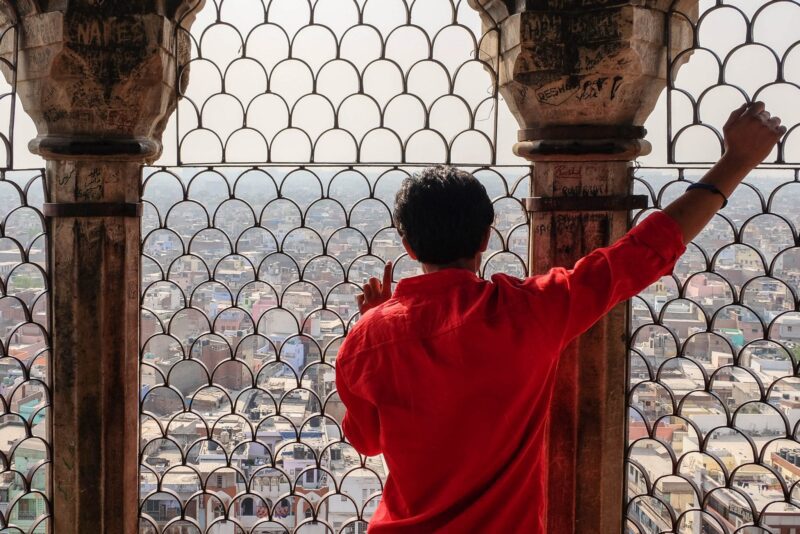
I decided that the best solution was to enlist some local knowledge courtesy of 23-year-old Delhi resident, Annie, a tour guide with Urban Adventures on their popular Delhi Street Food Walk. We meet at the bustling Vishwidhalaya Metro Station, north of the city’s old centre. Weaving through the crowd, Annie is easy to spot, hiding away in a quiet corner of the station sporting his bright red shirt. I’m surprised by our location, expecting labyrinthine streets and heaving chowks rather than the broad avenues and crumbling mansions, protected by wrought iron gates.

My fears were misplaced. Annie ushered us aboard a moto-rickshaw and within minutes we were whizzing away from the station in a plume of exhaust fumes and soot through the city’s expansive University campus towards the neighbourhood of Kamla Nagar. Annie seemed a little reserved at first, but within minutes of talking about street food, he had become animated and excitable. “I hope you’ve brought your appetite,” he quips “you’re going to need it.”
We hop off at the crossroads of two alleyways in the middle of Kamla Nagar, a sprawling grid of utilitarian apartment buildings, towering over dusty, dirt-covered streets. There’s a distinct smell of cow dung and sewage hovering in the air that does little to whet my appetite. However, I get the feeling that Annie is easing us in gently as we step inside our first eatery; a modern, but cosy, looking shawarma spot. Annie tells me that the area is popular with students from the local university, meaning that it is the perfect place to find cheap, delicious snacks. Our first dish didn’t disappoint. We’re served a mix of chicken shawarma and a vegetarian paneer option, both smothered in what Annie just refers to as green sauce. ‘You will find this sauce everywhere,” says Annie “Us Indians eat it with almost everything”. It’s a sharp, spicy mix of pureed green chillies, ginger and cumin. He’s right, it tastes wonderful on almost anything.

We wash it down with a cup of ice-cold fruit beer. As the drinking age in Delhi is set at 25, most of the students frequenting Kamla’s eateries rely on drinking this fruity iced tea rather than beer. I ask Annie what he thinks of the restrictions and he shrugs, “You can vote at 18, marry at 21, but you can’t drink until you’re 25. It’s strange.”
From here we walk towards one of Annie’s favourites, Momo’s Point, a spot on the alley-like Chattori Lane. We’re told that due to the current festival season, they’re only serving vegetarian options. Even without the meat, there is no shortage of choice,. There are dozens of momos listed; vegetable, panner, tandoori, masala, Afghani. Each of them coming in either steamed or fried. I scan the menu trying to decide but in the end, pass the burden on to Annie, letting him suggest his favourites.
Two dozen dumplings, smothered in chilli sauce are set down on the table in front of us. By this point, I’m realising why Annie enquired about my appetite. We’re just two dishes and half an hour into the tour and already my stomach is fit to burst.
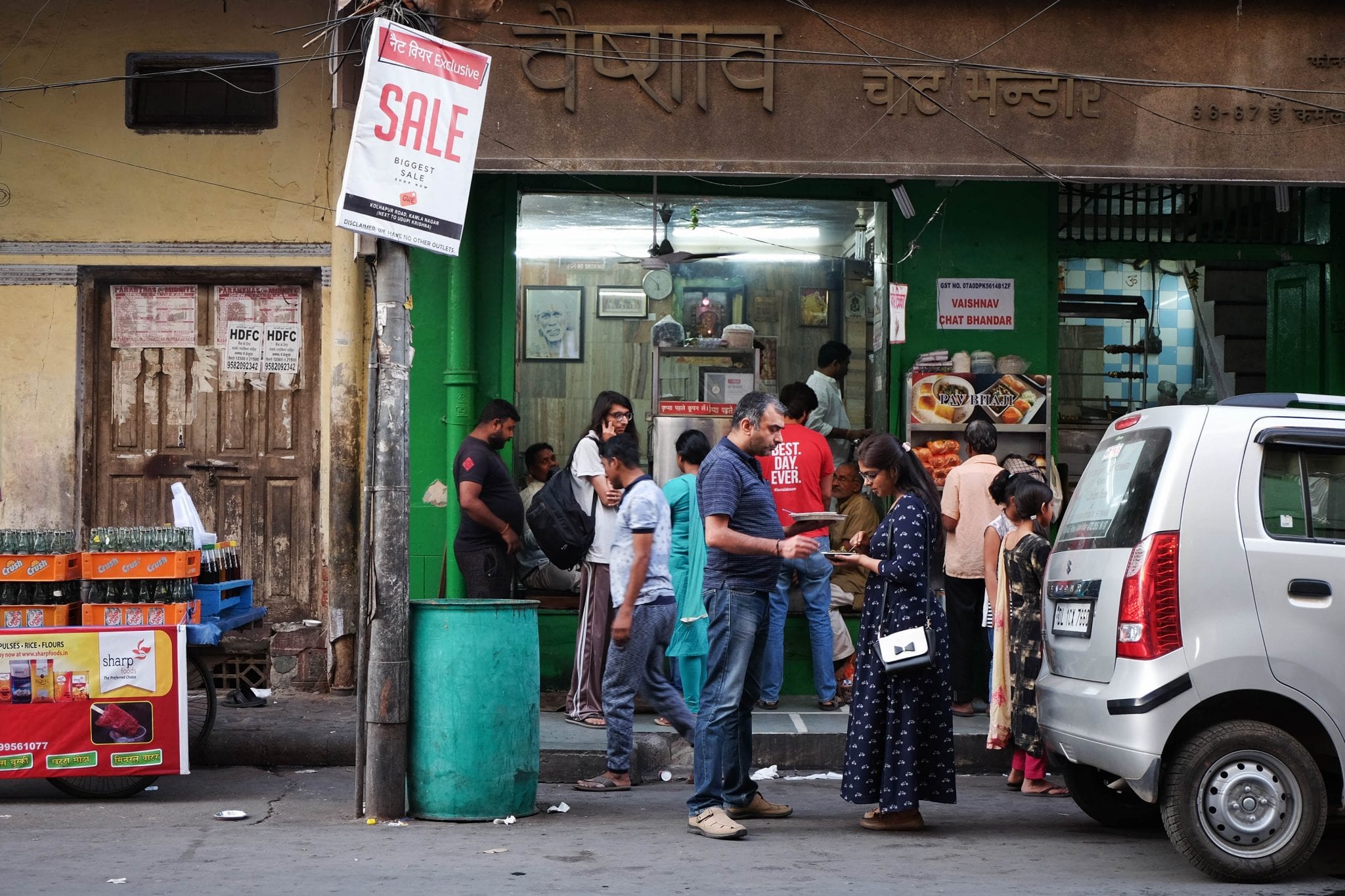
We emerge from the quiet backstreets into the heady mix of smog, traffic and clothes stalls that is Kamla Nagar Market, one of the city’s most popular shopping districts. By now it is approaching 5 pm and the streets are filled with people out on the hunt for post-work bargains and a bite to eat. Hawkers set up clothes stalls in the middle of confined thoroughfares as crowds of women gather around trying to get a look at their wares, there are food stalls dotted in every available inch of pavement or road with queues forming as the vendor rushes to dole out his meals to his hungry patrons.


At home, the term ‘street food’ has become synonymous with hipster, overpriced eateries. Places selling simple dishes for ten or 20 times what they would cost in their countries of origin. However, here in Delhi, it’s the cheap, convenient option. This heaving mass of 19 million people live on it. Street food fuels this metropolis.
One thing I have noticed during my time in Delhi is that many people live their lives in public, spending the balmy 40°C evenings outside rather than in a stuffy apartment. Eating is no exception. Every aspect of food production and preparation is on display for all to see. Stalls spill out of buildings and onto the street where people gather, often up to the roadside, leaving no space for walking. Most stalls are borderless, the queues blending into one another leaving you questioning where the person next to you bought their delicious-looking dish. Where there is no restaurant or cafe you will often find an enterprising cook, armed with just a hotplate and some pans, sliding a variety of battered or pastried vegetables into a pot of bubbling ghee and dishing it out small aluminium containers to customers that pull up alongside them. There isn’t a corner or cranny without an illuminated sign peddling some kind of cuisine.


The market is an assault on the senses, and the food choice can be overwhelming. As well as not knowing the names of the dishes on offer, It’s hard to tell what many of them are. Luckily, Annie makes a beeline for his favourites, ordering us a plate each of bhelpuri, a heap of puffed rice, vegetables and pomegranate seeds smothered in a tangy tamarind sauce. It’s light and sweet, offering a good contrast to the stodgy momos we had just eaten.

Without moving from the spot, Annie yells an order to the next stall along. Within seconds we have our fourth dish in front of us. Panipuri are fried, hollow balls of batter filled with pomegranate and sauce. “For this one, you have to put it in your mouth whole,” he says, leading by example and shoving the full squash ball sized treat into his mouth. I try to follow his lead but as soon as a bite down, the crispy outer shell explodes and covers half my face in sauce. He laughs. “I told you to be careful!”

Four dishes deep into my culinary exploration, dessert is the last thing on my mind, but we pass an ice cream and kulfi stand and Annie insists. Even though it is getting towards 6 pm, the temperatures were still well beyond 30 °C and the air is thick with humidity. My head felt slick with sweat and my clothes were beginning to cling to me. Maybe ice cream is a good choice after all. We watch as an aproned vendor crushes bags of ice on the ground and pours the shards into a huge metal drum. The drum is then spun as it is smothered in layers of cream, colourful sauces and topped once again with cream. The process is repeated until the cold, metal surface freezes the liquid into an icy treat.

While we waited for the freezing process to take hold, Annie disappears across the street, returning with yet another plateful of food. This time it was aloo chaat and poa bhaji. I realise that I’ve peaked too soon. I can barely look at it, my stomach bulging with curry and fried delicacies. It’s a stunning dish but all I can do is gradually pick at it until the cooling dessert is finished.
I feel a sense of relief as we head for our last stop, a small corner cafe filled with hungry students. The chefs stand on the roadside, frying a variety of morsels in huge vats of oil surrounded by gas canisters. As our swollen frames edge past them into the back of the cafe, I’m a little relieved for the tour to be ending. I wish I could carry on eating forever, but my body can’t take much more. However, Annie isn’t done with us yet. The final few dishes are placed in front of us; samosas, jalebi, rasmalai and kaju katali. I do my best to pick at them, trying not to be rude but I am well and truly full to the brim. I crunch on a few of the jalebi – sweet, orange strips of syrupy fried batter – for a sugar hit to push me out of my food coma, but it barely works


Feeling like an overinflated balloon, I emerge from the cafe even more bleary-eyed than when I began. Weaving my way back through the market, I feel so sated that even aromas of freshly bubbling chaat can’t tempt me. I feel that little more local and that, through Delhi’s food, I understand this crazy city a little better.
Although I couldn’t touch another bite, I’m hungry to experience more.
TOUR INFORMATION
To book the tour, visit the Urban Adventures Website
Local contact
Office phone number: +91 9717107864
Email address: [email protected]
Starting time: 4.00 PM
Duration: 3 hours
Meeting point: Vishwidhalaya Metro Station, Gate No. 4 (Yellow Line)
The tour costs €56 and includes a local English-speaking guide, rickshaw ride, entrance to Hindu temple + all food and drink.
India Essentials
When travelling, there are certain brands and resources that I always rely on when booking things like flights, accommodation and tours. Here are my recommendations.
Mobile Data and SIM Cards
Prepaid eSIM’s are a great way of accessing affordable data and staying connected while travelling. I use and recommend Airalo.
Booking Accommodation in India
When securing accommodation abroad, I almost always rely on Booking.com as they have everything from rental properties to homestays and luxury hotels.
Most cities in India also have a good range of hostels for the budget traveller and some of the country’s largest chains such as Moustache and Zostel have outposts here. I always use Hostelworld when booking my bed in hostel dorms.
Train Travel in India
Thanks to India’s extensive rail network, the country is best explored by train, however, booking rail tickets in India can be slightly confusing when using local booking services. The cheapest and easiest way of securing tickets is via 12GO, who allow you to search for journeys and book trains easily.
Tours in India
Many of India’s cities are vast, sprawling and chaotic, meaning that they are best seen with the help of a local guide. Whether you are planning an adventurous day trip or a delectable food tour, Get Your Guide and Viator have a huge number of options.

One Response
Yummy!! “Delhi Dil Walo Ki” Yes it is the best tagline to write about Delhi. Thanks for Sharing this Amazing Post! I Got Impressed With Your Writing Skills. I Must Say You Are An Incredible Writer Ever.