There’s something about Wroclaw that I can’t quite put my finger on. Despite constantly being overshadowed by Warsaw and overlooked by city breakers in favour of neighbouring Krakow or the northern city of Gdansk, Wroclaw has an undeniable appeal and is loved by almost everyone that visits. In a way, the city’s underdog status – despite being Poland’s 4th largest city – is probably its main strength, allowing it to surprise and charm those that underestimate its appeal.
Things are changing though. In recent years Wroclaw (pronounced vrots-wahf) has been awarded high profile accolades – it was crowned 2016 European Capital of Culture and Best European Destination in 2018 – that have put it firmly on the tourist map and attracted new investment, leaving the city feeling rejuvenated but without the tourist mobs of Kraków.


This is a city that is constantly reinventing itself. Since its inception almost 1000 years ago, it has consistently been traded between various kingdoms. For centuries, Wroclaw was the German city of Breslau, a name it kept until the end of WWII when it was handed over to Poland. The diverse influences can be seen in Wrocław’s architecture, with its gothic cathedrals, colourful Bohemian terraces and Baroque palaces. Nowadays, thanks to its 40,000 strong student population, Wroclaw has an energetic and youthful vibe with a healthy nightlife scene and a cultural footprint that punches way above its weight.
I would consider Wroclaw the perfect short city break destination. The compact old town, with its stunning, cobbled market square – the Rynek – and avenues lined with pastel-coloured houses, is perfectly walkable and the city’s foodie scene is booming thanks to the large, youthful population. Wroclaw is quaint, quirky and certainly cool. Here are the best things to do in the city.

The Best Things to do in Wrocław
1. Go Hunting for Wroclaw’s Mischievous Dwarves.
2. Shop for Local Delicacies at Hala Targowa
3. Gawp at the Expansive Panorama of the Battle of Racławice
4. Get a Bird’s Eye View of the Old Town
5. Stalk the City’s Lamplighter around Ostrów Tumski
6. Bathe in Colour at the Neon Side Gallery
7. Marvel at the Baroque Stylings of Wrocław University
8. Sample Communist-Era Cuisine at a Milk Bar
9. Explore the Experimental WuWA District
10. Step Back in time at Setka Bar
Go Hunting for Wroclaw’s Mischievous Dwarves
Wander around Wroclaw for any amount of time and you will be sure to stumble upon a rather bizarre sight. There are tiny bronze statues of dwarves everywhere. In the city centre this legion of little people, known locally as Krasnale, are ubiquitous. You are just as likely to stub your toe and trip over one as you are to spy one relaxing on a window ledge. They clamber up lampposts, peek from alleyways and even pass out in a drunken stupor on the streets.
While these statues appear to just be a cute and slightly twee gimmick to attract tourists, they actually have a deeper meaning that harks back to a darker period in recent Polish history.
The statues are a nod to the Orange Alternative, an anti-Soviet movement that used absurdity to stage peaceful and subversive protests in an attempt to undermine Poland’s communist government. Led by art student Waldemar ‘Major’ Fydrych, the group claimed the dwarf as its symbol, painting surrealist images – usually of a dwarf or gnome – over communist propaganda in an attempt to fight the oppressive regime’s censorship of free speech and public gatherings. The idea was to “show how absurd the situation was and encourage people not to be afraid.”

Following the fall of communism, the dwarves became a symbol of Wroclaw, repurposed as a tribute to the Orange Alternative protesters. The first statue to honour the anti-communist movement, known as Papa Krasnal, was unveiled in 2001 on the corner of ul. Świdnicka and ul. Kazimierza Wielkiego, the spot where many of the Orange Alternative’s protests took place.
In 2005, Local artist Tomasz Moczek was commissioned by the council to create 5 more characters; the Odra-Washer-Dwarf near Piaskowy Bridge, a hatchet-wielding butcher outside the old medieval slaughterhouse, a fencer, and two of the little guys pushing a large boulder in opposite directions on Świdnicka Street. The figurines proved so popular that soon local businesses were commissioning artists to produce more. Before long, there was a gnome population explosion.
So far, Tomasz has created over 100 dwarves for local charities, shops, and organisations. While the official figure stands at 163, it is thought that over 400 of these little blighters are running rampant around the city.
Wroclaw’s smallest residents have become so popular with visiting tourists that the official tourist office has created an official website where you can get to know them better, read their backstories and find out about their unique personalities. There is even a map available that takes you on a fantastical gnome hunt as you explore the city.
Read More: Hunting For Krasnale
Shop for Local Delicacies at Hala Targowa
Spread across two floors and containing 190 stores, Hala Targowa – Wroclaw’s Market Hall – was constructed between 1905 and 1908 by Richard Plüddemann and Heinrich Küster, with Küster deciding on the (at the time) innovative concept of using reinforced concrete to build the Hall. Despite looking fairly mundane from the outside, the hall’s stunning interior stands out due to the towering concrete arches that line the main thoroughfare, giving it a cathedral-esque appearance.
As well as being architecturally fascinating, Hala Targowa is worth a visit for both foodies and people-watchers too. On the main floor, you will find market traders drumming up trade from behind their fruit and vegetable stalls and a wondrous array of deli products such as cheese, meats and preserves. More recently, the hall has aimed to cater to tourists as well as grocery shoppers, with coffee shops, restaurants and bars all opening within the market. Targowa, in Hala Targowa’s cellar, is the best of the bunch, offering an extensive craft beer menu and good pub grub.
Gawp at the Expansive Panorama of the Battle of Racławice
Depicting the battle for Polish Independence fought against the Russians at Racławice – a village near Kraków – in 1784, this magnificent 120m long and 15m high painting was commissioned to celebrate the battle’s and was undertaken by Jan Styka, a painter from Lviv, who worked alongside Wojciech Kossak, Tadeusz Popiel, Teodor Axentowicz, Włodzimierz Tetmajer to complete it over the course of 9 months.
Thankfully, the painting survived WWII but remained in storage in Wroclaw for political reasons. As it depicted a Russian defeat, Poland’s communist leaders refused to display it and it remained hidden from the public until 1985.

Nowadays, the Panorama is the pride of Wroclaw, displayed in a purpose-built rotunda where it wraps around the entirety of the circular interior. Visitors are led around the rotunda by an audio guide that provides an audio commentary with a history of the painting and information about the events represented in this incredibly impressive work.
If this giant painting doesn’t satisfy your hunger for art, the nearby National Museum – housed in a beautiful building on Powstańców Warszawy Square – is brimming with fine art across its permanent exhibitions. Two of the collections are dedicated to medieval art – Silesian Stone Sculpture on the ground floor and Silesian Art of 14-16th centuries on the first floor – while a further two on the 2nd floor are dedicated to more recent work.
Get a Bird’s Eye View of the Old Town
In my opinion, there’s no better way to gather your bearings in a city than to stand high above it and surveying the streets below. Thankfully, the 91m tall tower of St. Elizabeth’s Church gives you the perfect opportunity to get a bird’s eye view of Wroclaw’s old town. Just be warned, the climb up the 300 thigh-straining steps of the winding tower stairwell is arduous. The gothic church itself is impressive if a little unlucky. It has been destroyed 3 times since its 14th-century construction: first by a hail storm in 1529, then by bombing in WWII, and finally, it was the victim of a fire in 1976.
For a slightly different viewpoint, head to the nearby St. Mary Magdalene’s Church and climb its two stunted towers whose cupolas were never replaced after WWII. One thrilling feature is the open-air ‘Penitents’ Bridge’ that spans the distance between the towers, 46m above ground.

Stalk the City’s Lamplighter around Ostrów Tumski
On an island surrounded by the Oder River, Ostrów Tumski – known locally as ‘Cathedral Island’ due to it being home to several Baroque palaces and the vast Cathedral of St John the Baptist – is not only Wroclaw’s most picturesque neighbourhood, it is also the most historically significant as it is here that the city was founded.
The area keeps much of its old-world appeal: the Botanical Garden is a peaceful refuge from the busy city centre and the quaint cobbled streets, still lit by antiquated gas lamps, provide the perfect setting for an evening stroll, especially if you make your way across the Tumski Bridge, a popular meeting spot for couples in love.
Gas street lamps were common in Wroclaw from their first use in the 1840s until 1960, when many of the lamps in the old town were replaced by electric lights. In the past, the lamplighter would be responsible for walking the city streets each evening igniting a city’s street lamps and then extinguishing them again at dawn. Thankfully, Ostrów Tumski managed to avoid modernisation, allowing the Wrocław lamplighter to carry on plying his trade. Keep your eyes peeled as you wander around the island at dusk, looking out for a man wearing a top hat and dark cape lighting the 103 gas lamps in the district.
Bathe in Colour at the Neon Side Gallery
Hidden away in a courtyard in a courtyard between ul. Ruska and ul. Antoniego accessible from either end through two small alleyways, this wonderful collection of Soviet-era neon signage is one of Wroclaw’s finest hidden gems.
The majority of the signs were salvaged by Tomasz Kosmalski and his Neon Side Foundation, who was dismayed by the disappearance of these once ubiquitous glowing logos and set about preserving them for future generations. The initiative started in 2005 when Tomasz purchased his first sign – the name of an old confectioner on Nowowiejska Street – and has expanded to a collection of 30 neon signs from various companies, brands, bars and cinemas, many of which are now defunct.
In a way, the location of this outdoor gallery is a beautiful example of history coming full-circle as Ruska 46c is the former address of the old Reklama company, which produced neon signs to be displayed all over Wroclaw.
The Neon Side Gallery is a public space and free to enter, so make sure you stop by on an evening to bath in its neon glow.

Marvel at the Baroque Stylings of Wrocław University
Wroclaw is very much a student city and a little north of the town’s market square is the bustling university quarter, a historic district brimming with cheap bars and cafes, wonderful architecture and cute bookshops.
The university itself was founded in 1670 by Jesuits, with both the magnificent Baroque main building and the adjacent Church of the Blessed Name of Jesus built at the same time on the former site of a Piast castle after a land grant from Emperor Leopold. In the 20th Century, the University has produced a whopping nine Nobel Prize winners and boasts both Robert Bunsen and Alois Alzheimer as former professors.
Although the huge Collegium Maximum is a functioning teaching space, visitors and tourists can enter to wander around the Museum of the University of Wrocław and view its extravagant Baroque interiors, including the jewel in the museums crown: Aula Leopoldina’ (Leopoldin Hall).
While the majority of the exhibitions in the university’s main Baroque building aren’t of much interest, the 42m high Mathematical Tower- an old astronomic observatory dating back to 1791 offers 360-degree views across the old town and Ostrów Tumski.

Sample Communist-Era Cuisine at a Milk Bar
Milk bars, or bar mleczny in Polish, may seem like a communist throwback and in some ways, they are. These government subsidised canteens serve hearty, traditional cuisine and blossomed during the post-war period as one of the few places that could guarantee a hot, nutritious meal – usually meat and potatoes, soups, vegetables, pierogi and as the name suggests, dairy.
Although not much has changed for them in terms of food, decor or service, their cheap, homely meals are still popular today. For tourists, they’re a perfect place to taste old-fashioned Polish food and get a feel for what the country was like before the iron curtain fell. For others, they’re a place to get a nostalgia fix or substantial home-cooked dish. I love milk bars. For just a few złoty it is possible to eat like a king.
In Wroclaw, I recommend stopping for lunch at Jacek i Agatka, located just outside of the old town between the main square and the Oder. Be warned that service in most milk bars is notoriously surly and English isn’t often spoken, so you may need to rely on a badly translated menu or perfect your pronunciation of certain local dishes.
Where: Jacek i Agatka Bar, pl. Nowy Targ 27
When: Mon-Fri: 8 am – 6 pm. Sat: 9 am – 5 pm.
Read More: Where to Eat, Drink & Brunch in Wroclaw

Explore the Experimental WuWA District
This is possibly one that will only appeal to the most ardent architecture enthusiasts, but the experimental neighbourhood of WuWA, located just past the Centennial Hall on the city outskirts is considered one of Europe’s most interesting modernist districts.
One of six model housing estates built by the Deutscher Werkbund in 1929 as part of the Living and Work Space Exhibition (Wohnung und Werkraum Ausstellung) uniting architects, artists, craftsmen and industrialists, WuWA was completed in just 3 months and was an attempt to showcase cheaper, more efficient building methods. 11 Silesian architects were involved in the projects, creating 32 buildings designed for a variety of purposes; model single-family houses, semi-detached and terrace houses, multifamily houses, a hostel and even nursery school.
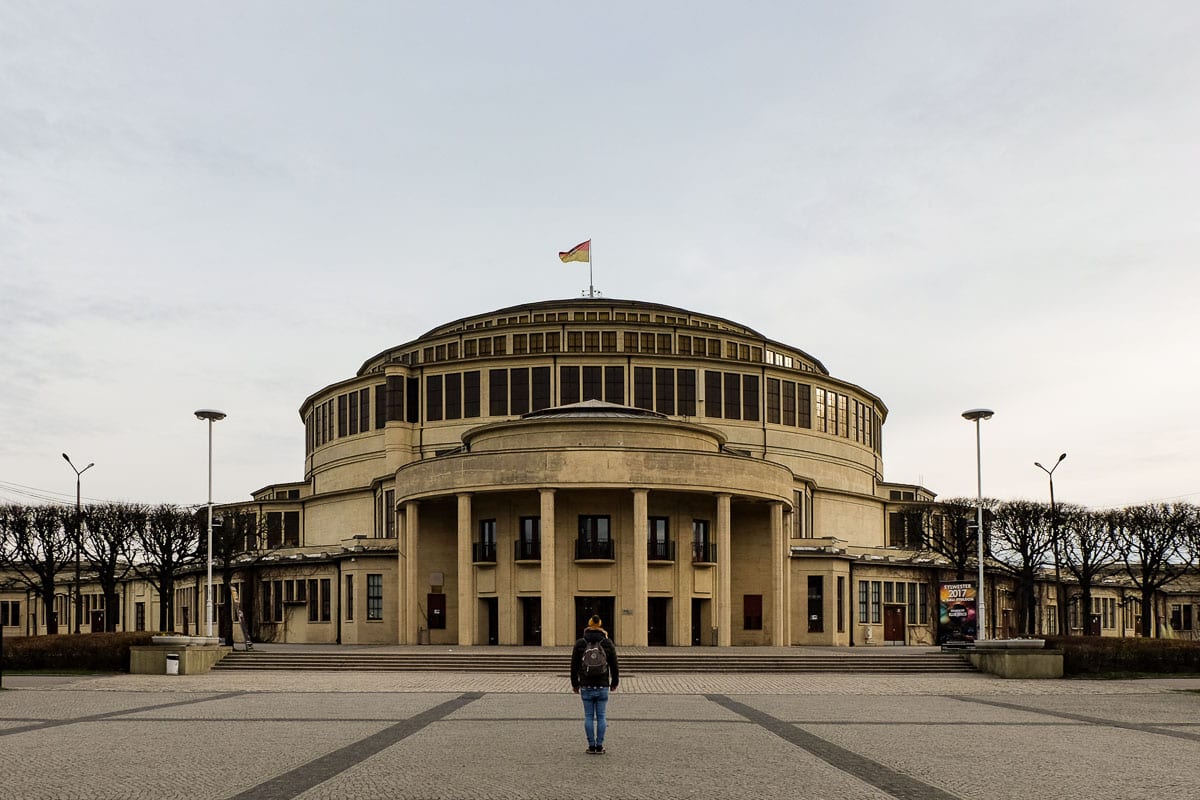
If the thought of exploring WuWA doesn’t appeal to you, the nearby Centennial Hall may be a little more interesting. This monumental building – Wrocław’s only UNESCO site – was opened in 1913 on the 100th anniversary of the Battle of Leipzig when Wrocław was chosen to host the Centennial Exhibition. Max Berg, the then city architect, had his design for a massive
Max Berg, the then city architect, was chosen to build the massive exhibition hall over 41 competing designs despite many objections to his plans. At the time, building a structure of such size out of steel and reinforced concrete was revolutionary but also considered foolish, with many people remarking that the structure would not be safe. However, this 42m high hall topped with a 65m diameter dome has managed to survive both world wars and is now considered one of the greatest architectonic achievements of the 20th century.
Step Back in time at Setka Bar
Wroclaw has no shortage of hip and stylish bars, rustic brewpubs or fancy cocktail spots in the bustling nightlife zone around Ulica Ruska. There is even a burgeoning craft beer scene lead by the brewmasters of places like Stu Mostów.
However, if you’re looking for a night out that is more a novelty blast from the past than one surrounded by beard-stroking beer snobs, Setka is the place for you. With a name that comes from the Polish word for a 100ml shot of hard liquor, Setka styles itself as a bar from the days of the People’s Republic of Poland and although the communist-era may not evoke memories of fun and colour, particularly as it is still so fresh in the minds of many Polish people, Setka is a colourful and rowdy drinking den that is worth stopping off at, even just to drink in the gaudiness rather than drink a pint of the average beer.

Bonus: Visit the Christmas Market
Come December, Christmas Markets are ubiquitous across Europe, with almost every major town or city giving its own take on the log cabin and mulled wine style markets that draw crowds of tourists and locals alike. Much of the time, these are themed as German Christkindlmarkts, selling typical German foods with German-sounding names above each of the stalls. After a December trip to Wroclaw, found that the city really knows how to put together a German-style Christmas extravaganza. After all, it was a German city itself until the end of the Second World War.
Wroclaw’s Market occupies much of the old town, where odours of cinnamon, fruits and baked treats mixed with the aroma of smokey barbeques crackling with sausages, all in the glorious setting of the city’s Rynek and its surrounding buildings; rows of pastel shades and Austrian bohemia, like an architectural rainbow wrapping itself around the festivities.
Jarmark Bożonarodzeniowych isn’t just confined to the main square. It spreads itself down Oławska and Świdnicka Streets where stalls brim with trinkets and souvenirs, all the way to Plac Nowy Targ where a neon tree and giant glowing presents jarringly sit in the centre of the grey, communist-era apartment buildings. In Plac Solny the cabins spread themselves among the 24-hour flower stalls.
The celebrations even find themselves stretching as far away as the Oder, where the Tumski Bridge, famed for its thousands of ‘love locks’, becomes a show in itself, emblazoned with illuminated love hearts at night. For it is the night-time that the market really comes alive. As the sun sets, it seems that all of Wroclaw descends on the Old Town to gather beneath the market’s towering, spinning propellor.

Where to Stay in Wroclaw
Hostels with cheap dorm beds can be a little hard to come by in Wroclaw but the city’s extravagant architecture means allowed grand old hotels to proliferate in the old town and places like the Monopol and MGallery are carrying on that tradition. There are dozens of good, mid-range options outside of the old town and thanks to the influx of visitors that are opting for weekend trips to Wroclaw in recent years, the Airbnb and apartment rental scene is booming.
Boogie Hostel
A mainstay on Wroclaw’s backpacking scene since 2008, Boogie own a number of properties around the city but their hostel in the old town is the best option for backpackers. Although dorm spaces are limited in favour of private rooms, the hostel exudes style and is a must-stay for the budget-conscious.
Ibis Styles
You know what you’re getting with the Ibis brand and their ‘Styles’ offshoot, with its more thoughtful design and bold stylings, are always a good option when looking for accommodation. The Wroclaw hotel is located directly across from Wrocław Główny, adding to the convenience.
The Bridge MGallery
With a name that gives a nod towards Wrocław’s status as ‘the city of one hundred bridges’, the luxurious and elegantBridge Wrocław MGallery Hotel is situated on the city’s beautiful and peaceful Ostrów Tumski island and boasts a gym, spa and bike rental service.
Getting to Wroclaw
Copernicus Airport is located in the south-west part of Wrocław, about 10 km away from the city centre. The No. 106 bus leaves the airport for Wroclaw Central Railway Station every 15 minutes and takes approximately 40 minutes.
The lavish railway station, built in 1857 to much acclaim, is worth visiting in itself but has good transport links to the rest of the country and is just a short walk from Wroclaw’s old town.