Sri Lanka is a country of such resplendent beauty, one that is famed for its sacred temples, golden beaches, and verdant tropical forests where elephants and leopards wander, that it is hard for me to pin down one characteristic or attribute that defines the nation’s image. However, somewhere deep down, I suspect that it’s Sri Lanka’s hill country that holds the most appeal. It provides the greatest pull; It’s a place where sprawling colonial manor houses perch on hillsides; where blue trains climb slowly along picturesquely placed tracks, bumping and grinding their way through plantations and past waterfalls; and where heart-stopping views are a dime a dozen.

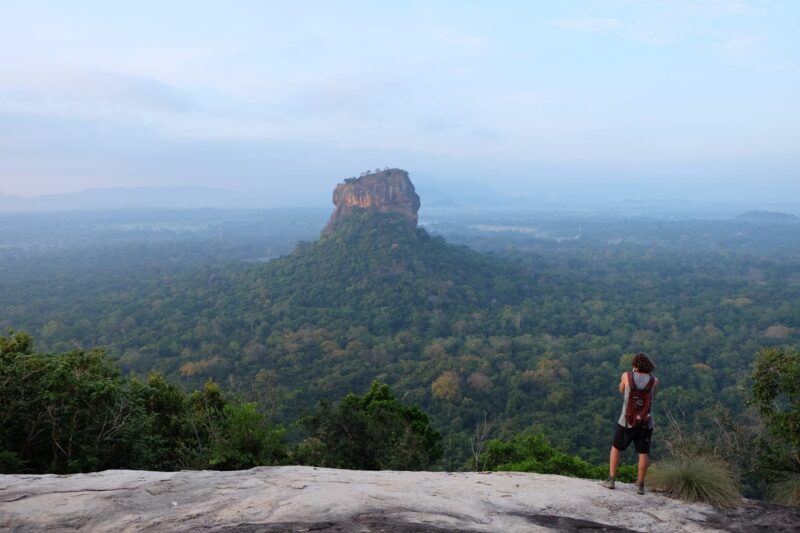
It’s from my vantage point at the peak of Alugolla Hill that I’m reminded why I hold this region of the nation in such high regard. Standing at the base of a half-finished Buddha statue – its exposed brick and cement body already dozens of metres tall despite it still waiting for its head and pristine white rendering to be applied – the whole of Uva Province unfolds below me. To the east, the imposing outline of Pidurutalagala, Sri Lanka’s tallest mountain, occasionally appears from beneath its shifting cloud cover while to the south, the land slopes downwards, its gradient gradually levelling until it reaches the southern coast where the beaches of Tangalle and Yala meet the glittering Indian Ocean. A blanket of perfectly manicured tea bushes covers the hills to the north, gradually giving way to great plains where parades of elephants roam the grasslands and forest in search of the great tanks built by the reservoir kings of centuries past.
Today, however, the serenity of this hilltop sanctuary is somewhat disturbed by a media circus. Groups of journalists and camera crews mill around, thrusting their microphones at anybody willing to give them a quick soundbite. Military officials stand stoically in their sharply pressed uniforms with their hands clasped behind their backs. Soldiers hang around chatting in their jungle fatigues beside freshly polished military jeeps. There are local dignitaries, representatives of Sri Lanka Tourism, and a group of giggling schoolchildren dressed in their white shirts and Ghurka shorts.

On the hillside are dozens of mounds of soil and freshly dug holes, beside each one is a small sapling – eucalyptus, pine or fruit tree – all waiting to be planted. The tree-planting initiative, one operated by the Badulla Buddhist Society, is an effort to quell ongoing damage from climate change and create awareness in the local community for the need for greater environmental protections in and around Uva province.
“The entire cosmos is a cooperative. The sun, the moon, and the stars live together as a cooperative. The same is true for humans and animals, trees, and the Earth. When we realize that the world is a mutual, interdependent, cooperative enterprise — then we can build a noble environment. If our lives are not based on this truth, then we shall perish.”
Buddhadasa


For a number of years now, tree planting has been the zeitgeist. Major corporations promise to plant trees by the billions as a way to persuade customers of their green credentials while NGOs and world governments now consider it a legitimate way of tackling the climate crisis, at least in part. In July 2019, Ethiopia made the headlines by planting over 350 million trees in just one day while New Zealand launched a target of a billion by 2027. Pakistan met that target as early as 2017 and have since decided to set their sights on planting 10 billion.
In a world where travellers are becoming more ethically conscious and aware of their carbon footprint, offsetting seems to be a viable alternative to stopping flying. It’s a climate change solution that doesn’t require scientists to come up with technological solutions to draw carbon dioxide out of the atmosphere, it‘s available now, and it is easy for everyone to get involved.

As travellers, being environmentally conscious is important. We travel to countries, use resources, possibly contribute to damaging the local environment and leave behind an enormous carbon footprint. I am very much of the mindset that travel is about reciprocity, it’s an exchange: People are welcoming you to their country and ideally, you should be able to offer something in return. In a country with as much natural beauty as Sri Lanka, it’s important to keep the balance between tourism and preservation. This is where tree planting helps.
It is a solution that works in many different ways. Tree’s and vegetation are such important life-givers: They reduce soil erosion and flood risk, provide vital habitat, improve air quality by absorbing carbon dioxide from the atmosphere, storing it in their trunks, branches and roots, before releasing oxygen back into the air.
Sri Lanka is no stranger to the climate emergency and in Uva province, it is becoming a major issue. Warming has caused an increase in fires destroying natural habitat and greater rainfall has led to soil erosion at a previously unseen scale. It’s hoped that this programme of planting will help mitigrate the issue.


I watch as the soldiers and school children, part of Parisara Niyamuwo’s Environmental Society that aims to create awareness of environmental protection for the next generation, work their way up and down the hillside, carefully planting, filling the holes with soil and then conscientiously watering their new saplings. Altogether, 200 new trees are sown on Alugolla Hill before we move our focus closer to town at a patch of empty wasteland on a riverbank. For the moment, this is just derelict land, an area of dirt and dust beside the town, but as we slowly work our way around the plot, placing trees in the ground, the vision of the Badulla Buddhist society begins to take shape: creating a new wooded area that will provide vital habitat and stop the river cutting through the land.
We reflect on our work while all squeezed into the living room of a local family, sipping tea and taking bites from plump, filling-stuffed samosas. It’s strange to think that it may take decades for the work we have completed to show results, for the trees to reach maturity but in a way, tree planting is an act of faith. It is not a quick fix, but the hope is that I can return to Badulla in a decade and walk through a woodland that we created, seeing the fruits of what we did here today.

MORE INFORMATION
The tree-planting project is hoping to increase their activities and plant over 1000 trees within selected areas around Badulla. If you would like to take part in this project or a similar one in a different region, get in touch with the Sri Lanka Tourism who will be more than happy to help facilitate you.
Where to Stay
There are no shortage of accomodation options in Badulla and the neighbouring towns but of them all, the time-warped Bandarawela Hotel in Bandarawela is the most unique. The Bandarawela began life as a planter’s clubhouse 1893 and still sits atop a long and winding driveway at the entrance to the town like a rambling wooden reminder of the past.
It’s been over 90 years since the owners stopped updating the décor and furniture, meaning that the hotel is a veritable time capsule – you half expect to see a group of men in pith hats and Gurka shorts to come rambling through the lobby, elephant guns in hand – with wrought iron beds, polished wooden floors and faded sepia photographs adorning the walls. It certainly is unique and the perfect place to stay if you have even a passing interest in the area’s colonial history.

This post contains affiliate links. By clicking a link and making a purchase, I may receive a small commission at no extra cost to you.