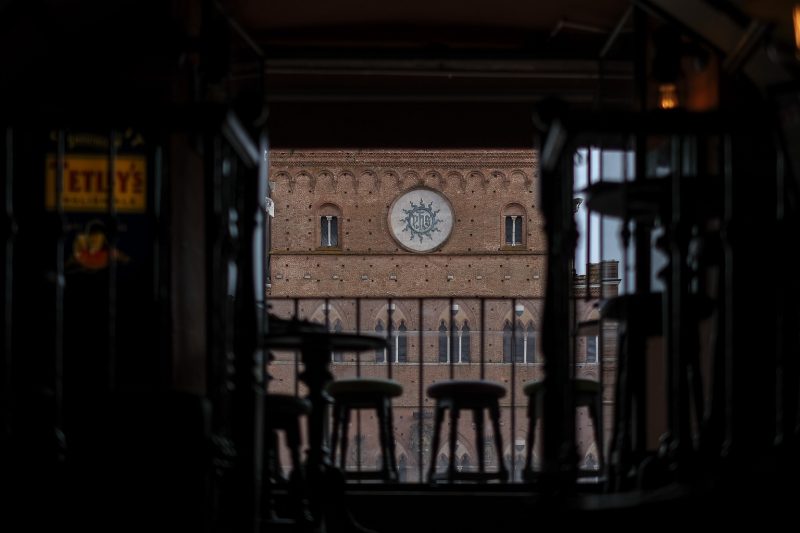
On the terrace outside of a cafe on the edge of Piazza dei Priori, I cradle a small porcelain cup of espresso, waiting for it to cool in my hands, a warm pastry dusted with sugar resting on the table. The stone beneath my feet still holds the night’s chill, despite the sun beginning to rear above the buildings and dabble the paving slabs in large swathes of sunlight. Right now, the square, so often described as one of Tuscany’s finest, feels almost too large for the hour. There are only a handful of people moving through it, or sitting along its perimeter; someone noisily raising a set of shutters to unlock a shop door, a couple crossing quietly toward a side street, the faint clink of cups from behind the counter inside.
It’s an impressive place to begin your morning. The buildings rise in muted tones of grey dusty brown, their stone facades worn by the centuries. While the buildings are magnificent, nothing here feels ornamental. The Palazzo dei Priori stands firm and unembellished, its tower cutting into a pale sky, casting long shadows that stretch across the square. It’s not difficult to imagine this place as it once was: a place of firm civic debate, merchants arriving from the countryside to sell their wares, and officials moving through the space with the same sense of purpose as the camera-toting tourists have today.


By the time this square began to take shape in the 13th century, Volterra was already ancient. It had passed from Etruscan control into the Roman Republic, later becoming a municipium under the Empire, before enduring centuries of shifting power during the early medieval period. By the High Middle Ages, it had emerged as an independent commune, wealthy from agriculture, trade, and its prized alabaster, before eventually falling under the influence of Florence in the 15th century. The piazza, and the palazzo that dominates it, were symbols of that civic identity. These were assertions of power, permanence, and order in an often unstable world.
I finish my coffee and set the cup down, realising how little has changed.
One of my favourite things about Volterra is that it takes a little bit of time to get under its skin. Unlike other Tuscan towns that present their beauty immediately for all to see, you really need to put in the time on foot here, layer by layer, street by street. Even from this central piazza, there’s an innate feeling that something older and more intriguing lies just beyond the edges.

Leaving the café, I follow one of the narrow streets that juts away from the square, the sound of my footsteps echoing lightly off the ground and bouncing against stone walls. Within a few turns, the openness of the piazza gives way to a network of tighter lanes, thin passages, and worn archways that make feel every street feel almost entirely enclosed. Window boxes bloom with flowers, laundry hangs between buildings and the occasional window is thrown open. Somewhere, unseen, a radio plays softly.
Almost without warning, the street opens up and I find myself stood before one of Volterra’s ancient thresholds: the Porta all’Arco.
It stands modestly, considering its age. Blocks of stone set in place over two thousand years ago, long before the Romans arrived, and even longer before the medieval walls enclosed the town as it is today. The gate dates to the 4th century BC, when Volterra was one of the principal cities of the Etruscan League, a network of powerful city-states that dominated central Italy. These walls once enclosed a much larger settlement, evidence of the city’s importance long before Rome’s expansion. Three carved heads watch from above the arch, their expressions weathered and fading but still there if you look hard enough. Passing beneath it feels significant, even if you can’t quite explain why.

Beyond the gate, the landscape stretches outward in soft, rolling lines. The hills are pale in the morning light, their contours fading into the distance and blending with the dawn mist that still hangs over the ground. It’s easy to understand why the Etruscans chose this place. It’s high, defensible, and connected to the land in every direction. They called it Velathri, one of their most important cities, a centre of trade and power long before Florence or Siena rose to prominence.
When the Romans absorbed Volterra in the 3rd century BC, they built upon this foundation rather than entirely replacing it. The city managed to retain a degree of status, with its position and resources ensuring its continued relevance within the expanding Roman world.
However, although modern Volterra plays on its Etruscan heritage much of what defines the town today came later. The Romans left their mark, most visibly in the Roman Theatre that’s carved into the hillside just below the town. Standing above it, looking down at its curved rows of stone seating, it’s difficult not to imagine the lives that once unfolded there. There would be performances, plays, and political gatherings that tell the story of a very different city to the one I just walked through.


Back inside the walls, the medieval city takes over again. The streets climb and dip unpredictably, leading you past workshops where alabaster is still shaped by hand, just as it has been since Etruscan times. The stone itself seems interwoven with Volterra’s personality, glowing faintly in shop windows, catching the light in unexpected ways.
During the Middle Ages, this tradition became one of Volterra’s defining industries, with its alabaster exported all across Europe. Even as political control shifted, from local bishops to Florentine rule, the craftsmen endured, tying the town’s identity as much to its artisans as to its rulers.
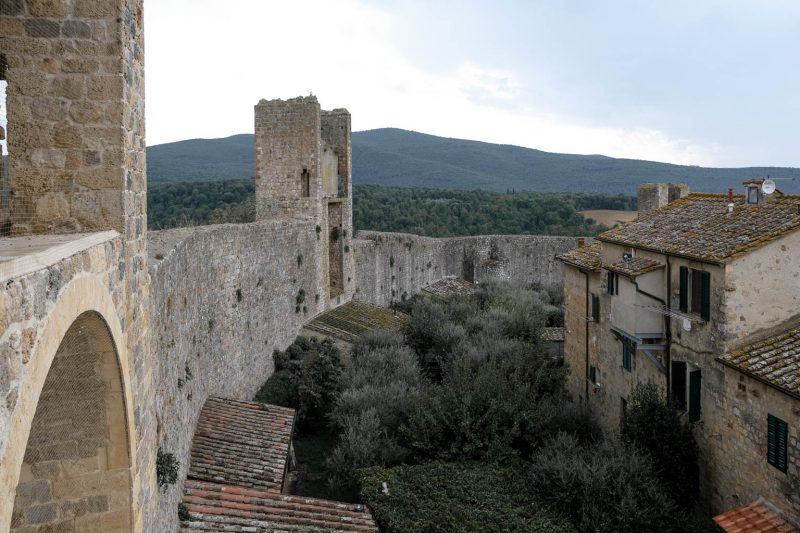
Every so often, you find yourself on the towns edges, where it offers a view: Occasionally, a gap in the walls, followed by a sudden drop in elevation, reveals the countryside. These moments feel almost accidental, as though you’ve stumbled into them, but this is one of the joys of Volterra and its location. The walls themselves, rebuilt and reinforced over centuries, trace the outline of a town that has continually adapted, shrinking and expanding with the tides of history.


By the time I find my way back toward the centre, the square has begun to fill. The stillness of the morning has somehow given way to something much livelier. People point their cameras at the buildings and cafe chairs scrape gently against stone. The volume of voices rise and fall. The town, it seems, is fully awake.
But even now, there’s a sense that much of Volterra remains just out of reach. It’s not hidden, exactly, but not immediately given either. Unlike Tuscany’s more popular destinations, this is a town that requires you to wander its streets at your own pace, even to look a little closer, to unravel what makes it tick.Eventually, you will realise that the real question isn’t what there is to see here, but how deeply you’re willing to look.
And that’s perhaps its greatest appeal.
Where is Volterra?
Perched high in the rolling hills of western Tuscany, Volterra sits in a dramatic position between the valleys of the Cecina and Era rivers, with its honey-coloured walls rising above rolling fields, cypress-lined ridges and a sun-scorched landscape. It sits within the province of Pisa, yet feels quite far removed from its tourist-packed streets and the well-trodden sightseeing circuit that defines much of the area.

Despite being less visited than some of the other nearby towns, Volterra is surprisingly well placed for exploring Tuscany. It lies roughly 90 minutes by car from Florence, just over an hour from Pisa, and around 1 hour 30 minutes from Siena. The famously photogenic towers of San Gimignano are only a 40-minute drive away, making Volterra a perfect base for a wider Tuscan itinerary.
However, what truly defines Volterra’s location is not its proximity to major cities, but it’s sense of isolation. Unlike many of Tuscany’s major hotspots, the town is not served by a direct train, and reaching it requires either a car or a combination of rail and bus. This slight inconvenience means that it is off the main tourist trail and has helped preserve its character. Volterra has fewer crowds, and although it is still touristic, there is still an authenticity that can feel increasingly rare elsewhere in the region.
How to Get to Volterra
There is a bit of planning needed to reach Volterra when compared to some of Tuscany’s larger cities, but that extra step is part of what has preserved its quiet charm. Perched high on a hill and surrounded by rolling countryside, the town is not directly served by major rail lines, so most journeys involve at least one change or a final stretch by road.
There is a bit of planning needed to reach Volterra when compared to some of Tuscany’s larger cities, but that extra step is part of what has preserved its quiet charm. Perched high on a hill and surrounded by rolling countryside, the town is not directly served by major rail lines, so most journeys involve at least one change or a final stretch by road.
If you’re travelling form abroad, Pisa’s Galileo Galilei is the nearest airport, just over an hour’s drive from Volterra, and often the most convenient option for international and low-cost flights, particularly from the UK. From here you can hire a car directly at the airport or connect onward by train and bus.
Florence Airport, officially known as Amerigo Vespucci Airport, is a little further away. The journey takes around 90 minutes by car, however, it offers a wider range of airlines and international routes. It’s a good choice if you’re planning a broader Tuscan itinerary that includes time in Florence itself.
When looking at other options for my trip, Bologna Airport was also a possibility. It serves as a major international hub with excellent rail connections into Tuscany. From Bologna, you can take a high-speed train to Florence or Pisa before continuing on to Volterra.
By Train and Bus
Unfortunately, Volterra doesn’t have its own train station. However, it is still possible to reach it using public transport. The nearest station is Saline di Volterra, located on the Pisa–Florence rail line. From there, a local bus climbs up to the town in a journey that takes around 30 minutes but feels much longer as it snakes through the hills.
Alternatively, you can take a train to Pontedera or Colle di Val d’Elsa and continue by bus. Connections can be infrequent and require careful timing, so it’s worth checking schedules in advance.
By Guided Tour or Transfer
If you’re short on time, reluctant to take public transport or navigate rural roads yourself, then guided tours are a good way to squeeze in a lot of sights in a stress-free way. Many tours from Florence or Pisa combine Volterra with stops in nearby towns, often including San Gimignano. It’s incredibly convenient, but be aware that it can limit how much time you have to explore Volterra itself, so it’s only best if you’re on a tight schedule.
By Car
When travelling in Tuscany, I would always recommend hiring a car and self-driving. Driving to Volterra is not only the most practical choice, but also the most scenic. This is Tuscany at its most cinematic; rolling hills, cypress-lined drives, and long, golden horizons. Having your own car allows you to experience it fully, hanging around in whatever place takes your fancy and being able to take any diversion that appeals to you, rather than rushing between connections.
From Pisa, the journey takes around 1 hour 15 minutes. The most straightforward route follows the SS68, a winding but well-maintained road that cuts inland from the coast through woodland and open countryside before climbing steadily towards Volterra. It’s an easy drive by Tuscan standards.
From Florence, allow around 1 hour 30 minutes to 2 hours depending on traffic and your chosen route. The quickest option is to take the FI-PI-LI (Firenze–Pisa–Livorno) dual carriageway west towards Pisa, exiting at Pontedera or Ponsacco, then joining the SS68 for the final stretch. As it is mostly along major roads, it’s much less scenic, though the landscape improves dramatically as you leave the main road and head towards Volterra.
For a more leisurely and picturesque drive from Florence, consider heading south via San Gimignano. This route threads through classic Tuscan countryside before joining smaller provincial roads into Volterra. It takes longer, but allows you to see some of the region’s most iconic scenery.
If you’re travelling from Siena, the drive takes around 1 hour 30 minutes. The route via Colle di Val d’Elsa is the most direct, gradually giving way to more rugged terrain as you approach Volterra.
Be aware that, as you near Volterra, the roads narrow and begin to twist more sharply. This final stretch is slow-going but the views are spectacular, with wide-open vistas across the surrounding valleys.
Hiring a car is highly recommended not just for reaching Volterra, but for exploring the surrounding countryside. Some of Tuscany’s greatest spots lie off the main routes in quiet villages, at local wineries, and roadside trattorias that you’re unlikely to stumble upon any other way. I tend to use Discover Cars for my car rental when travelling, as they allow you to book in advance and compare multiple providers for the best deal. Cars can be picked up from Pisa, Florence and Bologna Airports.
Parking in Volterra
The town itself sits within medieval walls, and the historic centre is largely restricted to non-residential traffic, (a ZTL – Zona a Traffico Limitato), meaning you’ll need to park outside the city walls and walk in. This is a mistake that I made and didn’t realise until I received a parking fine in the post a few months after my Italian road trip.

There are several car parks just outside the gates; The most convenient options include Parcheggio Docciola, which offers covered parking and a lift that takes you up towards the historic centre, and Parcheggio Porta a Selci, a good option if you’re staying nearby. Parcheggio Vallebuona is another popular choice, mainly if you’re just popping to Volterra for the day, though it involves a slightly longer uphill walk.
Parking is generally paid during the day (tickets can be purchased from machines), but prices are reasonable compared to larger Tuscan cities. In peak
Getting Around
Volterra’s historic centre is relatively compact and entirely walkable. No cars are allowed along most of the streets, so this is your only real option. From the moment you pass through one of its stone gates, everything lies within easy reach: from the grand sweep of Piazza dei Priori to the ruins of the Roman Theatre of Volterra on the edge of town.
That said, ‘easy’ doesn’t always mean effortless. The streets are steep and often cobbled, with sudden inclines and uneven steps that can catch you off guard. Comfortable footwear is essential, and it’s worth allowing extra time to move between sights, partly for the gradients, but mostly because you’ll want to stop often, whether for a view, a photograph, or an impromptu espresso.


If you’re planning to explore beyond the town, Volterra does have a small local bus network, primarily connecting it with nearby villages and transport hubs. These are useful if you’re travelling onwards to places like Colle di Val d’Elsa or Pontedera, but they are less relevant for getting around within Volterra itself.
Schedules can be limited, particularly on weekends and outside peak tourist season, so it’s best to plan ahead if you’re relying on public transport.
Where to Stay in Volterra
Being a small town, accommodation in Volterra here leans towards intimate, characterful stays: this is a mix of family-run guesthouses, converted monasteries, and countryside agriturismos where the pace of life to match slowed down experience of the surrounding villages.There are a few mid-range hotels here, and many properties sit within the historic centre, placing you steps from the town’s main sights, while others are scattered across the countryside, offering space, views, and an insight into rural Tuscany.
Hotel La Locanda
Hidden within the medieval streets of the historic centre, Hotel La Locanda occupies a former convent and brings a bold, design-led approach to a historic setting. Rooms are individually styled, combining neoclassical touches with vibrant colours and unexpected details, creating a space that feels both artistic and intimate. Its location, just steps from the Roman Theatre and main piazzas, make it one of the best places to stay if you want to be fully immersed in Volterra’s daily life.
Albergo Etruria
For a more traditional stay, Albergo Etruria offers classic Tuscan charm right in the heart of town. Housed within an 8th-century building, it pairs historic character with a warm, family-run feel. Rooms are simple but comfortable, and the atmosphere is welcoming rather than formal.
Agriturismo Pretenzano
For a more rural experience, Agriturismo Pretenzano offers the chance to stay in the Tuscan countryside while still being only a short drive from town. Surrounded by gardens and open land, it combines the feel of a working farm with comfortable accommodation, including an on-site restaurant serving local produce.
Hotel San Lino
Set in a converted monastery near the edge of the historic centre, Hotel San Lino manages to walk the fine line between accessibility and tranquillity. The interiors are understated and elegant, while outside, a small garden and pool offer a welcome retreat after a day of sightseeing.
Best Things to Do in Volterra
From its Etruscan origins to its Roman remains and medieval heart, the town offers a rich mix of experiences that are rife for exploring, whether you’re standing in a grand piazza, stepping inside an ancient gate, or simply wandering its streets.
Wander the Historic Centre
Encircled by medieval walls that contain layer upon layer of history, the old town is a dense network of narrow streets, steep lanes, and small piazzas that are a real joy to wander around. If you have enough time, then it is worth exploring slowly with no single route to follow. Instead, the best approach is to walk aimlessly, turning down side streets, navigating the perimeter gates, and allowing yourself to get a little lost along the way.


Architecturally, Volterra feels a little more austere than many of its Tuscan counterparts. The buildings are constructed from local stone, giving the town a muted ochre and brown colour, but despite this simplicity, there is a lot of beauty in the buildings. Yes, it’s less showy than Sienna or Florence, but the streets are full of small details hidden in a worn doorway, arches, a carved stone, and flower-filled window boxes.

As you move through the centre, you’ll notice a big change from street to street. Some areas, particularly around Piazza dei Priori, feel quite open and animated, with cafés, small shops, and a steady flow of visitors, while just a few streets away, you could be on a quiet residential lane where laundry hangs overhead between buildings, and it feels much more local.
Along certain streets, alabaster workshops and artisan shops provide a glimpse into some of Volterra’s oldest traditions. Their windows display everything from small, hand-carved pieces to larger decorative works, while inside, craftsmen work away just as they have for generations.

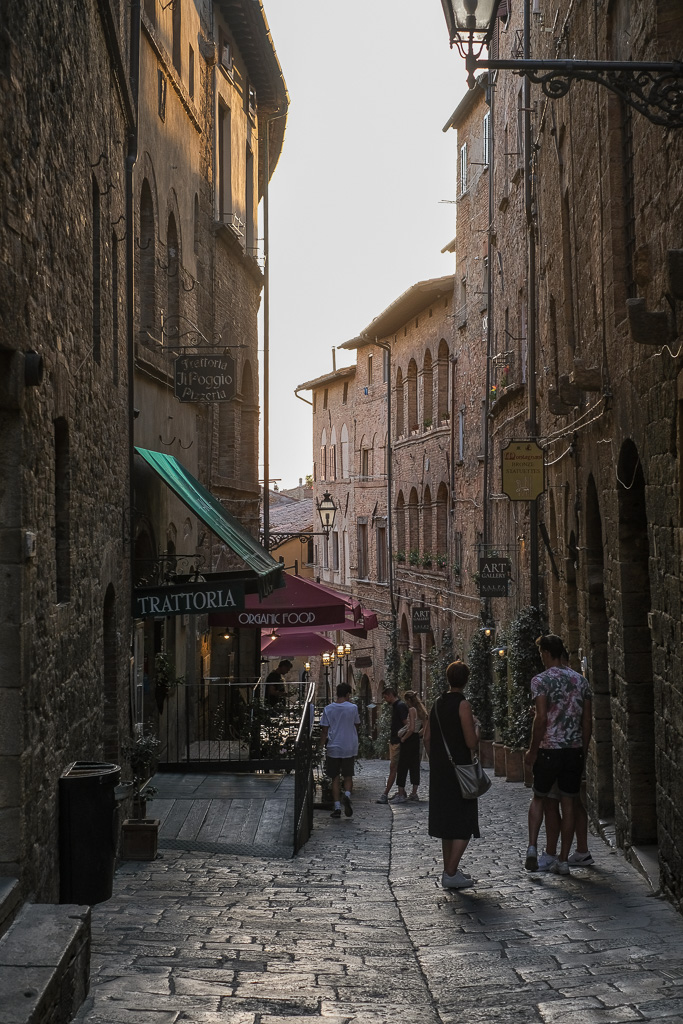
The town’s elevated position also means that views can suddenly appear unexpectedly. Make your way down some alleyways and, at the end, you can easily spot the surrounding landscape through small openings and gateways in the walls.
Step into Piazza dei Priori
At the heart of Volterra lies Piazza dei Priori, a space that feels both imposing and quietly timeless. Often described as one of the finest medieval squares in Tuscany and sitting at the heart of Volterra, Piazza dei Priori has served as the political and social centre of the town for centuries, and remains the most obvious starting point for any visit.
The square is dominated by the Palazzo dei Priori, Tuscany’s oldest town hall, built in the early 13th century. Its crenellated façade and tall tower overlook the piazza, giving it a distinctly fortress-like character. The building still functions as the town hall today, and stepping inside (when open) allows you to explore historic chambers and climb the tower for views across Volterra’s rooftops and the surrounding countryside.


Along the edges of the square are a series of equally austere medieval palazzi, their stone façades largely unchanged over the centuries. Unlike the softer, more decorative architecture found in other Tuscan towns, the buildings here are as solid and restrained as in the rest of Volterra, almost severe in their simplicity. However, this does give the piazza a unique atmosphere.
Despite its historical significance, Piazza dei Priori is bustling during the day as people pause to take photographs, locals mill around in the square, and cafés spill out at its the edges. It’s an ideal place to stop for a coffee or aperitivo, not just for the setting, but for the chance to observe daily life.
Look closely, and you’ll notice details that hint at the square’s long civic history, such as coats of arms embedded into the walls, worn stone steps shaped by centuries of use, and subtle variations in the buildings that reflect different periods of construction and influence.
Visit the Roman Theatre
Set just below the historic centre, the Roman Theatre of Volterra is one of the town’s most striking and is remarkably well-preserved, considering the fact that it dates back to the late 1st century BC. While many of Volterra’s museums focus on its earlier prominence as an Etruscan city, these ruins offer a powerful glimpse into Volterra’s Roman past that followed.
The theatre was built during the reign of Emperor Augustus, at a time when Roman influence was reshaping cities across Italy. Carved directly into the natural slope of the hillside, it follows the classic Roman design: a semi-circular seating area (cavea) facing a raised stage (scaenae frons), once richly decorated with columns and statues. Rows of stone seating are still clearly visible, along with sections of the stage and the columns that once supported elaborate backdrops.

A great quirk of Volterra’s geography is that all of this can be viewed from above, from the road and viewpoints near the town walls, revealing the full layout where it seems to emerge from the surrounding greenery and overlooked by medieval buildings.
Beyond the theatre itself, the archaeological area also includes the remains of a Roman bath complex, added in later centuries. Though it isn’t really recognisable as a bath house, its ruins help to paint a broader picture of daily life in Roman Volterra.
Interestingly, the theatre lay buried for centuries after the fall of the Roman Empire, gradually disappearing beneath layers of earth and later construction. It wasn’t until the 1950s that systematic excavations uncovered the site, revealing the extent of what had been preserved beneath the surface.
If you plan on visiting, the best overview is from above, where you can appreciate the full structure and its position within the landscape. Alternatively, you can enter the site itself and walk among the ruins.
Discover Volterra’s Etruscan Heritage
Long before it became the town it is today, Volterra was one of the principal cities of the Etruscan world. Known in antiquity as Velathri, it was part of a powerful network of independent city-states that dominated much of central Italy before the rise of Rome. Today, it remains one of the best places in Tuscany to connect with this relatively unknown and often-overlooked civilisation as it’s remnants are still visible in the fabric of the town.
One of the most striking survivals is the Porta all’Arco, an ancient gateway built in the 4th century BC. Formed from massive blocks of stone, the arch has endured for over two thousand years, even surviving later medieval modifications. If you look closely, you’ll notice three carved heads set above the arch, believed to date from the Etruscan period, and passing through it feels like stepping back in time.
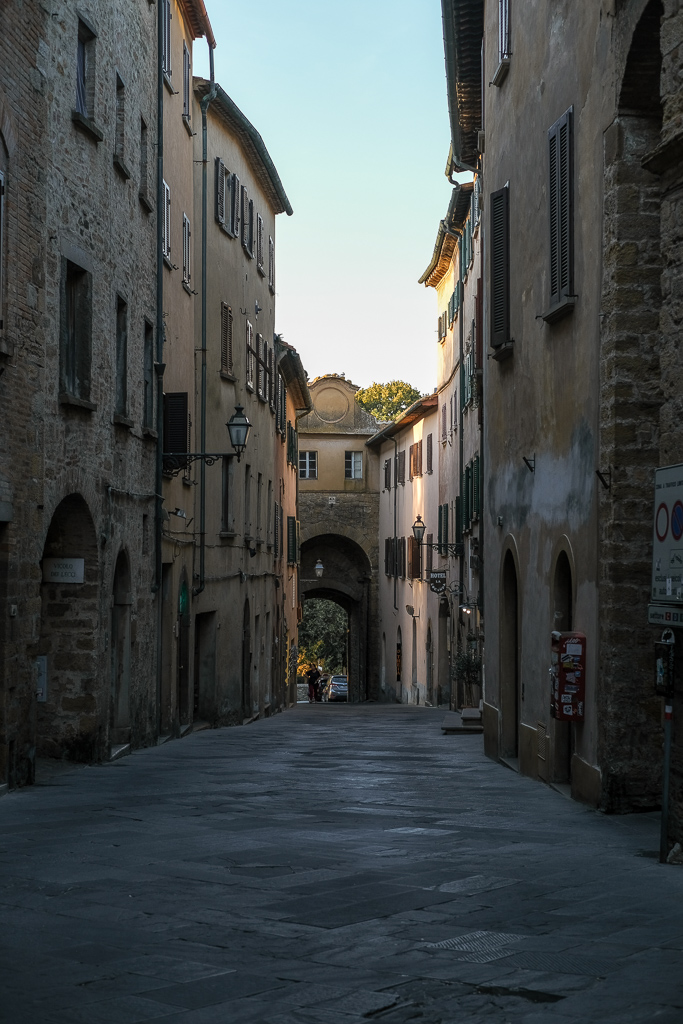

Beyond the gate, sections of the original Etruscan walls can still be traced around the edges of Volterra. These fortifications once enclosed a much larger area than the current medieval centre, which is an interesting reminder of the city’s former importance. Walking along these quieter outer paths offers not only a sense of scale but also fantastic views across the surrounding valleys.
To explore this history in greater depth, the Guarnacci Etruscan Museum is an essential stop. One of the oldest public museums in Europe, it houses an extraordinary collection of Etruscan artefacts, particularly funerary urns carved from local alabaster. These urns, often topped with reclining figures, provide a rare and intimate glimpse into Etruscan beliefs about death and the afterlife.
Among the most famous pieces is the “Ombra della Sera” (Evening Shadow), a slender bronze figure whose elongated form feels strikingly modern despite its ancient origins. It’s a reminder of how distinctive Etruscan art can be, often differing markedly from the classical styles that came soon after.
Another key site is the Etruscan Acropolis of Volterra, located within a public park just outside the centre. Here, you can see the remains of temples and foundations dating back to the Etruscan period, later built over by Roman structures. The site is less visually dramatic than the Roman theatre, but no less significant.
However, Volterra’s Etruscan heritage is really compelling in how seamlessly it blends into the town as it is today, with traces of the past dotted all around the town. A gate here, a wall there, as well as the artefact in the museums and archaeological sites.
Visit the Volterra Cathedral
At the heart of Volterra, just a short walk from Piazza dei Priori,, the Volterra Cathedral offers one of the town’s most quietly impressive experiences. Dedicated to Santa Maria Assunta, and sitting just a short walk from Piazza dei Priori at the the heart of Volterra, the cathedral dates back to the 12th century, though much of what you see today reflects later renovations, particularly following a devistating earthquake in the 15th century.
From the outside, the Duomo is relatively understated, even austere, compared to others in Tuscany. Its Romanesque façade is simple, built from pale stone with minimal decoration, and it’s easy to pass by without realising what lies within. Step inside, however, and the contrast is striking.


The interior is richly detailed, with a coffered ceiling that immediately draws the eye, covered in geometric panels that are adorned with gilded ornamentation, only adding a little more warmth to the otherwise cool stone interior. The space feels grand but it isn’t overwhelming, its proportions are fairly balanced and its decoration is carefully layered rather than feeling excessive.
Along the nave and side chapels, you’ll find a series of artworks spanning different periods, including pieces attributed to Renaissance artists and later additions that reflect the cathedral’s evolving history. One of the highlights is the ornate pulpit, carved with intricate detail, as well as the chapels themselves, many of which contain frescoes, sculptures, and devotional artworks that reward closer attention.
Adjacent to the cathedral is the Baptistery of San Giovanni, a separate octagonal structure clad in distinctive white and green marble. While simpler than the Duomo, it adds another architectural layer to the complex and is worth a brief visit if open.
Experience the Alabaster Workshops
Alabaster craftsmanship is a practice that stretches back over two millennia in Volterra, and remains one of the town’s defining cultural identities. Long before the medieval walls were built, the Etruscans were already carving alabaster here, using it to create funerary urns, sculptures, and decorative objects. Thanks to the abundance of this soft, translucent stone in the surrounding hills, Volterra became one of the most important centres of alabaster production in the ancient world and it has become a legacy that has endured ever since.
Alabaster is uniquely suited to intricate work. Softer than marble, it can be carved with remarkable precision, allowing artisans to create delicate details and smooth, luminous surfaces. When polished, it takes on a warm, almost glowing quality, particularly when light passes through thinner sections, giving many pieces a distinctive, almost ethereal appearance.
You’ll still find small workshops and studios in Volterra today, tucked between medieval buildings, where this centuries-old craft continues. In some, artisans work openly at their benches, shaping raw stone into finely detailed forms using a mix of traditional techniques and modern tools. Shops throughout the historic centre also display everything from small souvenirs to elaborate sculptures and decorative pieces. While some items are mass-produced, many workshops still produce handmade pieces, often signed by the artist.
To understand the full story behind alabaster in Volterra, a visit to the Ecomuseum of Alabaster is essential. Located within the town, the museum traces the history of alabaster from its Etruscan origins through the medieval and Renaissance periods to its modern revival. Exhibits include ancient urns, tools used by artisans, and examples of how styles and techniques have evolved over time.
One of the most compelling aspects of the museum is how it places alabaster within the broader context of Volterra’s cultural identity, not just as a craft, but as an industry that shaped the town for centuries. It highlights the lives of the artisans themselves, the trade networks that once carried Volterra’s alabaster across Europe, and the challenges the craft has faced in the modern era.
See the Medici Fortress (From the Outside)
Dominating the skyline is the Medici Fortress, a 15th-century structure built under Florentine rule. Today it functions as a prison and is not open to the public, but its imposing exterior and hilltop position make it a key part of Volterra’s visual identity.
The best views are from nearby vantage points, where you can appreciate both the scale of the fortress and its commanding position above the town.
Take in the Views Over the Tuscan Countryside
Although Voterra’s historic streets may be the main draw to this town, its setting certainly adds to the appeal. From various points along the town’s edges, you’ll find panoramic views across rolling hills, fields, and distant ridgelines.


These viewpoints are at their best come sunset, when the light softens, and the landscape is bathed in golden light. Most people gather along the walls beside Piazza Martiri della Libertà as sunlight begins to fade to take in the spectacular views, giving this area an exciting buzz each evening.
Best Things to do Near Volterra
As you can see from the above list, Volterra has more than enough to fill a day or two. However, a big part of its appeal lies in the fact that it’s surrounded by some of Tuscany’s most beautiful landscapes and lesser-visited towns. If you venture beyond the city walls, you’ll find a patchwork of vineyard-covered hills, medieval villages, and winding country roads that feel tailor-made for slow-paced exploration.
Visit San Gimignano’s Medieval Towers
Just 40 minutes away, San Gimignano is one of the region’s biggest tourist draws. Famed for its cluster of medieval towers that rise dramatically above the surrounding countryside, it attracts so many more visitors than Volterra.


Explore the Tuscan Countryside by Car
Some of the best experiences near Volterra aren’t in close proximity to the city and are instead along the roads and villages surrounding the town, through vineyards, olive groves, and gently rolling farmland. Driving without a fixed plan is the best way to stumble upon unexpected discoveries such as roadside trattoria’s, hilltop hamlets, and viewpoints overlooking an endless patchwork of fields. The routes between Volterra, Colle di Val d’Elsa and San Gimignano are particularly scenic.

Discover Local Wineries and Vineyards
This part of Tuscany is rich in winemaking tradition, and visiting a local vineyard gives you a deeper connection to the landscape. Many wineries around Volterra produce lesser-known but excellent wines, often in small quantities. Tastings typically include local varieties paired with olive oil, cheeses, and cured meats, all enjoyed with views over the surrounding countryside.

Visit Bolgheri and the Tuscan Coast
For a change of pace, head west towards the coast and the village of Bolgheri, around an hour’s drive from Volterra. Known for its famous cypress-lined avenue and prestigious wines, Bolgheri offers a different perspective on Tuscany that blends inland tradition with coastal influences.
Explore the Berignone Nature Reserve
If you’re looking to swap medieval streets for wild landscapes, the Berignone Nature Reserve lies just south of Volterra. This protected area offers hiking trails through forests, rivers and rocky outcrops, with far fewer visitors than Tuscany’s more famous countryside spots. It’s an ideal escape for walkers and nature lovers.
Visit Lajatico, Home of Andrea Bocelli
A short drive north-east brings you to Lajatico, best known as the birthplace of Andrea Bocelli. The village itself is small and unassuming, but just outside lies the striking Teatro del Silenzio, which is an open-air amphitheatre set among the hills, that hosts an annual summer concert by Bocelli.
Tours from Volterra
I would generally advise to explore Volterra at your own pace without much of a plan, however guided tours offer a deeper, more structured way to experience both the town and the surrounding Tuscan countryside, as well as neighbouring destinations. From vineyard visits to full-day excursions linking nearby hill towns, these tours help you to tick off sights as well as connect with the local landscape, history, and food that define this part of Italy.
- Winery Guided Tour and Experience with Tasting
- San Gimignano, Volterra, St Galgano Abbey Small Group Tour
- Volterra: Private Walking Tour of Historic Landmarks
- Fresh Pasta Cooking Class at a Tuscan Farmhouse
- Volterra Truffle Hunting with Lunch or Dinner
- From Florence: San Gimignano and Volterra Day Trip
Where to Eat & Drink in Volterra
Although it is only a small town, Volterra is packed with great dining spots and eating here is a more local experience than in some of Tuscany’s other towns, shaped by the countryside and the seasons. Menus here lean heavily on Tuscan classics such as wild boar ragù, handmade pasta, pecorino cheeses, and truffles when in season, often served in intimate, family-run settings where recipes have been passed down through generations.


Osteria La Pace
Where: Via Don Giovanni Minzoni, 55, 56048 Volterra PI, Italy
When: Thursday to Tuesday 11.30am – 3.30pm & 6.30pm – 10.30pm
On a quiet street in the historic centre, Osteria La Pace embodies everything that makes dining in Volterra so memorable. The space is small and atmospheric, with rustic wooden tables and a menu that changes with the seasons. Dishes generally lean towards traditional but are executed with care. Expect pici pasta with rich ragù, slow-cooked meats, and simple antipasti that let local ingredients shine. It’s an intimate spot, from the handwritten menu to the friendly service, all combine to make this feel more like being welcomed into someone’s home.
Brasseria del Grifone
Where: Piazza XX Settembre, 17, 56048 Volterra PI, Italy
Anyone who knows me will know that whenever I travel, I will seek out a local brewery. While there are several fantastic breweries dotted around Tuscany, there is only one in Volterra itself, and that is Brasseria del Grifone.

This craft brewery and gastropub has a more contemporary edge than the city’s classic trattorias and almost brings an urban energy to the historic centre. Here, the beer is the star of the show: brewed on-site and offering quite a large range of craft styles, from light and refreshing lagers to rich and complex stouts.
The atmosphere is informal and lively, with a spacious interior and outdoor seating that spills out onto the square outside, offering views across the town’s edges. It is perfectly suited to an evening drink as well as a full meal. For those craving a break from local wine or simply looking to experience a different side of Volterra, this is one of the town’s most distinctive spots.
Enoteca Del Duca
Where: Via Don Giovanni Minzoni, 55, 56048 Volterra PI, Italy
When: Thursday to Tuesday 11.30am – 3.30pm & 6.30pm – 10.30pm
Just off Piazza dei Priori, this long-standing favourite blends traditional Tuscan cooking with a slightly more refined approach. The wine list is a standout, showcasing regional bottles that pair effortlessly with the menu. It’s the kind of place where diners drag on into the night, guided as much by chat over the drinks as it is by the food itself.

La Carabaccia
Where: Via Don Giovanni Minzoni, 55, 56048 Volterra PI, Italy
When: Thursday to Tuesday 11.30am – 3.30pm & 6.30pm – 10.30pm
Just outside the city walls, La Carabaccia pairs sweeping countryside views with hearty Tuscan cooking. The terrace is the star attraction, offering panoramic views that stretch across the surrounding hills, which are especially striking at sunset. The menu focuses on robust, flavourful dishes, from grilled meats to rich pasta plates, all served in generous portions.
Bar Trattoria Da Badò
Where: Borgo S. Lazzero, 9, 56048 Volterra PI, Italy
When: Thursday to Tuesday 12.30am – 2.30pm & 7.30pm – 10pm
Family-run and full of character, Trattoria Da Badò is a warm, informal introduction to Tuscan home cooking. The focus here is on simplicity, from fresh ingredients and traditional recipes to generous portions, all served in a relaxed setting. Expect dishes like ribollita, handmade pasta, and slow-cooked meats, all prepared with a sense of authenticity that feels true to the region.
La Sosta del Priore
Where: Vicolo delle Prigioni, 1/2, 56048 Volterra PI, Italy
When: Sunday to Thursday 11.30am – 8.30pm; Friday 11.30am – 8.30pm; Saturday 11.30am – 9pm
Small, unassuming, and often with a queue trailong down the street, this gourmet sandwich shop has developed something of a cult following, for good reason. Specialising in elevated street food, it takes the idea of the Italian panino and reimagines it with carefully sourced ingredients and inventive flavour combinations rooted in Tuscan tradition.
Fillings might include pecorino with fig jam, porchetta with seasonal vegetables, or even traditional ingredients like lampredotto, all layered into freshly baked bread. The emphasis is on quality, with each combination designed to highlight the region’s produce.
It’s a hole in the wall, with a small seating, indoor seating area area across the street, meaning ppace is limited, so it may be worth considering taking your sandwiches away to enjoy on a nearby bench or viewpoint. However, that’s part of the appeal. This is food designed to fit into your Volterra itinerary, offering a quick snack as you go about your day.
Pasticceria Migliorini
Where: Via Antonio Gramsci, 21, 56048 Volterra PI, Italy
When: Wednesday to Monday 6.30am – 8pm
For something sweet, Pasticceria Migliorini is a bit o local institution. Located near the centre, it’s the perfect place to pause for a coffee and a pastry between sightseeing stops, or an early-morning breakfast snack. The display counter is filled with classic Italian treats such as cantucci, tarts, and delicate pastries, all of which are best enjoyed with a strong espresso.
Pizzeria Da Nanni
Where: Via delle Prigioni, 40, 56048 Volterra PI, Italy
When: Wednesday to Saturday 12.30pm – 9pm
It may not look like much compared to some of Volterra’s more upmarket dining spots, but this hole-in-the-wall pizzeria lures you in with it’s neon signage and budget friendly prices. It’s a simple interior, with a few tables scattered in front of a counter that hides an enormous wood fired pizza oven where the chef works up a sweat baking pie after pie. It may not offer the best pizza you will find in Tuscany, but it certainly hits the spot. Especially at the end of the night after a few too many Aperol Spitzes, which I can vouch for from experience.

When is the Best Time to Visit Volterra
With its position high in the Tuscan hills, Volterra changes subtly with the seasons, each bringing a different side to the town and a new reason to visit. There’s no singular ‘perfect’ time, only the version of Volterra that best suits how you want to experience it.

Spring is widely considered one of the best times to stop by. The surrounding countryside begins to bloom, with green hills replacing the muted tones of winter, and temperatures are warm without being overwhelming. This is a particularly good time for walking, both within the town and in the wider countryside. Visitor numbers are still relatively manageable, especially compared to the height of summer.
The problem with summer is that although it brings warmth, energy, and longer days, with temperatures often climbing into the high 20s or beyond, the town feels busier and more animated, with festivals, outdoor dining, and a steady flow of visitors passing through. This is the busiest time of year with rooms and accommodation not only being more expensive, but filling fast. While Volterra remains quieter than nearby San Gimignano, the difference is less pronounced in peak season.

I visited in autumn, when the landscape shifts to warm, earthy tones, and the harvest season brings a big focus on local produce, especially truffles, mushrooms, and new wines, making it the ideal time to visit for foodies.
The weather remains pleasant, often with clear, sunny days, and the crowds begin to fade. It’s a time when Volterra feels calmer and more grounded, making it ideal for travellers seeking a more immersive, slower-paced experience.
How Long Should You Spend in Volterra
Volterra is relatively small, so at first glance, its main sights are clustered within a walkable historic centre and it doesn’t take a long time to explore. However, between its layered history, atmospheric streets, and surrounding countryside, you can spend anywhere between a day and a week here, depending how much you want to explore the surrounding area.
One Day in Volterra
If you’re short on time, Volterra works well as a day trip. In a single day, you can explore the historic centre, wander through Piazza dei Priori, visit the Roman Theatre of Volterra, and step inside the cathedral.
There’s enough time to pause for lunch, browse a few artisan shops, and take in the views across the surrounding hills. However, a day trip inevitably feels a little rushed, particularly in the middle of the day when the streets feel packed and visitors arrive from nearby towns.
One Night
Staying overnight enhances the experience. As day-trippers leave, Volterra settles down: streets empty, restaurants are quieter, and the atmosphere becomes noticeably more intimate.
Evening is when the town is at its best, and followed by a slow morning the next day, this allows you to experience both sides of Volterra: its lively daytime energy and its more contemplative after-hours character. One night is an almost ideal amount of time to spend here.
Two to Three Days
With two or three days, you can use Volterra as a base rather than just a destination. This allows you to explore the town at a relaxed pace, revisiting favourite spots, spending time over meals, and discovering quieter corners, while also venturing into the surrounding countryside.
This is enough time to also take a day trip to San Gimignano, visit local wineries, or simply drive through the hills without a fixed plan. It’s a more immersive way to experience this part of Tuscany.
Up to A week
Staying longer not only allows you to see all the sights at a relaxed pace, it also allows you to embrace the general flow of life in a small Italian town. In a way, Volterra lends itself to slow travel: morning coffees in quiet piazzas, afternoons spent exploring the countryside, and evenings that drag on over food and wine.
For those looking to disconnect and settle into Tuscan life, a longer stay, particularly in a countryside agriturismo, you will get a much more local and immersive experience.
Practical Travel Tips for Volterra
A visit to Volterra is relatively straightforward, however, although this is a relatively simple hilltop town to explore, like any destination, it comes with its own quirks. A little preparation goes a long way in ensuring you experience the place to its fullest, particularly in peak season.
Plan activities around Opening Hours
Volterra follows a more traditional Italian daily schedule, particularly outside peak summer months. Many shops, smaller museums, and even some restaurants close for a few hours in the afternoon (typically between 1pm and 4pm).
You’re best using this time to do as the locals do, settling in for a long lunch or leisurely coffee, retreating from the heat, or simply walking around to take in the town’s beautiful streets. Key sights like the Roman Theatre of Volterra and museums may also have reduced hours in winter, so it’s worth checking ahead.
Book Restaurants in Advance
Volterra’s dining scene id great for a town of its size, but the it is is still relatively small, and the best restaurants fill up quickly in peak season. If you have somewhere specific in mind, it’s wise to reserve a table. In quieter months, this is less essential, but booking ahead is still a good idea for weekends or popular spots.
Arrive Early or Stay Late
If you’re visiting on a day trip, timing is quite important. Arriving early in the morning or later in the afternoon helps you avoid the busiest period (as well as find a parking spot), when visitors arrive from nearby towns like San Gimignano.
That said, I would always recommend staying in Volterra overnight, is at its most atmospheric in at sunset and beyond, when the streets are quieter and the light gives the stone buildings an appealing glow.
Carry Cash
Most restaurants, hotels, and shops accept cards, but smaller places, particularly cafés, bakeries, or market stalls, may prefer cash or have minimum spend requirements. It’s useful to carry a small amount of euros for convenience.
Be Prepared for Limited Public Transport
Public transport connections to and from Volterra do exist, but they can be infrequent and need careful planning. If you’re relying on buses or trains, check timetables in advance and allow extra time for connections. For flexibility, especially if you plan to explore the surrounding countryside, having a car is almost essential.
Is Volterra Worth Visiting?
While Tuscany seems to be defined by a few iconic sights and destinations, a town like Voterra is a bit of an outlier and, for those in the know, as much a reason to visit the region as the big hitters. In my view, it’s the small towns and villages – the off-the-beaten-track destinations – that really make Tuscany such a compelling place to visit. The question isn’t whether Volterra has enough to see, but whether it offers something different from the rest of Tuscany. The answer, for many travellers, is a clear yes.

Unlike the postcard perfection of Florence or the skyline of San Gimignano, Volterra feels quieter, less visited, and all the more atmospheric for it. Its Etruscan roots stretch back thousands of years, and that sense of history is layered into everything, from its ancient walls to its winding alleyways.
That said, Volterra won’t appeal to everyone. If you’re looking for a long list of major attractions or a lively nightlife scene, you may find it a little too subdued. It’s best suited to people who appreciate history, scenery, and a more understated kind of break.
In my opinion, Volterra works best as part of a wider Tuscan itinerary rather than as a singular destination, perhaps paired with more famous destinations nearby.
FAQs
Lorem ipsum dolor sit amet, consectetur adipiscing elit. Ut elit tellus, luctus nec ullamcorper mattis, pulvinar dapibus leo.
Can you visit Volterra without a car?
You can, but it requires some planning. Volterra doesn’t have a train station, so you’ll need to combine train and bus travel, usually via Pisa, Florence, or nearby towns like Pontedera. While it’s doable, having a car makes the journey much easier and gives you more flexibility to explore the surrounding countryside.
What is Volterra Well-Known for?
Volterra is best known for its Etruscan heritage, its well-preserved medieval architecture, and its production of alabaster, a traditional craft that you’ll still see in local workshops. It’s also recognised for its dramatic hilltop setting and panoramic views across the Tuscan countryside.
Is Volterra crowded?
Compared to other Tuscan destinations, Volterra is relatively uncrowded. It does get busier during the middle of the day in peak summer but mornings and evenings remain fairly peaceful.
Is Volterra good for a day trip?
Yes, Volterra works well as a day trip, even from as far as Florence or Pisa. However, staying overnight provides a much richer experience
Is Volterra better than San Gimignano?
Lorem ipsum dolor sit amet, consectetur adipiscing elit. Ut elit tellus, luctus nec ullamcorper mattis, pulvinar dapibus leo.