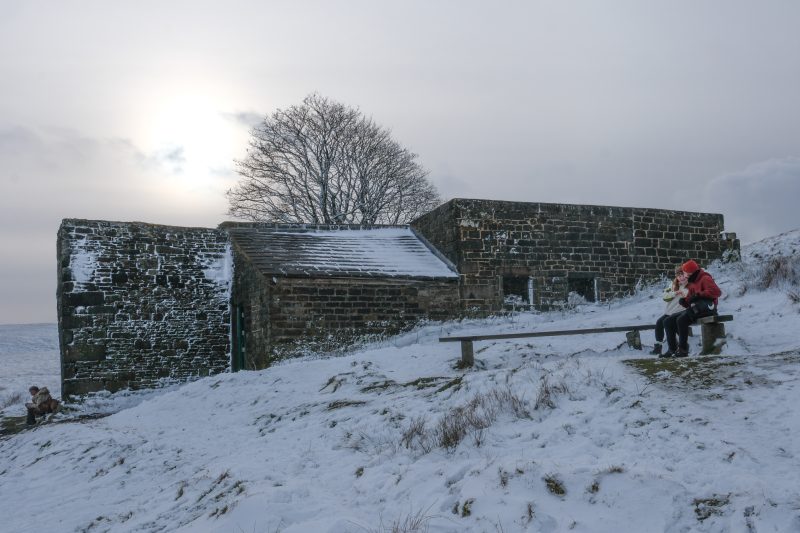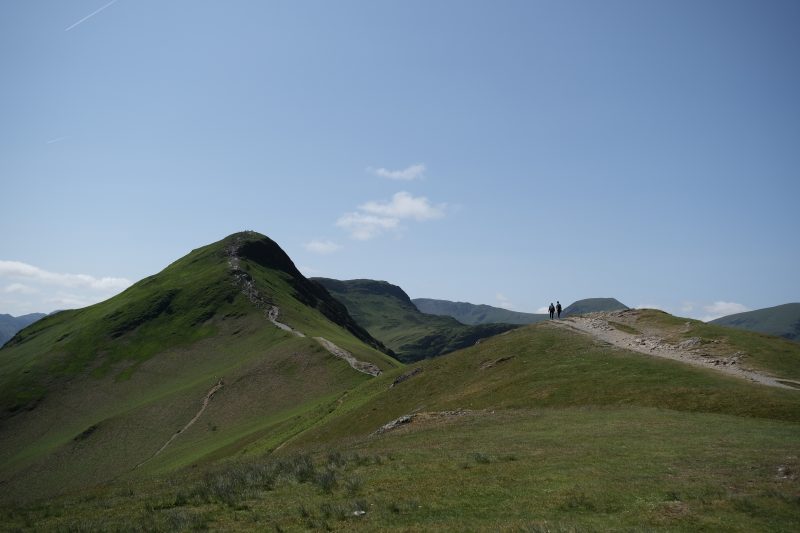
Passing from the Yorkshire Dales into the North York Moors can feel like crossing some invisible astral boundary into another, spookier plane of existence. The rolling green hills are replaced with mile upon mile of bleak, desolate moorland where the browns and greys of the landscape only occasionally broken by the deep, brooding purple of the heather that carpets its surface. This corner of Yorkshire is easily one of the most beautiful regions that England has to offer, but as I steadily make my way down White Way Heads towards the coast there is an eerie quality to the morning mist that clings to these vast stretches of nothingness.
It is easy to see why the moors have inspired so much literary creativity throughout the centuries. The 19th-century gothic fiction of the three Brontë sisters is what first comes to mind, whose home at the top of Haworth’s cobbled main street acted as a muse to their haunting tales. Then there is Bram Stoker, whose four week holiday in Whitby in July and August 1890 were pivotal to the creation of his most famous work; Dracula.

On an April morning, in the glaring sun of a late spring, Whitby has all the trappings of a typical British seaside town. At the harbour, families hang nylon fishing line through the railings into the water below hoping to catch a crab or two, while nearby shops sell smutty postcards alongside sticks of pinstriped rock, and overfed seagulls seem to outnumber the sunburned holidaymakers. In parts, it is kitsch and tired, like any similar coastal holiday hub, but it is also an infinitely charming place famed for its fishing industry, connection to Captain James Cook, and a world-renowned jet industry.
The scent of fish and chips lingers in the air as I walk along the promenade, past the row of multicoloured beach huts, down beside the grand pavilion, the diminished funfair, and finally the whalebone arch that stands atop the West Cliff, its skeletal form framing the mouth of the river Esk that sheers the town in two, both physically and metaphorically. On the one side, Whitby is a bustling seaside resort, on the other, it is a place filled with tales of witchcraft and ghostly legends have gone hand in hand with the town ever since a monastery was founded here in AD 657 by Anglo-Saxon St Hilda.
The original monastery is long gone, destroyed by a roving band of Danish invaders in 870AD, but the remains of the reconstructed gothic marvel, crumbling and worn ever since it met its end during Henry VIII’s anti-Catholic rampage of 1540, still stand, perched on a rugged hilltop, atmospherically looming over the town above the East Cliff.
It is a view of the Abbey across the horseshoe-shaped bay that would have partly inspired Bram Stoker to choose Whitby as his setting for Dracula. Stoker has arrived to Mrs Veazey’s guesthouse at 6 Royal Crescent – in an upper class, residential neighbourhood of townhouses on the West Cliff – at the end of July 1890. He had been working as the business manager of famed actor Henry Irving and, after an exhausting but unsuccessful tour of Scotland by the theatrical troupe, Irving had suggested a month’s holiday for Stoker on the coast, recommending Whitby.
It didn’t take long for Stoker to be enchanted with the stunning setting. Before long, he began to weave the town into the plot of the story he was working on, set in Styria in Austria, with a central character called Count Wampyr. At the time, stories of distant, eerie castles and supernatural beings in foreign lands were popular, but Bram Stoker soon realised that Whitby’s windswept headland, ruined Benedictine Abbey, and clifftop graveyard filled with weathered gravestones that were often circled by bats on a late summer evening would provide the perfect backdrop.
He had a week to explore Whitby on his own before being joined by his wife and young child. He spent his mornings wandering the town, taking in its rich folkloric and fishing heritage and entwining aspects of local oral history into the vampire tale.
On one of these wanderings, he made his way to what was known as the Coffee House End of the Quay and entered the public library. Here he found a book, “An Account of the Principalities of Wallachia and Moldavia” by William Wilkinson, that mentioned 15th-century prince called Vlad Tepes who was said to have impaled his enemies on wooden stakes. He was known as Dracula – the ‘son of the dragon’.
From the library, Bram would make his way to Whitby Harbor where he would speak to local fishermen and sailors who would regale him with stories of spooks and spectres. One such tale was of a Russian sailing vessel, the Dmitri, that ran aground on a beach within Whitby’s harbour just 5 years before Stoker’s visit. Only a handful of the crew were alive and it was carrying a mysterious cargo from Narva; crates of earth. It is said that rescue workers witnessed seeing a large black dog – consistent with the Yorkshire myth of the Barghest, an omen of death – emerge from the hull and flee up the 199 steps from Tate Sands beach into the graveyard of St. Mary’s Church. Those familiar with the novel will recognise this scene. Stoker noted down the details, changed the vessel’s name, and added a tempestuous storm. This became Dracula’s arrival in the seaside town of Whitby and in it, Bram had found a blurry place between fact and fiction.
The cobbled Victorian streets that surround the foot of the 199 steps now make a thriving living off the world’s most notorious vampire. Hints of Dracula can be found, usually with tongue firmly in cheek, in the names of boutiques, B&Bs, and cafes, while windows of local shops are filled with gothic-themed paraphernalia. Those wanting to come face to face with scenes from the novel can even take part in the ‘Dracula Experience’, a walk through one of Whitby’s historic houses – the first Title Deeds show Sir Isaac Newton to be one of the original owners – in which each room depicts a different scene of the story using mannequins, special effects and actors. It can feel a little cheap and tacky but well worth a few pounds for the jump scares that will inevitably have you shrieking before you leave.

Walking the steps themselves is a much more serious matter. I find myself panting for breath as I slowly and cautiously climb all the way from sea level to St. Mary’s Church which sits at the summit. My thighs burn and my calves feel tight, but even taking a rest bite on this gas lamp lined slope takes on a sinister edge when you realise that the intermittent benches that you may assume are for the benefit of weary tourists were actually intended to be used by pallbearers who used them to steady their coffins when they needed a break from carrying the dead to the church cemetery that stands at the top.
The Medieval Parish church, overlooking the East Cliff, is a rather odd building, a squat mishmash of shapes with a sign on the door letting visitors know that its cemetery does not contain Dracula’s grave due to him being entirely a work of fiction. This doesn’t stop tourists from lingering here though, just as Stoker would during his stay when he spent hours at St. Mary’s relaxing among the tombstones, absorbing local lore from the retired seafarers who gathered there. The headstones are weathered, many of them subsiding to the point that they occasionally become exposed by erosion, shedding bones onto the streets below. Either way, Stoker made sure to note the names on the worn engravings to use in his book.


Like Bram, his characters Mina and Lucy spend much of their Whitby holiday sitting in the graveyard of St Mary’s Church, culminating in a scene where Lucy is found on their favourite bench with two pin-prick marks on her neck.
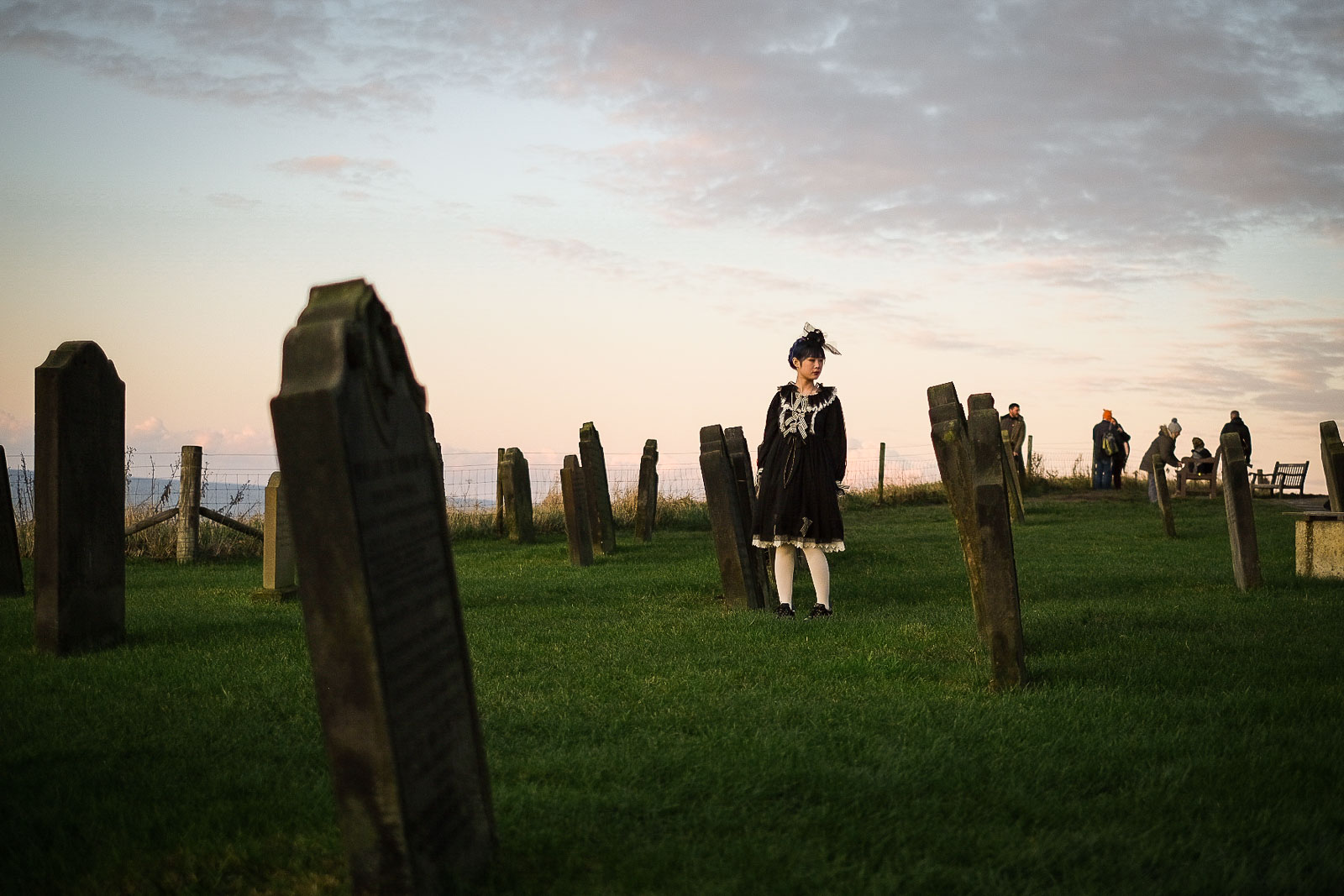
On the day that I’m in Whitby, it is the Whitby Goth Weekend, a music festival founded in 1994 that takes place twice a year, so I find that St. Mary’s is surrounded by goths, punks and steam punks in their elaborate costumes to celebrate the town’s Dracula connection. In fact, the entire town is overrun with revellers dressed as vampires, ghosts, and ghouls.

However, Dracula isn’t Whitby’s only connection to the supernatural. Like any English harbour town, the myths and superstitions of sailors hang heavily over the population. The seamen may have disappeared with Whitby’s fishing industry at the turn of the 20th century but their ghostly stories of spirits and witchcraft still circulate. Whether that is the Barguest Coach – pulled by headless horses that visits graves on the third night of their burial to pay their respect before transporting the graves of the dead sailor towards the sea – or the one-armed lighthouse keeper who makes his journey up the pier towards the lighthouse on stormy nights. These tales are as much part of Whitby’s legend as Bram Stoker’s famous vampire yarn; there’s the white woman of the abbey, the oysterman of Whitby, and The Landlady of the White Horse and Griffin – among dozens of others – all of which would deserve their own few paragraphs.
Finally, as the sunset descends on the Yorkshire coast, I find myself once again struggling up the 199 steps to St. Mary’s, much like Mina as she rushed to meet her sleepwalking friend. From the top, flocks of bats swoop over Whitby’s red tiled roofs that glow blood red beneath me in the fading light while the narrow lanes and alleyways slowly decend into a secretive darkness. There is no doubt that Whitby suits its gothic reputation, or is it the other way around?


7 Spooky Things to do in Whitby
In the years since Dracula was published, Whitby has fully embraced its reputation for the weird and supernatural. Here are some of the best spooky things to do in the harbourside town.
Whitby Ghost Walk
Perched between two regions rife with folklore – the desolate, windswept Moors and the crashing waves of the North Sea – it should come as no surprise that Whitby is a town with tales to tell, stories of shipwrecks and sailors, maritime superstitions, and spirits that wander the historic streets. This is, after all, said to be one of the most haunted towns in the UK.
There are two popular Ghost walks that regularly regale tourists with rip-roaring yarns; Firstly, Dr Crank meets guests at 7.30pm each evening at the Whale Bone Arch opposite The Royal Hotel on Whitby’s West Cliff to take them on a 75 minute walk to discover strange and supernatural tales of murder, mystery, and suspense (no booking needed; Adults £7, Children £4).
Another popular tour is with Rose Rylands, a former ‘Tour Guide of the Year’, who’s Ghost and Dracula tours are rich in local anecdote and legend. Starting at the top of the 199 Steps and taking in St Mary’s Church Graveyard, she will then walk you through the yards and alleyways of the old town. Tours last 75 minutes. Private bookings only.

The Dracula Experience
Where: 9 Marine Parade
When: Daily 9.45am – 5pm during summer. Weekends only between November and Easter
Entry: £5 Adults & £4 Children
Explore the Ruins of Whitby Abbey
Entry: £11.20 Adults & £6.60 Children (free for English Heritage members)
When: Daily 10am – 5pm
Climb the 199 Steps to the Church of St. Mary
Beside the abbey stands the ancient parish church of St. Mary, perched on East Cliff, which is reached by a climb of 199 steps, the very climb undertaken by Dracula after his ship, the Demeter, ran aground on the sands of Tate Hill.
In the novel, Mina and Lucy spend much of their holiday in the graveyard at St. Mary’s listening to tales of local folklore and legends surrounding some of the graves from an old fisherman, Mr Swales. These graves are now weather-worn and crumbling, some of them subsiding perilously over the eroding cliff face. Many of the graves here are empty, not as a result of the dead rising, rather that they were never filled, dedicated to sailors whose bodies were lost at sea.
During his visit to Whitby, Stoker spent hours wandering the cemetery, hearing some of the same stories that his characters were told and making sure to note down inscriptions and names from the headstones to use in his manuscript. ‘Swales’, was one such name, and became Dracula’s first victim in Whitby.

Lounge on the Bram Stoker Memorial Seat
The Bram Stoker Memorial Seat sits on the Khyber Pass looking out at the view of Whitby that Bram Stoker saw when he decided on the setting for his most famous creation. Almost all of the landmarks he included in his novel can be seen, including the 199 steps, the church, ruined abbey and the beach on which a shape-shifting Dracula bounded to shore.
The memorial plaque reads: “The view from this spot inspired Bram Stoker (1847-1912) to use Whitby as the setting of part of his world-famous novel DRACULA. This seat was erected by Scarborough Borough Council and the Dracula Society to mark the 68th Anniversary of Stoker’s death – April 20th 1980”
Browse the Whitby Museum's Curious Collection
To describe the Whitby Museum, Library & Archive as eclectic would be an understatement. Originally founded in 1823 by the Whitby Literary and Philosophical Society as a place to showcase local fossils, the museum’s collection has steadily grown over the two century’s since its inception as the society gathered more unique and bizarre specimens.
Alongside the displays of fossils, Whitby Jet and captain cook memorabilia you will find taxidermy, items related to local folklore and most notably, the Hand of Glory, an embalmed human hand reputedly cut from the corpse of a hung criminal.
It was from Whitby’s library – previously in a different location to where it now stands – that Stoker requested a specific book, The Accounts of Principalities of Wallachia and Moldavia by William Wilkinson, written about Wilkenson’s days as a British diplomat in Romania. In the book is the mention of a 15th-century prince called Vlad Tepes, nicknamed Dracula, who was said to have impaled his enemies on wooden stakes.
Attend the Whitby Goth Weekend
Since the 1990s, Whitby has become synonymous with the Goth movement, attracting large numbers to the twice-a-year Goth Weekend. Thousands of costumed revellers from all over the world arrive in the seaside town each October and April for a weekend of music, markets and spooky events.
For information about upcoming Whitby Goth Weekends, visit their website.


Where to Stay in Whitby
There are no shortage of places to stay in Whitby, ranging from budget-friendly hostels to boutiques and upmarket hotels. The Area around the West Cliff has an abundance of traditional seaside B&Bs all within a short walk from the city centre while the pretty streets around Tate Hill are lined with quaint former fisherman’s cottages that are available as holiday lets.
YHA Whitby
Sat right beside the ruined abbey at the top of the 199 steps, the YHA Whitby has a location that must be the envy of every hotelier in town and one that lends itself to a spooky stay. This is no creepy old mansion though, the refurbished abbey house has elegantly historic rooms, a conservatory, tea room and sprawling gardens that overlook the entire town. Both private and dorm rooms are available but the hostel is extremely popular so booking early is recommended.
Jet Black Jewel
Embracing Whitby’s gothic side with aplomb, each of the nine beautifully furnished rooms of this stunning boutique hotel are individually decorated to reflect a peculiar tale from the town’s history, folklore or legend. Breakfast is not included with your stay, but the hotel does have its own wonderful café bar on the ground floor that is equally well-appointed.
The Royal Hotel
Overlooking Whitby Harbour from opposite the famous Whalebone Arch of the West Cliff, the historic 115 room Royal Hotel may be a little worn and tired, but it is a Whitby landmark with one of the best locations in town.
Getting to Whitby
Trains to Scarborough run hourly from both Leeds and York. From Scarborough, buses also run hourly to Whitby, with the journey taking approximately an hour. If travelling by bus, the Coastliner service (£17.60 per day pass) makes regular journeys from Leeds via Tadcaster, York, and multiple other North Yorkshire towns. In 2018, it won the title of the Britain’s Most Scenic Bus Route.
By car, the A171 is the main route in and out of Whitby. From the South or West, follow the A64 towards the Yorkshire Coast, turning onto the A169 around Malton and through Pickering before joining the A171 just after Staithes. From the North, you can just follow the follow the A171 down from Guisborough.