A lush, volcanic outcrop in the North Atlantic situated closer to the African coast than mainland portugal, Madeira has managed to forge many of its own unique customs and traditions over the centuries since its discovery that set it apart from the mainland. This is especially seen in the island’s cuisine.
Making the most of its wildlife-rich waters and subtropical climate, locals have used the island’s produce to create a culinary feast of dishes that are only really found in Madeira: bright plates of scabbardfish in banana passionfruit sauce; spirituous of honey-flavoured poncha and crumbling slabs of molasses cake.
You won’t run out of great new flavours in Madeira and your tastebuds will always be satisfied. There are Michelin-starred eateries and curbside bakeries peddling warm pastéis de nata. Intriguing fruits such as monstera, custard apples and banana passion fruit can be sampled at Mercado dos Lavradores while the latest haul of castanhetas and chicharros is easy to stumble upon, deep fried, at any of the island’s many small fishing villages.
Food in Madeira is excellent, and here are some of the dushes that you must try when visiting.
What to Eat in Madeira
Black Scabbard (Espada)
Found in the deepest, darkest depths of the waters around Madeira, black scabbard fish – or Espada as it’s known in these parts – is available in relatively few parts of the world but has become one of the island’s most famous fish dishes. It is one fearsome-looking creature; a long narrow body that ends with large, bulbous eyes and sharp, needle-like teeth. I guess that you don’t need to be beautiful if you dwell in the inky abyss.


The flavour of espada is much more palatable than its appearance and fillets of this fish are often served ‘the Madeiran way’ – seasoned with garlic and lemon juice before being drizzled in passion fruit and banana sauce.
Where to eat Espada in Madeira
Black scabbard fish can be seen in all their nightmarish glory laid on the metal tables of the fishmongers at Mercado dos Lavradores. However, if you don’t want to be put off your lunch, head to Restaurant Santa Maria, set within a former primary school, that dishes up delicious plates of Madeira’s abundant seafood. Santa Maria’s versions of espada are either served with banana and passionfruit sauce or rolled with bacon and shrimp before being drizzled with mango chutney.
Espetada Madeirense
If you spend any amount of time wandering Madeira’s mountain trails, you will be familiar with the island’s bounty of flora, particularly the bay laurels that grow all through the forests and mountainsides. For centuries the branches of these trees have been put to good use, fashioned into skewers and threaded through succulent cubes of beef that have been marinated in salt, garlic and bay leaves. It is then grilled and often served dangling above your table, swinging from a hook. It is thought that the laurel skewer imparts some of its flavours into the meat, making for an even more delicious meal.
Where to eat Espetada Madeirense in Madeira
With the dish originating in Estreito de Câmara de Lobos, this town has a few good espetada spots, although Santo António is the most highly regarded. Originally opening in 1966 as an unpretentious tavern, it is now jam-packed every weekend with people seeking out their meat skewers.
In Funchal, make your way to O Polar. There are only two dishes on the menu, chicken and espetada, served in large portions with chips, fried maize and bolo de caco.
Bolo do Caco
Although bread is a global food staple, it seems that every nation or culture has its own take on it; The French have their baguettes, Chileans enjoy a Marraqueta and if you travel to India, you’re likely to indulge in a paratha or two.
The typical and traditional bread of Madeira is the delicious Bolo do Caco. This bread, made from wheat flour and flattened until it resembles a round, thick disc is named for the way it is cooked – over hot coals on a basalt stone, or caco.

Where to eat Bolo do Caco in Madeira
Most restaurants in Madeira will serve bolo de caco, usually as a side or as a starter and often sliced in half with warm garlic butter smeared inside. For fresh bread, try heading to Petit Fours Patisserie to the west of Funchal city centre.
Limpets
Limpets, a delicacy known locally as ‘lapas’, are a type of aquatic snail that is found attached to rocks around Madeira’s coast, noticeable for their conical shell shape and meat that is not dissimilar to mussels. Usually, they are served on their own, fried with garlic and doused with lemon and butter.
Where to eat Limpets in Madeira
As with any dish that’s popular in Madeiran gastronomy, limpets have their own dedicated festival each July at Casa do Povo in Paul do Mar. However, at any other time of the year, head to Barqueiro in Funchal.
Tuna
Tuna is plentiful in Madeira and has long been a valuable resource in the island’s fishing industry. This can be seen in Funchal’s fish market where you can watch as fishmongers with long machetes carefully carve the bodies of these enormous fish into thick, red steaks.


The tuna steaks are normally seasoned with salt and marinated in a sauce known as molho de vilão’ – villains sauce – a concoction made from vinegar, olive oil, garlic, oregano, and pepper.
Where to eat Tuna Carpaccio in Madeira
Taberna Moderna in Funchal is a great place to try tuna steak but for something truly special, try Maktub Pub in Paul do Mar. As well as being considered the best spot on the island for sunset cocktails, this unpretentious restaurant that resembles a tropical dive bar, has a ‘fish experience’ on the menu where one of the courses sees the venue’s owner carving a chunk of tuna into thin strips of tuna carpaccio at the tableside.
Chestnuts
Curral das Freiras, the Nun’s Valley, sits right at the heart of Madeira in a deep gauge at the foot of a volcanic crater that slices through the island’s interior.
These are verdant slopes filled with farms and plantations but the region’s chestnut trees have particular importance. The fruits of their growth appear in the autumn and winter, meaning they can be harvested at a time when many of the island’s other crops are not producing and, as such, are widely used in traditional recipes. The humble chestnut is even used as flour in the making of sweets, savouries and bread.

Each year, the Chestnut Festival, which has taken place in Curral das Freiras since 1983, celebrates this local culinary heritage with stalls selling chestnuts and dishes made with chestnuts. The festival includes a parade and a culinary contest between the restaurants of the region.
Where to eat Chestnuts in Madeira
Restaurante Sabores do Curral, sitting at the heart of the Valley of the Nuns, doesn’t look like anything special from the outside, but they are masters of utilising the local chestnut bounty to create delectable and beautiful chestnut-based dishes. I was lucky enough to sample a range of their dishes starting with roast chestnuts and molasses dip, followed by a wonderful chestnut cream soup. This was followed by pork loin stuffed with chestnuts and smothered in Madeira wine and sugarcane sauce for a main with a selection of chestnutty cakes and pastries for desert.
Local Fruits
Spend any amount of time in Madeira and you will be blown away by the sheer quantity of different fruits that spring up around the island’s hillsides thanks to its subtropical climate. Most noticable are the banana trees that carpet almost every slope and produce smaller, sweeter fruit than is usually seen in most European supermarkets. However, Madeirans are particularly passionate about passion fruit and it is utilised in sauces, drinks, deserts and even in locally-made chocolates.


The fruit and vegetables found here are like a living history of Madeira’s mercantile past; the abundant purple passionfruit and pitanga (a small, sweet and sour fruit that resembles a tiny red pumpkin) where both brought over from Brazil while the previously unknown to me custard apple originated in the Andes. There are plenty of unusual fruits to try, such as tabaibos, a species of cactus known as ‘figs of the devil’ and monstera fruit, which tastes like a juicy combination of pineapple and banana.
Where to eat Fruit in Madeira
Mercado dos Lavradores – Fuchal’s Art Deco and Art Nouveau inspired market – is easily the best place to sample all of the fruits that Madeira has to offer. It is at its best on Friday and Saturday mornings when the inner courtyard becomes jammed with stalls stacked high with local produce.
Carne Vinha D'Alhos
Although Carne de Vinha D’Alhos is normally served at Christmas, this dish can be found in Madeiran restaurants year-round. It’s a relatively simple recipe, consisting of cube pork marinated for at least 2 days in a mixture of white wine, garlic cloves, vinegar, bay leaves, and pepper before being fried in lard. Typically, it is served with fried bread or bolo do caco.
Where to eat Carne Vinha D'Alhos in Madeira
No need to seek out a fancy restaurant for this one – the small, café-style snack bars dotted around the outskirts of Funchal’s farmers market serve a mean carne de vinha d’alhos
Bolo de mel da Madeira
You may be as shocked as I was to discover that Madeira cake has no real links to the island of Madeira. This sweet, dense loaf cake was actually an 19th century English invention, named for the wine that it often accompanied on British dining tables at the time
Madeirans are more likely to indulge in bolo de mel, a dense, crumbly honey cake made with sugar cane molasses and packed with flavourful cinnamon, anise, cloves, walnuts, almonds and orange zest to create a picy, moist and sticky treat.
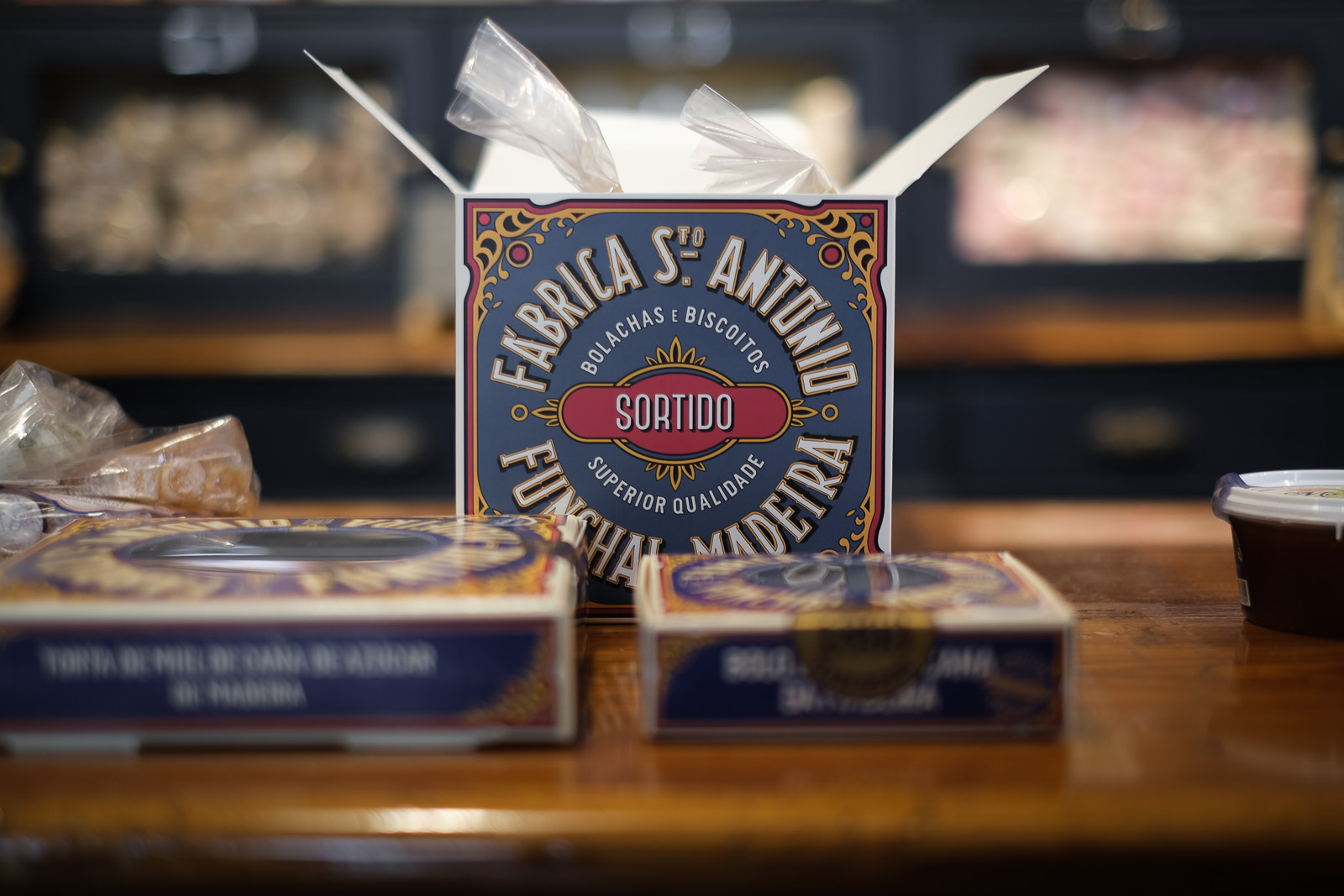


It is thought to be the island’s oldest desert and was traditionally baked for Christmas ensuring to produce a large enough batch that it would last the entire year as it can typically stay good for a whole 12 months with its flavours intensifying over time.
Where to eat Bolo de mel in Madeira
For Funchal’s best bolo de mel de cana, seek out Fabrica Santo Antonio in the city centre. This quaint old shop and factory with its early 20th-century display cases, scales and counters was founded by Francisco Roque Gomes da Silva in 1893. He was inspired by the large English presence on Madeira and decided that he could make a successful business baking cookies for the Brits to eat with their afternoon tea. With that, Madeira’s first biscuit factory was born. Much of the original machinery (imported from England) is still used today, although the factory has since diversified to create jams, marmalades, sweets and molasses cake.
Chocolate from UauCacau
If molasses cake isn;t enough to satisfy your sweet tooth, wander down the street from Fabrica Santo Antonio to UauCacau, a chocolate shop founded by master chocolatier Tony Fernandes. They offer over 40 different flavours of beautifully moulded, colourful chocolates based on products of the island including banana, mango, passion fruit, pitanga, poncha or Madeira wine.

What to Drink in Madeira
You will need something to wash down all of that wonderful Madeiran food, and the island doesn’t skimp on drink choices, particularly drinks of the alcoholic variety.
Madeira Wine
There is no drink more emblematic of the island than Madeira wine. Like Portugal’s other famous alcoholic export, port, Madeira is a fortified wine, dating back centuries to the days when wines were taken on board merchant vessels as victuals, with brandy being was added to each barrel to improve its keeping qualities during the long sea voyages. Surprisingly, it was found that the heat and humidity of the ship’s cabins dramatically enhanced the wine’s complexity and it soon grew in popularity worldwide.


Such was the popularity of Madeira wine that winemakers soon began attempting to replicate the aging process on land, first with what became known as the canteiro process – using the sun to heat the barrels – and later using specifically designed ovens in the estufa (stove) method.
Both processes are still used today, although the ‘stoves’ have been replaced by heated water jackets around the barrels, allowing the wine makers to more accurately control the temperature – typically a constant 45 ° C to 50 °C for a period of three months. The wine is then aged in wooden casks for 3, 5, 10 or 15 years and comes with differing levels of sweetness or dryness depending on what point in the fermentation process the fortification takes place.
Madeira wine is normally made with a range of grape varieties, such as primarily made with a handful of grape varieties, including Tinta Negra Mole, Sercial, Verdelho, Bual, and Malvasia, although the grape colour doesn’t have much of an influence on the appearance of the final product; Madeira gains an amber or toffee colour through its heating and oxidation process.
Where to Drink Madeira Wine
Occupying a former Franciscan monastery, Adegas de São Francisco, Blandy’s Wine Lodge is probably the best place in Funchal to learn all about Madeiran Wine. The Blandy family’s history of wine production dates back to 1811 when John Blandy, along with his brothers Thomas and George, founded his own business as a wine shipper and general trader. Eventually, he purchased this property in Funchal due to it having the perfect layout, shape and structure to create a combination of unique temperature and humidity conditions for ageing Madeira wine.
The company is still run by the 6th and 7th generations of the Blandy family, Michael and Chris Blandy, and a fascinating tour of their wine lodge covers the making of barrels at the Cooperage, the transformation of grapes into Madeira wine, a look at their Brasilian satinwood storage vats and a look of the on-site museum. This is followed by the most important part of the tour; a Madeira wine tasting session. Tours last 45 minutes and cost €11.00 per person.
Poncha
While I mentioned earlier that Madeira wine is the emblematic drink of the island, the locals tend to favour poncha, a deceptively intoxicating mixture of sugar cane liqueur, honey, orange and lemon juice. Recipes for this tipple vary ever so slightly across the island but the main base of the punch remains the same. Typical varieties are passion fruit poncha, the ‘regional’, and the ‘à pescador´’ or Fisherman’s poncha. Just ensure that your concoction is muddled and mixed with a traditional poncha stick.

The origins of poncha aren’t completely known. Some people believe that its roots lie in the 16th century, when lemons, preserved in brandy and cane molasses, were used to treat scurvy while others claim that it was first made by fishermen in the village of Câmara de Lobos as a way to keep themselves warm on cold evenings.
Where to Drink Poncha
This potent concoction can be found in most bars on the island, although the best small, traditional poncha bars can be a little harder to located due to the fact that many are nameless. As Câmara de Lobos is thought to be the original birthplace of poncha, then this is the ideal place to start. Venda do André has been serving the drink for almost 70 years and shifts up to 500 glasses of the stuff on a good weekend.
Locally Brewed Craft Beer
While major cities like Porto and Lisbon currently have a thriving craft beer scene, it seems that the rise in small, modern breweries that has been sweeping its way across Europe for the past decade and a half hasn’t quite managed to straddle the small stretch of the Atlantic between this island outpost and the Portuguese mainland.
For the most part, beer drinkers are limited to Coral lager, brewed on the island since 1969 and now owned by Heineken. Recently, there has been a slight surge in craft beer offerings thanks to bars like FugaCidade in Funchal, who ship in kegs, cans and bottles from independent producers on the mainland, and Vilhoa, a small craft beer supplier that has been in operation since 2016 with the aim of importing craft and artisan beer from Portugal to supply bars and restaurants across the island.


But what about craft beer brewed on Madeira itself?
Sitting on Funchal’s waterfront, the Beerhouse may not look like a typical craft brewery with its tented roof, gaudy, German-inspired logo and waiters in lederhosen, but it is in fact Funchal’s only microbrewery. The beer is good too; you can sit amongst their small tanks to sample the lager, weissbier and blondes that are brewed on site using hops and malts grown locally in the hills above the city.
Getting to Madeira
There are direct flights to Madeira from multiple UK airports. Jet2 offer flights to Madeira from Birmingham, Bristol, East Midlands, Edinburgh, Glasgow, Leeds Bradford, London Stansted, Manchester and Newcastle.
Jet2 also have a range of package holidays to Madeira.
Madeira’s airport is located 10 miles east of Funchal and connected by the Aerobus which runs once an hour from the airport to the Lido area (or Hotel Zone) on the west side of Funchal, via the city centre. A one-way ticket costs €5. A taxi to the city centre costs between €25 and €30.
Where to Stay in Madeira
One of Funchal’s newest openings, Hotel Next is the latest offering from the ever-popular Savoy Group’s six luxury hotels that they operate across Madeira.
However, the Next offers a twist on stylish and contemporary accommodation, focusing on a younger clientele and taking lessons it learned while opening during the COVID-19 pandemic to implement state of the art, automated features; your entire experience can be operated from a phone app, whether that is setting your room to the ideal temperature before you head back to the hotel, ordering spa treatments and room service, or even activating the ‘do not disturb’ light on the exterior of your suite. Its high-tech credentials and focus on co-working spaces make the hotel ideal for digital nomads, TEFL teachers and millennials.
However, this doesn’t mean that Hotel Next has forgotten the basics. The rooms themselves are stylish and sleek with an updated take on a mid-century modern aesthetic while the hotel is packed with excellent facilities. The poolside Recharge bar and restaurant serves up some of the best food you will find in Funchal – refreshing ceviche and colourful poke bowls of plump tuna steak – all with views out over the ocean, while the rooftop has its own pool and cocktail bar where you will find a DJ pumping out the tunes on a weekend evening.
I was provided with a complimentary stay at the Next by Savoy Signature with Jet2Holidays
I travelled to Madeira as a Guest of Jet2 and Visit Madeira, however, all views expressed are my own.