
The farmer carefully shredded the dry tobacco leaves with a pair of scissors before laying the wrinkled fronds across the kitchen table. He shaped them with a dexterity that I wasn’t expecting from his cracked, work-worn fingers. He talked us through each step of the process in gravelly Spanish, his voice hoarse from years of cigar smoking. I didn’t catch much of it. Between his the huskiness of his mumbled words and his thick moustache – so luxuriant that it would make Tom Selleck’s top lip shrink with inadequacy – barely a single syllable found its way to me.
Other than this small kitchen table, the house was sparse; a two-room cabin sitting among the tobacco fields of the Viñales valley. A few short feet away, the farmer’s wife stood by the stove – a concrete worktop with a small wood fire burning on top – stirring a pan of coffee the colour of tar, and with a consistency that wasn’t too dissimilar. I gulped it down with a grateful nod and barely concealed grimace before continuing to watch the demonstration.


Although Tobacco is still big business in Viñales, much of the town is turning itself over to tourism. In the main square, small stands hawk souvenirs while tourist-focused restaurants and bars are scattered along its centre. Almost all of the colourful homes along here have been transformed into casa particulares, the Cuban equivalent of bed and breakfasts, one of the few forms of private enterprise available to regular Cubans as a way to supplement their measly $30 a month government salary. There is even a hop on/ hop off bus that winds through the valley, stopping at various viewpoints and attractions for the benefit of holidaymakers.
Some of these enterprises are more authentic than others. At the Viñales Mural de la Prehistoria you can find a huge mural daubed on a rock face, portraying world history up until the age of humans. It has been decried as an eyesore and grumpily, I have to agree. It has the air of a child’s painting, blown up to be visible for miles around. Not only that, but the cost of refurbishing the work is eye-wateringly high in a region that would benefit from more useful government spending. Only marginally more interesting is Cueva del Indio, an underground river that cuts beneath the valleys pincushion hills. For a few dollars, you can take a ‘Pirates of the Caribbean’ style boat ride through the caves. However, for a more realistic view of Cuban country life, nowhere provides a better insight than the tobacco farms nestled in the valley.

The microclimate, both sun-drenched and sodden with rain, combined with the fertile soil, creates the perfect conditions for crop cultivation. It’s thought that the lumpy limestone mogotes that speckle the landscape are responsible for capturing the clouds and holding them in place. It’s these factors mean this small, rural village produces the best tobacco – and therefore, the best cigars – in the world.
As we trekked through the fields in the torrid sunshine it was hard to imagine that this region ever saw rain at all. Squinting, hands shielding my eyes and sweat streaking down my face we made our way across the rusty soil towards the farm. The heat was oppressive. Even the few farmers that we came across had abandoned their fields for the afternoon. In an attempt to escape the rays, they hid in the shade of wooden lean-tos. They couldn’t look more stereotypically Cuban; bedecked in fading green army fatigues and clenching cigars between their teeth, fanning themselves with their wide-brimmed hats and mopping their brows. The majority of them are old, still working the copper-red fields with ox-drawn ploughs and no modern machinery – the traditional, labour-intensive way. It is out of necessity rather than any sense of nostalgia. Their children have abandoned farming for the burgeoning tourism industry or moved to the city for work.

They watched in amusement as we schlepped and sweated our way through the valley. We found one farmer dosing in a small shack, feet on his table and hat pulled down over his eyes. A Champions League game played out on his small CRT television to no one. The only person that we found working was a man of around 70, curing tobacco in the shelter of a drying barn. His weather-worn face dripping with sweat as he carried bundles of cured tobacco leaves and then hung them from the rafters like thousands of crinkled brown chrysalis. He explained that he would leave them there for a month, only then would they be ready to sell. The Cuban government buy around 90% of the product for use in their state-owned companies such as Cohiba and Montecristo, taking a small sample first and gauging the price based on the lowest quality leaves. The farmers are left with the remaining 10% to do with as they wish.


The Campesino carefully coiled the leaves into a tightly wound cylinder before inspecting his work, clipping the end with a small pair of scissors, and then holding it out for me to take. Once his hands were free, he picked up his own cigar and resumed his puffing. It is amazing that in just a few minutes, a small bundle of leaves can be transformed into an object that is so desired by so many and, in the case of the Cohibas sold in the tourist shops of the town centre, so valuable. The cigars that these farmers rolled and sold to tourists didn’t have the label and therefore the price tag of Cuba’s famous brands. Using their share of the crop, they managed to supplement their measly government pay by selling bundles – 10 cigars wrapped in a ribbon with a price tag of $10 – to tourists like me. I wasn’t obliged to buy but felt that it was a fair price to pay for his hospitality, coffee and demonstration alone.

It’s this ‘make do and mend’ mentality that seems to define the Cuban spirit. Wherever you travel in Cuba, people are taking what little they have and using it to its full potential in hope of improving their situation; whether that is renting out spare rooms in your home, selling cigars or giving tourists horseback tours of the valley.


We ate at our Casa that night – a huge meal of lobster, rice, plantain, fruit – cooked by our hosts for only $5 – and ruminating on how the valley has managed to successfully merge its old way of life with the new. For the men in the fields, nothing much had changed; they still spend their days planting, harvesting and curing tobacco while others raise livestock for food or to use as draft animals. It shows the ingenuity of the Cubans that they had continued to do this while also embracing the influx of tourists, earning a little extra money by selling tours and cigars.
Nowhere is this more clear than at La Finca Agroecologica El Paraiso, an organic farm just outside of town. Organic farming isn’t just a trend in Cuba, it is a necessity. With limited access to pesticides, the Cubans have become experts in growing food organically, with methods such as planting marigolds between the crops to keep insects away. The owner, Wilfredo, has opened his farm up to allow people to tour the grounds and he even serves meals in his beautiful wooden farmhouse. We settled down at a long banquet table on the porch of the house. Below us, the spire of Vinales’ church emerged from the treeline. In the distance were the lush limestone karsts, framing an incredible view of the whole valley. Bottles of Ron Cubay lined the table and gradually plates upon plates of roast pork, steamed vegetables and rice were brought to us. It was more food than we could eat and the best meal I tasted in all of Cuba. Even the farm’s cat that had been patiently waiting at my feet, and then on my lap, eventually had its fill and wandered away, sated. As night fell, the blue sky gave way to a star-filled night, the lack of light in this part of the country giving us a show as the milky way emerged from the darkness. I couldn’t have felt any more content. Crickets chirped from the fields and chickens clucked, only drowned slightly by the farmworkers strumming an impromptu performance of Buena Vista Social Club’s ‘Chan Chan’ from within the house.

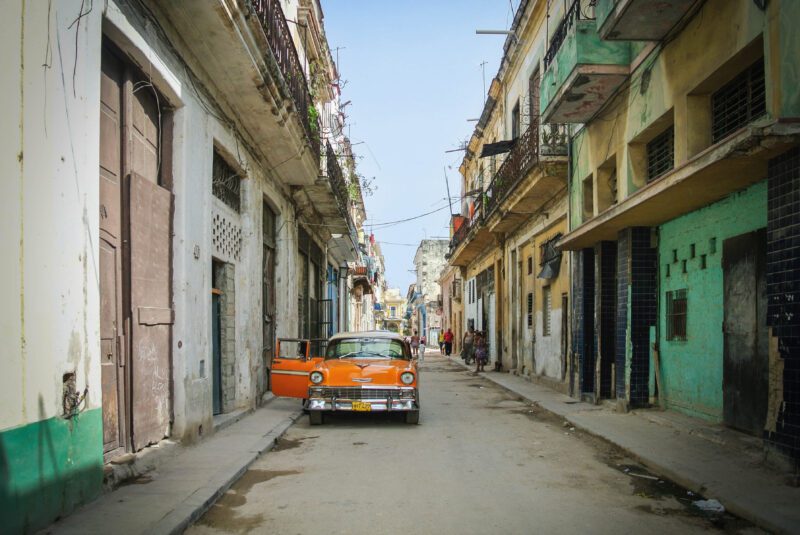
Despite this embracing of visiting foreigners, you only need to walk a block or so from the touristic centre to feel that you are once again in the middle of nowhere. Campesinos rumble by on horse and trap while chickens roam freely on the dusty road. The clattering of ancient Chevy’s is replaced by the snorting of pigs and guttural groans of cattle. Only the slight rumble of a crowd at the local baseball stadium, if you can call it a stadium, disturbed the peace. I was told that it was an important game – Vinales were playing against their local rivals – so wandered inside to see. If it was such a vital match, no one had informed the crowd. The scattering of people of people seemed more interested in chatting to me and posing for my camera than the events playing out on the field. At the back of the bleachers, a couple of old men dosed. On the pitch, not a lot was happening. The players stood around in their mismatched uniforms, chatting, seeming intent on never throwing a ball. I’m not a baseball aficionado – in fact, I know nothing about the game – so maybe this is the norm; just a bunch of men standing on a painted diamond for hours on end, not doing much.

The contrast with Havana is stark. Unlike the capital, and surprising for a town that is increasingly reliant on the tourist dollar, no one I met on my rural wanderings was intent on selling me anything. People would wave from their rocking chairs as they ruminated on their porches or yell a hearty ‘Hola!’ from horseback when they passed. Only a husky, rotund gentleman in a Stetson with a tiny, wooden pina colada stand seemed to be taking advantage of this influx of visitors, but even then, he seemed more concerned in chatting to me and showing me photographs of his pet Desmarest’s hutia than convincing me to purchase a drink.

I finished my stay in the small, open-air salsa bar nestled in the corner of the town’s main square. On the stage, a band beat to the sound of Son rhythms while the gathered crowd indulged in salsa moves, fuelled by a constant supply of cheap beer and overly strong mojitos. It was a 50/50 mix of tourists and locals, the latter pulling the former to their feet to get physical on the dancefloor, pulling them close for a lesson in Cuba’s national dance. Performers in elaborate carnivale costumes worked the audience as people span and gyrated around them.
As I ended my evening in the local way, on the porch of our casa, cigar in hand and ice-cold Bucanero at my side, I couldn’t help but fall for this place. With all the rights and wrongs of Cuba’s communist system and the frugal existence that many are forced to endure, the people of Vinales seem intent on living life to the full. Working by day, dancing all night and embracing outsiders as if they have lived in this small town their whole lives. Beyond the classic cars, cigars and minty mojitos, communism and propaganda, this is what makes Cuba truly special. At that moment, there is no place that I would rather be.


2 Responses
Beautiful photos you’ve got here! Cuba is a stunning country and the people are so resilient and welcoming. I love the country but never explored the tobacco culture while I was there!
I think that’s what struck me about the country too – just how welcome I felt and how friendly people were. Hopefully, you get to go back and visit Vinales!