Benny Moré once sang “Cienfuegos is the city that I like most”. He was the most popular singer that the island has ever produced, known for his blending of so many Cuban styles – mambo, son, guaracha – and by far the most influential. So much so that his musical legacy still lives, permeating throughout the Island.
By immortalising Cienfuegos in his lyrics, he put the city on the musical map. The city, in turn, has immortalised him in its own way. Bars, clubs and music venues all bear his name, and at the intersection of Av 54 and Paseo del Prado, you will find a life-sized Bronze of Benny, a walking stick tucked under his arm and a wide-brimmed hat shielding him from the southern Cuban sun.
Despite not hailing from Cienfuegos – he was actually born 40 km away in the tiny central Cuban town of Santa Isabel de las Lajas – It is easy to see why he spoke so highly of the city. Known as the ‘Pearl of the South’ it is an enticing mix of Caribbean soul and French splendour. Founded by the French in 1819, its clusters of neo-classical buildings are unlike those found anywhere else in the Caribbean. They have earned the city UNESCO World Heritage status and occasional comparisons to Paris. Although the comparisons may be a little generous, the beauty of the architecture is undeniable.

I started my exploration in Jose Martí Park, the city’s main square. It is famed for its exquisite buildings; the baby blue mansion of Palacio Ferrer, The red dome of Palacio de Gobierno and the faded grandeur of Teatro Tomas Terry. For just 2CUCs you can step inside the theatre and gawp at it in all its splendour. After a long journey from Vinales, it was getting late in the day and I practically had the square to myself. In its centre stood the imposing figure of Jose Martí, the Cuban national hero whose carved likeness can be seen wherever you turn in the country. From a rooftop in the corner of the plaza, another revolutionary looked down on me; scaffolding adorned with Alberto Korda’s iconic image of Che Guevara and the words “Vive tu ejemplo, tus ideas perduran”, “Live your example, your ideas last”.

It wasn’t the first such propaganda that I’d spotted while travelling along the south coast. As I passed the Bay of Pigs, the journey was punctuated with billboards, each with an image of Cuban soldiers and words such as “Hasta aquí llegaron los mercenarios” – The mercenaries arrived here – marking important locations in the failed invasion of 1961.


The pastel pink Arco de Los Trabajadores (Arch of Triumph) – a monument to the formation of The Republic of Cuba in 1902, when Cuba seceded from US rule – stands proudly at one end of the park in another show of revolutionary spirit. It seemed strange to find so many little nods to the past dotted around the town. Even in Havana, where monuments to Cuba’s infamous guerillas are abundant, they aren’t scattered quite so densely. In Vinales there was just the occasional bust of Martí. Looking into the history of the region, it makes sense. Cienfuegos was the scene of a battle during the Spanish–American War in 1898, the city saw an uprising against Fulgencio Batista during the Cuban Revolution, and the Bay of Pigs invasion took place on this stretch of coast, just 90 km away. This region has played an important role in shaping Cuba’s history.

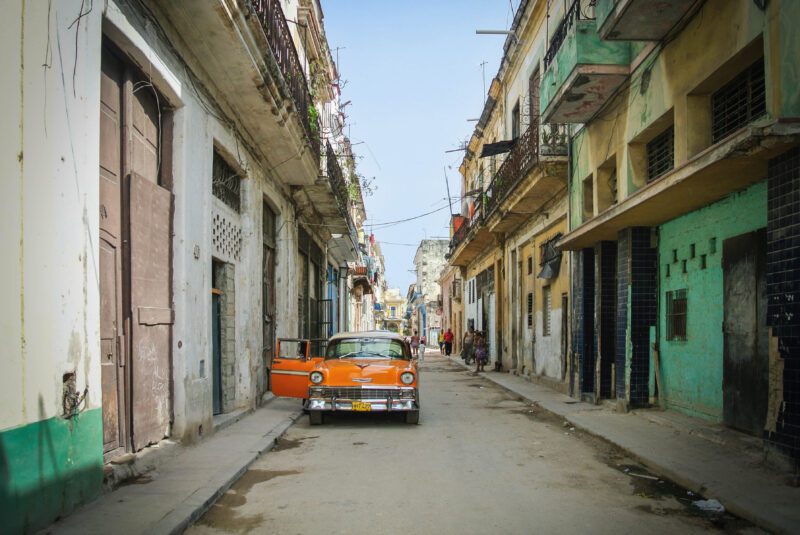
I made my way down Paseo del Prado, the main avenue cutting a long, wide path through the city. Compared to the tourist hubs of Havana and Vinales, Cienfuegos was peaceful. Paseo del Prado was practically empty, aside from the few children playing on the pavement. Families lounged on their painted porches, the sounds of Son crackling from their radios, and old men sat at fold old tables, locked in an intense game of chess or cards. Some homes here have no front doors, the property extending out to the roadside and lives playing out in public for all to see.

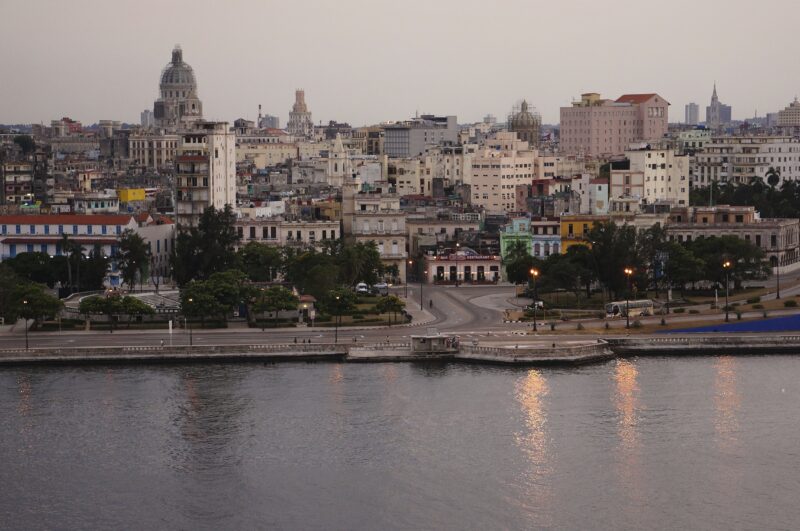
At the far end of the boulevard, I emerged at the Malecon; a road sweeping around the edge of the spectacular Cienfuegos Bay. Here I found Punta Gorda, the city’s upper-end neighbourhood, filled with vast, 1950s mansions. The crown in Punta Gorda’s architectural crown, however, is the incredible Palacio de Valle. Built between 1913 and 1917, it is an eclectic mix of styles. Its carved wood interiors are reminiscent of Spanish-Moorish designs while the red-tiled turrets jutting from the rooftop are in perfect keeping with Cienfuegos’ neo-classical style.

The palace’s restaurant was far beyond my budget. I instead climbed the spiralling stairs to the roof terrace so that I could take in the views of the bay while sipping my first mojito of the day. The sun was just setting and, finally, the sticky humidity of the afternoon was starting to abate. A breeze drifted in from the water and, in the distance, dark thunderheads reared up over the Caribbean sea. It wasn’t long before flashes of light crackled in streaks across the sky. Finishing up my drink, I thought I had better call it a day and made my way back to town to find shelter.


It was that evening that I found the spirit of Benny still flowing through the veins of the city. The locals emerged from their painted houses and made their way to a tiny bar, sandwiched in a courtyard next to Teatro Tomas Terry, to dance to salsa and bolero. I was torn away from my Cuba libre as a woman, who must have been in her 50’s, rotund and half cut, hauled me to my feet. Her hands- n my buttocks, she pulled me towards her and led me through a sloppy dance. On the stage, “Como Fue” (How it Was) played as an elderly lady in a straw fedora span, swirled and ground against a series of men a third her age.
My dancing shoes all worn out, I made my way back down Paseo del Prado past the worn colonial buildings towards my casa particular. The sounds of the very same song approached me, played by a brass band. They cornered the street, followed by a crowd of hundreds, all drinking, singing and dancing. I stuck with the parade of revellers as it marched its way towards the Malecon, eventually peeling off to find my bed. It is these scenes that make Cuba so compelling. Despite the hardship, the relative poverty and the downfalls of communism, a celebration or party is never far away. I’m not sure what the occasion was, but it was a scene that would have made Benny like Cienfuegos even more.