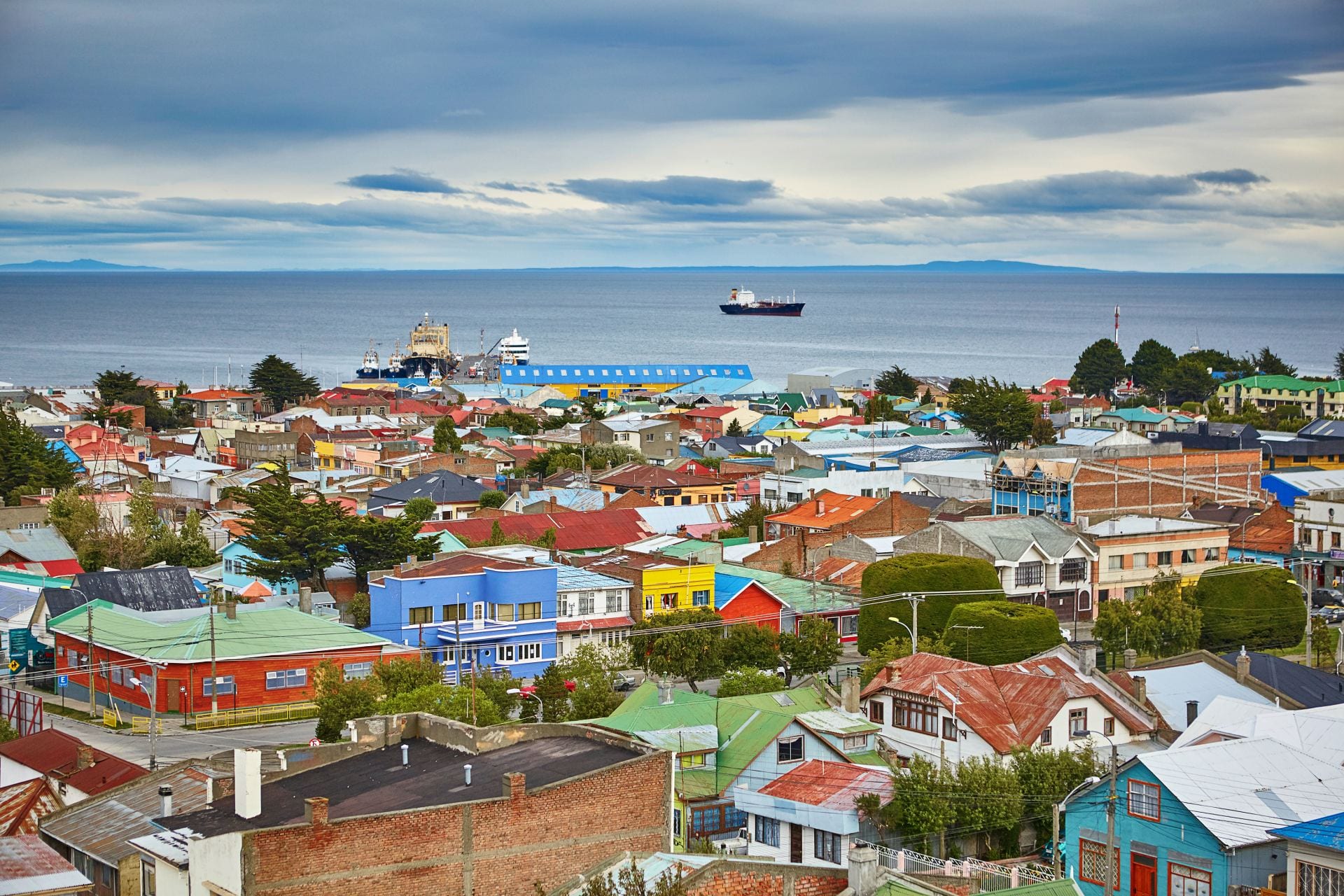
First established in 1843 as a penal colony, Punta Arenas has long been Chiles most Southern inhabited conurbation, an outpost at the end of the world. It’s a city that is constantly beaten by wind and waves blow in off the rough waters of the turbulent Magellan Strait, and despite its streets filled with colourful houses and monuments to an illustrious past, it can occasionally feel desolate and forgotten.
However, Punta Arenas remains Patagonia’s largest city. This wind-bitten port of nearly 130,000 grew rapidly in the 19th century thanks to the Patagonian sheep-farming boom to become a wool-production centre. Its position as a stop-off on journeys between the Atlantic and Pacific funnelled yet more wealth to the town. Then there are the local coal reserves, and local coal reserves, which funded the European-style splendour of the city’s mansions. Following WWII, the wool trade declined and the Panama Canal robbed the strait of its importance.
It’s this history that makes Punta Arenas an interesting place to visit. It is a mix of over-blown faded grandeur and run-down disorder. Manors and mansions still line the beautiful Plaza Muñoz Gamero and reminders of Punta Arenas’ seafaring legacy are found all over town in museums, street names and monuments.
Like the sailors of old, the majority of visitors to Punta Arenas are just passing through, on their way south to the Antarctic or north to Torres del Paine National Park, but linger for a couple of days and you may be surprised: the Magellan Strait may seem hostile, but it has plenty to offer nature lovers, history aficionados, and those that are curious about seeing more of Patagonia than just the star-attractions.
Getting to Punta Arenas
To/From Ushuaia
The journey from Ushuaia to Punta Arenas is particularly picturesque, taking you through the mountains surrounding Ushuaia and then onto the landscape of the Patagonian steppe and along the Magellan Straits. The trip takes around 11-12 hours, including a short ferry trip across the rough waters of the Magellan Strait at its narrowest point. Make sure you purchase a ticket (£35) at least one day in advance as the bus does tend to fill up quickly on the day.
Buses run from Terminal de Ómnibus de Ushuaia. Bus Sur leaves on alternating days at 8am while Buses Pacheco run every Tuesday, Thursday and Saturday at 9am. The timetable from Punta Arenas to Ushuaia is every Monday, Wednesday and Friday at 8.30am.
Book seats from Ushuaia to Punta Arenas.
To/From Puerto Natales and Torres Del Paine National Park
The bus journey from Punta Arenas to Puerto Natales runs regularly and takes just 3 hours. There is no central bus station but the buses tend to leave from their respective offices. Bus Sur run 5 buses per day (£8) between the two cities but once again, it is best to book at least one day in advance as tickets do sell out.

Getting Around
Punta Arenas is relatively small and easy to navigate thanks to its grid-like layout of streets. The majority of the town is walkable from Plaza Muñoz Gamero but taxis are available and charge a flat rate of 350 pesos to take you just about anywhere within the city limits.
Where to Stay in Punta Arenas
Due to the transient nature of Punta Arenas – most people are only passing through, spending the night when changing buses on their way between Puerto Natales and Ushuaia – you would think that high quality accommodation may be a little hard to come by. However, seeing as people backpacking in Patagonia will inevitably pass through here on their way north or southwards, there are plenty of high-quality hostels on offer, with the majority located within two or three block’s walk of the bus terminals or main square.
Hostel Good Vibes
A cozy and rustic hostel located in a 100-year-old building – declared as an important cultural heritage site – in downtown Punta Arenas, Good Vibes has an on-site coffee and pastry shop as well as an open kitchen and store that well-stocked with essentials.
Hostal Buena Estancia
A lovely little guesthouse located just 400m from the main square. Although it may be a little more expensive than the hostels located around town, Hostal Buena Estancia is clean and cosy, offering great double and twin room for couples.
Hotel Nogueira
Punta Arenas’ most extravagant hotel, Hotel Nogueira was once the mansion of sailor José Nogueira, one of the founding fathers of Punta Arenas who had built his fortune thanks to shipping, sea lion hunting and sheep farming. Now a national monument, this rather grand 22-room hotel – whose former guests include King Juan Carlos of Spain and Princess Anne – sits in front of Plaza Muñoz Gamero as a reminder of the city’s past glory.
What to do in Punta Arenas
Punta Arenas is first and foremost a port city, a point of embarkation for some of the region’s leading adventure cruises as well as a jumping-off point for international biology expeditions to the Antarctic peninsula. In truth, Punta Arenas can sometimes feel a little desolate and forgetten, especially in winter when covered in a shroud of sleet and rain. However, the city’s illustrious past does mean that it has plenty of history and splendour to keep you occupied for a day or two – particularly if you have an interest in the history of antarctic exploration – as you pass through on your way to Patagonia’s more popular destinations.
Mirador Cerro La Cruz
The best way to get your bearings in the city while also soaking up a fantastic view is to walk 5 blocks (15 minutes) along Calle Fagnano to Mirador La Cruz Viewpoint. Here you will find stunning views of the city’s colourful, corrugated iron rooftops as well as the straight of Magellan and, off in the distance, Tierra del Fuego. Nearby is also Castillo Milward, an eccentric manor house mentioned by Bruce Chatwin in his book In Patagonia due to the fact that this Gothic, red brick building was constructed by his relative, the sailor Charley Milward.
Cementerio Municipal
Although visiting a cemetery may not be everyone’s idea of a fun day out, Punta Arenas’ Cementerio Municipal is among South America’s most fascinating graveyards and was actually named by CNN as one of the most beautiful cemeteries in the world.
Along the Cyprus-lined alleys, you will get a glimpse of the city’s history from the humble graves of European settlers, illustrious mausoleums of industrial barons, and marble tombs of the ruling class. One of the most famous is the flashy replica of Rome’s Vittorio Emanuele where wool entrepreneur Jose Menéndez lies buried, or the Russian-style chapel of Sara Braun, one of the city’s most famous residents.
Where: Pedro Sarmiento de Gamboa 29
When: 7.30am – 7pm
Museo Naval Y Maritimo
This small museum near the Plaza offers a deep insight into Punta Arenas’ seafaring history, including an account of the Chilean expedition that rescued Sir Ernest Shackleton’s crew, naval history, and detailed displays revolving around the exploration of the southern oceans. The museum’s best exhibition is on the second floor, which has been transformed into the replica of a ship, complete with bridge and radio room.
Where: Pdte. Pedro Montt 981
When: Tues to Sun 9.30am – 12.30pm
Isla Magdalena
A one-and-a-half-hour ferry ride across the Magellan Strait takes you to an island that sits in its stormy centre, Magdalena Island. This wind-swept isle is home to the largest Magellanic penguin colony in all of Chile, where up to 120,000 nesting birds return every year between October and March to lay eggs and raise their young on a 1km square cliff beside the old lighthouse.
The ferry, Melinka, runs between November and February on Tuesdays, Thursdays and Saturdays from Tres Puentes Terminal and allows you one hour to explore the island (trip takes place between 5 and 10pm; CH28,000) and although the penguins are unafraid of humans, you should stick to the marked pathways. Alternatively, Solo Expeditions run a daily tour from 7am – 11am (CH38,000) that includes an hour on the island and a sail past the sea lion colony of Isla Marta.

Where to Eat & Drink in Punta Arenas
Due to its port, Punta Arenas is known for its seafood, with centolla (spider crab) and erixos (sea urchins) being the local delicacies. These can be found in most of the restaurants around town, but Mercado Municipal is probably the cheapest place to sample them. Despite not being a tourist hub, there are plenty of fantastic bars around town serving up a good selection of north Patagonian wines and surprisingly, the craft beer scene is fantastic: Cervecería Austral, Cerveceria Artesanal Hernando de Magallanes and Selknam Craft Beers all produce their own small-batch brews but Austral is the only place that offers regular tours and tastings.
Kiosko Roca
Establishing itself in Punta Arenas way back in 1932, Kiosko Roca has sionce opened branches in Santiago and Valparaiso. However, this little hole in the wall joint is still legendary amongst locals for its cheap choripan and milkshakes.
Where: Pdte. Julio A.Roca 875
When: Mon to Fri 7am – 7pm; Sat 8am – 1pm
Bar Shackleton
The most historic bar in town, Bar Shackleton is named in honour of the Anglo-Irish explorer led three British expeditions to the Antarctic during the Heroic Age of Antarctic Exploration, including the expedition in which they were rescued and brought to Punta Arenas in 1916.
Stepping inside is like travelling back in time to the glory days of Punta Arenas; wood pannelling adorns the walls and glittering chandeliers hand from the ceiling. The food here may be a little pricey for the average backpacker, but it is worth stopping by to sample their whiskey: a recreation of the drink taken to Antarctica by Shackleton during one of his expeditions between 1907 and 1909, found 100 years later.
Where: Hotel Nogueira
When: Mon to Sat 10.30am – 12pm (During low season until 10.30pm); Sun 10.30am – 10pm.
La Marmita
It may be worth stopping-by at La Marmita to verify their claim that they make the best pisco sours in all of Patagonia but hidden behind the bright exterior and graffiti-written sign is some of the best food in the city. This family-run restaurant located in the heart of Punta Arena’s Croatian neighbourhood serves up fantastic ceviche and soups and has a good selection of vegetarian fare.
Stepping inside is like travelling back in time to the glory days of Punta Arenas; wood pannelling adorns the walls and glittering chandeliers hand from the ceiling. The food here may be a little pricey for the average backpacker, but it is worth stopping by to sample their whiskey: a recreation of the drink taken to Antarctica by Shackleton during one of his expeditions between 1907 and 1909, found 100 years later.
Where: Plaza Francisco Sampaio 678
When: Mon to Sat 12.30pm – 11.30pm
La Taberna
Following the death of Sara Braun in the mid-20th century, her palace was sold to the union club where, in 1960, they established a subterranean clubhouse named La Taberna. Although this atmospheric basement drinking spot was once reserved for the city’s most powerful men, it is now open to everyone and has become one of Punta Arenas’ most iconic bars thanks to its cozy nooks and old-world appeal.
Where: Plaza Muñoz Gamero 716
When: Mon to Sat 6pm – 3am
Bar Bulnes
Serving up a delicious selection of Pizza and Burgers, Bar Bulnes is a favourite among locals because of their award-winning beer that they brew on-site. The prices are good too: a beer flight will set you back just CH7000 (£6.90).
Where: Avenida Presidente Manuel Bulnes
When: Mon to Thurs 5pm – 3am; Fri & Sat 5pm – 4am; Sun 5pm – 2.30am
Lomito's
The Chilean answer to an all-American diner with a neon sign outside that wouldn’t look out of place on Scarborough seafront, Lomito’s bears a little resemblance to an outdated Frankie and Benny’s with food to match. The majority of the menu is taken up by burgers and grilled sandwiches but it is relatively cheap and a good place to sip beers and watch sport with locals.
Where: José Menéndez 722
When: Daily 11am – 12pm

When to Visit Punta Arenas
Punta Arenas has an unpredictable climate, being at the mercy of three oceans as well as polar currents and it can get very cold and windy. Summer is obviously the best time to venture this way, however, during July the city comes to life with parades and fireworks for the Winter Festival of Punta Arenas. There’s also the annual Folk Festival of Patagonia each August, featuring musical performances showcasing Latin folklore.