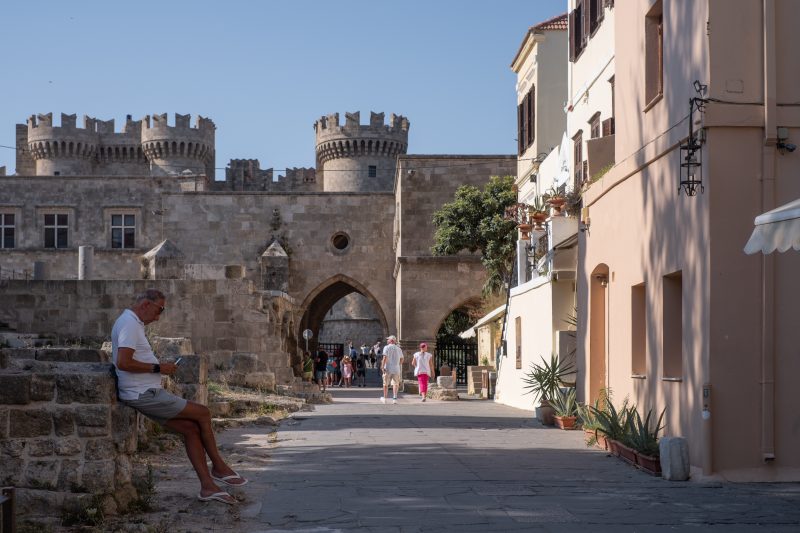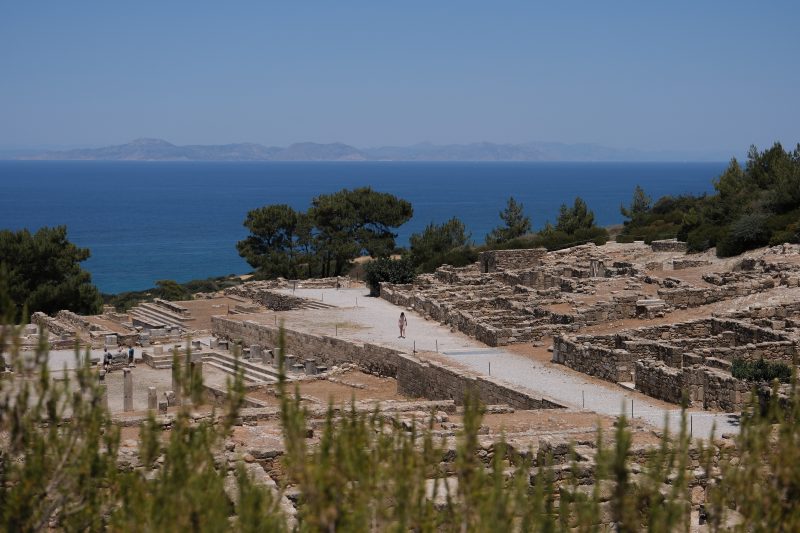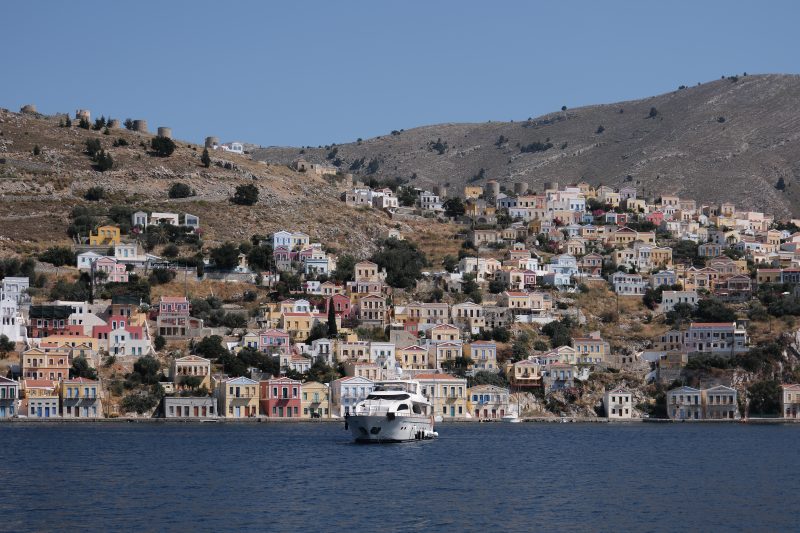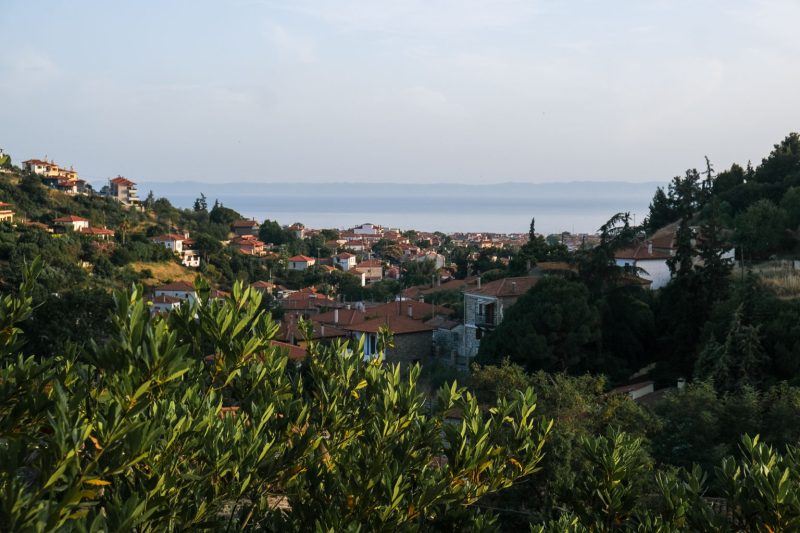
The road winds along the Aegean coast down the hillside and suddenly, it’s there: Lindos stretched out in front of you, a gleaming patchwork of whitewashed houses cascading towards the sea, framed by sandy bays and crowned by a commanding Acropolis. Few places on Rhodes deliver such a beautiful and dramatic view.
The village itself is a maze of narrow, car-free lanes where climbing vines and flowering bougainvillaea spill over walls. The compact streets are punctuated by a network of tiny squares that give way to arched doorways and mosaic-paved courtyards. These are the famous captain’s houses, built in the 15th and 16th centuries by wealthy seafarers, and many remain beautifully preserved with carved stone entrances and pebble floors. While much of the village has now given way to serving the tourists that flock here – souvenir shops, restaurants and lively tavernas – wandering the quieter edges is a chance to step into a living museum where daily Greek village life continues to unfold against a backdrop of centuries-old architecture.


At the heart of the village stands the Church of Panagia, its elegant bell tower rising above the rooftops. Inside, a dazzling collection of 19th-century frescoes decorates the walls, a vivid reminder of Lindos’ deep-rooted spiritual traditions. Just as captivating are the rooftop terraces scattered across the village. By day, they offer some of the best views in town; by night, they transform into atmospheric restaurants and bars where you can dine with the Acropolis illuminated above you.
That Acropolis is Lindos’ defining landmark and one of the most impressive archaeological sites on Rhodes. Perched high on a rocky outcrop, it has been a centre of worship and power since at least the 9th century BC, when a sanctuary to Athena was first established here. Successive rulers added to the site: the Greeks built temples, the Romans added fortifications, and the Knights of St John left their medieval walls still standing today. Walking among the ruins, with the sea stretching endlessly in every direction, is a reminder that Lindos has been a crossroads of civilisations for millennia.

That Acropolis is Lindos’ defining landmark and one of the most impressive archaeological sites on Rhodes. Perched high on a rocky outcrop, it has been a centre of worship and power since at least the 9th century BC, when a sanctuary to Athena was first established here. Successive rulers added to the site: the Greeks built temples, the Romans added fortifications, and the Knights of St John left their medieval walls still standing today. Walking among the ruins, with the sea stretching endlessly in every direction, is a reminder that Lindos has been a crossroads of civilisations for millennia.
Below, the village gives way to two perfect crescents of sand: the main Lindos Beach and the smaller, sheltered Pallas Beach. A short walk in the other direction brings you to the idyllic St Paul’s Bay, said to be where the apostle himself landed on Rhodes, now one of the island’s most photographed spots thanks to its still, turquoise waters and tiny, picturesque chapel.


As all of this suggests, Lindos has been continuously inhabited for thousands of years, and its strategic location on the east coast of Rhodes made it one of the island’s most important ancient settlements. During the classical period, it was a thriving maritime hub, famed for its skilled shipbuilders and traders. In the medieval era, the village grew beneath the protection of its fortified Acropolis, with many of the houses built during this time still standing today. Ottoman rule added further layers, from ornate doorways to decorative flourishes that remain part of the town’s architecture.
While Lindos’ historic past remains on full display, the shipbuilding and fishing industries that once dominated the streets have been replaced with a tourism boom and the energy of a thriving visitor destination. The trades and captains’ houses have mostly been replaced with restaurants and souvenir shops. Now, Lindos is as much about sipping a cocktail in the courtyard of a cool bar as it is strolling into a centuries-old church; as much about climbing to the Acropolis as it is about swimming in a sheltered bay. This harmony of ancient and modern is what gives Lindos its allure nowadays. Few places on Rhodes manage to capture the island’s essence so completely: dazzling natural beauty, layers of history, and a timeless village atmosphere that continues to draw people here.
Getting to Lindos
There are regular international flights arriving at Rhodes International Airport (Diagoras), located around 14km from Rhodes Town. During the summer season, the airport is served by the majority of the UK’s main airports, as well as numerous direct flights from major European cities.
Year-round connections are also available via Athens. Alternatively, ferries connect Rhodes to Piraeus (Athens’ port) and several nearby islands, offering a scenic and slower-paced way to travel.
Lindos sits on the east coast of Rhodes, around 50km south of the island’s capital, Rhodes Town, and just under an hour’s drive from the airport. The village is perched on a hillside beneath its famous Acropolis, sandwiched between two picturesque bays. Its location makes it an easy day trip from the north of the island or a good base for exploring the south and east coasts.
By Car
Driving is the easiest way to reach Lindos. The route follows the island’s main coastal road (E95), taking around an hour from either Rhodes Town or the airport. The drive is straightforward, passing through resorts like Faliraki and Kolymbia, with opportunities to stop at viewpoints or beaches along the way.
Parking is limited within Lindos itself, as the village is pedestrianised. Cars must be left in large car parks on the edge of the village. From here, it’s about a 10–15 minute walk downhill into the centre. There is limited parking along this road, but you will need to arrive early to get a space. In peak season, shuttle buses and taxis operate between the car parks and the village to make the descent easier, especially if you’re carrying luggage.
Having a car also gives you the freedom to explore nearby beaches or venture into the island’s mountainous interior without relying on public transport. Discover Cars is a great company to use for this, as they allow you to compare multiple providers before booking.
By Public Transport
Regular buses link Lindos with Rhodes Town and other east coast resorts. Services are operated by KTEL and run several times a day, with tickets costing just a few euros. The trip from Rhodes Town takes around 90 minutes, while Faliraki to Lindos takes about an hour. Buses are comfortable and air-conditioned, though they can get busy in July and August.
The bus stop for Lindos is located at the top of the village, near the main road. From there, it’s a short but steep walk down into the centre of the village itself.
By Taxi or Airport Transfer
A taxi from Rhodes Town to Lindos takes about an hour, with fares typically ranging between €70–90 one way, depending on the season. From the airport, expect similar journey times and costs.
Pre-booking a private transfer from Diagoras Airport to Charaki is also a good option. The service often costs around the same price as an Uber, with the bonus that you will not need to wait for your pickup or potentially have to traipse to a meeting point. This is particularly useful if arriving late at night, meaning that you won’t have to worry about the stress of finding a taxi when you’re tired. I usually use Get Transfer, who will arrange for a driver to meet you on arrival.
Where to Stay in Lindos
Lindos has preserved its traditional architecture, meaning many stays here are tucked into atmospheric old stone houses with beautiful shaded courtyards and whitewashed walls. Alongside the charm of the boutiques and rentals that sit in the village itself, there are a number of luxury resorts just outside of town for those wanting a beachfront escape or a balcony overlooking the bay.
Melenos Lindos
Where: Main Street, Lindos, 85107
Best for: Couples seeking romance and cultural immersion
Sitting in a prime location just beneath the Acropolis, Melenos Lindos is a boutique gem. Rooms are designed in authentic Rhodian style with hand-painted ceilings, intricate stonework and antique furnishings. The terraces, draped in bougainvillaea, offer spellbinding views across the rooftops to the Aegean. Its rooftop restaurant is among the finest in the village
Lindos Blu Hotel
Where: EO Rodou Lindou 615, Lindos 851 07
Best For: For travellers who want the charm of Lindos within easy reach but the facilities of a full luxury resort
Perched on the hillside just outside the village, Lindos Blu is one of Rhodes’ most acclaimed adults-only resorts. It’s sleek and contemporary in design, featuring cascading infinity pools, a private stretch of beach, and panoramic sea views from every room. The spa provides a serene retreat after days of sightseeing.
Caesars Gardens Hotel & Spa
Where: Krana, Lindos 851 07
Best For: Indulgent spa treatments ans world-class dining
A little inland from the village, Caesar’s Gardens offers a slightly bohemian take on Rhodian hospitality. Set amid olive groves and lush gardens, the property blends stone architecture with earthy, calming interiors. Its pool is fringed with cabanas, and the spa makes use of natural local ingredients. The restaurant sources much of its produce from the hotel’s own farm, creating a genuine farm-to-table fine dining experience.
Things to do in Lindos
While the Acropolis may be the main draw, the village of Lindos is every bit as captivating in its own right. A dazzling cluster of whitewashed houses tumbling down the hillside towards the sea, its beauty lies in both its postcard-perfect appearance and the seafaring history layered into its narrow lanes, rather than a list of sights and must-do activities.
The Acropolis of Lindos
No visit to Lindos is complete without climbing to its Acropolis, an ancient citadel that dominates the village’s skyline. Perched dramatically on a rocky headland 116m above the sea, it offers some of the most spectacular views on Rhodes: the labyrinthine alleyways of Lindos below, the sweeping arc of Lindos Bay, and the sheltered waters of St Paul’s Bay just beyond.


The site itself is layered with history. The earliest fortifications date back to the 6th century BC, when Lindos was a powerful city-state and the Temple of Athena Lindia was its spiritual heart. Later came the Romans, who added their own touches, and then the Byzantines, Knights of St John, and the Ottomans, who each left their imprint. Today, you can still see the remains of the Doric Temple of Athena, the grand Hellenistic stoa, and sections of medieval walls that once protected the settlement. Wandering among these ruins gives a vivid sense of how Lindos’ fortunes rose and fell over centuries, shaped by trade, war and faith.

Reaching the Acropolis requires a walk uphill through the village, followed by a steep climb via stone steps. Expect it to take around 15–20 minutes from the centre of Lindos. The path can be uneven and exposed, so sturdy shoes, water, and sun protection are highly recommended, especially in summer. Donkeys are still used to carry some visitors up the first part of the route, but I would advise against supporting this and choosing to walk instead. Animal-rights groups have urged visitors to consider how the donkeys are treated.
The site is open daily, generally from morning until late afternoon (always from 8am, but closing times vary by season), and there is an entrance fee of €20 to enter, which I thought was a little pricey for the experience. To avoid crowds and the midday heat, it’s best to go early in the morning or later in the afternoon. Allow at least an hour to explore, longer if you want to linger and soak up the views.
Exploring the Village
The village is entirely pedestrianised, making it easy to explore on foot. Narrow streets wind throughout, shaded by overhanging vines and punctuated by centuries-old, wooden doorways. Many of these houses, known as ‘captain’s houses,’ date back to the 15th and 16th centuries, built by wealthy seafarers who left their mark in carved stone doorframes and pebbled courtyards, locally referred to as hohlaki. Some remain private homes, while others have been transformed into shops, guesthouses or tavernas, but the sense of heritage lingers everywhere you look.


At the heart of the village lies the Church of Panagia, a small but richly decorated Greek Orthodox church. Inside, the walls are covered with 19th-century frescoes depicting biblical scenes, while the exterior’s elegant bell tower is one of Lindos’ most beautiful buildings. Other than the ruins above the town, there are few defining landmarks; however, Several of the old captain’s houses are open to visitors, offering a glimpse of life in centuries past. Their interiors often feature ornate ceilings, painted furniture, and mosaic floors, showcasing the artistry of Lindos’ craftsmen.
Beaches & Bays
One of the great appeals of Lindos is how close the village sits to some of the most beautiful beaches on Rhodes. Two fantastic stretches of sand bookend it, and within a short walk, you’ll find even more golden sands, calm turquoise waters, and sheltered coves that feel a world away from the town. Each beach has its own character, meaning that there is one to suit every mood: whether you’re after family-friendly shallows, a romantic hideaway, or somewhere lively with water sports.
Lindos Main Beach (Megali Paralia)
Just below the village, Lindos’ main beach stretches out in a wide curve of golden sand. The water here is shallow, clear and calm, making it ideal for families and relaxed swimmers. The beach is fully serviced, with sunbeds, umbrellas, and tavernas right by the sand for lunch or drinks. Despite its popularity, the broad expanse means it rarely feels overcrowded, and the views back up to the Acropolis are superb.

St Paul’s Bay
On the southern side of the Acropolis lies the sheltered cove of St Paul’s Bay, almost so sheltered that it is completely enclosed by headland but for a small gap.

Named after the apostle said to have landed here during his travels, it’s a smaller, more intimate spot than Lindos’ main beach, with soft sand, crystalline waters and a chapel perched on one side. Sunbeds line the shore (although they are expensive to rent), and it feels calmer than Lindos beach, making it a favourite for couples. The water is exceptionally clear, perfect for snorkelling or simply floating in the shallows, and the waterside Tambakio restaurant is a lovely spot for an afternoon pick-me-up or a leisurely lunch beside the sand.
Pallas Beach
A smaller extension of Lindos Main Beach, Pallas sits closer to the village and has a more laid-back, intimate feel. It’s framed by tavernas and beach bars, which extend out onto the sand, making it an easy place to combine sunbathing with long, leisurely lunches.
Vlycha Beach
A short drive or taxi ride north of Lindos, Vlycha offers a quieter, more spacious alternative. The sand here is mixed with pebbles, and the bay is larger, giving a sense of openness compared to the sheltered coves closer to the village. It’s well equipped with sunbeds, umbrellas and water sports, but retains a peaceful, uncrowded character, even in the height of summer.
Read More: The Best Beaches in Rhodes
Lindos Ampitheatre
Just below the Acropolis, the ancient amphitheatre of Lindos is one of the village’s most evocative, yet often overlooked, archaeological sites. Carved directly into the natural rock of the hillside, the semicircular theatre once seated an audience of up to 1,800 people. It was built during the Hellenistic period, when Lindos was at its cultural and political height, hosting everything from theatrical performances and religious ceremonies to public gatherings.

Though much of the site lies in ruins today, the outlines of the tiered seating are still clearly visible, curving gracefully around what was once the central performance area. The amphitheatre lies just at the edge of the town, and it’s worth combining a visit with a trip up to the Acropolis itself, allowing you to piece together the scale of ancient Lindos and its importance in the region.
Where to Eat & Drink in Lindos
Being such a tourist draw, it should be no surprise that the maze of streets that winds around the hillside is packed with restaurants, cafes and bars. In town, rooftop terraces glow with lantern light as the Acropolis looms above, while by the seaside, tavernas spill their tables onto the sand, dishing out freshly-caught seafood.
The mix is varied: Wine bars and cafes are packed with customers and alive with conversation late into the night, Rhodian kitchens and family-run restaurants dish out local classics, while creative new fine dining spots and cool bars bring this ancient town a more modern edge. The breadth of choice can make deciding where to eat a bit of a chore. Whether you’re after an authentic meze spread, an elegant dinner, or just a quick pint, here are some of my favourites.
Apollo Bar
Where: Lindos 851 07
When: Daily 9am – 4am
You are never too far from a great drinking spot. However, while many Lindos bars cater to cocktail drinkers and beach-goers, Apollo Bar has carved out a niche as the village’s main craft beer haven.


Sitting back from one of Lindos’ cobbled alleys, this small bar does serve up great wines and cocktails from its stylish countertop, but you’ll also find a good range of Greek IPAs, wheat beers, and lagers alongside a fantastic range of classic cocktails. You will only find Voreia on tap as well as bottles from the likes of Strange Brew, Noctua, and Happy Brewers, alongside many other beers from across Greece.
While the inside of the bar is a charming mix of classic cocktail bar with a modern flourish, it’s best to take a seat on the expansive terrace. Whitewashed walls, stone floors, and views of the Acropolis rising above the village. Order a cold bottle from Septem, Pikri, or another Greek microbrewery and appreciate its refreshing taste after a day of climbing up to the ancient ruins.
Read More: A Craft Beer Guide to Rhodes
Mythos All Day Restaurant
Where: Main Square, Lindos
When: Daily 10am – 10.30pm
I’ll admit that I chose to have dinner at Mythos almost entirely for its rooftop views rather than its menu and reviews, but I’m happy that I did.


Perched on a rooftop with sweeping vistas across both the Acropolis and the bay below, Mythos is a local favourite that’s open from morning until late, but it’s best to arrive in the early evening when it transforms into a lively dining spot with one of the best sunset views in the village. The clutter of Greek statues and artwork on the terrace gives off a casual atmosphere, while the menu tends to stick to traditional dishes. If you’re able to, linger here as the Acropolis turns golden in the fading light, staying well past dinner for another round of drinks under the stars.
Soul Society Wines
Where: Lindos 851 07
When: Daily 11am – 12am
Walking past Soul Society, it was initially the cool branding that got my attention: cool signage depicting a line-drawing of a dog holding up a wine glass that felt like it belonged to a natural wine bar that you would expect to find in a major metropolitan city, as opposed to the more traditional spots you come across in Greek villages.


Thankfully, this spot lives up to the branding. Part wine bar, part bottle shop, it curates a thoughtful selection of Greek and international wines, showcasing everything from local varietals like Athiri and Assyrtiko to more adventurous blends. The walls are covered in bottles, but there is also enough space for you to sit with a glass, despite it being small, dark and intimate. Wines are served alongside small plates of cheeses, cured meats, and olives that make it tempting to stick around for another glass or two. The staff are knowledgeable and passionate, happy to guide you through the nuances of Greek winemaking and introduce you to wines that you’re unlikely to encounter elsewhere.
AKRES Lindos
Where: Lindos 851 07
When: Daily 4pm – 1am
A newer arrival on Lindos’ already busy dining scene, AKRES is the village’s answer to fine dining, expressing a postmodern eclecticism that transfers the essence of the local culinary tradition of Rhodes to the present day through a modern approach. Expect elegant plating and new takes on classics such as Τsigareli, Sypiorizo, and Mousaka.
Alongside the a la carte menu, they have 4 tasting menus available – each with 4 courses – ranging from €60 to €140. Expect imaginative presentation and bold flavours. The cocktail menu is equally strong, with mixologists crafting drinks that match the artistry of the food.
With its chic décor, attentive service and rooftop setting, AKRES feels like the sophisticated face of Lindos, and more likely a place for a special occasion as opposed to a standard meal at a classic taverna.
Yannis Bar
Where: Lindos 851 07
When: Daily 9pm – 3am
Tucked into the winding, cobbled lanes, Yannis Bar is a Lindos institution in its own right. Small, cosy and always welcoming, it’s the kind of place that has a loyal band of tourists and visitors that return year after year. The cocktails are good, but it’s the atmosphere that makes it special. It’s the perfect spot for both a pre-dinner aperitif and a relaxed nightcap.
Is Lindos Worth Visiting?
Absolutely. There is something very distinct about Lindos that makes it unique compared to any other village on the island: A character that feels so very Greek, yet not so much Rhodian. On paper, it has everything you expect to find on the island’s coast, such as sandy beaches, great tavernas, and a lively atmosphere, but the hilltop ruins and whitewashed houses set it out as unique and make it a must-visit when in Rhodes.

The appeal lies in how effortlessly it blends these different aspects. The Acropolis is not just an archaeological site but a dramatic backdrop to an evening dinner; the beaches are not sprawling resorts but sheltered coves with calm, inviting water that are only a short walk away from the town itself. Dining isn’t limited to tavernas or cafes; it ranges from family-run kitchens serving meze to fine dining restaurants and chic wine bars. And when the sun goes down, in summer at least, Lindos transforms again, offering both quiet corners and lively nightspots. In a way, it’s greater than the sum of its parts.
In person, though, it’s the atmosphere that leaves the strongest impression. From almost anywhere, you’ll catch glimpses of the sea shimmering beyond the rooftops, or the Acropolis standing tall above it all.
Because of this, Lindos is certainly worth visiting for a day trip, if not for a few days to be used as a base for exploring the wider island.
When is the Best Time to Visit Lindos?
Like much of Rhodes, Lindos is at its most inviting from late spring through early autumn. The months of April to June are especially nice as the days are warm but not overpoweringly hot, the sea is steadily warming for swimming, and wildflowers still scatter the surrounding hills. The village is lively but not yet crowded, making it easier to wander its narrow lanes or explore the Acropolis in relative peace. Restaurants and bars are open, but the pace is relaxed.


Peak season (July & August) brings high heat, with daytime temperatures regularly climbing into the mid-30s°C, which can make the climb to the Acropolis daunting, especially as there isn’t much shade once you reach the top. This is when Lindos is at its busiest, attracting visitors from across the island who come for the beaches and nightlife. Expect a buzzing atmosphere and packed tavernas, with the town feeling a little too crowded at times. Be sure to book accommodation well in advance.


Along with early spring, autumn is another sweet spot. The sea is at its warmest after the long summer, the crowds are dwindling, and the weather remains reliably sunny without the heat being unbearable. This is a great time for swimming, boat trips, and exploring the coastline, while evenings are less hectic than in July and August, meaning you won;t struggle to get a seat at a restaurant, even as a walk-in. By late October, some restaurants and bars close as the village prepares for winter.
Despite tourist facilities and restaurants being closed in the off-season, a visit at this time is a good opportunity to see the village return to its regular, local way of life and see the authentic face of Lindos, though you’ll need to accept limited options for dining and nightlife.