The smoke curls upwards into the thick, summer air, gradually unfurling in white wisps against the orange sky before dissipating. The smell of charcoal mixes with that of the hot pork fat that melts and drips onto the coals as fastidious hands turn the skewers one after the other, ensuring an even sear. The makeshift grills line an entire side of the village square, half concealed by the cloud of grey mist emanating from the hot coals. The queue of waiting, hungry patrons – eagerly standing with paper plates in their hands – snakes back along the perpendicular side of the plaza. It’s like watching an ultra-efficient assembly line at work; one person turns the meat; another piles plates high with Greek salad and souvlaki; while the final touch is the ice cold can of Mythos that is cracked and poured.


Charaki began to stir with anticipation long before the sun started to set. Not much seems to happen in this village on the eastern coast of Rhodes, where the mountains fold gently into the sea. However, once a year, the little fishing community gathers for its annual festival; a day that begins in reverence and ends in unbridled celebration.
I had booked my accommodation – an airy, modern apartment on the outer rim of the town; one with a pool and terrace that offered views of the Aegean that stretch from Feraklos Castle, which looms over the town, to the whitewashed terraces of Lindos and its ancient Acropolis – expecting a peaceful few days. What I wasn’t expecting was a text from the apartment owner, reading “Tonight, the celebrations start at 8pm. Live music will begin. They will have grilled souvlaki and loukoumades.”
There’s no context and no indication of why a festival is being thrown, but I am not one to turn down the opportunity to have a few drinks, gorge on freshly made Greek food, and possibly put my dancing shoes to work.

By late afternoon, the narrow lanes that cut from the sea towards Charaki’s church are already alive with movement: families in their best clothes, elderly women clutching prayer beads, and children weaving through the crowd with a restless energy. A youthful brass band, dressed in freshly pressed suits and velvet hats, bring their instruments to their lips, emitted hoots and elongated notes in practise for their evening performance.
The church itself is modest, its walls whitewashed to a brilliance that catches the last of the light. Outside, beneath the bell tower, a gilded statue of a stands adorned with photos and flowers, its gleaming face darkened by the years yet luminous in the glow of votive candles. A line forms. People arrive one by one, pausing first to bow their heads, before leaning forward to give the effigy a gentle, reverential kiss. They then step quietly inside.


The interior is cool and dim, heavy with the scent of beeswax and incense. Candles flicker in the alcoves, their soft light reflected in the eyes of the worshippers who murmur their prayers.
When the final bell peals, the mood shifts. A hint of veneration still hangs in the air, but it’s overtaken by sense of exultation. Beyond the church doors, the main road of Charaki has transformed into a feast. The Iron grills, hastily assembled along the street that afternoon, glow with charcoal embers, and the air carries the irresistible scent of sizzling meat and oregano.
Men fan the flames, skewers of souvlaki sizzling above the coals with a satisfying hiss, while others bring trays laden with fresh bread, olives, and wedges of salty white cheese. Just a few feet away, fluorescent lights beam down, illuminating the women that rapidly pile bowls full of sticky, fried loukoumades The whole village seems to empty onto the road. Tables and chairs, mismatched but plentiful, have been set out in long rows on the central square, and they soon groan beneath the weight of food and carafes of local wine.

I settle down at one, my plate piled high with kebabs, cucumber and bright red, sliced tomatoes. It’s only a matter of minutes before the other chairs fill and the conversation swells like a tide.I can;t understand the Greek chatter that’s aimed at me, but it doesn’t matter; exaggerated hand gestures and expressions convey all the meaning that we need them to and a few shared cans of beer, bought at the local mini market and presented to the table in plastic carrier bag, ensure that we all become firm friends faster than you can snap back a ring pull.
At one table, grizzled fishermen laugh over what I like to think are stories stories of storms weathered at sea; at another, children balance precariously on chairs, faces sticky with honey-drenched loukoumades. Each plate is passed around, each glass refilled and empty beer replaced, each group of people radiating a warmth of familiarity. The sound of cutlery and chatter mingles with the faint wash of the tide on the pebbled shore just beyond the square.


As the sun sinks lower, the colour of the village changes. The bay reflects the molten hues of the evening, casting the limestone cliffs and the ruined silhouette of Feraklos Castle into shadow. Against this golden backdrop, the music begins. The men on stage tune their bouzoukis and lutes, and soon the first notes ripple across the crowd. The music is at once plaintive and joyous, an auditory slice of Greek tradition that acts as a thread, connecting both the young and old generations that have to come together to celebrate. As the volume rises, so too does the energy.

Dancers in traditional dress – headscarves, embroidered waistcoats, flowing skirts, and sashes knotted at the waist – step forward. They grasp each other’s hands and begin to move in a circle, their steps measured, their expressions solemn. Then, with each turn of the melody, the pace quickens, skirts flare, and the circle grows until half the square is swept into motion. The syrtos is an old dance, but it feels electric as locals and tourists alike join the line. Feet stamp against the concrete, gripped hands are raised, and singing rings out beneath the glow of the spotlights.


When darkness eventually arrives, the festival is already in full swing. The villages is lit with strings of bare bulbs, their light casting a warm glow on faces flushed with wine and exertion. The music grows steadily louder, moves faster, until almost everyone is on their feet, either at their tables or within the rings of dancers. As it approaches midnight and I make my way back to my apartment, the party continues, with the twang of guitars echoing deep into the night.
It’s a testament to the fact that, despite Rhodes being heavily touristic, a favourite of package holidays and overrun with resorts, there are pockets where Dodecanese tradition is not only preserved, but carried in the steps of every dancer, and in the songs of every musician.
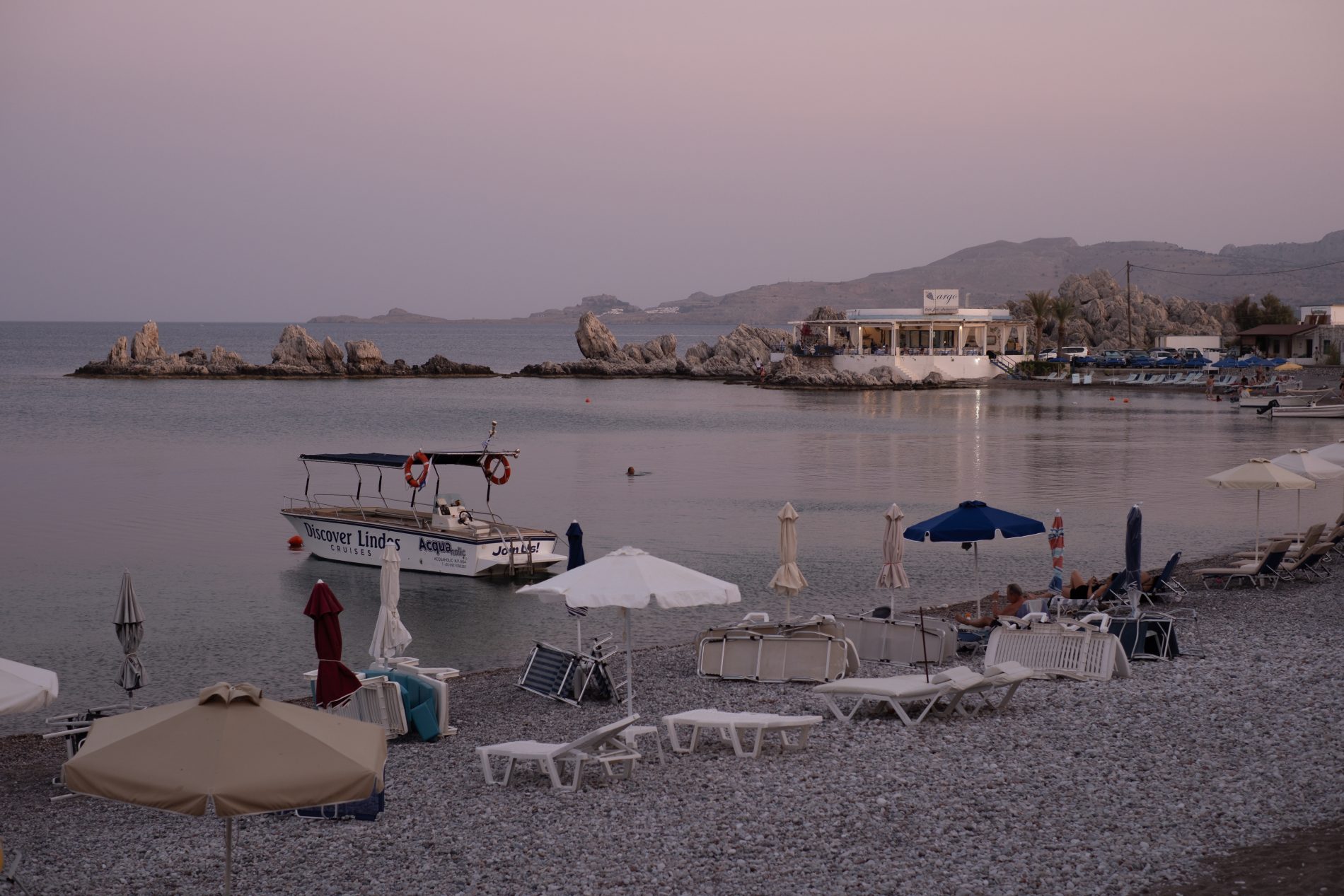
On ordinary days, Charaki feels very different. When the festival banners are packed away and the last musical notes fade, the village is a place of hushed simplicity. The bay curves around its still water like a horseshoe, its shingle beach lined with fishing boats and quiet tavernas where every table overlooks the sea. I found joy in quiet mornings that began with a coffee to the soundtrack of thrumming engines as fishermen return with their catch, the water in their nets still glittering with the silver of sardines. By midday, the sun is high and the village falls into a hush as most people take to the water, cats curl under tamarisk trees, and the waves set the only soundtrack.


However, historically, Charaki has been more than just a sleepy fishing village. Rising above the town are the ruins of Feraklos Castle, a medieval fortress first held by the Byzantines and later by the Knights of St John, who used it as a bastion against pirates and invaders. Its jagged walls, now crumbling and overgrown, remain a reminder of Rhodes’ turbulent history as a crossroads of empires. Climbing to the top rewards you with a panorama that stretches acrossnthe Aegean to the shores of Turkey, although you would be forgiven for finding the climb a little too strenuous when you could be drinking an ice-cold beer on the pebble-strewn beach.
Today, Charaki is still a sanctuary, just of a different kind; Close enough to Lindos and Rhodes Town for day trips, yet far enough removed to preserve its own gentle pace. It offers something rare on an island so loved by tourists: a glimpse of authenticity, of community, and of traditional daily life. While the the sea and the seasons dictate the rhythm, people who linger long enough soon find themselves adjusting to it.

For those who come seeking Rhodes’ more rowdy experiences, Charaki may seem too subdued. But for those in search of something else; a slower moment,a place to relax by the sea with a good book, or to simply have the joy of eating freshly grilled fish right beside the water, this little village is perfect. In a way, Charaki is a reminder of why people fall in love with Rhodes in the first place..
Getting to Charaki
There are regular international flights arriving at Rhodes International Airport (Diagoras), located around 14km from Rhodes Town. During the summer season, the airport is served by the majority of the UK’s main airports, as well as numerous direct flights from major European cities.
Year-round connections are also available via Athens. Alternatively, ferries connect Rhodes to Piraeus (Athens’ port) and several nearby islands, offering a scenic and slower-paced way to travel. Charaki is about 40km (roughly a 45-minute drive) from Rhodes International Airport.
By Car
The easiest way to reach Charaki is by rental car. In general, the roads around the island are well-maintained and frequently signposted.
From the airport or Rhodes town, head east toward the main island highway (Eparchiaki Odos Pastidas–Kremastis) and follow the signs for Lindos and the East Coast (E95/EO95). This is the main north-south road that runs down the island’s eastern side. Stay on the E95 for most of your journey. You’ll bypass Faliraki and the town of Archangelos. At the village of Masari, look for the sign to Charaki before turning left off the E95 toward Charaki (Χαράκι), Agathi Beach, and Feraklos Castle.
This is a well-marked junction just before Archangelos if you’re coming from the north.
Having a car also gives you the freedom to explore nearby beaches, Lindos (just 15 minutes away), or venture into the island’s mountainous interior without relying on public transport. Discover Cars are a great company to use for this as they allow you to compare multiple providers before booking.
By Taxi or Airport Transfer
You can pre-book a taxi from the airport to Charaki, which takes about the same time as a car and costs around €60–€70, depending on time of day and the number of travellers.
Pre-booking a private transfer from Diagoras Airport to Charaki is also a good option. The service often costs around the same price as an Uber, with the bonus that you will not need to wait for your pickup or potentially have to traipse to a meeting point. This is particularly useful if arriving late at night, meaning that you won’t have to worry about the stress of finding a taxi when you’re tired. I usually use Get Transfer, who will arrange for a driver to meet you on arrival.
By Bus
Public buses run regularly between Rhodes Town and Archangelos, the nearest large town to Charaki. From there, it’s a 10-minute taxi ride into the village. This is the slowest but most economical option for budget travellers or those not in a hurry.
Where to Stay in Charaki
Charaki’s low-key charm extends to its accommodation. Instead of the sprawling resorts that you’ll find elsewhere on the island, in Charaki, you will mostly have the options of staying in family-run guesthouses, self-catered apartments, and a handful of boutique stays set around the bay. Most are within steps of the water, meaning you can wake to the sound of waves and enjoy sea views from a balcony shaded by bougainvillaea.
For those who want to immerse themselves in village life, simple studios along the seafront are ideal. Many of them come with kitchenettes and are run by local families who’ll happily share insider tips on where to eat or swim. Travellers looking for a touch more comfort will find stylishly modern apartments tucked behind the beach, complete with rooftop terraces and airy interiors that make the most of the incredible Aegean light.
Kouros Stone Suites
Where: Charaki 851 02
Best for: Large, family sized apartments in a quiet part of the village
One of Charaki’s most stylish boutique stays, Kouros Stone Suites blends traditional stone-built architecture with sleek, contemporary interiors. Each suite is large and individually designed, combining rustic textures with modern comfort, while the communal pool area has a terrace that offers views out to Feraklos Castle and the sea beyond.
I even arrived to find my fridge well-stocked with wine, beers, fruits and local treats. It’s a luxurious yet intimate option, particularly well-suited to couples looking for a quiet romantic escape away from the village centre.
Alia Luxury Suites
Where: Charaki 851 02
Best for: An indulgent stay with everything you need on-site
For those seeking a resort-style experience just a short stroll from Charaki Bay, Alia Luxury Suites delivers. Set in landscaped grounds with two pools and a spa, this boutique-style retreat offers spacious suites with chic interiors, private terraces and, in some cases, swim-up access. The on-site restaurant and bar add extra convenience,
Haraki Mare Studios & Apartments
Where: Charaki 851 02
Best for: Homely comfort just steps from the sea
A more polished option on the seafront, the rooms of Haraki Mare may be relatively basic, but this is combined with lovely, homely touches. Its bright, airy apartments are equipped with kitchens and private terraces, many with sweeping sea views. It’s ideal for couples or families who want a little extra comfort without losing the intimacy of a small-scale stay.
Things to do in Charaki
Charaki is a small village, and its allure lies in the simple pleasures that define life here. That means there isn’t much to do; days unfold gently. The mornings often begin with a swim in the bay’s calm waters, followed by unhurried walks to nearby beaches or up to the castle ruins that guard the shoreline. Charaki offers a chance to slow down;. Whether you’re clambering up to Feraklos Castle, floating in the clear Aegean, or simply enjoying the peace of sunbathing and reading a book beside the bay, the best thing to do in Charaki is to just relax and enjoy the calm surroundings.
Climb to Feraklos Castle
Towering above the bay is the atmospheric ruin of Feraklos Castle, a medieval stronghold that once served the Byzantines and later the Knights of St. John.
The castle dates back to the Byzantine era, and its strategic position on the east coast made it a key defensive stronghold. In the 14th century, it was taken over by the Knights of St. John, who reinforced its walls and used it to guard the coastline from pirate raids and Ottoman invasions. Though abandoned in the 16th century, its imposing silhouette still dominates the landscape, offering a reminder of Rhodes’ long and turbulent history.

The short but steep hike up the hillside takes around 15–20 minutes and rewards you with sweeping views over the coastline. On clear days, you can see across the bay to Agathi Beach, down the coastline towards Lindos, and inland to the olive-dotted hills. The hike is best completed in the cooler hours of the morning or at sunset, when the ruins glow gold in the fading light.
The castle itself is unguarded and free to explore. Unlike some of the more polished historical sites on Rhodes, there are no ticket booths or barriers, just an open invitation to wander through the crumbling ruins and take in a piece of the island’s history.
Walk to Agathi Beach
Close to the ruins of Feraklos Castle and less than 2km from the village, Agathi Beach is a sandy cove known for its shallow, turquoise waters and gentle slope. Because of this, it has become a favourite for families and anyone looking for a traditional Greek beach day that is an alternative to the cobbles and stones of Charaki Bay.
You can drive there in minutes or enjoy a scenic walk past olive groves and wildflowers. while the small tavernas directly on the sand offer simple Greek dishes such as souvlaki and grilled fish. Facilities are limited compared with larger resorts, but that’s part of its charm; Sunbeds, umbrellas, and simple beach bars are available, serving cold drinks, Greek salads, and fresh grilled souvlaki.
Swim, Paddleboard or boat in Charaki's Tranquil bay
Charaki’s calm bay makes it an ideal spot for snorkelling, especially around the rocky outcrops at either end of the beach. The visibility is excellent, and you’ll often see shoals of fish darting through the shallows.


Paddleboards and pedalos are occasionally available to rent through local guesthouses or beach vendors, while boat tours to nearby coves and beaches can be arranged in advance with local operators.
Day Trips to Lindos, Archangelos & Further Afield
While there isn’t a lot going on in Charaki itself, it sits in a prime location for short trips to some of Rhodes’ most interesting sights. Within a 15–30 minute drive, you can dip into history, culture, and wonderful scenery, and still get back in time for a sunset dinner at the beachfront.
It’s the ideal base for exploring Rhodes. The ancient whitewashed town of Lindos is just 15 minutes away by car, famous for its clifftop acropolis, rooftop restaurants, and charming alleyways. To the north, the working town of Archangelos offers a more authentic slice of island life, with pottery shops, traditional bakeries, and fewer tourists. For those with a car, day trips to Rhodes Town or the forested interior (as well as the Island’s wine routes) reveal diverse landscapes and layers of history.
Lindos
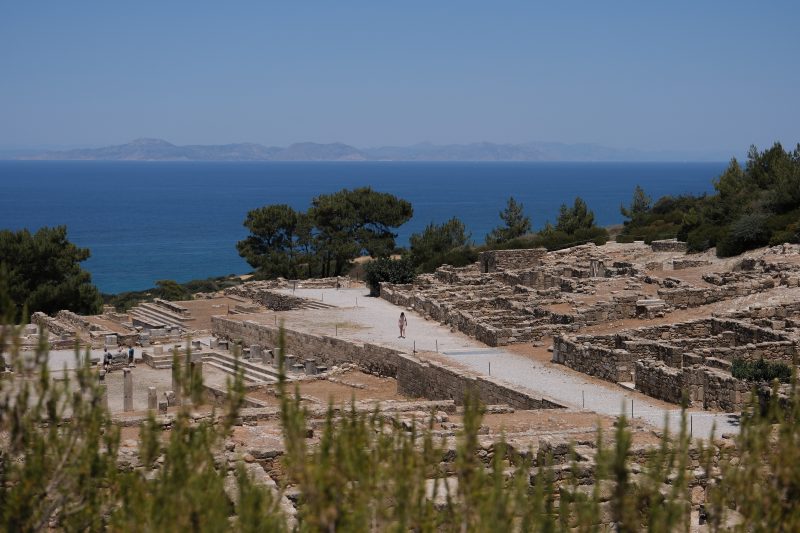
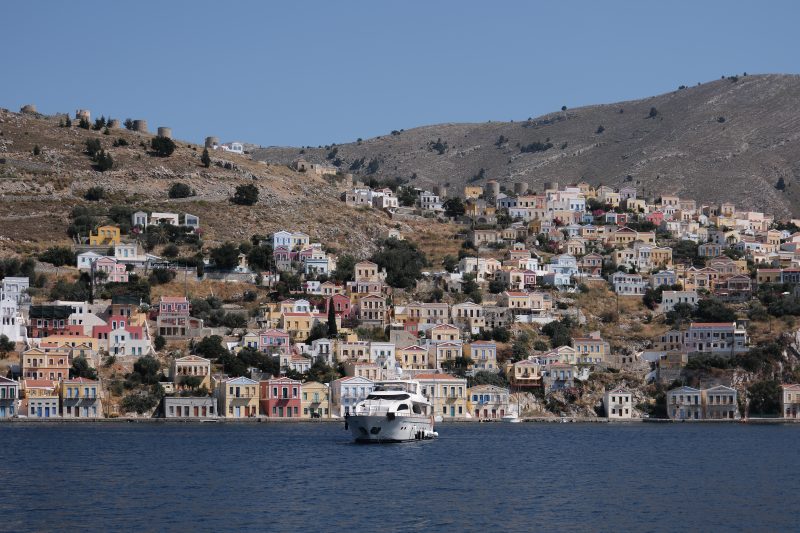
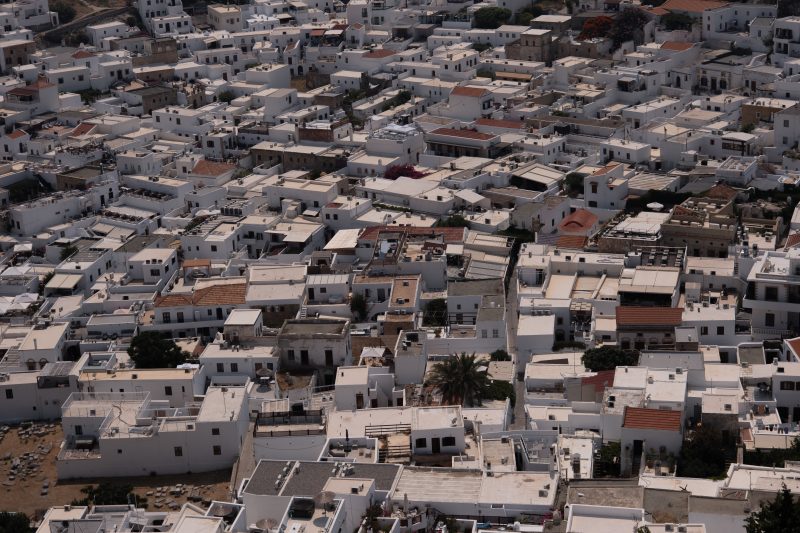
Just down the coast, Lindos is one of Rhodes’ crown most beautiful villages; a whitewashed town spilling down a hillside towards a turquoise bay, overlooked by its iconic Acropolis. The climb to the top is worth it for the views and the sense of history: the Acropolis holds ruins from the Greek, Roman, and medieval periods, all stacked together on one dramatic headland.


In the village below, labyrinthine lanes are lined with boutique shops, rooftop restaurants, and shaded courtyards, making it perfect for a day of wandering. Arrive early or late to avoid the midday crowds and heat.
Archangelos
Heading inland, Archangelos feels worlds apart from the polish of Lindos. This working town is one of the largest traditional villages on Rhodes, known for its pottery workshops, Byzantine churches, and colourful houses painted in bold shades of ochre, blue, and green. The Church of the Archangel Michael, with its striking bell tower, is worth a visit, as are the local bakeries. Make sure to try kouloria (sesame bread rings) or pitaroudia (chickpea fritters), both Rhodian specialities. Archangelos is less touristy than the coastal towns, making it a good place to see everyday island life.
Tsambika Monastery & Beach
Another worthwhile outing is to Tsambika Monastery, perched dramatically on a hilltop overlooking the coast. The climb, a gruelling 300 steps from the car park (particularly strenuous in the Greek heat), is rewarded with breathtaking views of Tsambika Beach, one of the longest sandy stretches on Rhodes.


The monastery itself is small but revered; legend holds that women who pray here are blessed with fertility. After your visit, head down to Tsambika Beach for a swim and a long, sandy walk.
Rhodes Town
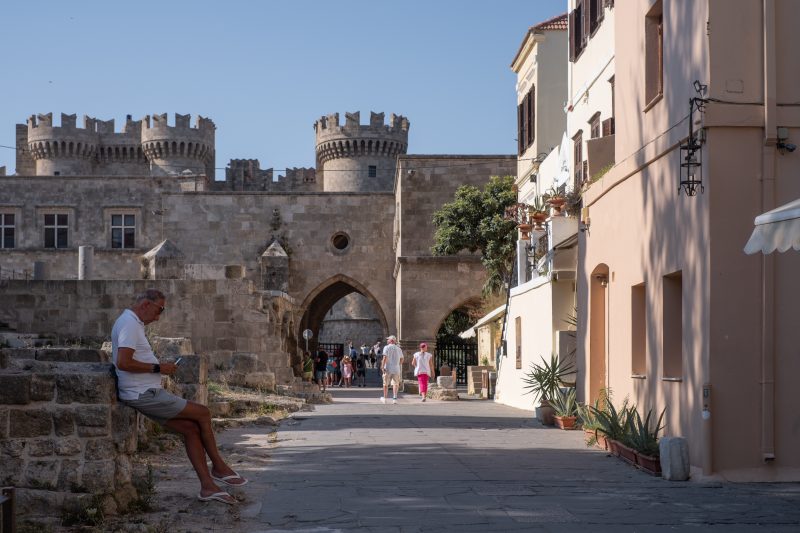
For a deeper dive into the island’s history, make the longer journey to Rhodes Town, a UNESCO World Heritage Site. The medieval Old Town is enclosed within extensive stone walls built by the Knights of St John. Inside, cobbled streets lead past Gothic architecture, Ottoman mosques, and hidden courtyards.

Highlights include the Palace of the Grand Master, the Street of the Knights, and the bustling Mandraki Harbour. While it makes for a longer day out, Rhodes Town offers a fascinating contrast to Charaki’s quietness.
Where to Eat & Drink in Charaki
Charaki’s waterfront is strung with tavernas and cafés that embody what I love about Greek island dining: simple, unhurried, and always with service that makes you feel you’re dining with family, rather than paying your way in a restaurant.


Here, tables spill onto the promenade, just metres from the water, where you can feast on grilled fish landed that morning, share plates of meze, and linger over carafes of local wine.
Zografos Taverna
Where: Charaki 851 02
When: 12pm – 11pm
If you spend most of your time by the shore and beach of Charaki, you may miss Zografos Taverna, set as it is on the road that leads out of town. I didn’t get to eat there myself, but I was assured by the owner of our rental apartment that it is one of the best restaurants in the village, and always criminally empty,meaning you won’t struggle to get a table.
Taverna Kostas & Elena
Where: Charaki 851 02
When: Monday to Saturday 1.30pm – 10pm; Sunday 2pm – 9pm
A short stroll from the main strip, Taverna Kostas & Elena has a relaxed, friendly atmosphere and classic Greek home cooking. The menu is packed with family recipes; think slow-roasted lamb, tender stifado (beef stew with onions), and vibrant Greek salads topped with creamy feta. Portions are famously large, and the hospitality is equally generous.
3G Bar Restaurant
Where: Charaki 851 02
When: 11.30am – 1am
Overlooking the bay, 3G is part café, part taverna, part all-day hangout. The menu is broad but they do good takeaway gyros and souvlaki that you can pick up and eat on the beach with a coup[le of beers while the sun sets. It’s ideal if you are looking for somewhere casual to grab a quick bite in the evening.
Captain’s House Taverna
Where: Haraki Bay, Charaki 851 02
When: Daily 12pm – 11pm
I’m not sure what is was that made me stop at Captain’s House Taverna rather than the countless other restaurants that line Charaki’s shore. It could have been the smell of freshly fried fish emanating from the kitchen or the friendly welcome from the wait staff, but I’m glad that I did.
The focus is on simple, well-prepared Greek classics like grilled meats, fresh seafood, and vegetarian dishes like gemista (stuffed peppers and tomatoes). The standouts for me were the bubbling dish of moussaka and the freshly battered squid, that was the perfect combo of crispy and tender. The owners often pop out to chat, adding to the sense that you’re part of the local fabric, if only for a night.
Nouvelle Mediterranean Cuisine
Where: Charaki 851 02
When: Monday to Friday 3pm – 11pm; Saturday & Sunday 1pm – 11pm
For something a little more contemporary and a diversion from multitude of restaurants dishing up home-style cooking, Nouvelle Mediterranean Cuisine brings a refined, modern edge to the Charaki dining scene. Expect inventive takes on Greek and Mediterranean classics, such as octopus carpaccio or fresh pasta with seafood and saffron.
It’s a little pricier than the other restaurants on this list, but it is a good place you each if you’re looking to treat yourself. The presentation is elegant but unfussy, and the atmosphere remains relaxed. While it isn’t on the seafront, they do have with a terrace that’s perfect for sunset dining.
Argo Restaurant
Where: Charaki 851 02
When: Daily 12pm – 11pm
Sitting at the edge of the bay and seemingly perched atop a rocky outcrop, Argo is fairly difficult to miss, with its stunning art deco exterior glimmering in the glow of the sunset each evening. While they don;t necessarily serve up the best food that Charaki has to offer, Argo certainly has the best location and is a much sought-after spot for sundowners and seafood.
Bottoms Up Tavern
Where: Χαράκι, EO Rodou Lindou, Rodos 851 08
When: Friday to Wednesday 8am – 1am; Thursday 8am – 10pm
With its playful name and warm welcome, Bottoms Up is a casual, no-frills taverna right on the seafront. It’s a favourite for mid-afternoon snacks, such as grilled sardines, meze plates, or a Greek salad piled high with tomatoes and olives, and stays open late into the evening on most days for those wanting a simple dinner with a side of sea breeze. The atmosphere is cheerful and unpretentious, much like Charaki itself.
Cocktails & Dreams
Where: Charaki 851 02
When: Daily 6pm – 3am
Being the laidback town that it is, the nightlife in Charaki is never going to rival that of Faliraki, and late-night spots are few and far between. In fact, Cocktails and Dreams may be the only one. Set a little back from the bay, it delivers what the name suggests: frosted, ice-cold mugs of Alfa and all the classic beach bar cocktails, from Pina Coladas and Sex on the Beach to Aperol Spritzes – just what you need if you’re looking for a nightcap under the stars.
Is Charaki Worth Visiting?
Charaki may be small and quiet, but that’s precisely where its charm lies and the reason that I feel it’s worth visiting. For travellers in search of peace and simplicity away from the busier resorts, this fishing village offers a glimpse of Greek island life that still feels authentic. The bay, sheltered and calm, is perfect for long swims in water so clear you can see the pebbles beneath your feet, and evenings are best spent at a seafront taverna, lingering over grilled fish or lamb baked with herbs while the light fades behind Feraklos Castle.

Of course, this tranquillity won’t appeal to everyone. Charaki is undeniably quiet: there’s little in the way of nightlife or sights. The beach, while beautiful, is partly pebbled and less developed than others on the island. Accommodation tends to be simple, leaning towards studios and family-run apartments rather than luxury hotels, and while you can get by with buses, it’s likely that you will need a car to make the most of staying at this part of the island. Out of season, too, many tavernas and bars close, leaving the village almost in hibernation.
Yet for those who appreciate a slower pace, the positives far outweigh the negatives. Charaki remains unspoiled, even in high summer. It sits in a prime position for day trips to Lindos, Archangelos, and Tsambika, but always offers a calm retreat to return to at the end of the day.
When is the Best Time to Visit Charaki?
Like much of Rhodes, Charaki is at its most inviting from late spring through early autumn, when the sun is high and the Aegean is warm enough for long, lazy swims. May and June are especially nice, with mild temperatures (although it was unseasonably hot during my visit), wildflowers still dotting the hills, and the village easing into the summer before the peak crowds arrive. July and August bring the hottest weather, with days that practically demand afternoons spent in the shade of a taverna or floating in the calm bay. Even then, Charaki never feels overrun compared to Rhodes’ more popular resorts; its small size and low-key atmosphere mean it remains quieter than elsewhere on the island.

For those who prefer cooler air and softer light, September and early October are a wonderful time to visit. The sea is still warm from the summer heat, the tavernas are open and welcoming, and the evenings carry the kind of golden glow that makes a sunset walk up to Feraklos Castle unforgettable. Winter, on the other hand, is a different story: while the village never loses its charm, many restaurants close and the weather, though mild compared with northern Europe, can be unpredictable.