A lone island created from 70 volcanoes and marooned far out in the Pacific Ocean, Easter Island is one of the Earth’s most remote places: The nearest civilisation is over 2,000km away. It may be this isolation that fuels people’s intrigue in Rapa Nui, or it could be the enigma of the lost culture that arose on this 163 square kilometre patch of land, eventually falling in such mysterious fashion, that draws people here.
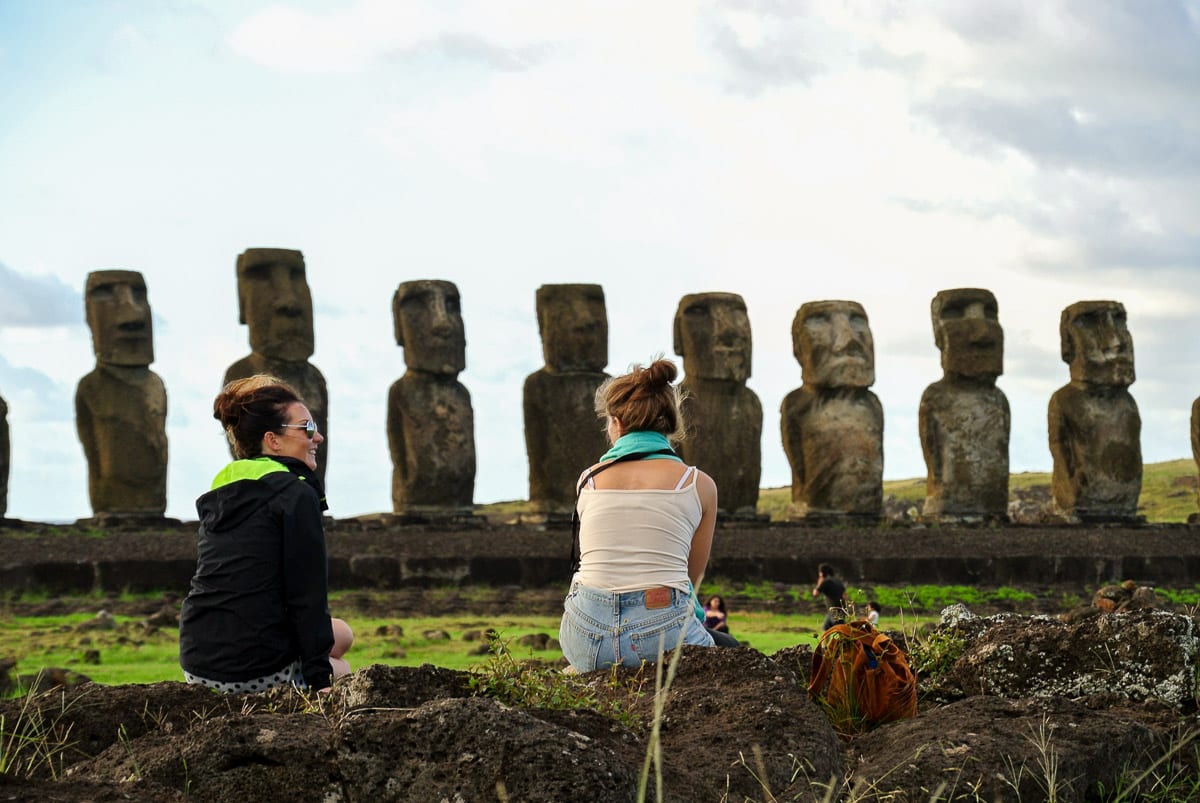
It’s thought that Te Pito O Te Henua, or the Navel of the World, was once home to 30,000 people; people that erected and worshipped stoic stone sentinels that still line the coastline, pockmarked and weather-beaten by centuries of waves and wind. Only a few hundred native islanders remain on Rapa Nui, but their culture and strong Polynesian roots make Easter Island an intriguing and compelling place to visit.
A Brief History of Easter Island
The mysterious moai that line Rapa Nui’s shore are Easter Island’s lasting legacy. Standing as tall as 4 metres and weighing up to 14 tonnes, no one knows for sure why the island’s residents decided to carve them in such huge numbers but it must have been a considerable task that they thought was worth their while. It’s thought that they were constructed to honour the islander’s ancestors, kings and people of importance but, as there is no extensive written or oral history, their purpose remains enigmatic.
It’s also not clear when the island was first settled. Estimates range from 400 to 800AD when intrepid explorers arrived via a fleet of wooden outrigger canoes to this tiny speck in the vastness of the Pacific Ocean from wither the Pitcairn or Marquesas Islands in Polonyseia. Separated from all other civilisations, the people of Rapa Nui quickly developed their own distinct culture, creating a complex multi-tiered society that focussed heavily on erecting and worshipping the moai.
Not much is known of how the civilisation declined, but it is thought that the cutting of millions of giant palms to clear fields, transport the moai, or make fires, ruined the island’s ecosystem, fatally depleted resources which led to food shortages. Unable to support the moai-crafting workforce, full-scale warfare erupted. Construction of moai ceased and the statues were toppled.
By the time European settlers – led by Dutch admiral Jacob Roggeveen – arrived on Easter Sunday in 1722, the island was a barren wasteland with few inhabitants.
Getting to Easter Island
Due to its remote location, flights to Easter Island can be prohibitively expensive, in some instances being as much as £800 return. However, if you choose to fly in the off-season, it is possible to reach Rapa Nui for as little as £125 each way from Santiago if you book well in advance. I flew in April and paid just £260 for a return flight. LATM is the sole operator and flies up to 3 times a day from Santiago Arturo Merino Benitez (SCL). The journey takes 5 and a half hours.
Aeropuerto Mataveri is located close on the southeastern side of the island’s only town, Hanga Roa, and is walking distance from the town, although most hotels and hostels will meet you in arrivals and provide a free transfer.
ITINERARY OVERVIEW
MYSTERIOUS MAOI, STELLAR SUNSETS & PRISTINE BEACHES: 3 DAYS ON EASTER ISLAND.
Day 1: Hanga Roa
Day 2: Ahu Tongariki & the Southern Coast
Day 3: The Northern Coast & Inner Loop
DAY 1
Explore Hanga Roa
A tiny village of just 4,000 inhabitants and located in the south-western corner of the island, this little outpost is the only town on Easter Island and where the majority of hostels and hotels are located. It has all the amenities you should need: the main road of Atamu Tekena is lined with cafes, supermarkets and tour agencies while the pier and bay are ringed by a number of restaurants that offer wonderful sea views.
WHERE TO STAY ON EASTER ISLAND
Hotels and hostels on Easter Island can be expensive compared to the rest of Chile and tend to be of a slightly lower standard due to the relative lack of options or competition. Having said that, a dorm bed in a budget hostel will only set you back £15-20 per night while camping will cost even less. The majority of guesthouses are situated in Hanga Roa with the exception of Explora Rapa Nui & Camping Ana Tekena. Just be sure to book well in advance as rooms do book up quickly.
BUDGET / Camping Mihinoa
One of the few budget options on the island that offers sea views, Camping Mihinoa gives you the option of camping, sleeping in a 5-bed dorm, or one of their basic rooms. There are 3 good-sized kitchens on-site allowing you to save money and cook your own meals, wi-fi, and the possibility of renting camping equipment if you don’t have your own.
Check availability
BUDGET / Sustainable Camping Ana Tekena
In an ecosystem as fragile as Easter Island’s, sustainability is important. In direct response to growing environmental concerns, Camping Ana Tekena focusses on respecting the local environment: Rainwater is reused in the bathrooms, the energy comes from solar panels and they run a robust recycling program. Equipment rental is available on site and the owners also organize activities such as horseback riding, snorkelling, night fishing, and excursions to several archaeological sites. However, the best thing about Camping Ana Tekena is its proximity to Anakena, the island’s best beach.
MIDRANGE / Rangi Moana
Located 20-minutes’ walk outside of Hanga Roa beside Botanical Garden Tau Kiani, Rangi Moana offers compact and cute individual cabanas, family sized cottages and an on-site swimming pool. An added bonus is that they offer a reduced price for solo travellers.
Check Availability
LUXURY / Explora Rapa Nui
Located 8 km from Hanga Roa, on a 9.6 square km plot of land that is unsuitable for agriculture and contains no archaeological remains, Explora Rapa Nui is the Islands most luxurious hotel. The beautifully designed all-inclusive resort features a pool, spa, well-stocked bar and wonderful onsite restaurant. Like their Torres Del Paine outpost, they carry LEED certification (Leadership in Energy and Environmental Design).
Check availability
Start your first day on Easter Island with a leisurely walk around Hanga Roa to gather your bearings. There isn’t a great deal to see or do but it is a charming Polynesian town filled with cute tiki bars, cafes and souvenir shops. Head down to Av. Atamu Tekena and stop in at Insular rent-a-car to book either a 4X4 or mountain bike for the next couple of days before popping into Supermarket Kai Nene to pick up supplies if you plan on making your own lunch or dinner during your stay.
The Mercado Artesanal is worth a quick visit to check out the local art while across the road, Inglesia Hanga Roa – a church established in 1937 by its first priest, Father Sebástian Englert – is a rather unique building: a catholic church covered in elaborate wood carvings.
Much of the action in town is centred around the waterfront and pier, so swing that way to watch the fishermen bringing in their catch. Make sure to make a stop at the Island’s post office on Av Te Pito Ote Henua (Mon to Fri 8.30am – 5pm & Sat 10am – 1pm) along the way. Here you can have your passport adorned with one of the world’s most elusive and sought-after passport stamps: An Isla de Pascua stamp decorated with moai statues.


Just south of the pier is the tiny Playa Pea, a beach with a small man-made rock pool that is safe to swim in. However, the most fun can be had by donning a wetsuit and braving the waves with the surfers and bodyboarders in the rough ocean seas.
From there, head northwards on Avenida Policarpo Toro, past the Mana Gallery where you can find displays of traditional Polynesian art, towards the colourful Hanga Roa Cemetery. Afterwards, walk further north to Museo Anthropologo (free entry). Not only is this museum a great introduction to the history of Rapa Nui, it has wonderfully detailed explanations of the island’s culture and moai statues as well as displays of rare archeological finds.

Come evening time, the chic Te Moai restaurant serves some of the best fish on the island, both the ceviche and sashimi are stellar, and the al fresco dining on the second floor in hanging wicker chairs offers views out towards the moai of Ahu Ko Te Riku and Ahu Tahai as they are silhouetted against the setting sun. You can stay here with a glass of Chilean wine to watch the sunset or alternatively, purchase some bottles of beer and head outside to the patch of grass beside the platform where people gather to watch the sun go down. Here, at night, there is limited light pollution and the countless stars illuminating the night sky are spectacular.
DAY 2
Ahu Tongariki & the Southern Coast
Today is an early start. It’s recommended that you wake a couple of hours before sunrise and drive eastwards on the southern coast road towards one of the islands most impressive and awe-inspiring attractions, the 15-strong row of moai that make up Ahu Tongariki.
Dazzling in scale, Rapa Nui’s largest moai site was unfortunately destroyed by a tsunami in 1960, the statues and their top knots scattered across the land. In the early 1990’s they were re-erected by a Japanese company and now provide one of Easter Island’s most enduring images: a line of indomitable gods illuminated by the orange glow of the morning sky.

HOW TO GET AROUND EASTER ISLAND
Although Easter Island is small in size, there is no public transport. You will have to rent a car, scooter or bike to get around and see all of the major sights. I used Insular Rent-a-car to hire a Suzuki Jimny 4X4 for one of the days during my visit (55,000 CLP / £54 per day) and a mountain bike another day (17,000 CLP / £16.50). Just be warned if you are renting a mountain bike: The Island is fairly hilly and will take a couple of hours to pedal across. A 125CC scooter will set you back 35,000 CLP.
Alternatively, there are a number of agencies on the island that run guided tours. Although this can be a little more expensive than travelling around the island yourself, there is no replacement for an informative, knowledgable and engaging guide, particularly when Rapa Nui’s history is so fascinating.
Once daylight has arrived, join the coastal road again, heading back in the direction that you travelled just a few hours ago. Take the northern fork when the road splits, looping inland towards Rano Raraku. Arguably Rapa Nui National Park’s most popular site, Rano Raraku volcano was once the island’s main quarry from which all of the moai were carved. Of the 887 remaining statues on the island, roughly 400 are strewn in and around the volcanic crater. Pathways meander around the volcano’s slopes, weaving between dozens of finished moai, abandoned on their journey to the coast with some buried deep in the soil up to their necks. For a greater understanding of how the monoliths were carved, look out for El Gigante, at 72 feet tall (22 meters) and about 270 tons, it is the largest moai ever made and is still attached to the crater’s bedrock. The trail leads all the way up hill, through scrub-land and trees into the volcano’s crater and alongside the vast crater lake where even more moai are abandoned.
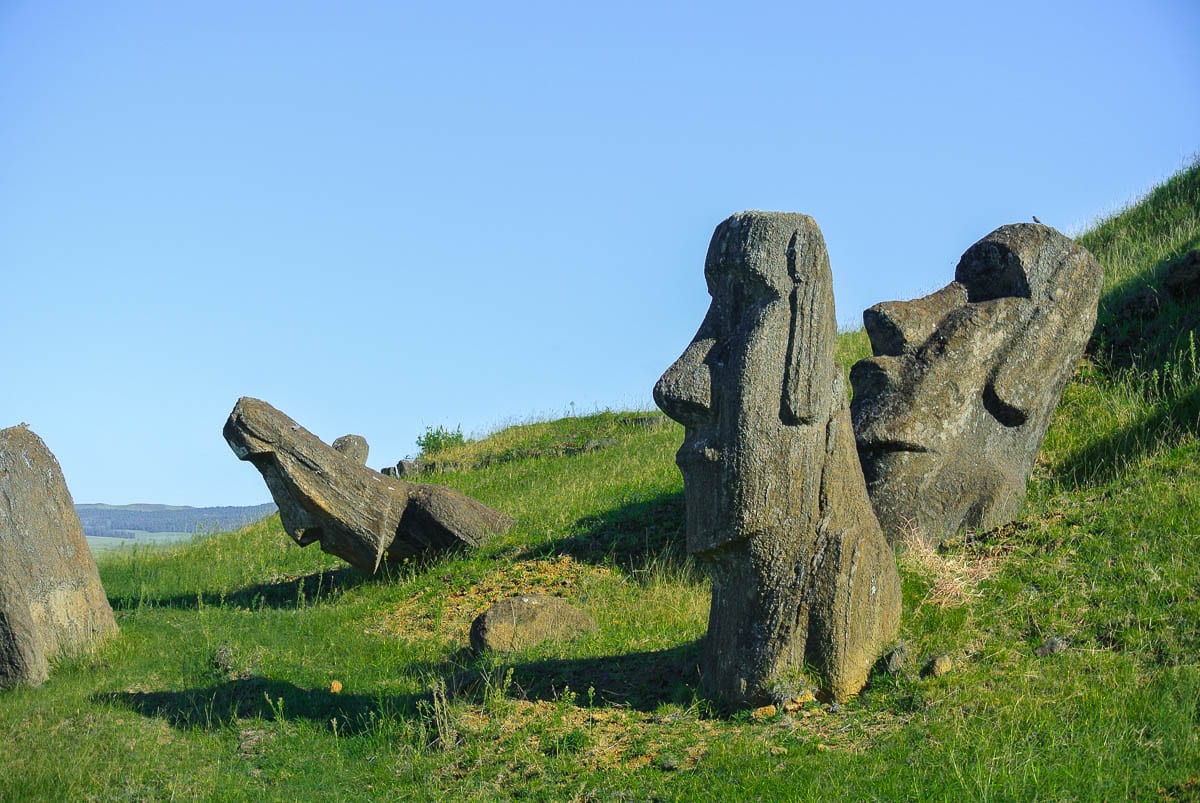
Joining the coastal road once again and heading back towards Hanga Roa, there are a number of other ahu to discover. Firstly, Ahu Hanga Tetenga isn’t too impressive with its two toppled and shattered moai, but further along the route is Ahu Akahanga, believed to be the burial site of the island’s first king, Hotu Matu’a. 3km away you will come across the final ahu on this stretch of road, Ahu Vaihu with its 8 moai lying on the ground amongst their scattered topknots.

In the far south-west corner of the island, south of Hanga Roa, stands Rano Kao, the giant 3000 foot-wide crater of an extinct volcano that helped shape the island 2.5 million years ago. A dirt path leads up to the summit where a freshwater lake was a main source of water for ancient Orongo villagers and a mirador offers some of the best views of the island. At the ranger station, you will have to pay 50,000 pesos to reach the Orongo Ceremonial Village which consists of 53 carefully restored houses hugging the cliffside that was once home to members of the birdman-cult.
It is thought that the Birdman religion flourished on the island in the 18th and 19th centuries when islanders worshipped the creator, Make-Make, and a half-bird, half-human deity. A dangerous and brutal competition was staged each year in order to select the Birdman in which military and tribal chiefs swam the islands shark-infested waters to reach a group of coastal islets. Here they would then battle to collect the first Manutara egg of the season, with the winner becoming the Birdman, their family receiving elevated social status.
Following dinner in central Hanga Roa, attend traditional Rapa Nui dance show. Yes, it is a little commercialised and touristy, but the young dancers and musicians at Kari Kari are extremely talented and the colourful costumes are fantastic. The show takes place here every Tuesday, Thursday and Saturday (9pm, 12,000 Pesos) while on Wednesday, Friday, and Sunday at a venue beside Au Bout du Monde – a restaurant that you should definitely eat at while on the island – Matato’a put on a stunning musical and dance performance accompanied by umu, a typical Rapa Nui cuisine.
Ensure that you arrive early to guarantee a ticket to the evening’s performance as it does tend to sell out. Alternatively, book in advance here.
DAY 3
The Northern Coast & Inner Loop
After a hotel breakfast, pedal northwards through Hanga Roa, past the moai of Ahu Ko Te Riku until you reach Caverna Dos Ventanas, known locally as Ana Kakenga. It can be a little hard to find, despite the fact that it is signposted. Look out for a tiny hole in the ground indicated with a cairn and climb inside. Here you will find a small network of tunnels that lead to a cliffside opening with a spectacular view of the sea. Just be warned, it’s not for the claustrophobic.
Heading a little inland to the base of Maunga Terevaka, the island’s highest point, you will find one of the most impressive ahu, Ahu Akivi. A peculiar aspect of these 7 intact moai is that they are the only ones that face out to sea. They are also precisely positioned to face sunset during the Spring Equinox.
If you are feeling energetic, it’s time to continue south until you reach Camino Vaitea Anakena, the road that cuts through the centre of the island. Ideally, you want to head eastwards once you hit the road, but be warned that it can be a rather strenuous 17km bike ride and is better undertaken with a car, but if you are a confident cyclist, you should be fine.
Reaching the eastern coast, you will be rewarded with Easter Island’s most beautiful beach, Anakena. While most of the coastline is fringed by jagged, black rock, Anakena Beach is an exception. Here you will find coral-white sands surrounded by clusters of towering palms palm trees, and warm, calm waters. The beach is the main attraction here but the elevated set of seven restored moai statues (Ahu Nau Nau) found behind the beach are some of Rapa Nui’s most picturesque, giving the location a real feeling of Polynesian paradise.


Here you will find food stands to purchase a well-deserved lunch and beer, along with fire pits, public toilets and fire pits. A relaxing afternoon at Anakena beach is the perfect place to spend your final afternoon on Easter Island before hopping back on your bike for the long ride back to Hanga Roa for your final evening.
IF YOU HAVE MORE TIME...
If you’re staying on Easter Island a little longer, it may be worth taking advantage of the rough pacific waves for a few surfing sessions. Hare Orca, beside Playa Pea, rent surfboards (12,000 pesos for 3 hours) and even offer lessons for beginners.
If you would like to get beneath the water, Orca Diving Centre in Hanga Roa is one of the most reputable outfits on the island, offering both day and night dives (30,000 pesos) or introductory dives for complete novices (40,000 pesos). Although the island’s coast may not be as rich in flora or fauna as other Pacific Islands, visibility is fantastic and turtle sightings are common. The seabed is littered with caves, arches, cliffs and lava platforms. There’s even an underwater moai, although this is a relatively new addition.
When is the Best Time to Visit Easter Island?
The peak tourist season for Easter Island is during the hottest months – from January to March. This also coincides with the 2-week long Tapati Rapa Nui Festival that takes place each February, celebrating the island’s culture in an explosion of colour and festivities. Unfortunately, this is also the most expensive time to visit in terms of both flights and accommodation. April onwards is comparatively quiet and a cheaper time to visit while the weather is pleasant year-round.
USEFUL INFORMATION
There are just two banks on Easter Island: Banco Estado (open Mon to Fri 9am – 2pm) on Tu’u Maheke and Santander on Policarpo Toro that accepts Visa cards. You can exchange money at either bank. Most hotels and some restaurants do accept card payment and US Dollars are widely accepted on the island.
About 42% of Easter Island has been designated Rapa Nui National Park, a World Heritage property teeming with ahu, moai, caves and petroglyphs. The entrance fee to the Rapa Nui National Park is $80 or 54,000 pesos for all non-Chilean visitors. There is a National Park booth after baggage claim and before the arrival hall of Mataveri Airport where you can buy the ticket. The entrance ticket allows entry to all the island’s archaeological sites for up to 10 days so make sure you look after it: Authorities are strict and will check at each site. If you forget to purchase a ticket at the airport, you can pick one up at the Ma’u Henua Indigenous Community Central Office in Hanga Roa.
Respect and conservation are incredibly important to the people of Easter Island. Please do not touch any archaeological remains, climb the Ahu or drive outside of the marked roads and trails. The Island’s sites are protected by law and huge fines will be issued to anyone breaking these rules.