I’d consider myself a football fan. I’m not the kind of person that watches their team week in, week out, through rain and shine – As a Hull City supporter that can get pretty depressing – but I’ll happily watch almost any football match available to me. When I knew that I was heading to Barcelona, I was hoping beyond anything that it would coincide with a home game. I’d give anything to see the skilled wizardry of Lionel Messi in the flesh.
Unfortunately, this was not to be. I arrived in Barcelona on a Wednesday and there were no Spanish league games that weekend and Barcelona had just played at home – Against Celtic in the champions league. What I would have given to be there. They won 7-0 with ‘La Pulga’ scoring a hat-trick. could you imagine the atmosphere and the celebrations? To say I was upset to have missed it is an understatement.
The one consolation for me was that I could still visit the Nou Camp whether there was a game or not. As the largest association football stadium in Europe (and not to mention the 3rd largest in the world), it is a destination in itself, open to the public in the form of the ‘Nou Camp Experience’.
This Nou Camp experience gives you access to the FC Barcelona museum, backstage areas of the stadium such as the dressing rooms and the chance to step out into the stadium. At €25 it is a little steep considering in most cities you can get to an actual football match for around the same price, but considering this is one of, if not the most famous ground in Europe, I couldn’t not visit.
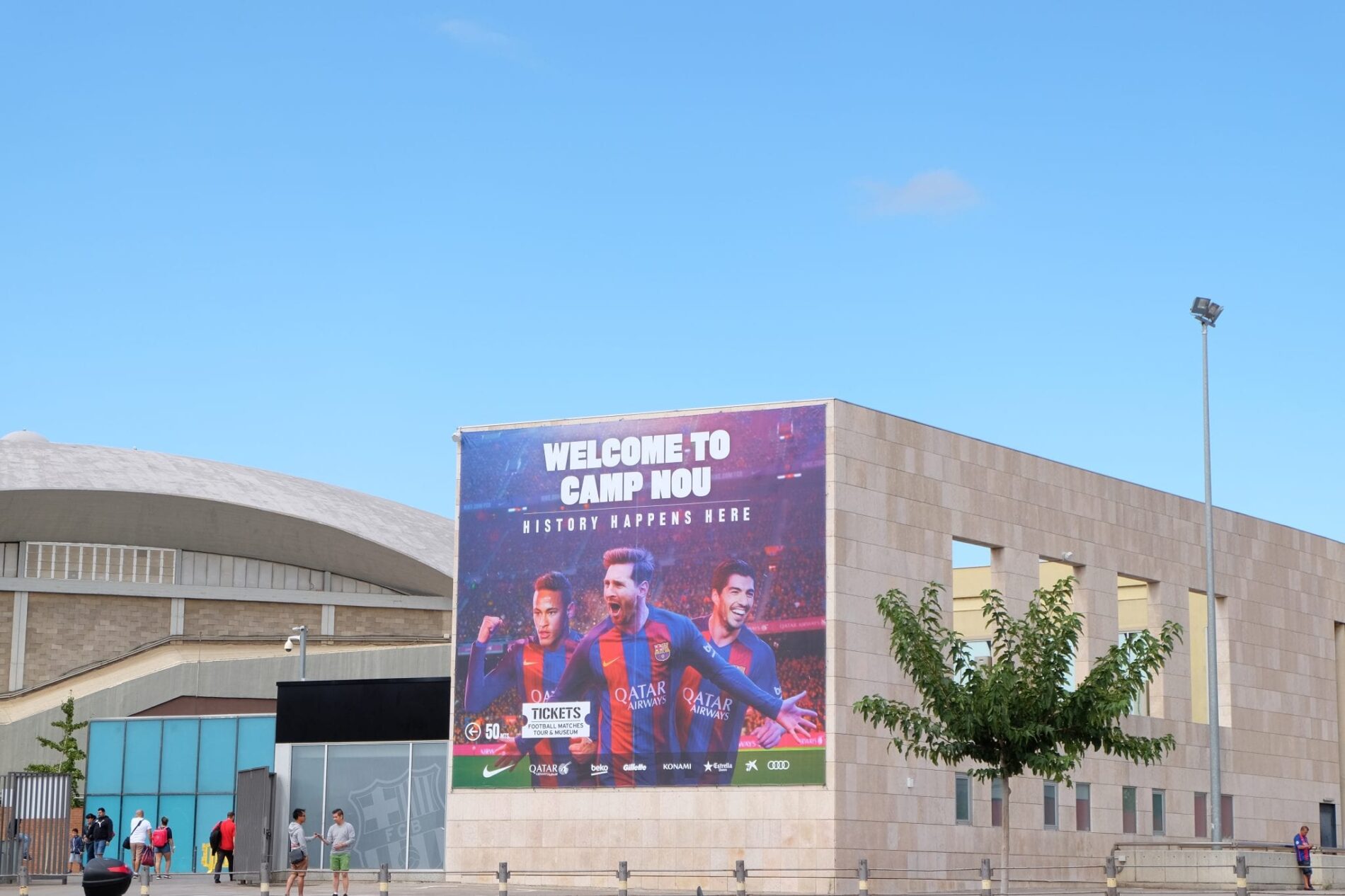
Your first glimpse of the Nou Camp experience is the FC Barcelona museum. The last football stadium tour I went on (La Bombonera, Buenos Aires) also had a museum section that was essentially a whole bunch of random tat – balls, shirts, boots and a few trophies – with not a great deal of context and although i’m a fan, I didn’t feel engaged by any of it. This was completely different. I’m not sure if it is because I’m more familiar with Barca’s players, history and competitive record but this was actually great.
The museum is minimally lit and ultra-modern. Along the walls, huge LCD screens display key moments from the club’s history; black and white footage of players in baggy shorts playing in front of moustachioed pipe-smoking gentlemen, the team celebrating it’s many Champions League wins, Lionel messy running rings around the opposition to score yet another wonder goal. Illuminated glass cases containing mementoes of Barca’s past fill the floor space and in the centre is the pièce de résistance – a parade of trophies on top of glass plinths. 5 Champions League trophies, the Cup Winners Cup, The European Super Cup. All of this goes to show what a big deal FC Barcelona are in the footballing world. The museum is overblown but impressive nonetheless. compared to the lacklustre museum I experienced in Buenos Aires, this is something else entirely.
I’m not sure if someone that doesn’t care for football – or even sport in general, – be impressed but I was. Even seeing the champions league trophies close up was worth the visit but maybe that’s just me.
A whole section of the museum is dedicated to wonder kid Lionel Messi – The kind of reverence that is usually reserved for a sportsman that has finished his career. I suppose that just goes to show how special he is; here is a man that still has many years of football still ahead of him, yet the club has made what can only be described as a shrine to the man. His shirt is in a glass case and a raised platform contains his multiple Ballon D’or trophies and Golden Boot awards in front of a blown-up image of his face.

We were gathered together by a tour guide for the next section of the experience – a backstage tour. This took us through the dressing rooms, physio rooms and press room. I’ll be honest; this part of the tour was a little disappointing. We didn’t get to see inside Barcelona’s dressing room, just the away team and I wasn’t allowed to have a photograph behind the microphones of the press room. There wasn’t a great deal to see and the whole thing felt a little rushed, like we were being herded through at speed to make way for the next group of tourists. However, after this was the moment I had been waiting for.
We were led through the player’s tunnel, a location I had seen hundreds of times on my TV, where Barca’s players line up in preparation for the contest about to take place in a matter of minutes. You sense a fraction of that thrill and anticipation that these megastars must feel as they listen to the roaring crowd up in the stands, hidden by the few short steps it takes to get up to the pitch.

And then there’s the pitch; I practically ran up the steps to get there in the way that the likes of Neymar and Iniesta do week in, week out. As I approached the tunnel entrance I saw blue sky appear, the towering tiers of seats and the immaculately manicured pitch in front of me. This was the reason I came on this tour. To get to stand in this place where so many historical sporting moments had taken place. Imagine the sounds of the roaring crowd singing and chanting, the building packed to the rafters. The scale of the stadium is impressive – I can only imagine what it must be like on match days.
I sat in the stands for a while soaking it all in, wishing I had been there on that previous Tuesday night to see Barcelona demolish their Scottish opposition with almost 100,000 other cheering punters.
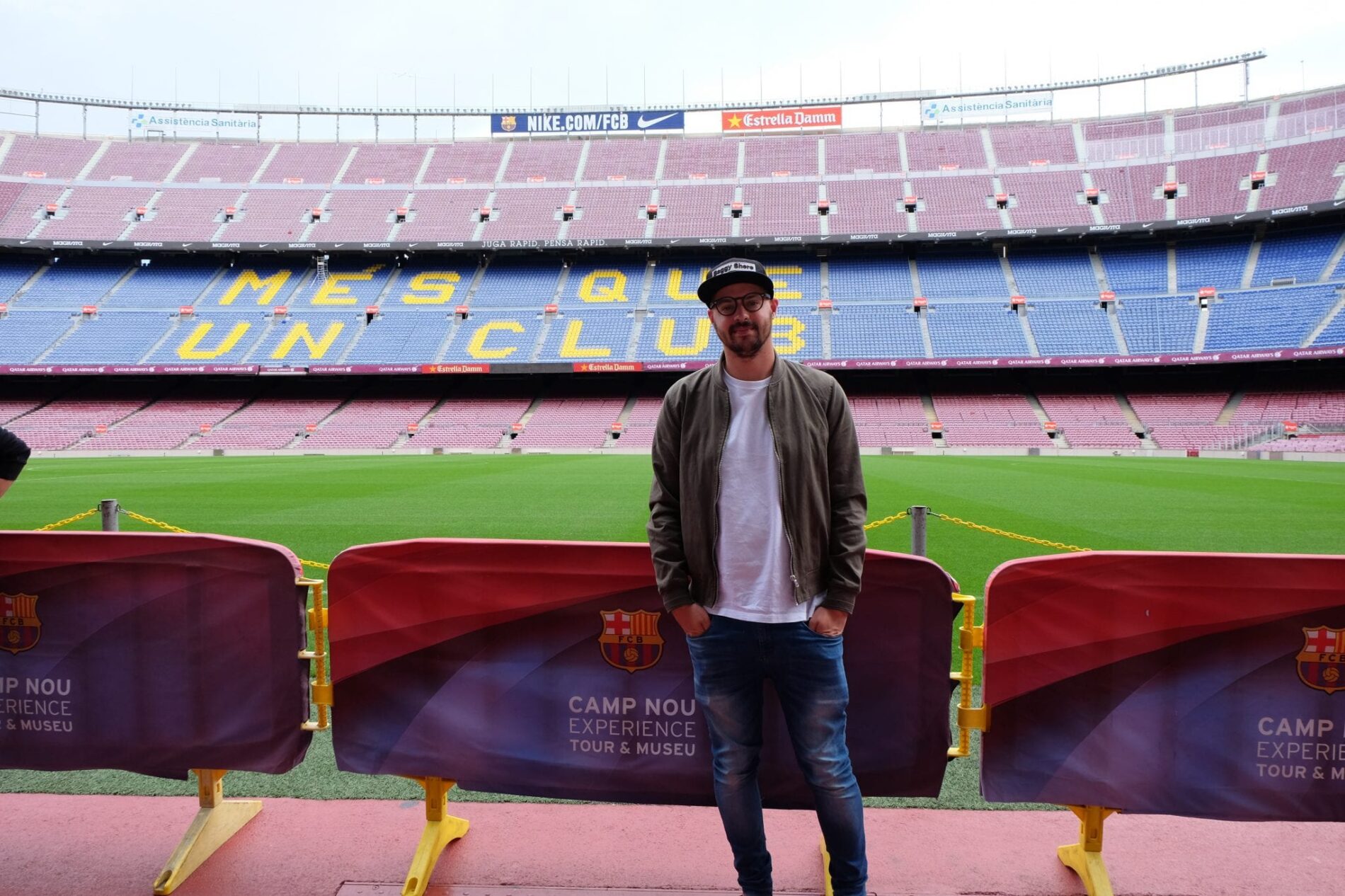
Making my way up the steps towards the top tier of the ground the size of this stadium becomes even more apparent, particularly to my legs as my thighs ache from the climb. I step into the commentary box for an incredible panorama of the whole ground and a bird’s eye view of the pitch below. On match days this would be filled with the world’s media, telling fans the tales of the team’s triumphs but right now it is deathly silent. I sit and take in the view for one last time before making my way back inside.

The whole trip took a couple of hours and I think that if you are a football fan, a trip to Barcelona isn’t complete without a visit to the Nou Camp. I loved the experience but if you’re not into sports, I can’t vouch for if it is worth the trip or not – at €25 the tour is a little steep. For me, that feeling you get as you step out on to the pitch is worth every penny.
How to get to the Nou Camp
Metro
L3 – Green line: The line circles around the north/west side of the stadium and it is best to hop off at Palau Reial so that you are close to the ticket office at the stadium’s gate 9.
L5 – Bule line: The line passes along the eastern side of the stadium. It’s best to hop off at Collblanc.
Bus
Line 59: Travels from the city centre through the Ramblas, Pl. Catalunya, Casanova/Villarroel.
Line H8: One of the horizontal fast lines that stops near the east/south ends of the stadium.
Line 54: From Estació Nord through Pl. Tetuan, Gran Via (up to Pl. Universitat), Muntaner/Aribau.
Line D20: From Barceloneta through Paral.lel, Pl. Espanya, Carrer de la Creu Coberta/Carrer de Sants/Carretera de Collblanc (all names of parts of the same stretch of road).
The hop on – hop off tourist bus also stops at FC Barcelona.
Information
There are a number of ways to purchase tickets for the Nou Camp Experience. The simplest is online, meaning you won’t have to queue when you arrive (Although there was no queue when we visited). If you decide to wait until you arrive, there is a ticket vending machine by the ice rink on-site or a ticket office at gate 9 of the stadium.
General ticket – €25
Children’s ticket (6 – 13yrs) – €20
Over 70s – €20
under 6 – Free
Opening times can vary depending on the time of year or whether it is a match day or not. It is best to check the club’s website for opening hours.