Crisscrossed by a labyrinth of underground cave cities and dotted with fantastical spires, the millennia-old settlements of Cappadocia in Turkey’s Anatolia region have been wowing visitors with its mix of bizarre man-made structures and spellbinding geology.
There’s no denying that the majority of tourists to Cappadocia arrive in order to take flight in the colourful balloons that lift-off in their hundreds each morning, viewing its fantastical topography from the sky, but Cappadocia has much more on offer than just the thrill of floating above it.
Cappadocia has been millions of years in the making, the result of ancient volcanic eruptions, approximately 9 to 3 million years ago which covered the region with thick ash that eventually solidified ready to be carefully and slowly carved by nature into the phallic and whimsical structures that are seen today.
The region has been occupied since the Hittites arrived 3,500 years ago and began hacking away at the soft stone, followed by the Greeks, Romans, Seljuks and Ottomans who continued the process of carving homes, churches, stables and sanctuaries out of the landscape. Each civilization that arrived quite literally made its mark on Cappadocia, leaving a land rich in history and humanity that begs to be explored both from on the ground and flying above it.
The Best Things to do in Cappadocia
1. Göreme Open Air Museum
2. Rise Early with the Hot Air Balloons
3. Try a Testi Kebab
4. Head Underground in Derinkuyu or Kaymakli
5. Climb to Cappadocia’s Highest Point: Uçhisar Castle
6. Take a Walk Amongst the Phallic Formations of Aşıklar Vadisi
7. Go Hiking in the Valleys around Göreme
8. Relax with Sunset Drinks at Haruna
9. Sip tea in the Melendiz River
10. Keslik Monastery
Göreme Open Air Museum
Cappadocia hasn’t always been a Turkish settlement. Göreme was inhabited by the Hittites as early as 1800 to 1200 B.C. and later, due to its position on the boundary of two empires, by first the Persians followed by the Byzantine Greeks. For this reason, you will find that most of the ancient religious sites that occupy Cappadocia’s rocky landscape are not Mosques, but monasteries.
Cappadocia became a site of religious refuge during the early days of Christianity. By the fourth century, Christians fleeing persecution had arrived in large numbers and established monastic communities here, tunnelling and carving into the soft rock to excavate monasteries and cave chapels that they daubed with frescoed paintings, some of the best-preserved date back as far as the seventh century.
Of these ancient monasteries, Göreme Open Air Museum is perhaps the most impressive; a series of rugged, rocky cones that have been hollowed out to form a network of centuries-old chapels, churches, and homes. You will find over 30 rock-hewn churches here, built by the Byzantine Christians. The museum’s most spectacular chapel, the 11th-century Karanlık Kilise (‘dark church’) where every bit of wall and roof space is covered in individual scenes has a small, additional entrance fee, but other highlights such as the Snake Church where St George — a Cappadocia local — is depicted slaying a dragon and Elmali Kilise are in included in your entrance ticket.

Rise Early with the Hot Air Balloons
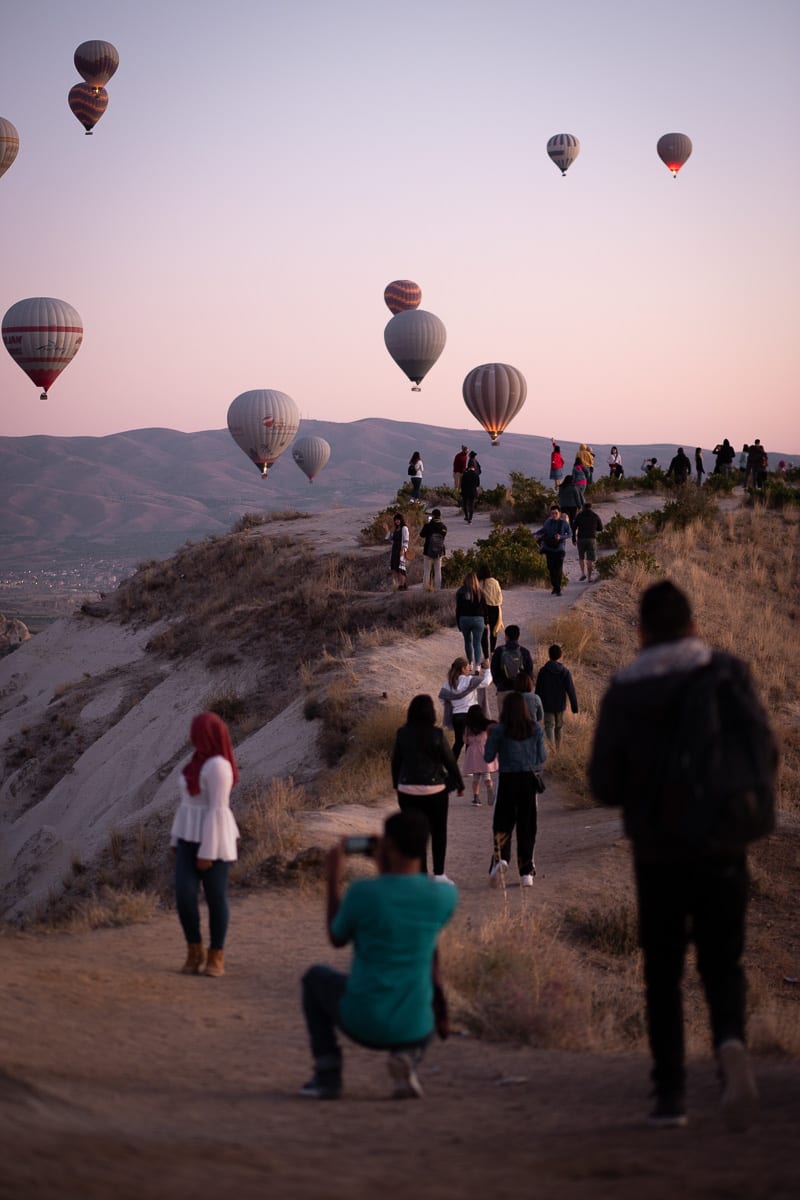
The quintessential Cappadocian experience demands an early rise, preferable pre-dawn before the sun has begun to climb beyond the crags and karsts of the other-worldly landscape. After all, hot air balloon rides require the steady calm of early morning before the wind speed rises and the glorious golden light of a sunrise.
Hot air balloons and Cappadocia go hand in hand. It is an image perpetuated by the hundreds, if not thousands of social media posts circulated each day in which influencers and tourists pose in front of a sky filled with glowing, colourful orbs. It hasn’t always been this way. Back in 1998, when the first company began offering flights to tourists, they had just 5 balloons. Now, there are almost 200 registered hot air balloons that can carry up to 1,200 passengers, a number that has been steadily increasing thanks to the popularity of Cappadocia on social media apps like Instagram.

What makes Cappadocia such a ballooning hotspot? Mostly it is due to the region’s dry, predictable weather patterns – flights can generally take place on over 300 of the year’s 365 days – but the topography is just as much a part of the appeal. Taking to the skies and floating 2,000ft above the ground, the pink and red ridges that extend like webs from the smooth hillsides take on an other-worldly feel and the absurd ‘fairy chimneys’ stand to attention like a battalion of rocky soldiers.
If a flight aboard a balloon is a little beyond your budget, take a stroll up to Asiklar Tepesi (Lover’s Hill) – the plateau high above Goreme – in the morning darkness to watch as bursts of orange flame turn flattened fabric into intimidatingly large buoyant orbs that take to the skies, first glowing in bright flashes against the black sky, before shimmering in the morning light. The sheer scale and number at which these orbs take flight only adds to the spectacle and it is no wonder that what feels like the entirety of the town has trodden to the Hill’s peak in order to experience it.
You will need to arrive at least 30 minutes before sunrise to see the balloons taking off, an hour if you want to watch as they are pumped with hot air and inflated in beautiful synchronicity. The hilltop can become rather crowded and there is a small (unofficial) fee to pass the barrier beside Ascension Cave Suites Hotel.

Try a Testi Kebab
The Cappadocia region, particularly the village of Avanos is renowned for its pottery works. The Kızılırmak (Red River) has supplied generations of craftsmen with the red clay used to create their ceramics and Pottery has been produced in this region as far back as around 2000 BC, the time of the Hittites. Even today, it is one of the area’s main exports.
With this in mind, it’s quite fitting that Cappadocia’s most popular delicacy – the testi kebab – is famed more for the pottery cooking vessel than for the dish itself. Meaning ‘jug’ in Turkish, a testi kebab consists of meat, vegetables, herbs and spices that are stuffed into a clay pot, that is then sealed with bread dough and left to stew for a number of hours in a tandoor until succulent and juicy.
The pot is served up to you still hot with the waiter cracking the top open and allowing the contents to bubble down into a dish, providing a bit of tableside theatre alongside a delicious meal.

Head Underground in Derinkuyu or Kaymakli
I have already talked about how human hands expanded on the work that natural erosion had already started in Cappadocia, creating a region honeycombed with caves, tunnels, places of worship, stables, and storehouses all dug into the soft stone. However, while Uçhisar Castle and the chapels of Goreme are carved into existing structures, many of Cappadocia’s other residents chose to dig in the other direction, creating entire underground cities with as many as eight different stories hidden underground. Thought to have been first been carved by the Hittites, this network of hidden settlements was first mentioned by Greek historian Xenophon in the 4th century BC. Currently, 37 underground cities have been excavated, with an estimated 100 more dotted around the region.
One such subterranean labyrinth – Kaymakli – was initially excavated over 2,600 years ago as a refuge from incoming Arab and Mongol invaders before being expanded during the Byzantine era in order to avoid Ottoman persecution. It is thought that, as invading armies approached, a series of beacons were lit as a warning – a message that could spread all the way from Jerusalem to Constantinople in a matter of hours – allowing Christians to relocate to these caverns, sometimes for months at a time.
Here you can delve five levels down, hunching through a maze of small and narrow tunnels until you find yourself several hundred feet below the surface. This is not for the claustrophobic or fainthearted – these tunnels were built for defence rather than comfort – but if you can overcome a fear of small spaces, exploration of these underground churches, kitchens and stables are very rewarding.
Climb to Cappadocia’s Highest Point: Uçhisar Castle
The highest point in central Cappadocia, Uçhisar Castle is a 200-ft turret of volcanic rock that was sculpted over 30-million years by the elements, and then later by humans, who arrived in the second millennia BC and began to carve their own network of tunnels and caves into the soft, volcanic stone.
These caverns were used for centuries by villagers as a place to take refuge from invading armies and as you wind your way up through the tunnels, you will pass homes, pit ovens and even livestock mangers that were scooped straight out of the rock 4,000 years ago by the Hittites. The castle’s summit provides a sublime panoramic out across Uçhisar village, neighbouring castle crags (Uçhisar translates to ‘3 fortresses’) and across Cappadocia’s surreal landscape.

Take a Walk Amongst the Phallic Formations of Aşıklar Vadisi
Legend says that peri – a type of Persian winged spirit – inhabit Cappadocia’s famous fairy chimneys, but even these mischievous beings may find the phallic structures of Love Valley a little too humorous to call home.
Seeing the towering phalluses, it’s easy to see how this part of Cappadocia gained its name. Often hundreds of feet tall, these narrow columns topped with mushroom-like summits are not a man-made homage to male fertility but have been naturally formed over millennia by wind erosion. Of Cappadocia’s geological wonders, the columns of Love valley are certainly some of the most arresting, but also some of the easiest to explore. The valley is within walking distance from Goreme and the area containing the rock formations can be traversed easily in half an hour. There is even a small, rustic café sitting at their centre where you can escape the Turkish sun and enjoy a cup of cay or ice-cold Efes.
To extend the walk, it is possible to continue down the valley all the way to Uçhisar. The path isn’t all too well defined in places, but if you stick to the valley floor, you should be able to reach the castle after 2 – 3 hours of hiking.
Getting to Love Valley
Love Valley is around a 3km trip from central Goreme, taking just 5-minutes by taxi or dolmus and 40-minutes on foot. Head north on the main road out of Goreme, before taking a left onto the smaller Nevşehir Merkez road (signposted Nevşehir). Entering ‘Love Valley’ into Google Maps will, unfortunately, lead you to the viewpoint high above the formations, so you will need to take a left a few hundred metres beforehand, taking you into the along the bottom of the valley. It is a 10-minute walk from here to the main rock formations.

Go Hiking in the Valleys around Göreme
Contrary to what social media tells you, Cappadocia is so much more than hot air balloons and posing with rooftop breakfasts, as you may have already gathered from previous entries in this list. It is the region’s mystique that makes it so enchanting: The fairy chimneys and still-inhabited rock caves dotted throughout modern villages, the rich history of tunnelling Christians, invading armies and Silk Road merchants, and a mind-blowing geological profile unlike anywhere else on earth.
Luckily, Cappadocia is very walkable, allowing you to experience all of this on foot. Surrounding Göreme, ridges and valleys spread across landscape like a web, with hiking trails winding through them and looping back on each other, creating an interconnecting path of gorges, precipices and plateaus. Each valley seemingly has its own identity, based on the colour of its rocks (Rose Valley), the shape of its formations (Swords Valley) or its ornithological inhabitants (Pigeon Valley).
Each Valley can take anywhere between one and 3 hours to complete, although multiple trails can be combined (either by choice or by taking a wrong turn, as trails are not always clear) to extend your walk for the best part of a day.
Trailheads are generally signposted in most of the valleys, but many of the paths are sparsely marked. If you decide to trek without a guide, it is important that you stick to the paths to avoid getting lost.
Read More: 5 Short & Easy Hikes in Cappadocia


Relax Over Sunset Drinks at Haruna
Sitting atop the luxurious Carus Cappadocia Hotel, Haruna is a rooftop bar that sits high above Goreme between the town’s mysterious and phallic fairy chimneys that commands epic views across the valley towards the rugged outcrop of Uçhisar.
It’s a popular sunset spot, so arrive early to get a prime seat for golden hour when the warm light illuminates the nearby geological marvels in reds and oranges. If you’re planning to eat here, you can sit within one of their elegant domes beneath strings of fairy lights and enjoy their signature grilled lamb. Otherwise, stop in for a nightcap before heading back to your hotel.

Sip tea in the Melendiz River
In a region characterised by a dry, brown and red landscape of porous volcanic stone, the verdant basalt gorge of the Ihlara Valley stands out. Snaking beneath the Hasan Dağı Volcano, 44 miles south-west of Uçhisar, this is a different Cappadocia to the ‘fairy chimney and balloons’ version that is normally depicted. Here, trees and greenery line the banks of the Melendiz River in the 10-mile-long, narrow canyon that stretches between Ihlara Village and Selime.
The majority of visitors tend to walk just the central portion of the trail, from the main entrance above Sümbüllü Church along to Belisırma about 1.5 hours away, ambling along the Melendiz. Amongst the lush greenery of the valley, there are interesting signs of human activity; Churches cut into the rock of the dramatic canyon cliffs and chiselled pigeonhole-like doorways and windows rising high above the river that hide hidden dwellings, so high that reaching them seems impossible. Some, such as Kirkdamalti Kilise (St. Georges Church) are still covered in perfectly preserved Greek paintings.
The village of Belisırma is the perfect endpoint for a walk, or resting spot if you are planning on hiking the entirety of the trail. Here you will find a concentration of riverside restaurants where tables perch on wooden jetties above the water, or tiny cafes were the table legs are partly submerged in the shallow stream, allowing you to enjoy a çay or cup of Turkish coffee with the feeling of cold water rushing through your toes.

Keslik Monastery
Just south Mustafapaşa, this rock-cut Byzantine monastery complex was occupied from the 7th century to the 13th century and was once home to 200 monks that lived within its caverns. The site’s highlight is the 13th-century chapel with an interior covered in colourful frescoes and the 9th-century Stephanos Church in the neighbouring rock cone.
Guided tours are given by Cabir Coşkuner, the enthusiastic and knowledgable site caretaker who spends each day here cleaning the caverns, offering tours and serving refreshing cups of çay to visitors in his tea garden.
Read More: A 3-Day Cappadocia Itinerery
Getting to Cappadocia
Cappadocia is served by two airports, Kayseri Airport and Nevsehir Airport, both offering multiple flights each day to and from Istanbul and Izmir with Turkish Airlines and Pegasus.
Shuttle bus services operate from both airports to the majority of the region’s popular villages. Tickets must be pre-booked online (Helios Transfer or Cappadocia Express come recommended), however, if you have already booked accommodation, they should be able to arrange a shuttle for you.
Travelling by local bus is cheaper if a little more arduous (trust me on this one, it was a pain). From the airport, you will need to catch a Dolmus or taxi to Kayseri bus station and then wait for an onward bus to your destination of choice.
Where to Stay in Cappadocia
Although Cappadocia region is rather vast, the majority of the area’s main attractions are located within a relatively small area, situated in a triangle made up of the roads connecting Nevşehir, Avanos and Ürgüp. Any of the villages around Ürgüp – Göreme, Çavuşin, Uçhisar and Ortahisar – are perfectly situated and make a good base for exploration, but Göreme is the main visitor hub with the most amenities catering to tourists.
Kemal's Guest House
Located on the edge of Goreme, Kamal’s guest house may not be able to offer the same atmosphere as one of the town’s cave hotels, but it more than makes up for it in hospitality. The rooms are basic yet spacious and the verdant garden space is the perfect suntrap for enjoying one of Kemal’s stomach-busting Turkish breakfasts and the roof terrace has fantastic views across the town. Easily the friendliest hotel in town.
Kelebek Special Cave Hotel
Considered to be one of Cappadocia’s first boutique cave hotels, Kelebek has been at the front line of the region’s rise in fortunes. Consisting of two interconnecting stone houses complete with fairy chimneys, in-house hammam, pool deck, and bar, Kelebek has just as much to offer as some of Goreme’s more expensive stays, at a slightly lower price, and hopefully without quite so many Instagram influencers clogging up the roof terrace.
Sultan Cave Suites
Perched high above Goreme atop Aydinli Hill, with a sun terrace that offers far-reaching views across the town, particularly of the early morning hot air balloon flights, it’s no surprise that Sultan has become the Cappadocia hotel de jour for people looking to get the perfect Instagram shots. However, this is more than just a photo backdrop; the hotel has stunning rooms, the majority of which have a private terrace. Guests can also use Kelebek’s pool and hammam free of charge.