I wasn’t expecting our first stop on a historical tour of Budapest to be at a tree dedicated to the memory of Michael Jackson. It stands opposite the Kempinski Hotel on the edge of Erzsébet tér, its entire surface covered in letters and laminated photographs of the ‘King of Pop’.
“Michael would stay at the Kempinski whenever he was in Budapest,” explained our guide. “His fans would gather opposite the entrance, by this tree, to try and catch a glimpse of him.”
Upon his death in 2009, the same fans decided to commemorate him by dedicating the spot that they had spent so many hours to his memory. Flowers, notes, and photographs cover almost every inch of bark. They’re surprisingly fresh. The tree is meticulously maintained, with the weather-worn relics periodically removed and replaced. Budapest is a city that is only too familiar with memorials, although not many are as uncontroversial or as analog as this one. Just a short walk away, Szabadság tér is the scene of a fraught statuary conflict.
Following the fall of the Soviet Union in 1991, the majority of Budapest’s communist monuments were removed and relegated to the surreal ‘Memento Park‘ on the outskirts of the city. Here the statues of Stalin, Marx, and Engels stand, scattered throughout a well-manicured park, stripped of all menace and meaning in an open-air museum. In Szabadság tér, one tribute to the Soviet era remains; a large obelisk topped with a Communist star, in honour of the Red Army’s ‘liberation’ of Hungary. It is a contentious issue for many of the city’s residents who would like to see it gone. Unfortunately for them, it is protected by a bilateral treaty between Hungary and Russia.
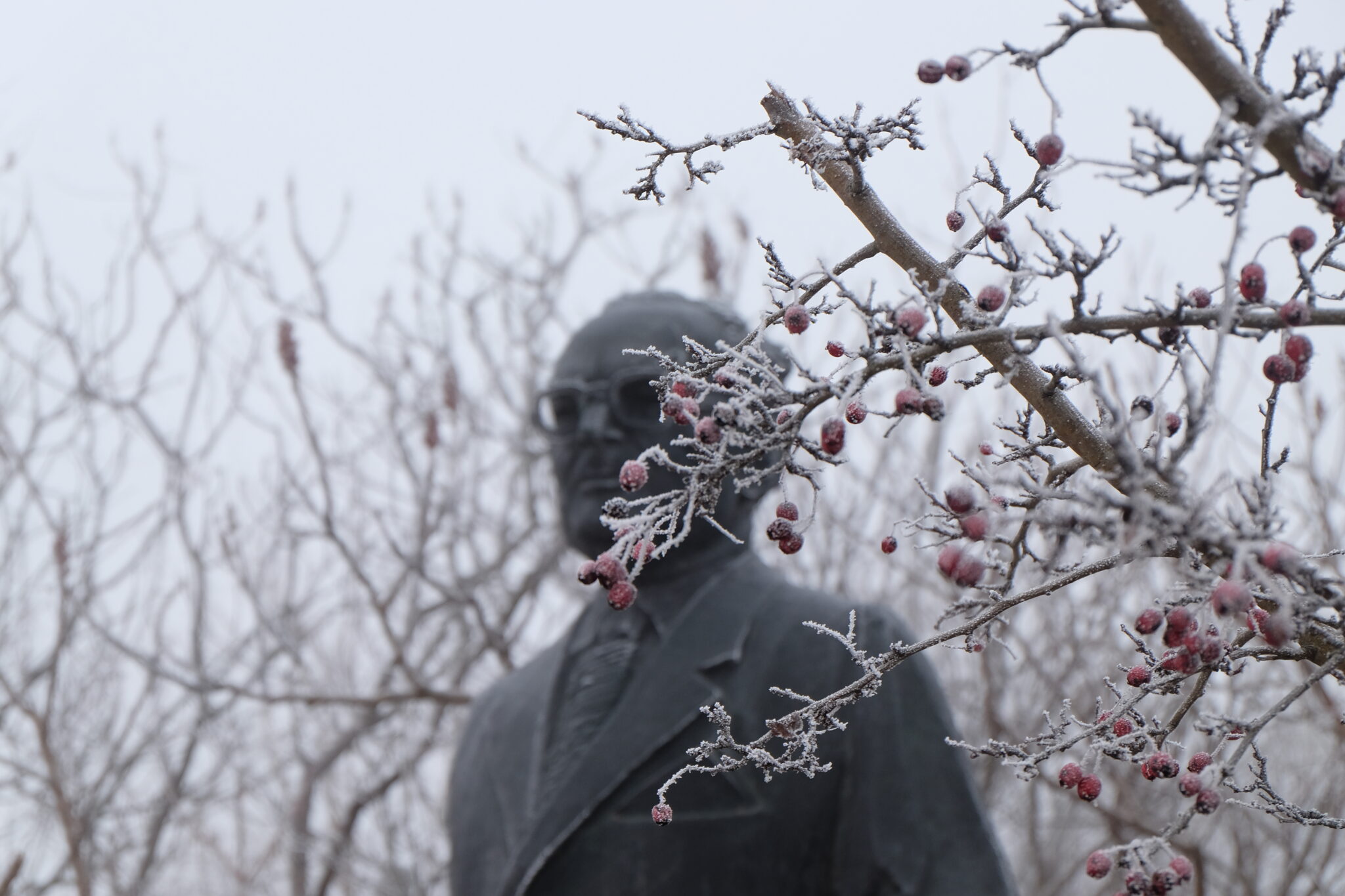
In an attempt to dilute the obelisk’s meaning, various groups have periodically erected their own monuments in its periphery. In 1996, a statue of Imre Nagy, a hero of Hungary’s anti-Soviet 1956 uprising, was placed between Freedom Square and Martyr’s Square (Vértanúk ter). He stands on a ‘bridge to freedom’, facing the beautifully ornate parliament building with his back turned to the communist obelisk. In 2011 another attempt to undermine the Soviet column was built in the form of a bronze Ronald Reagan, a figure much loved among Hungarians for his hard stance against communism. Rather than turning his back like Imre Nagy, he is striding towards the monument, facing it head-on.
This battle is a reflection of Hungary’s struggle to define itself and forge an identity since the fall of communism in 1991. This identity crisis and constant reinterpretation of history by Hungary’s government is why Szabadság tér’s most recent installation is also the most controversial.

The monument depicts Archangel Gabriel, symbolising Hungary, holding an orb, representing the power of the state. Hovering above him is the eagle of Nazi Germany swooping in to steal the orb from his grasp.
A low fence of hastily assembled barbed-wire surrounds the plinth. Shoes, suitcases and age-worn household items are scattered on the floor. Grainy photographs of 1940’s Budapest hang from the wire. It is another makeshift tribute, but one that has more meaning – both historically and politically – than Jackson’s tree. Scribbled notes and printed sheets tell the stories of the people in the photographs and of the Hungarians to which this seemingly random collection of items belonged; The mother who was killed in Auschwitz, the young boy that was loaded onto a transport never to be seen again, the father who met his end on the banks of the Danube at the hands of the Fascist Arrow Cross.


The statue’s depiction of Hungary as a victim of the Nazis is why it is so controversial. In truth, Hungary was a wartime ally of Germany and the photographs scattered around the square are an attempt by Budapest’s Jewish community to shine a light on this whitewashing of history.
In the lead up to World War II, Admiral Miklós Horthy allied Hungary with the Axis Nations. He saw a victory for them as a way for Hungary to regain the two-thirds of its historic territory that it lost after World War I and the signing of Treaty of Trianon. It wasn’t until later in the war that Horthy regretted his decision and began negotiating with the Allies. Consequently, the German Army invaded. Horthy was allowed to stay in power but didn’t last long. When he once again tried to disengage from the war, he was toppled by Hungary’s own Fascist Arrow Cross party. It was under this political turmoil that almost 450,000 Jews were deported and murdered in Auschwitz.
It is not clear when Jewish people first appeared in Budapest. It is thought that they may have settled during the 12th or 13th centuries. They have been present in the area that is now Hungary for hundreds of years longer than Hungary has even existed. When Budapest was formed in 1873, there were about 45,000 Jews living in the city. By 1930 this number had grown to 200,000. As business owners, doctors, lawyers, musicians and journalists, Jews were by far the most visible of Budapest’s minority groups. Due to their success, they quickly found themselves being used as scapegoats by Hungarian leaders. The Arrow Cross began to attract more followers and anti-Semitic policies were put in place.


Following German Occupation, a ghetto was created by decree of the Royal Hungarian Government. Several blocks of the old Jewish quarter, which included the 2 main synagogues of the city – the Neolog Dohány Street Synagogue and Orthodox Kazinczy Street Synagogue – were fenced and guarded so that the occupants could not escape. No food was allowed in and the dead lay in the street, uncollected. More than half of those that were forced into the ghetto in 1944 were sent to concentration camps. Those that weren’t often died of starvation, disease or the freezing conditions. Within only 56 days of German occupation, 437,000 Jews were deported from Hungary. In addition, Arrow Cross militiamen shot 10,000 to 15,000 Jews, often forcing them to strip naked on the banks of the Danube and face the river, before being shot at close range so that they fell into the water to be washed away. In just a few months, the population of the ghetto fell from 200,000 to just 70,000 people.

Today, a poignant and thought provoking reminder lines the riverside. The ‘Shoes on the Danube Bank’, created by sculptors Gyula Pauer and Can Togay, consists of 60 pairs of cast iron shoes. Behind the sculpture sit 3 plaques in Hungarian, English, and Hebrew: “To the memory of the victims shot into the Danube by Arrow Cross militiamen in 1944–45. Erected 16 April 2005.”
We walked from the riverside to Dohány St and what was once the edge of the ghetto. It is still the city’s Jewish quarter but is seeing a shift in fortune. None of the old wall remains – the last section was demolished in 2006 – but district VII, or Erzsébetváros as it is more formally known, lies roughly within the borders that were established in those few horrific months of 1944. Our guide went on to explain that the community here has always faced an uphill struggle against discrimination; the very reason that this was established as the city’s Jewish quarter is that it fell outside Pest’s city walls.
This all comes despite the communities constant attempt to assimilate into Hungary’s Catholic society. Just looking at the vast Dohány Street Synagogue where we now stood, you can see the efforts made to integrate; holding services in Hungarian, having a choir, and the little touches of Catholic architecture such as an organ and pulpit. This is what makes the events of the twentieth century even more surprising – despite their efforts to integrate, and the fact that they had settled here long before many ‘ethnic’ Hungarians, they were seen as Jews first and Hungarians second.
Hungary is still home to one of the largest Jewish communities in Europe, with 50,000 Jews calling Budapest home. As well as Dohány Street Synagogue, the largest in Europe, there are two other synagogues; Rombach Street Orthodox Synagogue and one on Kazinczy Utca. In reaction to the growing ethnonationalism that is rearing its head in many parts of Europe, many of Budapest’s young Jews are embracing their identity and becoming more visible. Some are even stamping their own mark on District VII by opening Kosher restaurants and cafes.
They couldn’t be doing it at a better time. This is fast becoming one of the coolest neighbourhoods in Europe.


We stepped inside Printa, a coffee shop and art co-op opposite Rombach Street Orthodox Synagogue, to avoid the freezing nighttime air and see first-hand the transformation that the district is going through. The airy, whitewashed spaces are decorated with framed prints and the baristas expertly pour flat whites for the typically hipster crowd. It is emblematic of the indie spirit found in the bars and cafes that line the maze of streets behind the Dohány Street Synagogue.
How did Erzsébetváros go from a run-down ghetto, mostly abandoned and crumbling since WWII, to the gentrified, cultural hub that it is today? It is mostly thanks to the creation of the ruin pub.
What remained of this area after the war was urban decay; tumbledown apartment buildings, abandoned warehouses, and wasteland where bombed-out buildings once stood.

Back in the early 2000s, a group of local artists started to rent one of these dilapidated buildings, an old factory, in the hope of creating an art space. This was to be a place to screen movies, hold musical performances, art exhibitions and a place to drink. As the building needed extensive renovation and decoration that the tenants couldn’t afford, they set about decorating the walls and rooms with whatever they could find; flea market furniture, junk, and graffiti on the walls. The ruin pub, and Szimpla Kert, was born. Szimpla Kert proved hugely popular and soon copycats were popping up all over District VII, truly putting the neighbourhood on the map for both tourists and locals alike.


As with anything countercultural, it soon became part of the mainstream. It was the opening of Szimpla that set the wheels in motion for District VIIs resurgence. Despite being just a short walk from the splendour of the city’s Andrássy út, it took this new kind of venue to attract people to the Jewish Quarter. Before long, dozens of ruin bars had opened and the hip young things of Budapest saw this neighbourhood as a nightlife destination. Artists and students moved in, more cafes and bars opened, and gentrification was in full swing.

No place is this more clear than Madách Square, a favourite hangout with locals that is filled with trendy coffee spots such as My Little Melbourne, Blue Bird Cafe and Printa. We wandered through Gozsdu Passage, a narrow street cutting underneath a sprawling apartment complex on the edge of what was once the Ghetto. Today it is lined with chain restaurants, expensive coffee shops, and pricey bars. Our guide tells us that the apartments above us were once incredibly affordable, but now he has no chance of earning enough to live here. It is a sign of the creeping gentrification that is so inevitable when a neighbourhood becomes ‘cool’.


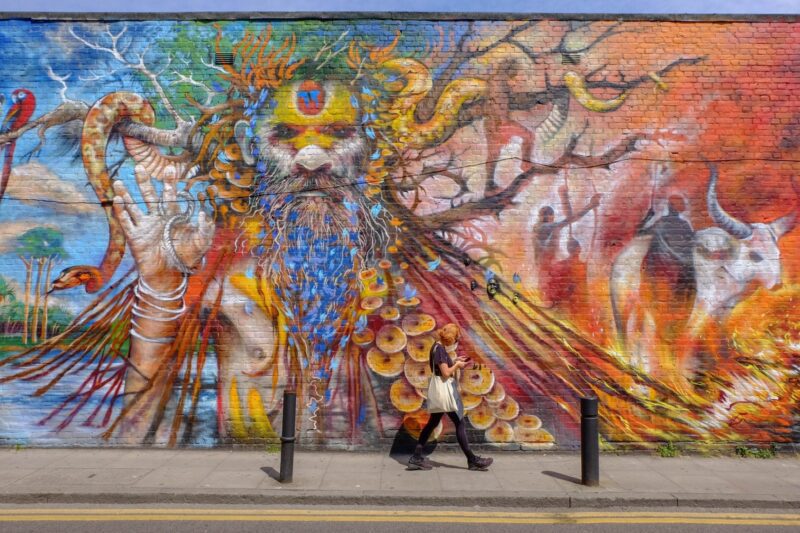
That isn’t to say that much of the destruction of WWII has been cleared. Empty lots where buildings have been destroyed are still dotted around the area. Only the locals have found their own way of beautifying these rubble-strewn spaces, decorating the bare firewalls with stunning street art. Urban art groups such as NeoPaint Works and Colorful City have set about brightening up the district and you can find their work on almost every street or vacant lot. As street art is very much illegal in Hungary, many of the largest pieces are commissioned by local authorities and so have a historical context or an educational message. This doesn’t make them any less interesting as the artists are still able to express themselves in their own unique styles. The largest of the murals is the piece dedicated to the “Match of the Century”, when Hungary defeated England in Wembley Stadium in 1953, on Rumbach Sebestyén Street, or the depiction of a bull scoffing greens beside Mika Kert that was painted to encourage people to eat more vegetables.

The piece that gave me greatest pause was a depiction of a Rubik’s cube taking up a whole wall. While it may just seem like a tribute to the toy’s Hungarian creator, Erno Rubik, it actually has a deeper meaning according to our guide. A Rubik’s cube has 43 quintillion different combinations. However, every single of these combinations of the 3×3 Rubik’s cube can be solved in 20 moves. Every problem has a solution, and it may be simpler than it first appears.
It took decades for the Jewish Quarter to solve its issue of decay and degradation but in the end, all it took was a few industrious residents with a goal of trying to improve their neighbourhood, to create a solution.

While the quarter appears to be undergoing a rapid transformation, hints of its Jewish roots remain. Among the contemporary and creative are little snippets of a turbulent history; the Holocaust Memorial, Raoul Wallenberg Memorial Park, and the Jewish Cemetery. Each hip new bar is sandwiched between historic buildings and some even grow from within their crumbling walls. You will still find Mikveh and Kosher shops dotted around the district with their ageing, wrought-iron signs bearing Jewish family names. Among the revellers spilling out into the courtyards of ruin pubs you will see orthodox Jews making their way to synagogue. This is why Erzsébetváros is one of my favourite places to visit – It has risen from the ashes to embrace its vibrant future, while still wearing the richness of its past on its sleeve.
As I pass Szimpla Kert one last time, I spot a discreet plaque on the wall that stops me in my tracks. It is a reminder that, despite the changes taking place in the Jewish Quarter, we shouldn’t forget its past. It simply reads “People used to live here”.

Where to Stay in Budapest
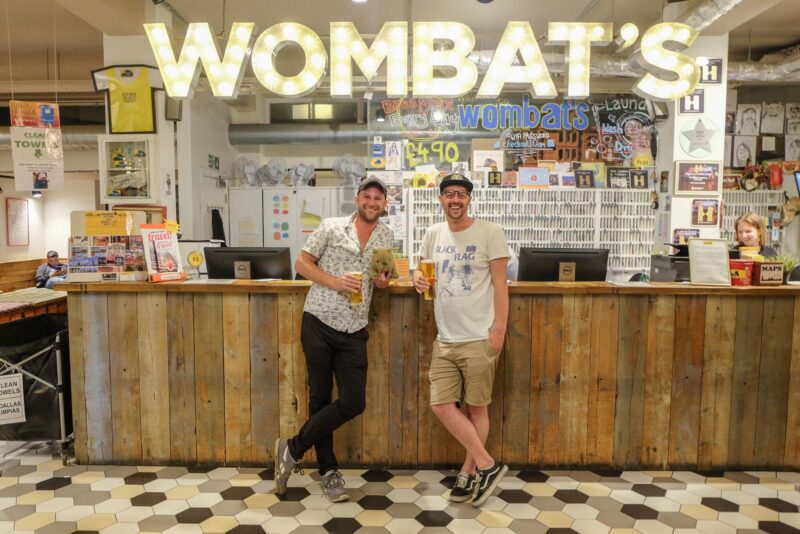
Wombats CITY HOSTEL
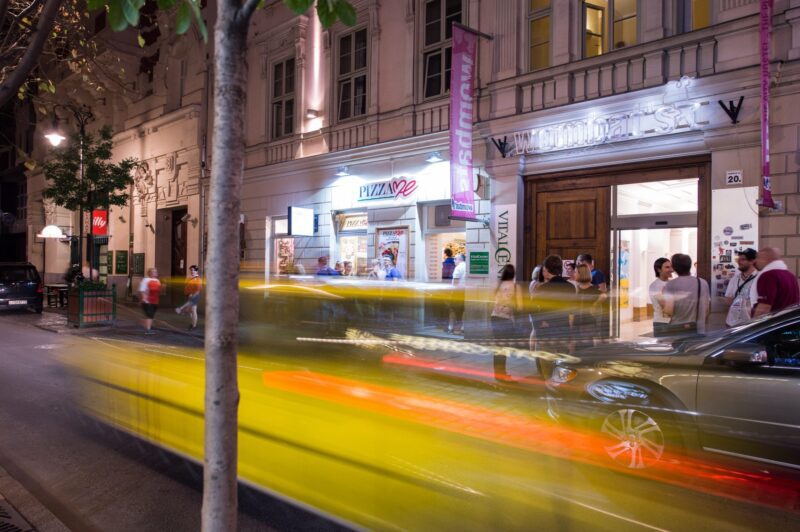
Its location at the centre of Király Street is what makes Wombats the perfect choice for anyone looking to explore the Jewish Quarter and its nightlife. It is just a few minutes walk to the likes of Ellato and Koleves Kert, while directly across the street is the passage of Gozsdu Udvar, a burgeoning network of bars and eateries that has cropped up on the ground floor of a sprawling apartment complex.
Wombats offer both private rooms and dorm beds to fit with whatever style you like to travel. For the best prices (up to 15% cheaper than other booking platforms) book directly through their website.
I took both the Communism and Jewish District tours with Free Walking Tours Budapest and would highly recommend them to anyone that wants to delve a little deeper into the city’s history. Both tours depart daily from Vörösmarty square at 10 am and 3.30 pm and no booking is required. Just turn up and pay what you feel at the end of the tour.
This post was brought to you as a result of the #wombatsTraveller blog trip, created and managed by iambassador in partnership with Wombat’s CITY HOSTELS. However, all views expressed are my own.