
There’s a slight clinking as the barman lines 3 shot glasses along the ramshackle bar. He grabs a tall, thin bottle and pours a steady stream of clear, viscous-looking liquor across the top of them and passes it to the waiting group of customers. After a quick collision of glass and an enthusiastic yell of “Egészségedre!” the drinks are emptied in one swift movement. Palinka, a fruit brandy that is quaffed in the gallons by thirsty Hungarians, is as typical and unique to this country as the venue in which I’m standing; One of Budapest’s many ruin bars.
I have a fraught relationship with Palinka, so instead, I opt for a generic Hungarian lager – a steal at just £1.80 a pint – and make my way like an inebriated Alice through the rabbit hole into the weird and wonderful world of Szimpla Kert.

I wander through the wide entrance hall, its walls covered with a seemingly random collection of street signs and artwork, up a narrow spiralling staircase and exit onto an upstairs balcony. Half a dozen further rooms, filled with mismatched, thrift store furniture and covered in scrawled graffiti fork off from this central hub. Some of them contain yet another bar, but others lead on to more doorways, more staircases, and what feels like a never-ending network of labyrinthine corridors. This place is a rabbit warren. The walls are a mix of chipped, crudely painted plaster and exposed crumbling brick. Wires hang precariously from ceilings and light fittings, crudely taped into place. I can’t help but think that the health and safety concerns are why the ruin bar hasn’t taken off elsewhere, but they’re also the reason why Szimpla Kert, and the ruin bar, exist in the first place.
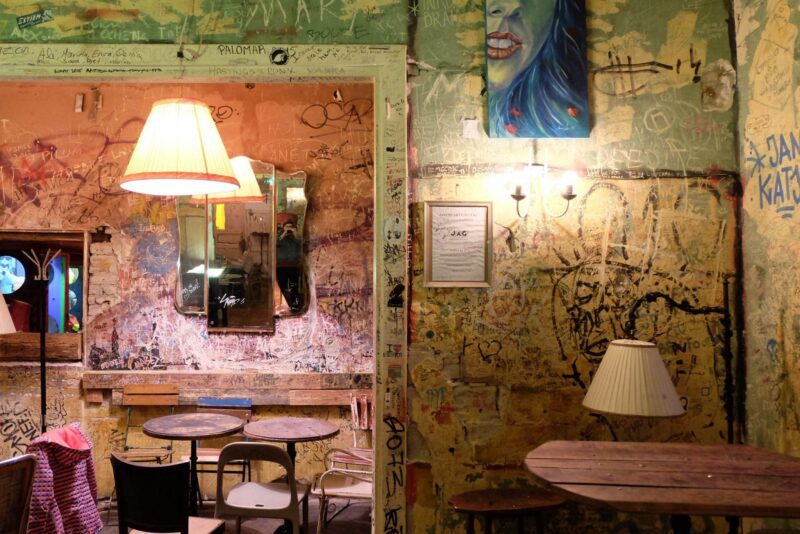
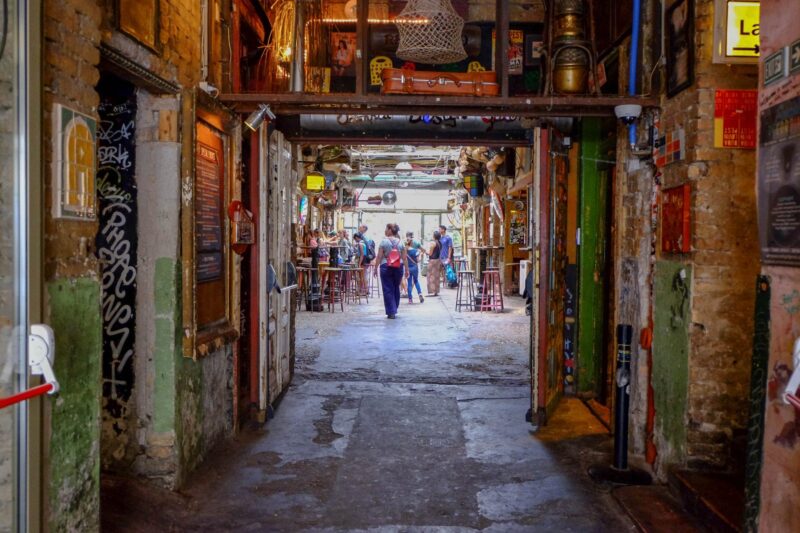
These dilapidated drinking establishments are as synonymous with Budapest as the Danube and The Széchenyi Chain Bridge. They’re one of the many things that make the city one of the coolest and best nightlife destinations in central Europe.
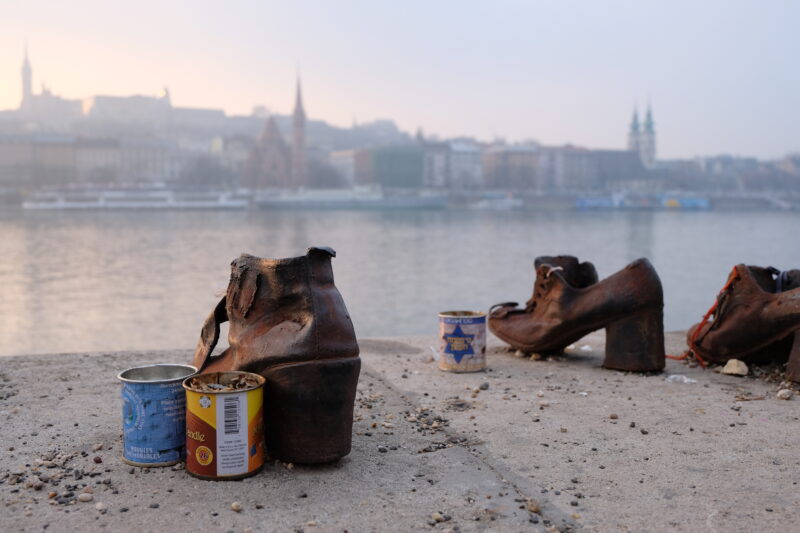
After World War II, the Jewish Quarter of Budapest was left in a ramshackle state. Parts of the area were fenced off as a ghetto for Hungarian Jews by the Nazis during the war. No one was allowed in or out, waste was not collected and people were left to die of starvation. The cramped conditions lead to the spread of diseases and the dead were left to lie in the street or in the bombed-out ruins of tenement blocks. Over half of the people that lived in the ghetto were eventually transported to concentration camps.
What remained of this area after the war was urban decay; tumbledown apartment buildings, abandoned warehouses and wasteland where bombed-out buildings once stood. The disrepair and neglect meant that refurbishment was beyond the means of most people. These complexes remained empty throughout the 60s, 70s and 80s.
In the early 2000s, a group of local artists started to rent one of these dilapidated buildings, an old stove factory in the 7th district, in the hope of creating an art space. This was a place to screen movies, hold musical performances and art exhibitions, as well as being a place to drink. As the building needed extensive renovation and decoration that the tenants couldn’t afford, they set about decorating the walls and rooms with whatever they could find; flea market furniture and junk, getting local artists to graffiti the walls. Szimpla Kert and the concept of the ruin pub was born.

It was the opening of Szimpla that set the wheels in motion for District VIIs resurgence. Despite being just a short walk from the splendour of the city’s Andrássy út, it took this new kind of venue to attract people to the Jewish Quarter. Before long the hip young things of Budapest saw this neighbourhood as a nightlife destination. Artists and students moved in, more ruin bars opened, and gentrification was in full swing.
A little of District VII’s Jewish history still remains in the form of Kosher restaurants, stores, and the grand Dohány Street Synagogue but what the neighbourhood is now known for are the trendy coffee shops, bars and boutiques that sit along the main streets of Király utca and Dob utca. It’s not just the artists and students that are settling here anymore, the ruin pubs have become a magnet for Budapesters from all walks of life.

It’s something I notice as I step into Szimpla’s outdoor courtyard. Sat at the ill-assorted furniture and jungle of potted plants are locals in their sixties and seventies, families with children, and the usual array of wide-eyed tourists. Maybe that’s the beauty of the ruin pub; they’re something different to everyone and each venue has its own unique take on the idea.
While places like Instant and Fogaz Ház are wild, sprawling nightclub complexes filled with late-night revellers, beer gardens like Mika Kert and Koleves Kert are the perfect spots for a quiet drink with friends. Szimpla even manages to stick to its original mission of being a community space, giving discounts to OAPs, hosting classes in Hungarian, and every Sunday the courtyard is taken over by a farmer’s market where local people can sell their produce and homemade food.

Just a few hundred yards away from Szimpla, I find myself in Ellato Kert, a beer garden-cum-Mexican taqueria hidden in plain sight down an alleyway behind a hanging plastic butchers curtain. It has none of the artful disorder of Szimpla, instead setting itself apart with a Mexican theme by stringing Papel Picado banners, pinatas, and Mexican flags from every inch of its ceiling. Another contrast is that many tourists are to be seen. The clientele is mostly made up of work colleagues deconstructing the day over drinks, or families with children.

After a swift glass of Soproni, I move across the road to sample two bars that didn’t exist on my previous visit to Budapest two years ago; Mika Kert and Koleves Kert. When I was last here, the space that these two garden bars inhabit were derelict, bombed-out lots, gated off and filled with junk. Now, they are thriving thanks to the addition of a small bar and a few dozen tables.
It is a common sight in District VII, to see these bars come and go. As I walk back to my hostel I pass a lot filled with workmen and cranes. New, modern apartment buildings are being constructed on a site that has been left mostly empty since the war. However, a fading painted sign reading ‘Stifler Kert’ shows that there was a ruin bar here before developers snapped up the space.
Just 15 years ago it would have been unthinkable that this forgotten corner of Budapest would be prime real estate. Now, thanks to the resourcefulness of a few residents, it is in demand and thriving once again. It is a constant evolution and there is no doubt that this neighbourhood will continue to change. New bars will come and go and developers will snap]ping up the space in which beer gardens once stood. However, for now, the ruin bars of the Jewish Quarter are the perfect example of how a little ingenuity, and a lot of junk furniture, can transform a derelict district into something wonderful.
The Best Ruin Bars in Budapest
Szimpla Kert
The original and granddaddy of all ruin pubs. Szimpla was the first to set up in the 7th district back in the early 2000s and has gone from strength to strength since then. The owners converted this old factory into a huge open-air cinema, cultural space and pub back in 2002 – As they didn’t have the funds to renovate or decorate, the walls were painted by local artists and the rooms were furnished with whatever items could be scraped together. The modern ruin pub was born.

With this reputation comes a crowd, usually more tourists than locals, but with good reason. The decor and art installations alone make it worth a visit but you can also expect an open-air cinema, huge outdoor garden (complete with a seating area made from an old Trabant car), galleries and live music.
If you head there on a Sunday morning you can wander around the Szimpla farmer’s market where locals will be shopping for fruit and veg or stopping for a quick bite to eat.
Ellato Kert
This outdoor garden-cum-Mexican taqueria is hidden in plain sight down an alleyway behind a hanging plastic butchers curtain. Ellato Kert is a relative newcomer when compared to the behemoth that is Szimpla, however, word of mouth is slowly spreading. Still, you are more likely to stumble upon locals having evening drinks than you are a raucous bunch of travellers. I find that it works to Ellato’s benefit. The majority of locals that you speak to will quickly recommend this place as one of their favourite ruin bars.
It doesn’t quite have the kitsch factor of some of the districts other ruin bars, but the Mexican theme certainly makes it unique. Papel Picado banners, pinatas and Mexican flags adorn every inch of the ceiling and then there are the tacos. Ellato has a kitchen in the back games room dishing out a variety of tasty Mexican fare for anyone that feels hunger strike after one too many Palinkas.

Anker’t
Anker’t manages to avoid the ramshackle design of some of its competitors, instead opting for a more upmarket, minimalist and somewhat low-key approach. That isn’t to say that it doesn’t fit the ruinous nature of District VII. Anker’t is named after the romantically dishevelled shell of the three-story Anker Palace that the bar now inhabits.
In the summer months, Anker’t is a favourite with locals who come to enjoy the large courtyard and relatively peaceful atmosphere. However, if you are looking to let your hair down, the small interior plays host to club nights and live music.

Mika Kert
Mika Kert didn’t exist on my previous visit to Budapest and if I’m honest, I’m not sure if it will be there on my return. It seems to be the way with these fly-by-night ruin bars that open up on abandoned lots, making the most of the space before the developers get their hands on it.
While it does exist – across the road from Ellato Kert on Kazinczy street – it is a small but perfectly formed beer garden in which to start your evening.
Koleves Kert
Koleves is close to Mika both in terms of location and atmosphere. The restaurant of the same name, meaning ‘Stone Soup’ in Hungarian, is a Jewish Quarter mainstay and now, it seems the owners have decided to expand their enterprise, taking over the disused lot next door and creating one of the most appealing outdoor beer gardens in the city.

Mulberry trees dangle their branches down over the gravelled garden creating little pockets of shade in which to hide from the summer sun, groups of friends huddle in cosy alcoves around the garden’s perimeter while others laugh raucously and clink glasses at the colourful tables scattered around the courtyard.
The best thing about Koleves is that it never takes on the riotous club vibe of some of the other ruin bars. As evening draws in and the venue fills, it remains subdued and friendly. There’s still buzz, but one of people chatting excitably rather than partying, huddling on the swings and hammocks lining the large, octagonal bar or hunkering down in their favourite booth.
Kuplung
Located on one of the neighbourhood’s main party streets in an old car repair shop, Kuplung (meaning “Clutch”) is a small yet perfectly formed courtyard dominated by a huge blue whale mural and surreal sculptures of jellyfish floating overhead. Early evenings in Kuplung are fairly low-key with table service being the standard, however, as night draws in it is often transformed into a live music venue.
Racskert
Typical of the Jewish Quarter and its constant cycle of change, Racskert has popped up on what was once a car park, and then a builders yard, to become one of the best places to hang out in the VII District.
The Bosnian Serb owner utilised the leftover building supplies from his yard to decorate this once-dilapidated open space. Water pipes hang overhead, filled with neon lights to illuminate the beer garden. Scaffolding lines one side of the yard supporting a small, lush garden of potted plants and herbs.
Literally meaning ‘Rail Garden’, Open-air Rácskert has become a haven for foodies and revellers alike due to its vegan food trucks and festival-like atmosphere.
Mazel Tov
There is not much about Mazel Tov that screams ‘ruin pub’. As I walked inside, I was expecting to be met with the usual chic mix of retro furniture and ramshackle decor. What I found was a stylish and clean interior – more of a hip restaurant than a ramshackle bar. There are none of the graffiti-strewn walls of Ellato Kert or thrift store furniture of Szimpla, instead, you will find a beautiful, chic courtyard lit by strings of fairy lights dripping from the ceiling.
Although the venue is covered, the giant skylights and vines hanging from the upstairs balcony really manage to bring the outside in.
Of all of the ruin pubs in the 7th district, Mazel Tov is the only one that truly engages with the Jewish Quarter’s heritage. Although not kosher, Mazel Tov serves a range of delicious middle eastern cuisine; Felafel, hummus, and kebabs. Also, If you look closely at the end of the courtyard, you will even find one of the last remaining sections of the old Budapest ghetto wall.
Where to Stay in Budapest's Jewish Quarter
For centuries Király street – or King’s Street – has been one of the most important thoroughfares in Budapest. Even today it is constantly buzzing, filled with trendy boutiques, cool bars, and an endless supply of cafes and restaurants. This historic road remains the cultural heart of modern Pest, running perpendicular to the ruin pub filled Kazinczy and Akácfa Streets.
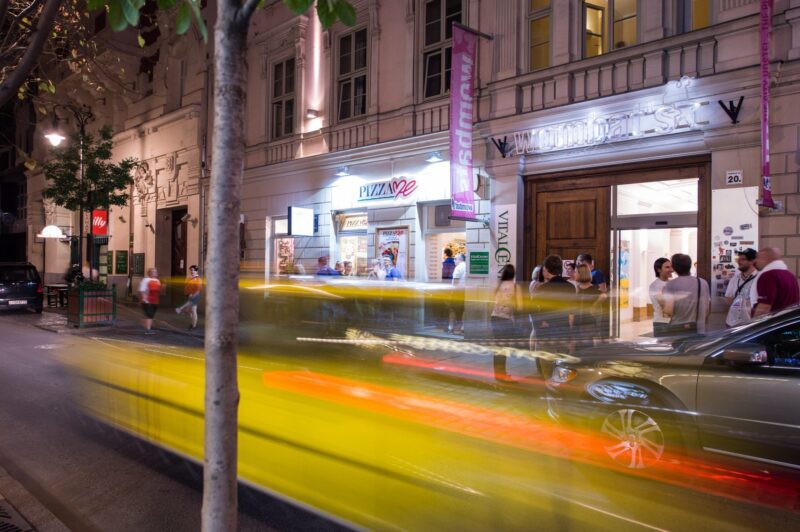
Its location at the centre of Király Street is what makes Wombats the perfect choice for anyone looking to explore the Jewish Quarter and its nightlife. It is just a few minutes walk to the likes of Ellato and Koleves Kert, while directly across the street is the passage of Gozsdu Udvar, a burgeoning network of bars and eateries that has cropped up on the ground floor of a sprawling apartment complex.
Wombats offer their own pub crawl (with drinking games and mingling beforehand at the wonderful ground floor ‘womBAR’) for those looking for a curated ruin bar experience with new friends.
Wombats offer both private rooms and dorm beds to fit with whatever style you like to travel. For the best prices (up to 15% cheaper than other booking platforms) book directly through their website.
This post was brought to you as a result of the #wombatsTraveller blog trip, created and managed by iambassador in partnership with Wombat’s CITY HOSTELS. However, all views expressed are my own.


2 Responses
I’ve been trying to retrace my night in Budapest. I was looking for a bar I went to with Spanish paper decorations (Ellato Kert)–I found it on your blog. THANK YOU!
There is definitely something so wonderful about reusing spaces that are/were derelict and bringing life back to a place. It will be interesting to see how the area evolves in a few years now the developers are moving in too!